
Are mollies good for aquaponics? Yes, for small indoor tank systems. Mollies aquaponics setups pair hardy, algae-grazing livebearers with herbs or houseplants grown on tank water. Mollies tolerate a wide range of conditions and breed quickly, so the main jobs are keeping water warm, stable and fresh, and controlling numbers before fry overload the system.
Key takeaway: Mollies suit tabletop and aquarium aquaponics, not food-fish production. Plan for fry from day one.
| Trait (sailfin molly) | Detail |
|---|---|
| Preferred temperature | 68–86°F (20–30°C) (Smithsonian, USFWS) |
| Breeding needs | About 72°F (22°C) or warmer |
| Diet | Mainly algae and plant matter, plus small invertebrates |
| Brood size | 10–140 live young (Florida Museum) |
| Gestation | About 3–4 weeks |
| Salinity range | Fresh to very salty water in the wild |

Why Choose Mollies Aquaponics Systems?
Mollies aquaponics systems are a good pick because mollies are hardy, peaceful and small. The Florida Museum says sailfin mollies feed mainly on algae and plant material, and USFWS notes they tolerate low oxygen better than many fish. That makes them forgiving for beginners running small tank systems.
- Hardy: handle a range of water conditions.
- Grazers: pick at algae on surfaces.
- Peaceful: mix with other small community fish.
- Small: suit desktop and aquarium systems.
Start with our aquaponics for beginners guide.
How Big Should a Mollies Aquaponics Tank Be?
A mollies aquaponics tank should be big enough to absorb rapid breeding. Small tanks crowd fast once fry arrive, which raises ammonia and stresses fish. Larger volume keeps water stable and gives room for growth. Choose the biggest tank you can maintain, and pair it with a grow bed sized to your feeding.
What Water Do Mollies Need in Aquaponics?
Mollies need warm, clean, stable water. Smithsonian and USFWS sources give a preferred range of 68 to 86°F (20 to 30°C). Wild mollies live in fresh to salty water, but plants in aquaponics need fresh water, so keep the system freshwater and avoid adding salt. Harder water with good mineral content suits mollies well.
| Parameter | Target |
|---|---|
| Temperature | 72–82°F (22–28°C) for steady breeding and growth |
| Salt | None in an aquaponics loop |
| Hardness | Moderate to hard |
| Ammonia and nitrite | Zero |
Test hardness with our GH and KH guide, and keep temperature steady with an aquarium heater.
How Do You Set Up Mollies Aquaponics?
Set up mollies aquaponics by placing a grow bed or raft above the tank, pumping tank water up through clay pebbles or net cups, and letting it drain back. Cycle the system first so bacteria can handle waste. Add a few mollies once ammonia and nitrite read zero.
- Pick a tank and heater for steady warmth.
- Add a grow bed or raft above or beside the tank.
- Run a small pump and a drain back to the tank.
- Add aeration with an air stone.
- Cycle the system until ammonia and nitrite read zero.
- Stock a few mollies and feed lightly.
- Plant herbs or houseplants once nitrate shows.
How Fast Do Mollies Breed in Aquaponics?
Mollies breed fast. The Florida Museum reports broods of 10 to 140 live young after about 3 to 4 weeks of gestation, and females can store sperm and give birth many times a year. In a closed system, numbers can climb quickly, so plan for fry before you buy fish.
- Keep one sex if you do not want fry.
- Let plants and cover shelter some fry.
- Rehome extras through local stores or clubs.
- Never release fish into ponds, ditches or streams.
What Do You Feed Mollies in Aquaponics?
Feed mollies a quality flake or pellet with plant content, once or twice daily, only what they eat in a few minutes. The Florida Museum notes they feed largely on algae and plants and also eat small invertebrates, including mosquito larvae. Grow duckweed as a treat.
Overfeeding fouls water faster than anything else in a small system.
Which Plants Suit Mollies Aquaponics?
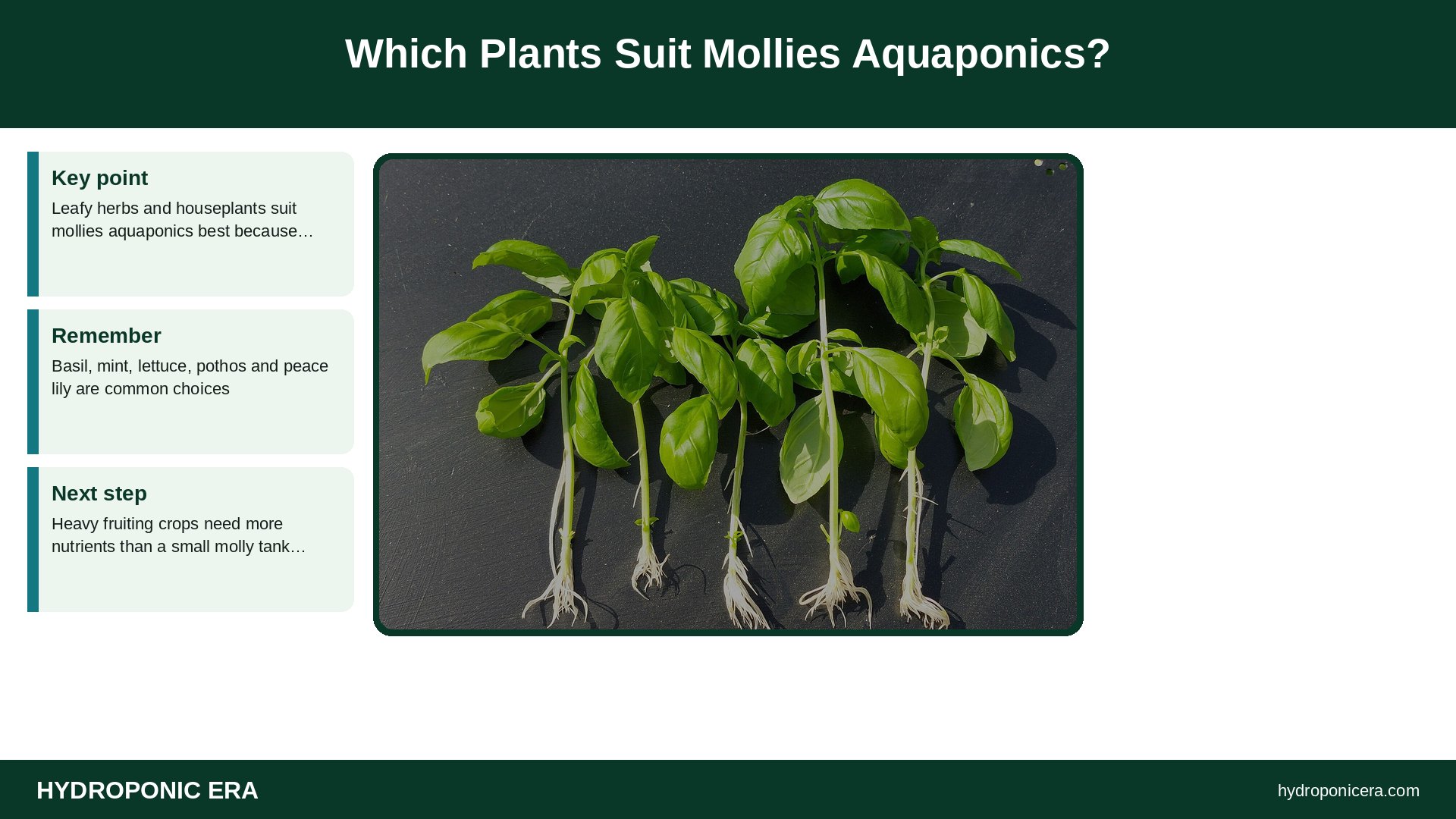
Leafy herbs and houseplants suit mollies aquaponics best because small fish produce modest nutrients. Basil, mint, lettuce, pothos and peace lily are common choices. Heavy fruiting crops need more nutrients than a small molly tank provides. See our list of plants that grow in water.
Can Other Fish Join a Mollies Aquaponics Tank?
Yes. Mollies are generally peaceful and mix well with other small community fish of similar size and temperature needs, such as platies and guppies. Avoid fin-nippers and large predators. Mixed livebearers multiply fast together, so the same fry plan applies.
What Are Common Problems and Fixes?
Most problems trace back to crowding, cold water or overfeeding. Watch fish daily and test water weekly so you catch issues early. In a mollies aquaponics loop, pale plants usually mean too few fish or too little feed, while cloudy water and gasping fish mean too many fish or too much food.
| Problem | Likely cause | Fix |
|---|---|---|
| Fish gasping at surface | Low oxygen, crowding | More aeration; thin stock |
| Cloudy water | Overfeeding | Feed less; remove waste |
| Pale plants | Low nutrients | Fewer plants or more fish |
| Clamped fins | Cold or poor water | Check heater; test water |
Read our guide to dissolved oxygen for aeration tips.
How Do You Care for the System Each Week?
Weekly care keeps a small system stable. Check the heater, pump and air stone, top up evaporated water with dechlorinated water, and trim dead roots and leaves. Count fish now and then so you notice when fry numbers climb, and rehome extras before the tank gets crowded.
- Daily: feed lightly and look over the fish.
- Weekly: test water, clean the pump intake, trim plants.
- Monthly: rinse grow media if flow slows.
Are Mollies Invasive?
Sailfin mollies are native to the US Atlantic and Gulf coasts but have been introduced elsewhere, and USFWS has screened their ecological risk. Never release aquarium fish or fry outdoors. Rehome extras responsibly, and check local rules before keeping mollies in outdoor ponds.
FAQ About Mollies Aquaponics
Do mollies need salt?
No; keep aquaponics freshwater for the plants.
Are mollies food fish?
No; they are ornamental and too small.
How many plants can they feed?
A few herbs or houseplants in a small system.
Do mollies eat algae?
Yes; algae is a main part of their natural diet.
Can they live in cool rooms?
Use a heater; they prefer 68–86°F (20–30°C).
Sources
- Florida Museum — Sailfin Molly
- USFWS — Ecological Risk Screening Summary: Sailfin Molly (PDF)
- Smithsonian NEMESIS — Poecilia latipinna
- Photo credits (Wikimedia Commons, edited with titles): Poecilia sphenops 9844805 by Tereso Hernández Morales (CC BY 4.0); Fish farming on Øksfjorden in Loppa, Troms og Finnmark, Norway, 2022 August by Ximonic (Simo Räsänen) (CC BY-SA 4.0); Covid test kit 2022 by Downtowngal (CC BY-SA 4.0); Basilikum (Ocimum basilicum) Stecklinge — Josef Schlaghecken by Schlaghecken Josef (CC BY-SA 4.0)