
Where should you put a grow room hygrometer? Put a grow room hygrometer at plant canopy level, shaded from direct light and away from fans, vents, humidifiers and heaters. Use more than one if the room is large. A reading taken at the wall or near the floor can differ a lot from the air your leaves actually feel.
Key takeaway: A grow room hygrometer is only useful if it is placed well and checked for accuracy. Relative humidity changes with temperature, so read both together to get vapor pressure deficit. Calibrate cheap sensors with a salt test at about 75% humidity before you trust them.
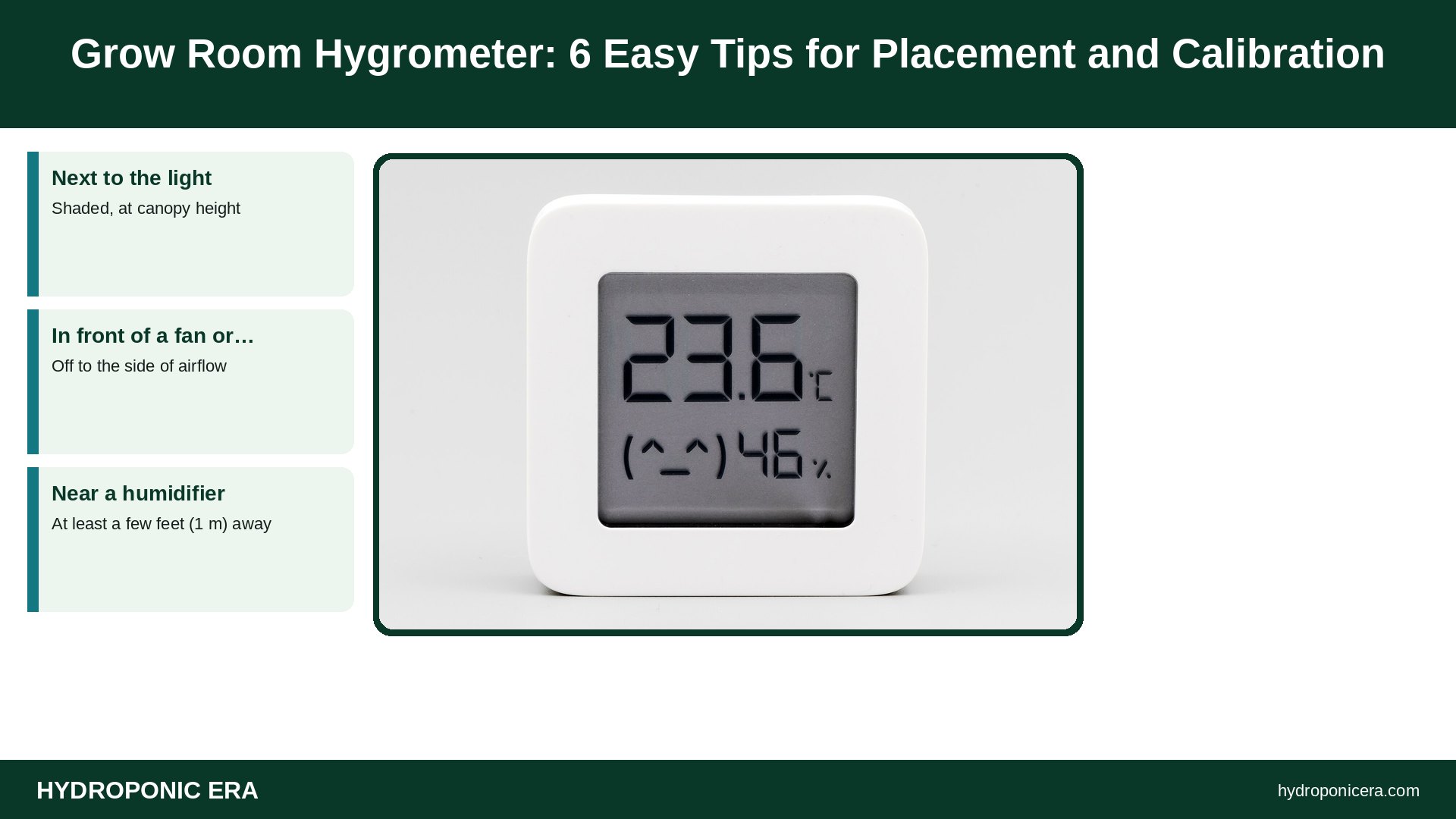
| Placement problem | Why it gives a bad reading | Better spot |
|---|---|---|
| Next to the light | Heat and radiation skew the sensor | Shaded, at canopy height |
| In front of a fan or vent | Moving air reads drier or wetter than the room | Off to the side of airflow |
| Near a humidifier | Reads wet while the canopy stays dry | At least a few feet (1 m) away |
| Near the floor | Cool air holds different humidity | Canopy level |
What Does a Grow Room Hygrometer Measure?
A grow room hygrometer measures relative humidity, the amount of water vapor in the air compared with the most it can hold at that temperature. Most digital models also show temperature, and many store minimum and maximum values. Those two numbers together tell you far more than humidity alone.
Because warm air holds more moisture, 60% humidity at 75°F (24°C) is not the same as 60% at 85°F (29°C). Growers combine the two into vapor pressure deficit, covered in our guide to humidity and VPD in indoor hydroponics. A good meter lets you compare readings throughout the day and spot swings when the lights turn on or off.
How Do You Place a Grow Room Hygrometer Correctly?
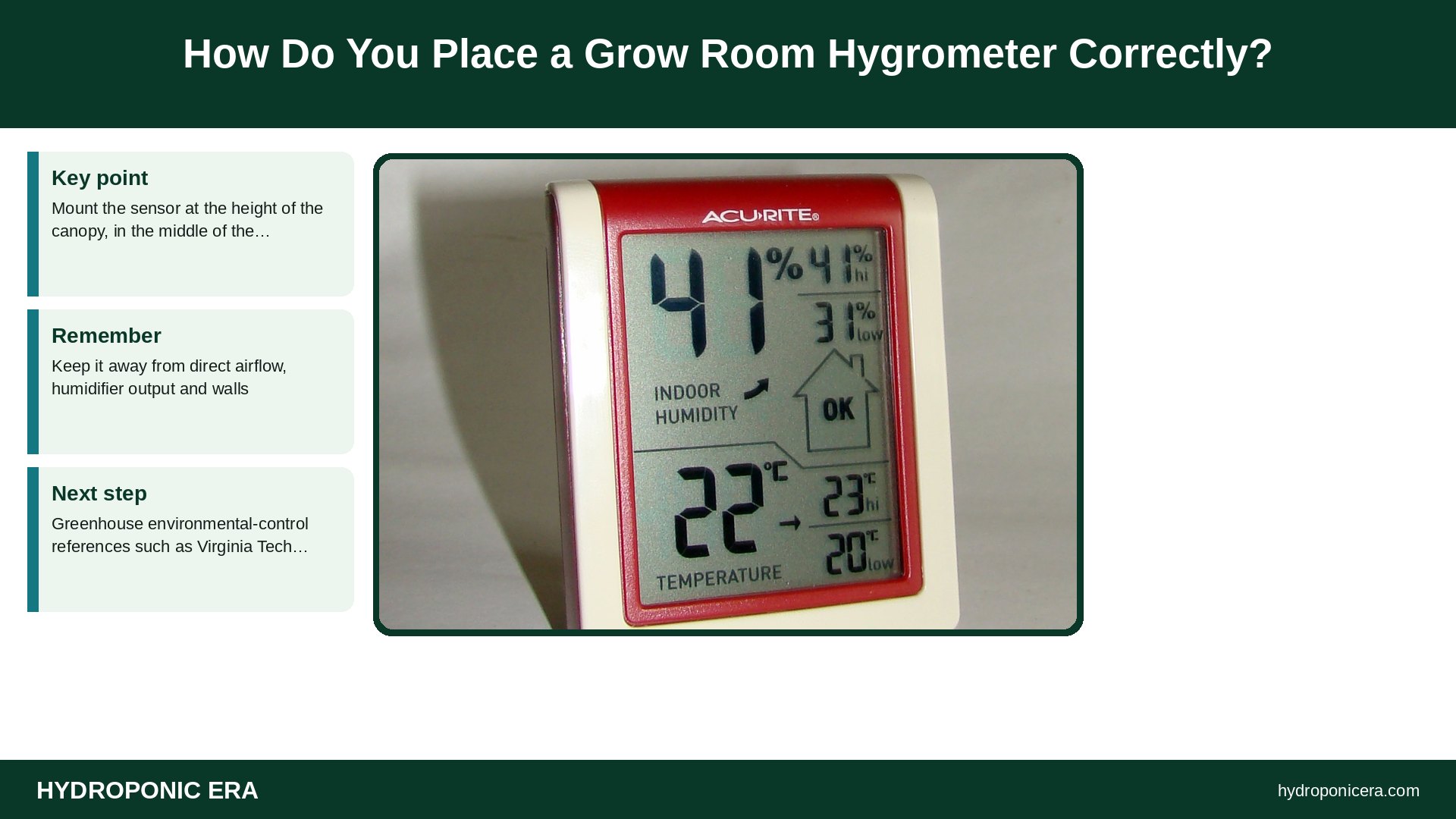
Mount the sensor at the height of the canopy, in the middle of the plants, and shade it from direct light. Keep it away from direct airflow, humidifier output and walls. Greenhouse environmental-control references such as Virginia Tech Extension’s guide cover humidity monitoring, and the practical rule is to measure at crop level and use several sensors in larger spaces.
- Hang the grow room hygrometer at canopy height in the center of the crop.
- Shield it with a small piece of white card or a vented cover so lamp heat does not hit it.
- Add a second sensor near the exhaust or the far corner to catch gradients.
- Move the sensor up as plants grow so it keeps reading the canopy.
- Compare the sensors weekly and note any gap.
Is Your Grow Room Hygrometer Accurate?
Many low-cost sensors are off by several percentage points and drift over time. Check a grow room hygrometer against a second meter or with the salt test, and replace sensors that never agree. Treat the readings as a trend tool, not a lab measurement, unless you have confirmed accuracy.
Humidity readings near saturation also become unreliable. Sensors can fail or read high above roughly 95% humidity, and condensation on the sensor will give false results. If your sensor sits in a humid tent, keep it dry and clean, and replace it if it shows 99% all the time.
How Do You Calibrate a Grow Room Hygrometer With Salt?
To calibrate a grow room hygrometer, place it in a sealed bag or jar with a small cap of damp table salt for 6 to 24 hours. Saturated salt creates about 75% relative humidity at room temperature, so the sensor should read near 75%. Note the difference and correct for it.
- Mix table salt with a little water into a damp slurry, not a puddle.
- Put the slurry in a bottle cap and set it in a zip bag with the sensor, without touching the sensor.
- Seal it and leave it at a stable room temperature for 6 to 24 hours.
- Compare the reading with 75% and note any offset.
- If the meter allows adjustment, correct it. Otherwise subtract or add the offset yourself.
The Ruuvi sensor guide describes this method and reminds readers that temperature should be steady, so keep the bag out of sunlight.
What Humidity Should a Grow Room Hygrometer Show?
Ideal humidity depends on the stage. Seedlings and cuttings like high humidity, while mature plants and flowering crops do better in drier air, because wet leaves invite disease. Instead of a fixed number, use your meter to keep the trend in a comfortable range and avoid long periods near 90% humidity.
| Stage | Humidity approach | Why |
|---|---|---|
| Seedlings and cuttings | Higher, with vented domes | Reduces water loss before roots form |
| Vegetative growth | Moderate | Supports steady transpiration |
| Fruiting or flowering | Lower and well-ventilated | Reduces gray mold and mildew |
Persistent high humidity is a common cause of botrytis gray mold in hydroponics and tomato leaf mold. If readings stay too high, add airflow with inline duct fans and carbon filters or a dehumidifier.
Should You Use More Than One Grow Room Hygrometer?
In a small tent, one well-placed grow room hygrometer is usually enough. In a larger room or greenhouse, use at least two or three, because humidity differs between the top and bottom, near the vents and at the far wall. A smart hub that logs every sensor makes problems visible.
Log the highs and lows for a week before you change fans or humidifiers. Many problems turn out to be timing, such as humidity spiking when lights turn off. A grow tent setup with sensors at two heights gives the clearest picture.
Digital or Analog: Which Grow Room Hygrometer Is Better?
A digital sensor with a min/max memory is the better choice for most growers. Analog dial models respond slowly and are generally less accurate, so they are fine for a rough check but poor for tuning a tent. Wi-Fi or Bluetooth models add logging, which helps you spot overnight humidity spikes while you are asleep.
Whatever type you buy, look for a readable display, a replaceable battery and a probe or remote sensor that can sit among the leaves while the display stays outside the tent. Write down the date you checked it against the salt test, and repeat the check every few months.
FAQ About the Grow Room Hygrometer
Where is the best place for a grow room hygrometer?
At canopy level, shaded from lights and away from airflow, humidifiers and walls.
How often should I check my grow room hygrometer?
Look daily, and compare with a second meter or do a salt test every few months.
Why does my grow room hygrometer read 99%?
The sensor may be wet, failing or near saturation. Dry it and recheck against another meter.
Do I need a hygrometer in a small tent?
One is enough, and it is one of the cheapest and most useful tools you can add.
Is the humidity on a thermostat reliable?
Not always. Use a dedicated sensor at plant height for better data.
Sources
- Virginia Tech Extension — Greenhouse environmental control (SPES-817)
- University of Kentucky — Biosystems and Agricultural Engineering report on greenhouse environments
- Ruuvi — How to calibrate a hygrometer or air humidity sensor
- Photo credits (Wikimedia Commons, edited with titles): 2023 Czujnik temperatury i wilgotności Xiaomi (2) by Jacek Halicki (CC BY-SA 4.0); Hygrometer-Thermometer by Pogrebnoj-Alexandroff (CC BY 3.0); 2008-09-20 Thermometer reading by Ildar Sagdejev (Specious) (CC BY-SA 4.0); Electrical conductivity meter by Nuno Nogueira (Nmnogueira) (CC BY-SA 2.5)