
How do beneficial nematodes control fungus gnats? Beneficial nematodes, specifically Steinernema feltiae, are microscopic roundworms that enter fungus gnat larvae in moist media and kill them in about 3–4 days. Apply them as a drench to damp medium at 60–70°F (16–21°C), and repeat in two weeks to catch later hatches.
Key takeaway: Beneficial nematodes are living biocontrol agents, so handling matters. Keep them cold until use, mix in cool water, drench damp media in the evening, and repeat every two weeks. They work best as prevention or on moderate infestations, and they do not kill adult flies.
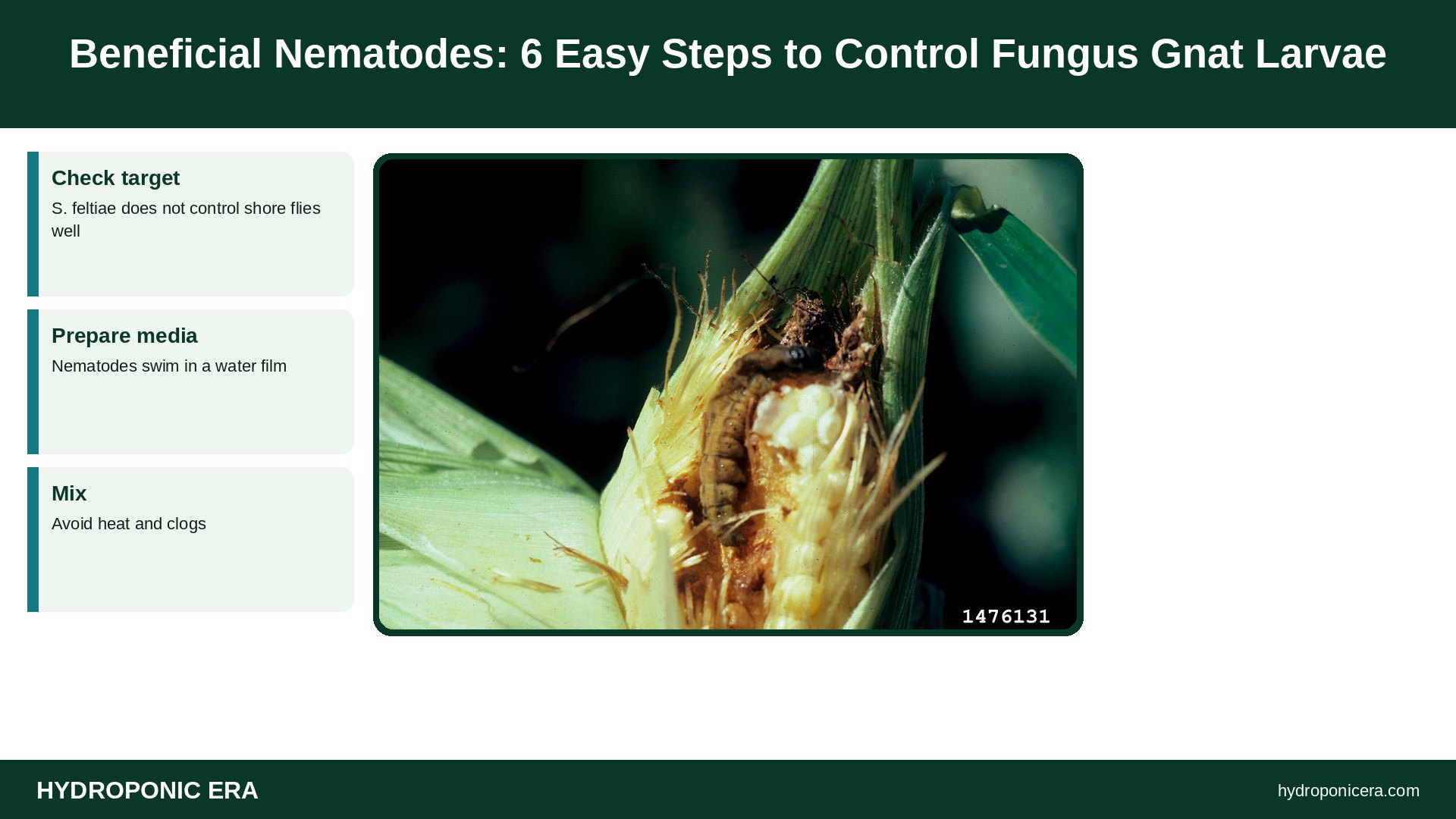
| Step | What to do | Why it matters |
|---|---|---|
| Check target | Confirm fungus gnat larvae, not shore flies | S. feltiae does not control shore flies well |
| Prepare media | Water the medium the day before | Nematodes swim in a water film |
| Mix | Use cool water, remove screens and filters | Avoid heat and clogs |
| Apply | Drench in the evening or on a cloudy day | Light and drying kill them |
| Repeat | Every 2 weeks, as the label says | Covers new larvae |
What Are Beneficial Nematodes?
Beneficial nematodes are microscopic roundworms that parasitize soil insects without harming plants, pets or people. The species sold for fungus gnats is Steinernema feltiae. It enters larvae through body openings and releases bacteria that kill the host within days. Garden stores sell them on a sponge or clay carrier, shipped cold.
UMass Extension notes that S. feltiae targets fungus gnat larvae and thrips pupae, and that they work best as a preventive. Because they are living, they need moisture, mild temperatures and shade. For identifying the pest first, read fungus gnats in hydroponics.
Which Pests Do Beneficial Nematodes Control?
Steinernema feltiae controls fungus gnat larvae in the medium and thrips pupae that drop to the soil. It is not the right choice for shore flies, where UMass lists a different species, Steinernema carpocapsae, so match the species to the target pest before you buy, and use the product within the date on the label.
- Fungus gnat larvae: the main use for S. feltiae.
- Thrips pupae: only the stage in the medium.
- Not shore flies: see shore flies vs fungus gnats.
- Not adults: pair with traps for flying adults.

How Do You Apply Beneficial Nematodes?
To apply beneficial nematodes, water the medium the day before, mix the nematodes in cool water, and drench the medium in the evening or on a cloudy day. UConn Extension advises removing screens and filters from sprayers and using low pressure. Keep the medium moist for a few days afterward.
- Take the pack from the fridge and let it warm for about 30 minutes.
- Mix with cool water, stirring so the nematodes stay suspended.
- Remove spray nozzles with fine screens, or use a watering can.
- Drench the damp medium in the evening or on a cloudy day.
- Water lightly afterward and keep the medium moist, not soaked.
Repeat every two weeks, or as the label states, so new larvae meet new nematodes. Pair the treatment with sticky traps to monitor adult numbers.
What Temperature and Moisture Do Beneficial Nematodes Need?
These animals need moist media and moderate temperatures. UConn lists media above 50°F (10°C) and below 80°F (27°C), with 60–70°F (16–21°C) best. UV light and drying kill them quickly. A medium that dries between waterings, or sits in a hot window, will give poor results.
Check the product date and keep unused packs cold. Do not leave the pack in a hot car or mixed water for hours, since they are alive and run out of energy. If the pack looks dried out or smells foul, do not use it.
Do Beneficial Nematodes Work in Hydroponics?
They work in moist hydroponic media such as coco, peat or rockwool, but not in open reservoirs. They need a medium to move through and larvae to find. In recirculating systems with pumps and filters, treat the growing medium, and avoid flushing the nematodes straight into the drain.
Another option for water-culture systems is Bti, covered in mosquito bits for fungus gnats. Choose the product by the system and always follow label instructions.
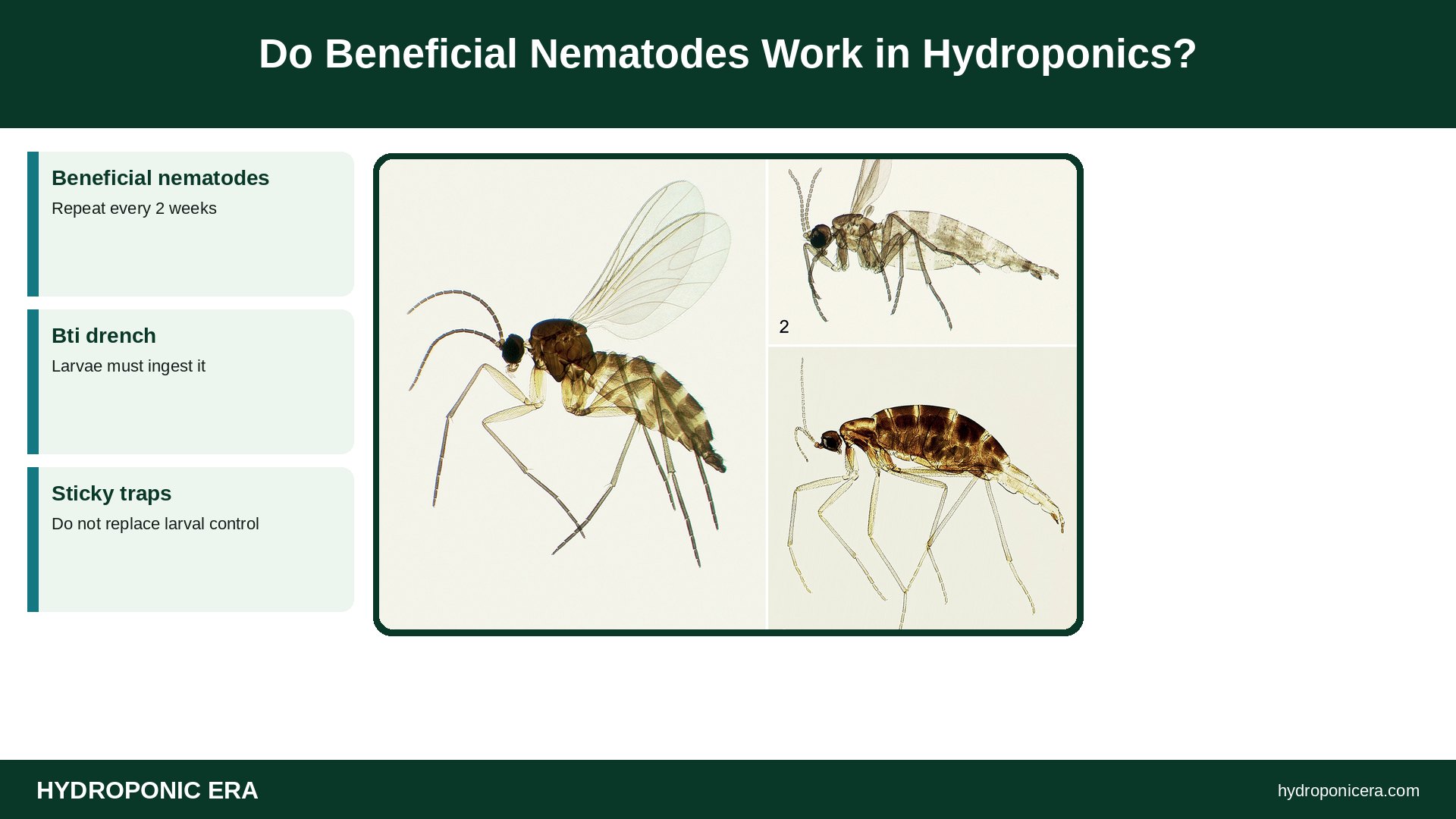
| Method | Best for | Notes |
|---|---|---|
| Beneficial nematodes | Moist media, prevention and moderate infestations | Repeat every 2 weeks |
| Bti drench | First-instar larvae in media | Larvae must ingest it |
| Sticky traps | Monitoring and trapping adults | Do not replace larval control |
| Drier surface | Prevention | Reduces egg-laying habitat |
How Can You Tell Whether Beneficial Nematodes Are Working?
Check larvae with potato slices. Colorado State University suggests placing a potato slice about 1/4 inch (6 mm) thick on the surface and checking for larvae after a day or two. Fewer larvae and fewer adult flies over two to three weeks show the treatment is working, while a rise in adults means repeat.
Remember that results lag. Nematodes kill larvae, so adults emerging from earlier pupae may still appear for a week or so. Keep traps in place and do not re-treat early unless the label allows it.
When Do Beneficial Nematodes Fail?
Treatment fails when the product is old, applied to dry or hot media, hit with sunlight, or aimed at the wrong pest. UMass notes they will not rescue a serious outbreak. In those cases, combine them with media drying, sanitation and traps, and reapply as the label describes.
How Should You Handle and Store the Pack?
The nematodes arrive alive, so order them close to the day you will use them. Keep the pack in the refrigerator, away from the freezer, and check the label for the shelf life. Open it only when you are ready to mix, because exposure to heat and air shortens their lifespan.
Wear gloves if you like, though the animals do not harm skin. Rinse containers afterward and pour leftover mix on moist soil rather than down a sunny patio, where the sun would kill them. If the batch arrives warm or dried out, contact the supplier before you apply it.

FAQ About Beneficial Nematodes
How long do beneficial nematodes take to work?
Larvae die within about 3–4 days, but adults continue to emerge for a while.
Can I use beneficial nematodes in a recirculating reservoir?
Not as intended. Use them in moist media, and consider Bti for water systems.
Are beneficial nematodes safe for pets?
They are not harmful to people, pets or plants, but still follow label and handling directions.
How often should I apply them?
Repeat every two weeks, or as the label states.
Can I store leftover nematodes?
They are alive, so use them promptly and keep them cold until use.
Sources
- Colorado State University Extension — Fungus gnats as houseplant and indoor pests
- UMass Extension — Biological control using beneficial nematodes
- UConn IPM — Beneficial nematodes fact sheet (2024)
- Cornell IPM — Steinernema feltiae beneficial nematode
- Photo credits (Wikimedia Commons, edited with titles): Steinernema carpocapsae at Helicoverpa zea by Whitney Cranshaw, Colorado State University, Bugwood.org (CC BY 3.0); BMNH258029 wing of the fungus gnat Sciophila fractinervis by The Natural History Museum, London (CC BY 4.0); Sciaridae (10.3897-zookeys.957.46528) Figures 1–3 by Menzel F, Gammelmo Ø, Olsen KM, Köhler A (2020) The Black Fungus Gnats (Diptera, (CC BY 4.0); Fleece lined greenhouse potting tray and seed pots – Flickr – peganum by peganum from Small Dole, England (CC BY-SA 2.0)