
Which chelated iron for hydroponics should you use? Choose chelated iron for hydroponics by your solution pH: Fe-EDTA works up to about pH 6.0–6.5, Fe-DTPA holds to roughly 7.0–7.5, and Fe-EDDHA stays available at pH 7.5 and above. Most home systems run at pH 5.5–6.5, so EDTA or DTPA is usually enough.
Key takeaway: Chelated iron for hydroponics is iron wrapped in an organic molecule so it stays dissolved and available to roots. The chelate type decides how high your pH can climb before iron drops out. Match the chelate to your pH, and fix pH drift before you add more iron.
| Chelate | Stays effective up to about | Best for |
|---|---|---|
| Fe-EDTA | pH 6.0–6.5 | Standard hydroponic solutions at pH 5.5–6.0 |
| Fe-DTPA | pH 7.0–7.5 | Systems with higher or drifting pH |
| Fe-EDDHA | pH 7.5–9 and above | Alkaline media, such as lava rock or lime-rich coir |

What Is Chelated Iron for Hydroponics?
Chelated iron for hydroponics is an iron salt bonded to a chelating agent, a molecule that grips the iron ion and keeps it soluble. Without a chelate, iron quickly reacts with phosphate and hydroxide at normal solution pH, turns into rust-colored particles and settles out where roots cannot absorb it.
This is why nearly every hydroponic fertilizer includes iron as a chelate rather than a plain sulfate. The three common forms are EDTA, DTPA and EDDHA, and they differ in how well they hold iron as pH rises. Our guide to iron deficiency in hydroponics shows how to spot the problem on leaves.
How Do EDTA, DTPA and EDDHA Compare in Chelated Iron for Hydroponics?
EDTA is the cheapest and works at slightly acidic pH, DTPA tolerates a higher pH, and EDDHA is the strongest and most expensive, holding iron even in alkaline media. A 2025 HortScience study of soilless media found all three chelates prevented iron chlorosis at pH 6.0–6.5, but above pH 7.2 only Fe-EDDHA worked. That is why a high-pH system calls for EDDHA.
- EDTA: good for pH 5.5–6.0 reservoirs and standard base nutrients.
- DTPA: a safer middle choice when pH creeps toward 7.
- EDDHA: best where the media or water pushes pH high, such as limestone-based media.
If your pH is in range yet leaves are still pale, the chelate is not always the problem. Check for iron precipitation after a pH adjustment and for root damage.

When Is Chelated Iron for Hydroponics Not Enough?
Extra chelated iron for hydroponics will not help if pH is wrong, roots are damaged or other metals are crowding it out. Excess copper, zinc and manganese compete with iron for uptake, and high phosphate can lock it up. Fix pH and balance first, then dose iron only if tests and symptoms still point to it.
- Measure the solution pH and bring it to 5.5–6.0.
- Check EC and recent changes to the feed program.
- Look for root rot, which blocks uptake even when iron is present.
- Review recent additions of micronutrient or trace-metal products.
- Only then add a chelated iron supplement at the label rate.
Pale new leaves with green veins are the classic sign. For timing after a reservoir swap, see chlorosis after a reservoir change.
How Do You Dose Chelated Iron for Hydroponics?
Dose chelated iron for hydroponics exactly as the product label states, and add it as part of the normal nutrient mix rather than as a separate pour. Many base fertilizers already contain iron, so extra iron is mainly for corrections. Overdosing can cause leaf spotting and compete with other micronutrients.
Check your mixing sequence so iron is diluted before it meets concentrated phosphate. The nutrient mixing order guide explains the order that avoids cloudiness. Use EC and TDS readings to confirm the solution strength after any addition.

How Should You Store Chelated Iron for Hydroponics?
Store stock solutions and powders in cool, dark, tightly closed containers. Iron chelates can break down in strong light, and EDDHA can decompose in strongly acidic stock solutions below about pH 4–5. Label the date and discard stock that looks cloudy or has an orange sediment.
| Storage issue | What happens | Fix |
|---|---|---|
| Clear bottle in sunlight | Chelate can degrade | Use an opaque container |
| Mixed with strong acid | EDDHA may break down | Keep iron stock near neutral |
| Mixed with phosphate stock | Iron can precipitate | Keep separate stock bottles |
| Old stock | Sediment or color change | Discard and remake |
Is It Worth Paying More for EDDHA or DTPA?
Only if your pH or medium needs it. The 2025 HortScience study reported that Fe-EDDHA costs roughly four times as much as Fe-EDTA and Fe-DTPA about twice as much. In a water-culture system held at pH 5.5–6.0, the cheaper chelated iron for hydroponics does the same job, so the extra cost buys nothing.
The calculation changes with alkaline media. Coarse volcanic rock, limestone-rich coir or hard source water can push pH up between checks. In those setups, a more stable chelated iron for hydroponics gives you a margin of safety, and our guide to lava rock in hydroponics explains why such media can run alkaline.
How Can You Tell Whether pH Is Causing Iron Problems?
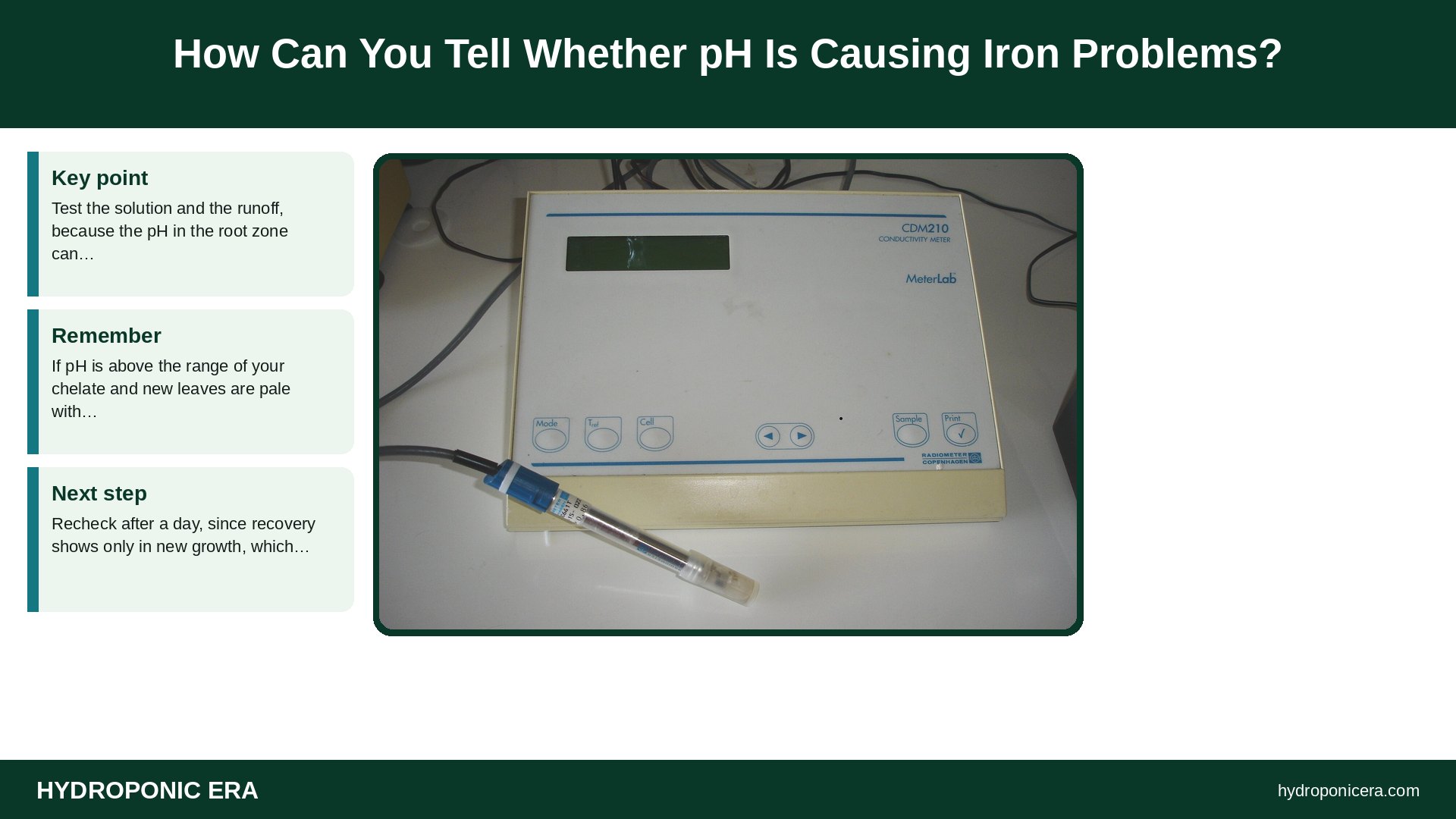
Test the solution and the runoff, because the pH in the root zone can differ from the reservoir. If pH is above the range of your chelate and new leaves are pale with green veins, move the pH down gently first. Recheck after a day, since recovery shows only in new growth, which takes several days.
Do not expect older yellow leaves to turn green again. Judge the fix by the color of new leaves, which should emerge with normal color if iron is available. Keep a log of pH, EC, iron doses and dates so you can link any new yellowing to a change in feed or water.
FAQ About Chelated Iron for Hydroponics
What is the best chelated iron for hydroponics?
For pH 5.5–6.0, Fe-EDTA or Fe-DTPA works. For high-pH media, use Fe-EDDHA.
Why are my leaves yellow with green veins?
This is typical iron deficiency, often caused by high pH or root problems rather than a lack of iron.
Can I use iron sulfate instead?
It is not stable in nutrient solution at normal pH because iron precipitates quickly.
Is EDDHA better than EDTA?
It holds iron at higher pH, but it costs more and is unnecessary at a pH of 5.5–6.0.
How often should I add iron?
Only when needed. Most complete hydroponic fertilizers already provide enough.
Sources
- Michigan State University Extension — Selecting which iron chelate to use
- HortScience 60(3) — Fertigation with Fe-EDTA, Fe-DTPA, and Fe-EDDHA chelates to prevent iron chlorosis in high-pH soilless media
- UF/IFAS Extension — Understanding and applying chelated fertilizers effectively based on soil pH
- Acta Horticulturae — Iron chelates and plant nutrition (ISHS 644_61)
- Photo credits (Wikimedia Commons, edited with titles): Iron chlorosis on young rose leaves in a garden, by baby-bear.org by Natalka Ukraine (CC BY 4.0); Agricultural Disease Detection Dog Training (20210225-ARS-LSC-1338) by USDAgov (Public domain); Calcium nitrate, waste water treatment by Cjp24 (CC BY-SA 4.0); Electrical conductivity meter by Nuno Nogueira (Nmnogueira) (CC BY-SA 2.5)