
What does trichoderma do for plants? Trichoderma is a beneficial fungus sold as a biofungicide that colonizes roots and crowds out root rot pathogens such as Pythium, Rhizoctonia and Fusarium. It works as a preventive, not a cure, so apply it before seeding or right after transplanting, following the product label.
Key takeaway: This fungus protects roots when it is on them first. Apply it at seeding, to plugs or as a drench right after transplant, and keep conditions warm and moist enough for it to grow. It will not cure an infection that is already established, so treat it as insurance.
| Product example | Common trichoderma strain | Typical use |
|---|---|---|
| RootShield and PlantShield | Trichoderma harzianum T-22 | Seed, plug or media treatment and drench |
| SoilGard | Trichoderma virens | Soil and media-borne disease prevention |
| Asperello T34 | Trichoderma asperellum T34 | Preventive root treatment in greenhouse crops |
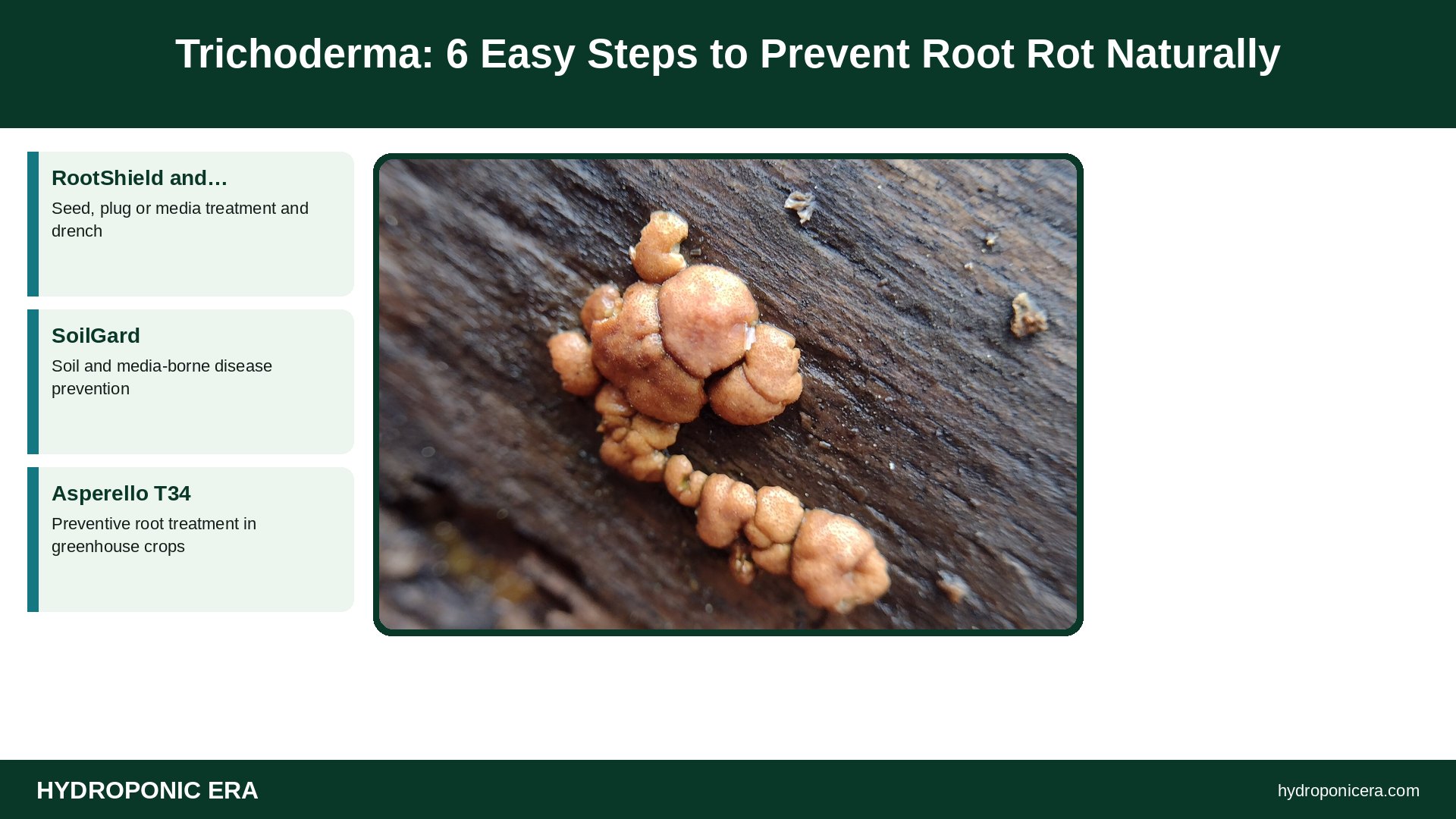
What Is Trichoderma?
This genus of soil fungi includes certain strains that are registered as biological fungicides for greenhouse and nursery crops. The fungus grows on and around roots, competes with disease organisms for space and food, and can parasitize some of them. Extension fact sheets list several commercial strains.
UMass Extension’s biofungicide fact sheet and Virginia Tech’s greenhouse publications describe the fungus as one of several biological options, alongside Bacillus and Streptomyces products. They describe it as preventive and note that results depend on timing, dose and growing conditions. It fits well with a clean, aerated root zone such as in Pythium root rot prevention in hydroponics.
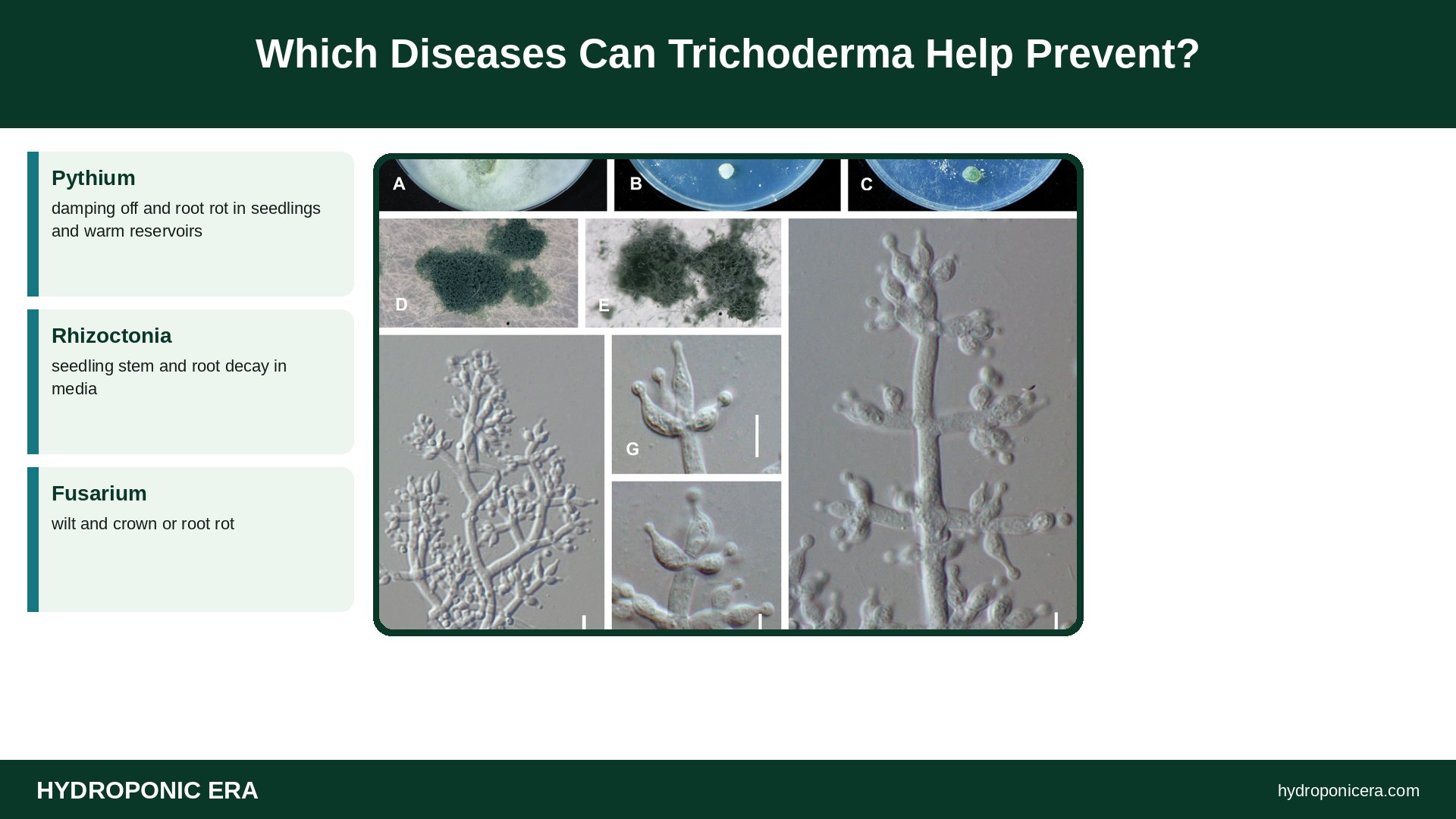
Which Diseases Can Trichoderma Help Prevent?
The fungus is mainly used against soil and root pathogens, including Pythium, Rhizoctonia and Fusarium, and in some products against Phytophthora. It does not control leaf diseases such as powdery mildew or botrytis. Always check the label of the exact product, because the diseases and crops vary.
- Pythium: damping off and root rot in seedlings and warm reservoirs.
- Rhizoctonia: seedling stem and root decay in media.
- Fusarium: wilt and crown or root rot.
- Phytophthora: listed on some labels only.
For seedlings, see damping off in hydroponic seedlings. For roots that are already brown, our guide to brown hydroponic roots helps you find the cause first.
When Should You Apply Trichoderma?
Apply it early. The best timing is at seeding, when treating plugs or mix, or as a drench immediately after transplanting. Extension guidance calls it preventive, so it should be on the roots before pathogens arrive. If disease is already present, it will not rescue affected plants.
- Mix the product into the medium, or treat seeds or plugs, before sowing.
- Drench the root zone right after transplanting or potting up.
- Repeat on the schedule printed on the label, often every few weeks for long crops.
- Keep the media moist and not too cold, so the fungus can grow.
- Remove any plants that already show severe rot.
Rutgers’ plant and pest advisory also lists it among organic options for suppressing soil-borne pathogens. Timing matters more than dose, so treat it as a routine step during propagation and transplanting.
How Do You Use Trichoderma in Hydroponics?
In media-based hydroponics, you can drench or mix the product into rockwool, coco or perlite at transplant. Not every product is labeled for recirculating water systems, so read the label first. The fungus needs a surface to colonize, so it works best in media rather than a bare nutrient reservoir.
Avoid combining it with hot water, disinfectants or chlorine, which can kill it. Check label guidance on fungicides before tank mixing. For media choices, see growing media for hydroponics, and for general root health, beneficial bacteria and enzymes.
Is Trichoderma Safe for Plants and People?
Registered products are generally considered low risk to plants, pets and people, but they are still pesticides by regulation, so follow the label. Wear gloves and avoid breathing the dust. Do not use a product on a crop that is not listed, especially food crops, unless the label permits it.
The product must be stored cool and dry, and its shelf life is limited because it is a living organism. Check expiry dates and avoid leaving containers in a hot garage.
Can You Use Trichoderma With Other Treatments?
Yes, with care. It often pairs with good sanitation, clean water and Bacillus products, but chemical fungicides can reduce its populations. Some labels ask for a waiting period between treatments. Compost tea is not a reliable substitute, since it varies in quality and is not registered for disease control.
| Practice | Fit | Note |
|---|---|---|
| Sanitation and clean trays | Excellent | Reduces pathogen load first |
| Bacillus biofungicide | Often compatible | Check the label |
| Chemical fungicide | May reduce activity | Follow label spacing |
| Compost tea | Not a replacement | See compost tea in hydroponics |
What Conditions Help Trichoderma Establish?
The fungus is alive, so it needs moisture, oxygen and a food source in the root zone. A medium that stays soggy starves roots of oxygen and favors Pythium, which undermines the treatment. Keep the medium damp but airy, avoid extreme heat and cold, and do not sterilize the medium right after applying the product.
Cleanliness before application matters just as much. Scrub trays, buckets and tools, discard old media, and start with clean water. Biological products add an advantage, but they cannot make up for dirty equipment or a warm, stagnant reservoir. Check the reservoir temperature as well, because warm water favors root disease.
What Mistakes Reduce Results?
- Applying the product after plants already show root rot.
- Mixing it with chlorine, strong disinfectants or hot water.
- Using an expired container, since the spores lose viability.
- Keeping the medium waterlogged so roots lack oxygen.
- Skipping the label and applying to crops that are not listed.
Combine good sanitation with good watering habits and the biological treatment for the best protection, and treat any plants that are already declining separately.
FAQ About Trichoderma
Can it cure root rot?
No. It is preventive. Apply it before disease starts, because it cannot revive roots that are already rotting.
When do I add it to seedlings?
At sowing or as a drench right after transplanting, following label directions.
Is trichoderma the same as mycorrhizae?
No. Mycorrhizae help nutrient uptake, while trichoderma mainly suppresses root pathogens.
Can I use it in a water reservoir?
Only if the label allows it. Most uses are for media, plugs and seed treatments.
How should I store it?
Cool and dry, away from sun and heat, and use it before the expiration date.
Sources
- UMass Extension — Biofungicides for greenhouse crops
- Virginia Tech Extension — Biological control of greenhouse diseases
- Rutgers Plant and Pest Advisory — Organic production: suppressing soil-borne pathogens
- UConn IPM — Biological fungicides
- Photo credits (Wikimedia Commons, edited with titles): Trichoderma europaeum by Bartosz Czołczyński (CC0); Trichoderma lentinulae (10.3897-mycokeys.73.51424) Figure 2 by Gu X, Wang R, Sun Q, Wu B, Sun J-Z (2020) Four new species of Trichoderma in the (CC BY 4.0); Fleece lined greenhouse potting tray and seed pots – Flickr – peganum by peganum from Small Dole, England (CC BY-SA 2.0); Hydroton by Lucis (CC BY-SA 3.0)