
Shore flies are small, sturdy, dark flies with light spots on their wings that breed in algae and standing water. Fungus gnats are delicate, long-legged, weak fliers whose larvae live in moist media and can feed on roots. Extension entomologists say shore fly larvae eat algae, not plants, so the fix is algae and moisture control. Fungus gnats need drier media plus larval control. Correct ID saves time and money.
| Trait | Shore flies | Fungus gnats |
|---|---|---|
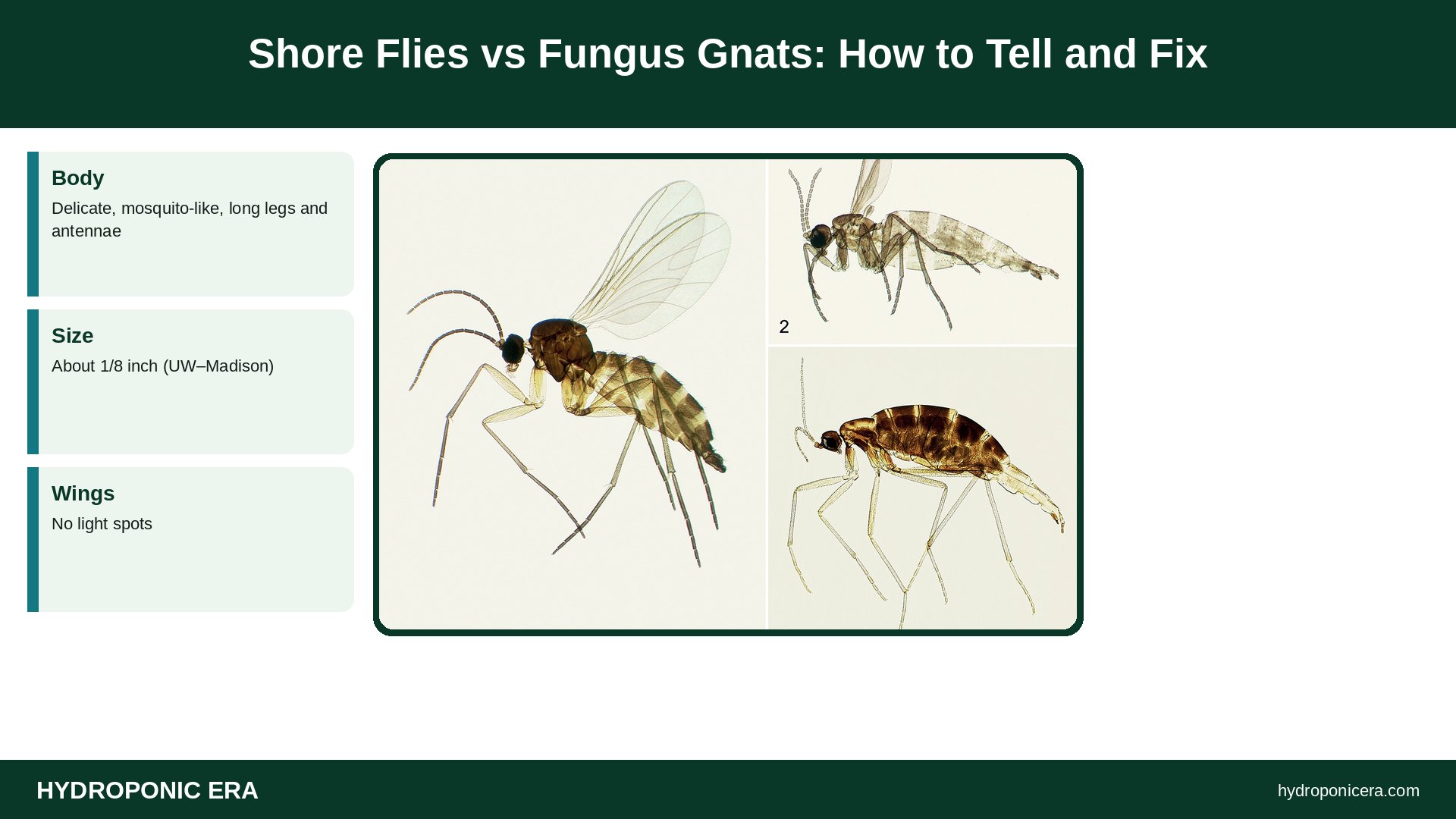
| Body | Robust, house-fly shape, short legs and antennae | Delicate, mosquito-like, long legs and antennae |
| Size | About 1/8 inch (UConn) | About 1/8 inch (UW–Madison) |
| Wings | Dark with about 5–6 light spots | No light spots |
| Flight | Strong fliers | Weak fliers; often rest on media |
| Larvae eat | Algae | Fungi, organic matter and sometimes roots |
| Main fix | Remove algae and puddles | Dry the media surface; BTI or biologicals |
How to Identify Shore Flies
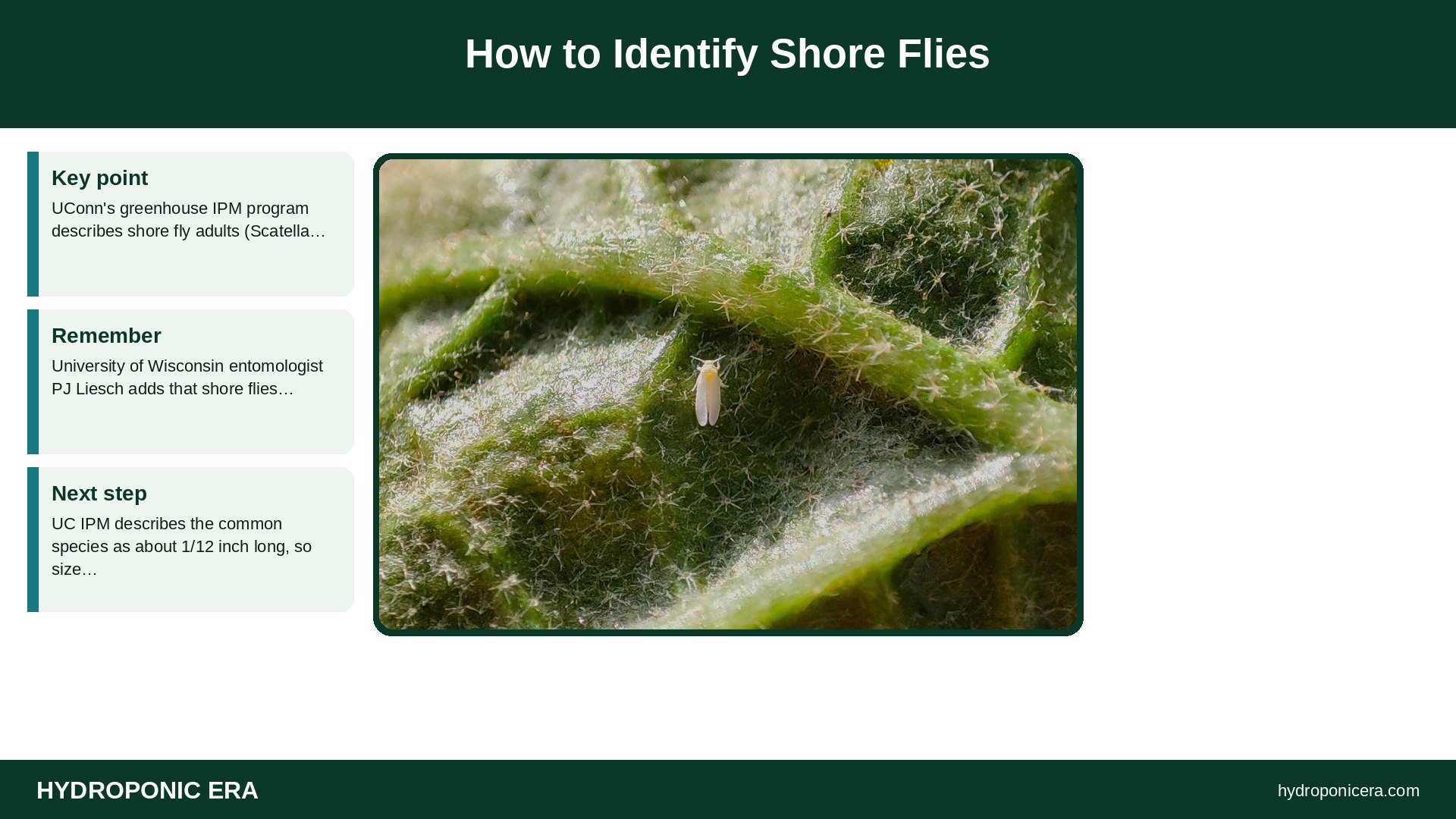
UConn’s greenhouse IPM program describes shore fly adults (Scatella species) as about 1/8 inch long with a robust body like a house fly, short legs and antennae, and five or six distinctive light spots on each wing. University of Wisconsin entomologist PJ Liesch adds that shore flies look like fruit flies and are very strong fliers. UC IPM describes the common species as about 1/12 inch long, so size alone won’t settle it; check body shape and wings.
A magnifier and a yellow sticky card make ID easy. On the card, these flies look stocky and dark with spotted wings. Fungus gnats look like tiny mosquitoes with long legs and thin antennae. Our sticky trap placement guide shows where to hang cards.
What Shore Flies Look Like Under a Lens
The University of Minnesota’s IPM program gives a closer description: adults in the genus Scatella are about 2 millimeters long, black, with reddish eyes and gray wings marked with clear spots. They resemble eye gnats or vinegar flies in shape. Darkwinged fungus gnats are about the same size and color, which is why they’re confused, but gnats are shaped like miniature mosquitoes.
Behavior helps too. UW–Madison notes fungus gnats are weak fliers often seen resting on the media surface, while the spotted-wing flies are strong fliers associated with algae and wet benches, walkways and sidewalls. Flies gathered on a green film in your flood tray are a strong hint.
Shore Flies vs Fungus Gnats: Larvae
The larvae tell the real story. UW–Madison describes fungus gnat larvae as slender, whitish or translucent maggots up to 1/4 inch long with a shiny black head. UConn’s photos show shore fly larvae without that black head, with two forked breathing tubes at the rear. Shore fly pupae sit near algae mats.
Are Shore Flies Harmful?

Mostly they’re a nuisance rather than a crop threat. UConn says shore fly larvae feed on algae and don’t feed directly on plants, but adult droppings (frass) leave dark specks on leaves that customers dislike. UConn also notes larvae have been reported to help spread soilborne pathogens such as Thielaviopsis basicola (black root rot) and Pythium via droppings, though how important that is in greenhouses is unclear.
Fungus gnats are the bigger plant risk. Purdue Extension calls fungus gnats the more serious of the two, and UW–Madison notes larval root feeding has been associated with root rots in greenhouses. See our fungus gnats in hydroponics guide and Pythium root rot guide.
Why Shore Flies Show Up in Hydroponics
All life stages live on or near algae, according to UConn. Hydroponic setups grow their food wherever light hits wet surfaces:
- Clear or translucent reservoirs and tubing
- Wet rockwool, coco and plug tops
- Puddles on trays, floors and under benches
- Uncovered openings around net pots
Numbers can explode fast. UConn says females lay up to 300 eggs in algae, and development from egg to adult takes as little as 8 days at 78°F or 14 days at 68°F. Adults live two to three weeks. Purdue reports 300 to 500 eggs per female.
How to Get Rid of Shore Flies: 6 Steps

- Kill the algae. Purdue says algae removal greatly reduces shore flies. Clean algae from trays, walls and floors. See our algae guide.
- Block light. Use opaque reservoirs, cover media and seal gaps. Our light-proofing guide lists simple fixes.
- Eliminate puddles. UConn advises reducing standing water, keeping floors level and draining, and letting the media surface dry between waterings.
- Don’t overfeed. UW–Madison notes excess fertilizer on wet surfaces feeds algae.
- Trap adults. Yellow sticky cards near the media surface help monitor and mass-trap.
- Use biological control in larger setups. UConn lists rove beetles (Dalotia coriaria) and beneficial nematodes, plus naturally occurring hunter flies.
Insecticides are a weak tool here. UC IPM says pesticides alone are unlikely to solve the problem, and UConn notes females can lay eggs about three days after emerging, so killing adults doesn’t last. Any product must be labeled for your crop and site, and the label is the law.
Fixing Fungus Gnats Instead
If your sticky cards show fungus gnats, the plan shifts. Let the top of the media dry between waterings, remove decaying plant debris, and consider a Bti (Bacillus thuringiensis var. israelensis) drench labeled for fungus gnat larvae; Purdue notes it works on gnat larvae but not shore fly larvae. Predatory soil mites and rove beetles also help. Many growers have both pests at once, so fix moisture and algae first; it helps against both.
Shore Flies by Hydroponic System
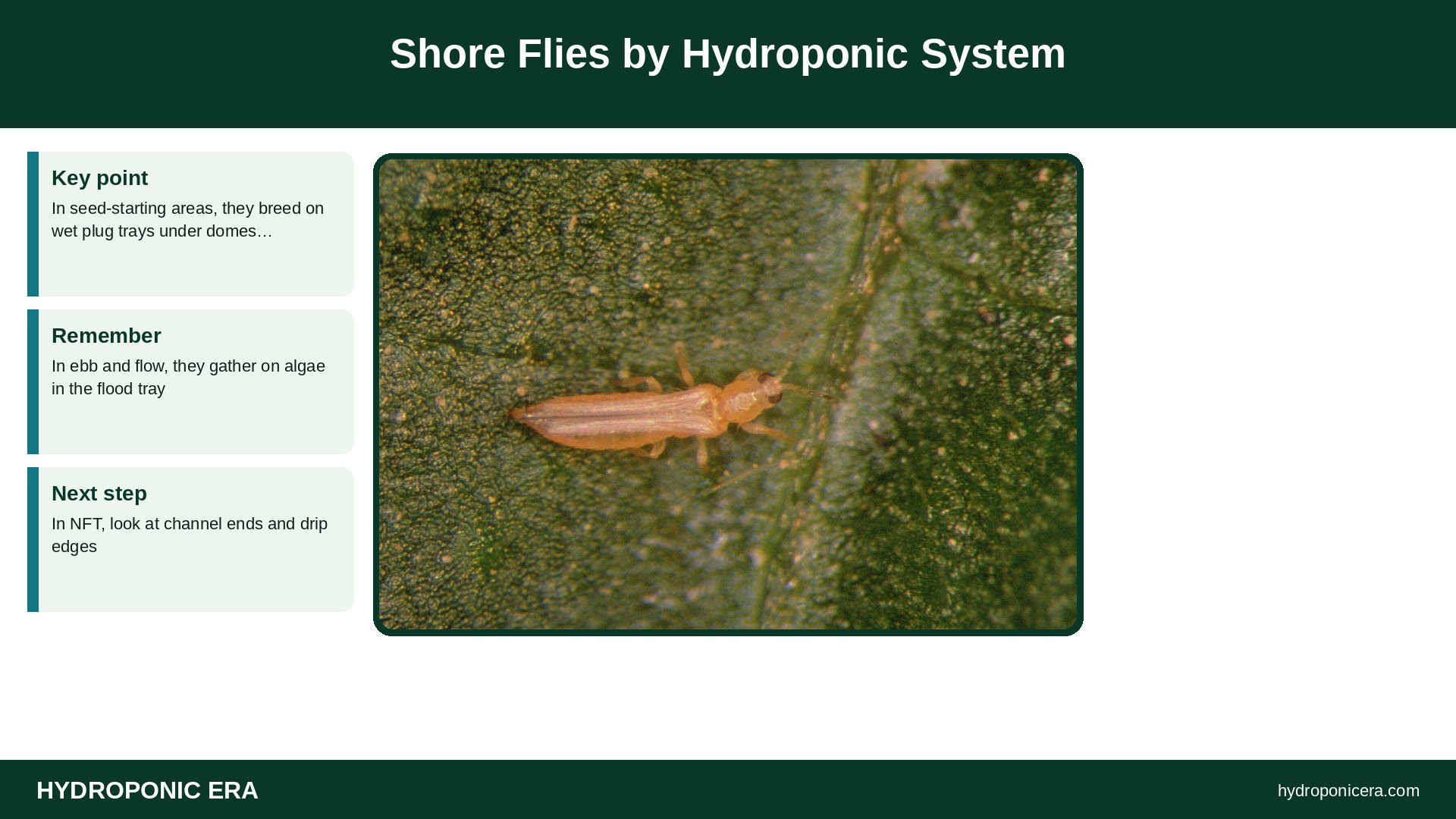
In seed-starting areas, they breed on wet plug trays under domes; prop domes open and bottom-water. In ebb and flow, they gather on algae in the flood tray. In NFT, look at channel ends and drip edges. In DWC, they favor algae on lid edges and wet media collars. Small jumping critters with no wings aren’t flies at all; see our springtails in hydroponics guide.
FAQs: Shore Flies
Do shore flies bite?
No. They feed on algae, and none of the extension sources list them as biting insects.
Do shore flies damage plant roots?
UConn says the larvae eat algae and don’t feed directly on plants. Fungus gnat larvae are the root feeders.
Will BTI kill shore flies?
No. Purdue Extension says Bti (sold as Gnatrol) controls fungus gnat larvae but not these flies. Algae removal is the main control.
How fast can shore flies multiply?
Very fast in warm conditions: about 8 days from egg to adult at 78°F, per UConn.
Related HydroponicEra Guides
- Fungus gnats in hydroponics
- Algae in hydroponic reservoirs
- Mosquito larvae in hydroponics
- Damping-off in hydroponic seedlings
Sources
- UConn Greenhouse IPM — Managing Shore Flies in the Greenhouse
- University of California IPM — Shore Fly (Floriculture)
- Purdue Extension E-111 — Fungus Gnats and Shore Flies
- University of Wisconsin–Madison Extension — Fungus Gnats and Shore Flies in Greenhouses
- University of Minnesota — Shore flies
- Photo credits (Wikimedia Commons, edited with titles): Sciaridae (10.3897-zookeys.957.46528) Figures 1–3 by Menzel F, Gammelmo Ø, Olsen KM, Köhler A (2020) The Black Fungus Gnats (Diptera, (CC BY 4.0); Bemisia tabaci under leaf of eggplant by Wee Hong (CC BY-SA 4.0); Deep water culture by ArcadiYay (CC BY-SA 4.0); Frankliniella occidentalis 5364132-LGPT by Frank Peairs, Colorado State University, Bugwood.org (CC BY 3.0)