
Mint rust is a fungal disease caused by Puccinia menthae. It shows up as pale, twisted spring shoots and dusty orange pustules under the leaves, later turning yellow and then black. It spreads through infected stems and rhizomes, so cutting leaves off rarely cures it. The reliable fix is to remove and bag infected plants, keep foliage dry, and restart from clean stock. Don’t eat or sell rust-spotted leaves.
| Mint rust fact | Detail |
|---|---|
| Cause | Puccinia menthae, a rust fungus that completes its life cycle on mint |
| First signs | Pale, swollen, distorted shoots in spring |
| Spore colors | Orange, then yellow, then black pustules (stems and leaf undersides) |
| Other hosts | Other mints, plus marjoram and savory (RHS) |
| Survives in | Infected rhizomes, stubble and wild mint |
| Best control | Remove infected plants and rhizomes; restart clean |

How to Identify Mint Rust

The Royal Horticultural Society lists pale and distorted shoots in spring, then dusty orange pustules on stems and leaves, sometimes followed by yellow or black pustules. Oregon State’s Pacific Northwest disease handbook describes brown, circular pustules on leaf undersides followed by yellowing and leaf drop, reddish blisters on young spring shoots, and a black spore stage on stems in fall. Swollen shoots with long, yellowish gaps between leaves point to a systemic infection.
Flip a leaf over. Rust pustules are raised and powdery, and the spores rub off on your finger. Flat brown spots without powder are more likely a leaf-spot disease, sunscald or nutrient problem. White powder on top of leaves is usually powdery mildew; see our powdery mildew guide.
Why Mint Rust Is Hard to Get Rid Of
The handbook explains that Puccinia menthae has five spore stages and completes its whole life cycle on mint. It overwinters on mint stubble and on wild or escaped mint. The spring stage can be systemic, meaning the fungus lives inside shoots that grow from infected rhizomes. That’s why trimming leaves rarely ends the infection: new shoots can emerge already infected.
There’s also strain specialization. In the Pacific Northwest, rust isolates from native spearmint don’t infect peppermint and vice versa. So one mint in your garden may stay clean while the one next to it collapses.
Is Mint With Rust Safe to Eat?
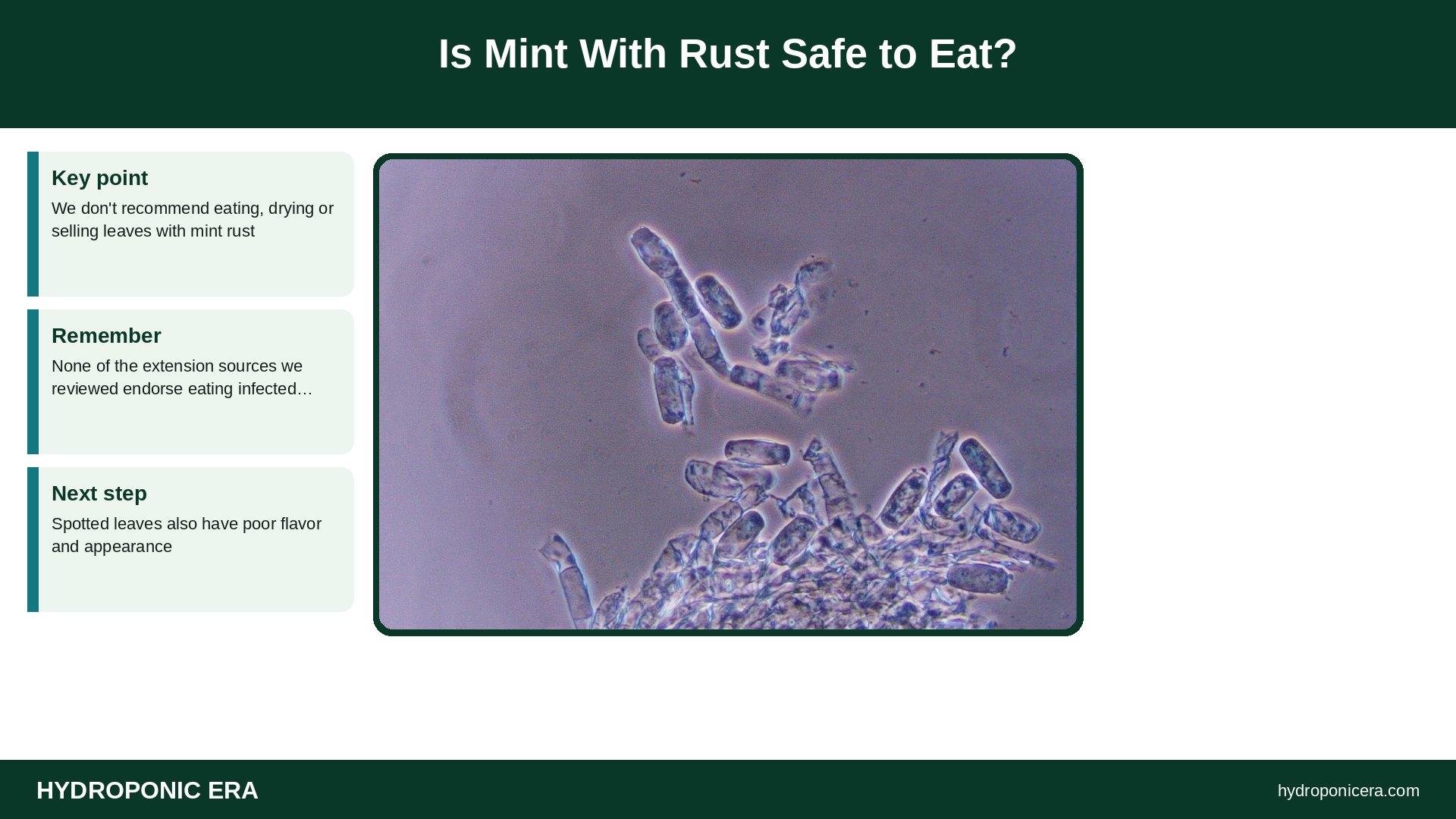
We don’t recommend eating, drying or selling leaves with mint rust. None of the extension sources we reviewed endorse eating infected leaves; they all direct growers to remove and discard infected material. Spotted leaves also have poor flavor and appearance. Harvest only from healthy, symptom-free plants, and wash herbs as usual. If you sell herbs, infected stems are a quality and trust problem you don’t need. Our home hydroponic food safety guide covers general handling.
How to Treat Mint Rust: 7 Steps
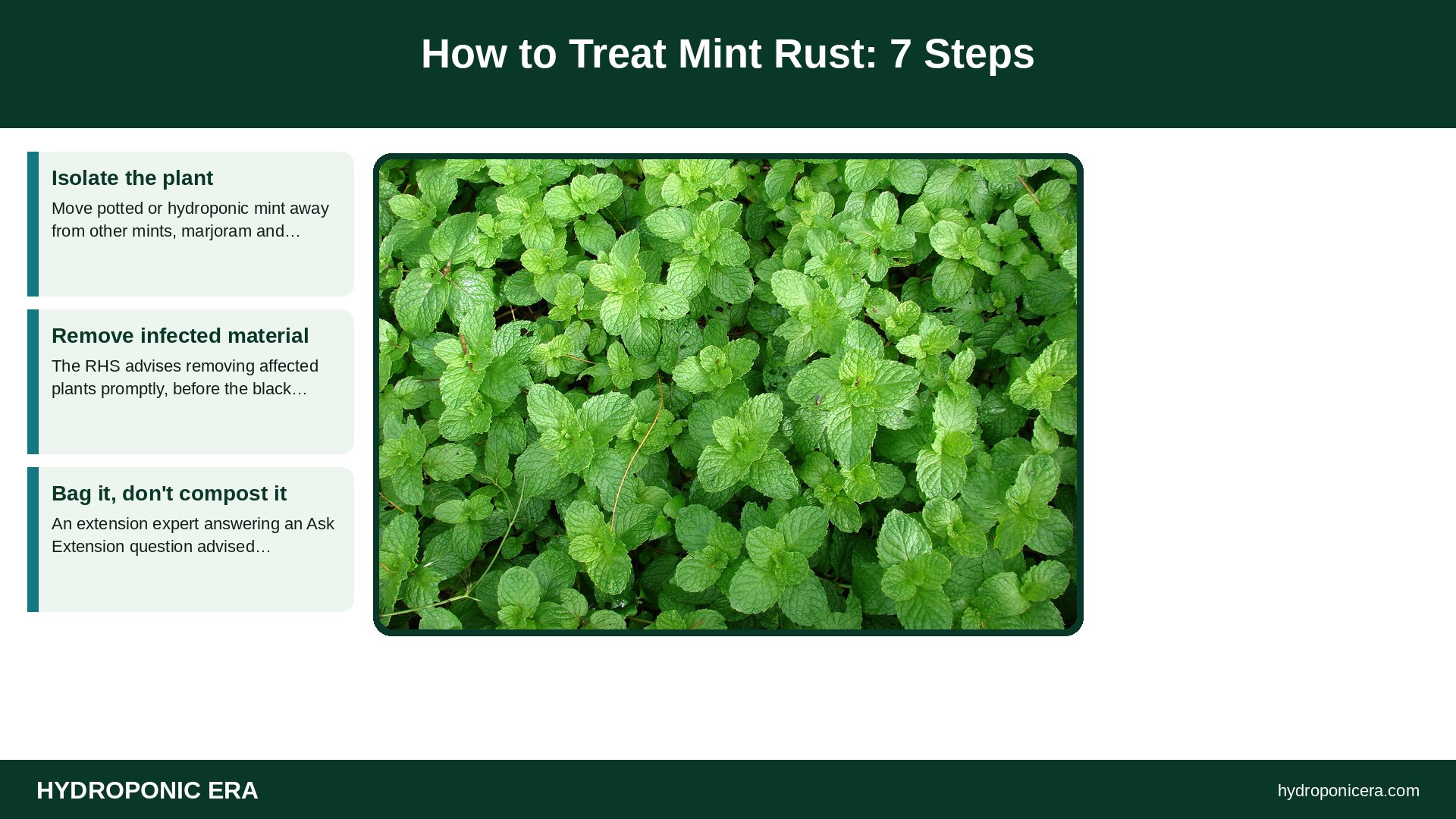
- Isolate the plant. Move potted or hydroponic mint away from other mints, marjoram and savory.
- Remove infected material. The RHS advises removing affected plants promptly, before the black resting spores form, and also removing infected rhizomes.
- Bag it, don’t compost it. An extension expert answering an Ask Extension question advised bagging diseased material and throwing it away.
- Save clean pieces. Both the RHS and Ireland’s Teagasc note that healthy, especially young, rhizome pieces may give disease-free plants.
- Consider hot water. The RHS describes a nursery method: wash rhizomes and immerse them in water at 111°F (44°C), no higher, for 10 minutes, then cool in cold water and plant. Use a thermometer; too hot kills the rhizome.
- Keep leaves dry. Water at the base, avoid wetting foliage late in the day and give plants space for airflow.
- Remove wild mint nearby. Outdoors, wild and escaped mint can carry spores back to your crop.
Fungicides for Mint Rust: Read the Label
Pesticide labels are legally enforceable. The U.S. EPA notes every label carries the statement “It is a violation of Federal law to use this product in a manner inconsistent with its labeling,” and sums it up as “the label is the law.” For this disease, that means:
- Use only products labeled for mint or herbs (or the crop group that includes them) and for rust.
- Follow the preharvest interval. It’s the required wait between spraying and picking edible leaves.
- Never add fungicide to a hydroponic reservoir unless the label specifically allows that use.
- Check options are limited. In the UK, the RHS says no fungicides with activity against mint rust are available for culinary herbs. US options also vary by state, so ask your county extension office.
The same extension expert noted sulfur gives “some control” and cautioned against home remedies or off-label uses without peer-reviewed support. That includes aspirin sprays; see our aspirin for plants review.
Mint Rust in Hydroponic and Indoor Systems
Indoor mint is less exposed to wind-blown spores, but the fungus still arrives on infected cuttings or nursery plants. In a hydroponic system:
- Quarantine new mint for two weeks and inspect leaf undersides. Our quarantine guide lays out a routine.
- Take cuttings only from clean plants. Rooting infected stems moves the disease. See our cuttings guide.
- Control humidity and airflow. Leaves that stay wet for hours favor rust. See our humidity and VPD guide.
- Sanitize after removal. Clean net pots, trays and tools before replanting.
- Feed in balance. Teagasc notes high nitrogen and low potassium are said to encourage rusts in general.
Preventing Mint Rust Next Season

Start with clean plants from a reputable source, grow each mint type in its own container, keep foliage dry, and inspect weekly in spring and fall. Commercial growers use propane flaming of stubble and early harvest, according to the Pacific Northwest handbook, but those field methods don’t translate well to a balcony or tent. For home growers, quick removal of the first infected shoot is the most effective defense.
For full growing details, see our hydroponic mint guide.
FAQs: Mint Rust
Can mint recover from rust?
Lightly affected plants sometimes regrow from clean rhizome pieces. Infected rhizomes can produce infected shoots, so removal and a clean restart is more reliable.
Does mint rust spread to other herbs?
The RHS lists other mints, marjoram and savory as hosts. It isn’t known as a basil or tomato disease.
Can I compost plants with mint rust?
Extension advice is no. Bag diseased material and put it in the trash.
Is mint rust the same as rust on other plants?
No. Rust fungi are usually host-specific. The mint pathogen is Puccinia menthae, which differs from rusts on beans, roses or grains.
Related HydroponicEra Guides
- How to grow mint hydroponically
- Powdery mildew in hydroponics
- Hydroponic airflow and fans
- Best herbs for hydroponics
Sources
- Pacific Northwest Plant Disease Management Handbook (Oregon State University) — Peppermint and Spearmint-Rust
- Royal Horticultural Society — Mint rust
- Ask Extension (extension expert response) — Treating mint rust (#331371)
- Teagasc — Technical Note: Mint Rust (2020)
- U.S. EPA — Introduction to Pesticide Labels
- Photo credits (Wikimedia Commons, edited with titles): Puccinia menthae Pers. 2174037 by Cesar Calderon from United States USDA APHIS PPQ (CC BY 3.0 us); Starr-080608-7435-Mentha spicata-leaves-Water plant Sand Island-Midway Atoll (41264499822) by Forest and Kim Starr (CC BY 3.0 us)