
Aspirin for plants is based on real science but oversold online. Plants use salicylic acid (SA), the compound aspirin breaks down into, as a signal to switch on their own defenses. However, University of Minnesota Extension Master Gardeners found the evidence “very thin” that spraying aspirin helps tomatoes. The only replicated home-garden trial we found, at the University of Rhode Island, couldn’t test disease control because no disease occurred. Aspirin is not a disease cure.
| Claim | What the evidence shows | Verdict |
|---|---|---|
| Salicylic acid helps plants activate defenses | Well established in plant science (systemic acquired resistance) | True |
| Spraying aspirin prevents tomato blight | No controlled trials found by UMN Extension volunteers | Unproven |
| Aspirin cures sick plants | No evidence; SA primes defenses rather than killing pathogens | Myth |
| Aspirin increases yields | URI 2005 trial: may increase fruit number under low disease; high plot variation | Weak evidence |
| More aspirin is better | SA can be phytotoxic | False |

Why People Use Aspirin for Plants

The idea comes from a real discovery. When a pathogen attacks a plant, the plant produces salicylic acid. A 2015 review in Frontiers in Plant Science describes SA as “an important phytohormone” that plays “a critical role in both local and systemic defense responses.” One of those is systemic acquired resistance (SAR), which the review calls a long-distance signaling mechanism that “provides broad spectrum and long-lasting resistance to secondary infections throughout the plant.”
Aspirin is acetylsalicylic acid. In water, it breaks down into salicylic acid and acetic acid. So gardeners reasoned that spraying aspirin might trigger the same defenses. It’s a logical jump, but logic isn’t evidence.
What the Research Says About Aspirin for Plants
University of Minnesota Extension
Asked whether aspirin spray prevents tomato blight, UMN Extension Master Gardeners reviewed the popular articles and found that controlled experiments, with and without aspirin under identical conditions, weren’t done. They noted that USDA researchers in 2014 found pure salicylic acid appeared to give tomatoes some resistance to certain infectious agents, but that aspirin contains other compounds, so results can’t be attributed cleanly. Their summary: “the evidence appears to be very thin.”
University of Rhode Island trial
Much of the online buzz traces to Master Gardener Martha McBurney’s 2004 raised-bed observations in Rhode Island. As garden writer Robert Pavlis reports, in 2005 she repeated the work with URI plant scientist Dr. Rebecca Brown using replicated plots of Early Girl tomatoes, two aspirin concentrations and a commercial product. Their conclusion, as quoted:
“Messenger and Aspirin applied at the rate of 250 mg per gallon of water may actually increase the number of fruit. We cannot make any conclusions as to the efficacy of these compounds in reducing disease, because of the lack of disease in the study. Variation among plots was quite high…”
That’s an honest, limited result. It doesn’t show aspirin prevents or cures disease. Pavlis also notes the 2004 observations weren’t properly measured or replicated, which is why the 2005 work matters more. Viral posts about aspirin for plants usually quote the dramatic 2004 anecdote and skip the cautious 2005 conclusion.
Why Aspirin for Plants Isn’t a Disease Cure
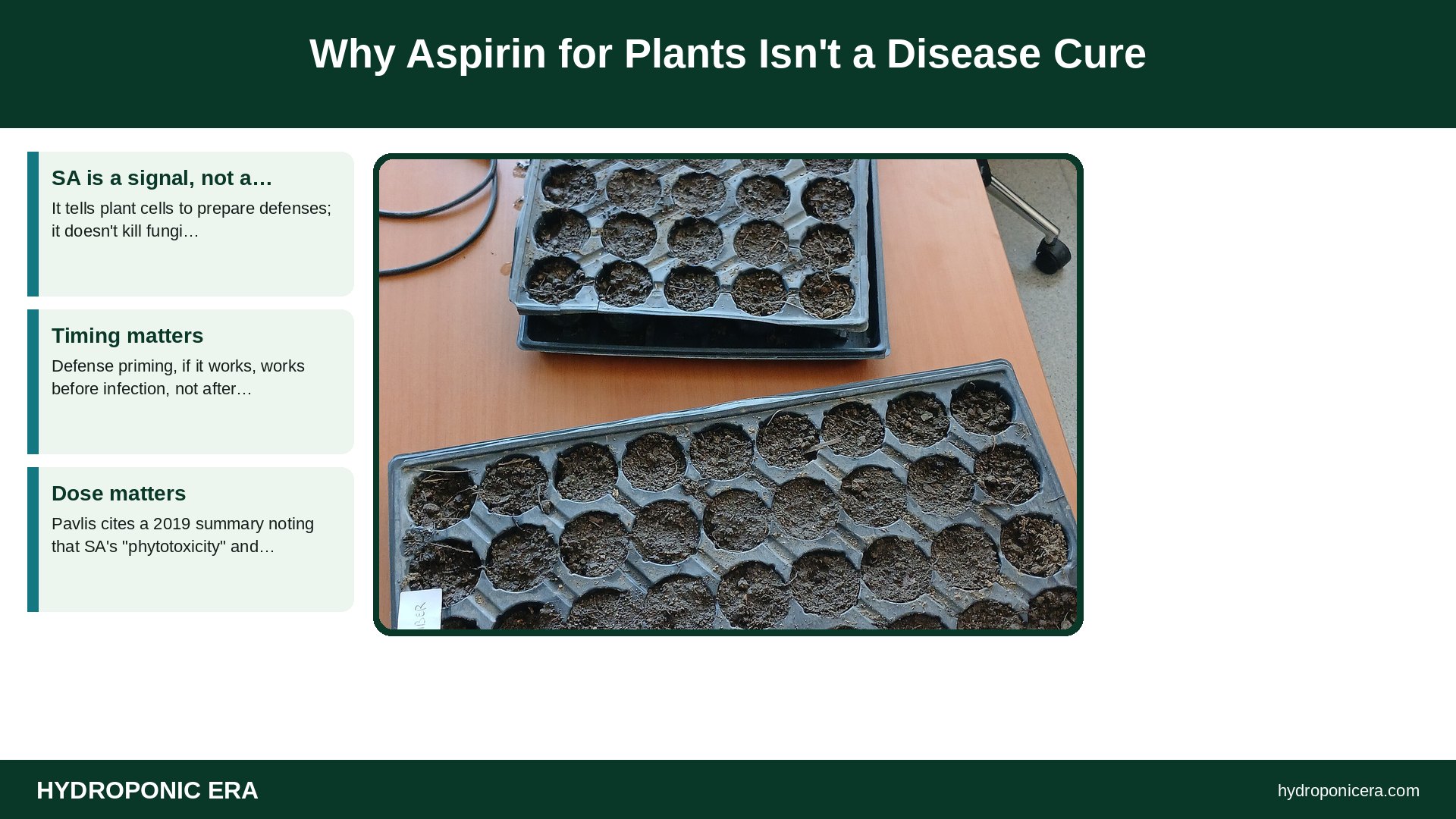
- SA is a signal, not a pesticide. It tells plant cells to prepare defenses; it doesn’t kill fungi, bacteria or viruses.
- Timing matters. Defense priming, if it works, works before infection, not after symptoms appear.
- Dose matters. Pavlis cites a 2019 summary noting that SA’s “phytotoxicity” and rapid breakdown in plants limit its use as a plant protection chemical.
- Real diseases need real fixes. Blights, mildews and root rots need resistant varieties, sanitation, airflow and, when appropriate, labeled products.
Aspirin for Plants in Hydroponics
We don’t recommend adding aspirin to a hydroponic reservoir. Any compound in a recirculating system reaches every root continuously, so a mistake affects the whole crop. Acids also shift pH, which you’d then need to correct. If you’re fighting disease in a system, focus on the basics:
- Root problems: cool, oxygenated water and clean equipment. See our Pythium root rot guide.
- Leaf molds: humidity and airflow. See our Botrytis guide and humidity and VPD guide.
- Viruses: remove infected plants and sanitize. See our ToBRFV guide.
If You Still Want to Test Aspirin for Plants: 6 Steps

This isn’t a recommendation, but if you’re curious, test it fairly in soil or containers, not in a shared reservoir.
- Choose matching plants of one variety, same age and size.
- Split them into treated and untreated groups, with several plants in each.
- Keep light, water, feeding and spacing identical.
- For reference only, the URI trial used 250 mg per gallon. Higher rates raise the risk of leaf damage.
- Spray a single leaf first and wait a few days to check for spotting or burn.
- Record fruit counts, plant health and any disease, and compare.
Keep aspirin tablets and mixed spray away from children and pets, and label the bottle clearly.
Aspirin for Plants vs Proven Disease Prevention
Compared with established methods, aspirin for plants sits at the bottom of the evidence ladder.
| Approach | Evidence | Notes |
|---|---|---|
| Aspirin spray | Thin; no proven disease control | Possible leaf damage at high rates |
| Resistant varieties | Strong | Check seed catalog disease codes |
| Sanitation and spacing | Strong | Reduces spread |
| Humidity and airflow control | Strong indoors | Key for molds and mildews |
| Labeled fungicides | Proven for listed diseases | The label is the law; follow it exactly |
The Bottom Line on Aspirin for Plants
Aspirin for plants is a fascinating idea with a real science connection, but home-garden proof is missing. Salicylic acid signaling is real; a dependable aspirin spray program isn’t. Use it as a curiosity experiment if you like, never as a substitute for disease management.
FAQs: Aspirin for Plants
Does aspirin for plants prevent tomato blight?
There’s no controlled evidence that it does. UMN Extension volunteers call the evidence “very thin.”
Can aspirin cure a sick plant?
No. Salicylic acid primes defenses; it doesn’t kill pathogens.
Can I put aspirin in my hydroponic reservoir?
We don’t recommend it. It exposes every root continuously and can shift pH.
What rate of aspirin for plants did the URI trial use?
The 2005 URI tomato trial reported results at 250 mg per gallon of water. That’s a study rate, not a proven treatment.
Related HydroponicEra Guides
- Banana peel water for plants: myth check
- Superthrive hydroponics: does it work?
- Hydrogen peroxide in hydroponics
- How to grow tomatoes hydroponically
Sources
- University of Minnesota Extension Master Gardeners via Ask Extension — Aspirin to prevent tomato blight? (#743779)
- Gao, Zhu, Kachroo & Kachroo (2015), Frontiers in Plant Science — Signal regulators of systemic acquired resistance
- Robert Pavlis, Garden Myths — Aspirin Spray for Tomatoes and the Vegetable Garden (quotes the URI 2005 trial)
- Photo credits (Wikimedia Commons, edited with titles): Regular strength enteric coated aspirin tablets by Ragesoss (CC BY-SA 4.0); Greenhouse filled with tomato plants and a bucket on the path by Shixart1985 (CC BY 2.0); Pepper and tomato seedling trays at Boğaziçi University 2026 by Furkan Akkurt (CC BY-SA 4.0); PepperFlower4K by Bst9jkj (CC0)