
Is pyrethrin safe for plants and people? Pyrethrin is a plant-derived insecticide from chrysanthemum flowers that kills insects on contact and breaks down fast. It has low toxicity to mammals but can irritate skin and eyes, and it is highly toxic to bees and fish. Use it only on listed plants, and follow the label.
Key takeaway: Pyrethrin is a fast-acting contact insecticide, not a long-lasting protectant. It only kills pests it touches, so timing and coverage decide results. Spray in the evening, keep it away from pollinators and fish tanks, and avoid mixing it with other products unless the label allows it.
| Question | Short answer | Source note |
|---|---|---|
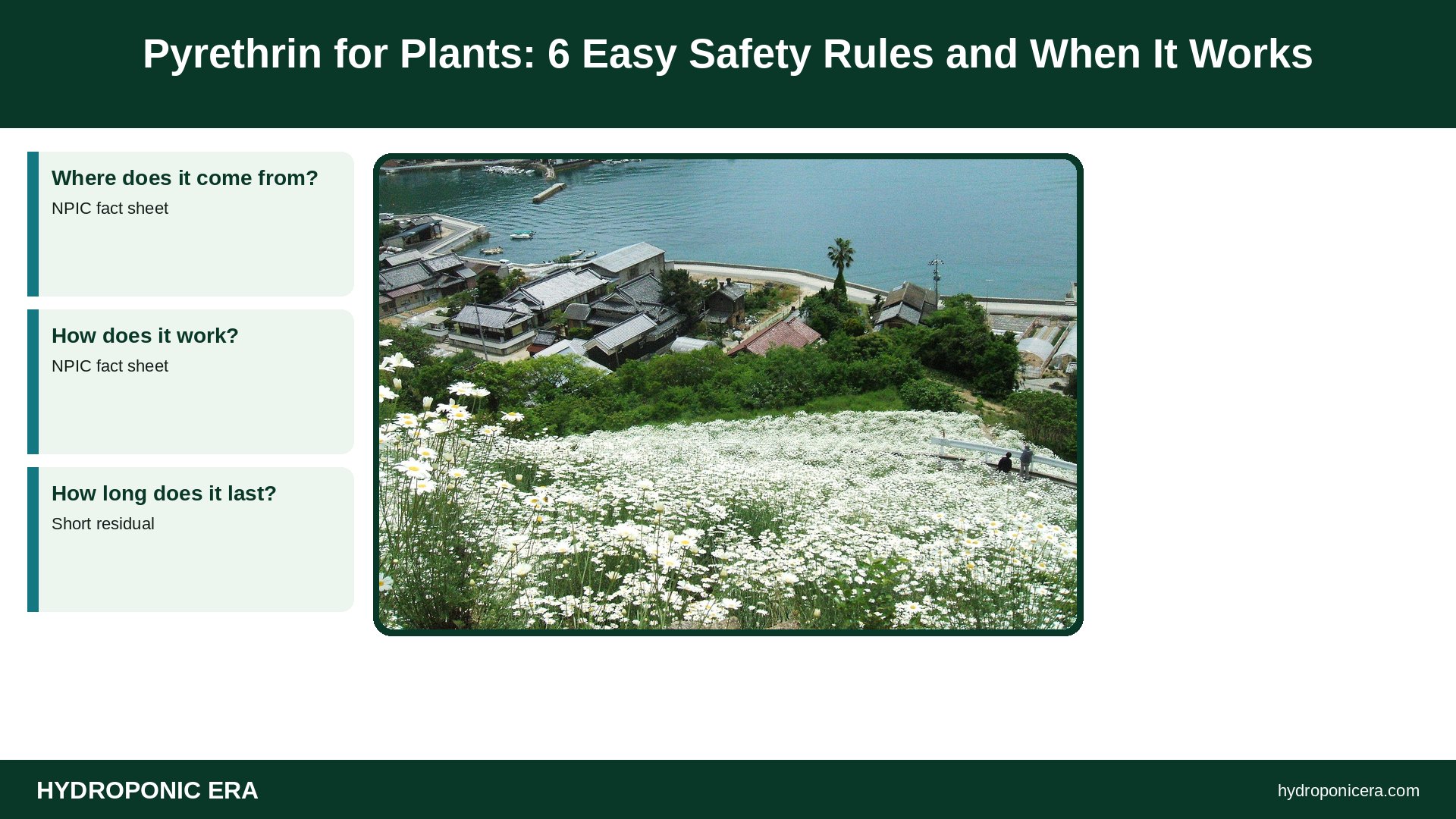
| Where does it come from? | Chrysanthemum flowers | NPIC fact sheet |
| How does it work? | Over-excites the insect nervous system on contact | NPIC fact sheet |
| How long does it last? | Breaks down quickly in sunlight | Short residual |
| Is it the same as pyrethroids? | No, pyrethroids are synthetic and longer lasting | NPIC |
What Is Pyrethrin?
Pyrethrin is a mix of six related compounds extracted from the flowers of certain chrysanthemums, and it is one of the oldest botanical insecticides. The National Pesticide Information Center explains that pyrethrin excites the nervous system of insects, causing paralysis and death. Many products add piperonyl butoxide to boost the effect.
Do not confuse pyrethrin with pyrethroids such as permethrin or bifenthrin. Those are synthetic copies built to last longer, and they behave differently in the garden. For a plant-based oil alternative, see neem oil for plants.
How Does Pyrethrin Kill Pests?
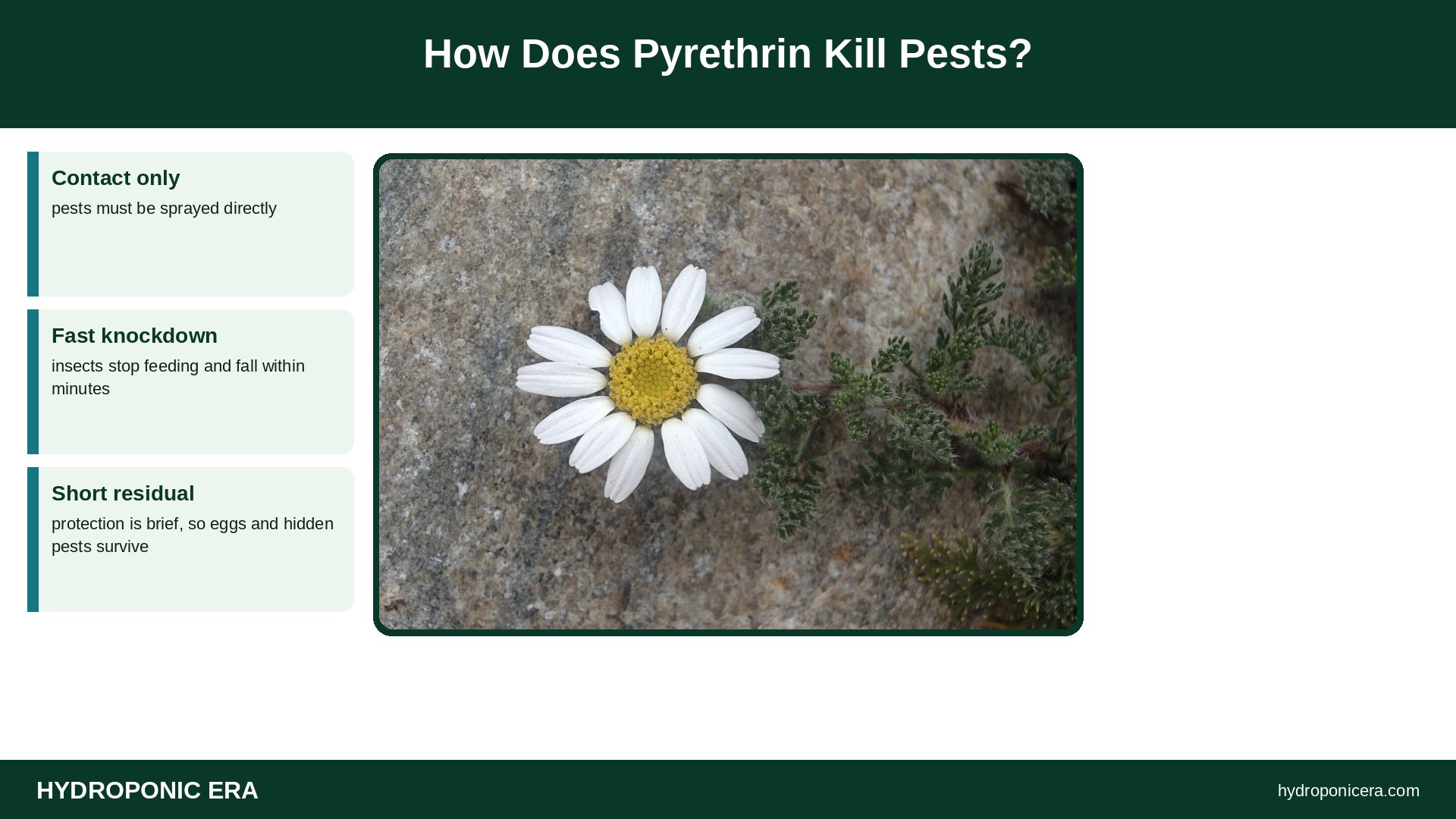
This botanical kills insects on contact by overstimulating their nervous system, which causes rapid knockdown. It has little or no residual action, because sunlight and air break it down within a day or so. That is why it must hit the pest directly and is often reapplied a few days later.
- Contact only: pests must be sprayed directly.
- Fast knockdown: insects stop feeding and fall within minutes.
- Short residual: protection is brief, so eggs and hidden pests survive.
- Broad spectrum: it also harms beneficial insects.
Because it also kills beneficials, avoid pairing it with predators for pests such as aphids and mites or lacewings in the same crop. Pyrethrin works best as a spot rescue, not routine spraying.
Which Pests Does Pyrethrin Control?
Labels cover many soft-bodied pests, including aphids, whiteflies, thrips and some caterpillars. Spider mites and pests that hide in the medium are harder to control, since pyrethrin only works on contact. Always read the label of your exact product, because the pests and plants allowed differ.
| Pest | Works? | Tip |
|---|---|---|
| Aphids | Yes, on contact | Spray under leaves, repeat after a few days |
| Whiteflies | Often, on contact | Target adults, repeat as the label allows |
| Thrips | Partly | Hidden in buds, so coverage matters |
| Spider mites | Limited | Use miticides or oil, see spider mites in hydroponics |
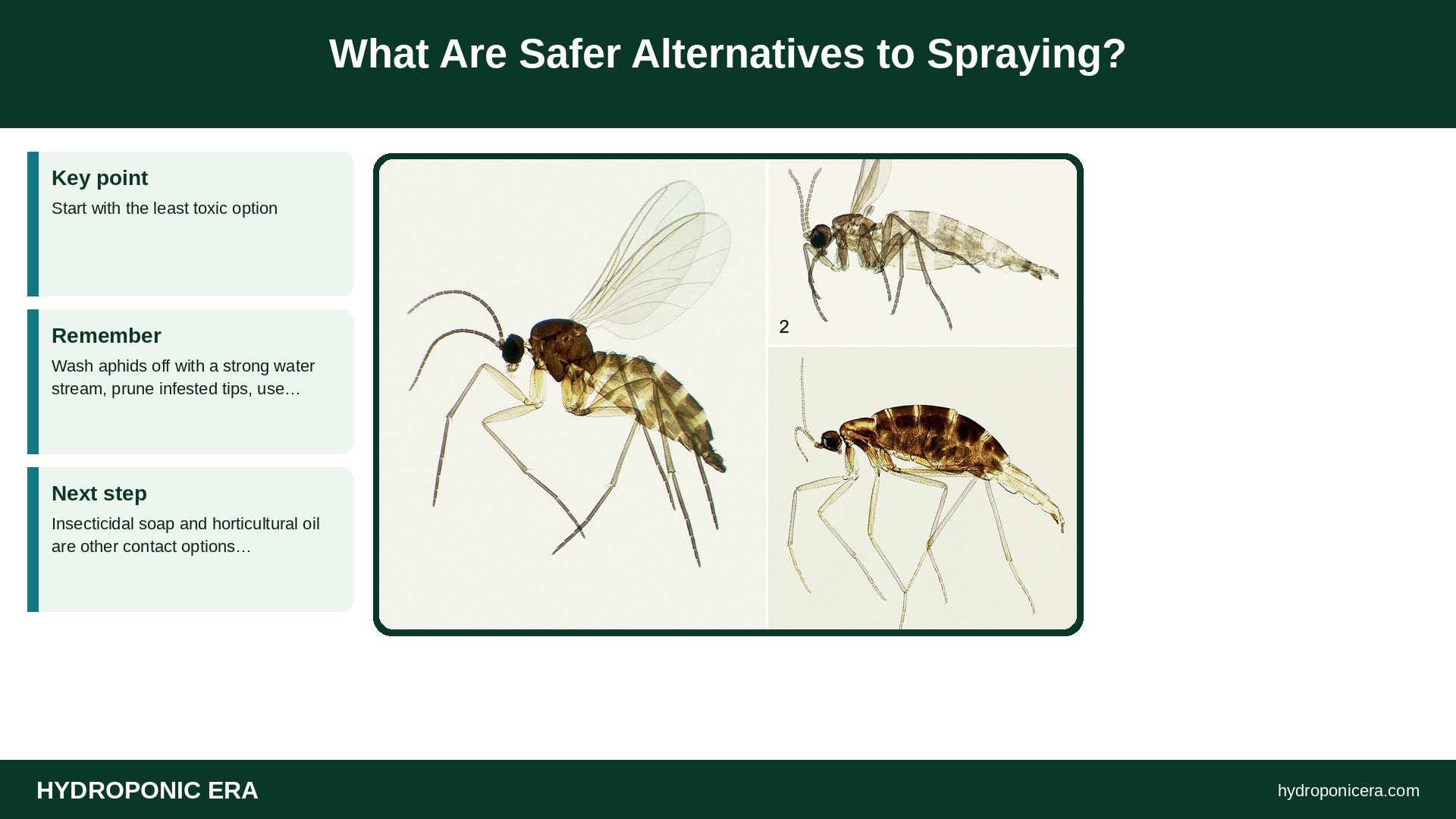
| Fungus gnat larvae | No | Larvae live in the medium |
How Do You Use Pyrethrin Safely?
Use the product exactly as the label says, wear gloves and eye protection, and spray late in the evening when bees are inactive. Do not spray open blooms, and never let drift reach a pond or aquarium. The National Pesticide Information Center lists skin tingling and irritation as common effects of overexposure.
- Read the label and confirm your plant and pest are listed.
- Wear gloves and eye protection, and avoid breathing mist.
- Spray in the evening, covering leaf undersides.
- Keep pets and children away until the spray dries.
- Store the product out of reach, and dispose of leftovers as the label states.
If someone is exposed and unwell, call Poison Control at 1-800-222-1222. Keep the label in hand when you call.
Is Pyrethrin Safe for Bees, Fish and Hydroponic Systems?
This insecticide is highly toxic to bees and to fish and other aquatic life, even though it has low toxicity to mammals. Keep it away from open reservoirs, aquaponic systems and fish tanks, and do not spray plants in flower. Aquaponic growers should read the guide to aquaponics pest control.
In a closed hydroponic room, cover reservoirs before spraying, and ventilate afterward. Rinse harvested edibles as the label requires and observe the waiting period before harvest. Some products are labeled only for ornamentals, so check that the plant is allowed.
Is Pyrethrin Organic?
It is a natural botanical insecticide, and some products carry an organic certification, but natural does not mean harmless. A product containing piperonyl butoxide or other synthetic additives may not qualify. Look for the OMRI or similar label if you grow organically, and read the full ingredient list.
The same caution applies to homemade chrysanthemum sprays, whose strength is unpredictable. Commercial products are tested, labeled and standardized, which makes dosing and safety far easier.
How Should You Apply the Spray for Best Results?
Coverage is everything with a contact insecticide. Mix only what you need, shake the sprayer, and wet both sides of the leaves, stems and the crevices where pests hide. Pests that stay hidden will survive, so a second application a few days later is often needed. Follow the label for the interval and the maximum number of sprays.
- Test on one or two leaves and wait a day to check for burn.
- Avoid spraying in hot sun, which can damage foliage and speeds breakdown.
- Spray in the evening, after pollinators have gone.
- Rotate with other approaches so pests do not adapt.
Rotation matters because repeated use of one mode of action can select for resistant populations. Combine spraying with sticky traps, cleaning, and, where the label permits, biological controls introduced after the spray has dried.
What Are Safer Alternatives to Spraying?
Start with the least toxic option. Wash aphids off with a strong water stream, prune infested tips, use yellow sticky traps for adult flying pests, and keep new plants quarantined for two weeks. Insecticidal soap and horticultural oil are other contact options that suit many indoor crops, and release of natural enemies can work for ongoing infestations.
When a heavy outbreak forces you to spray, pick the product that matches the pest and the crop, and do not stack several products at once. Mixing can burn leaves and raise the risk to you.
FAQ About Pyrethrin
Is it the same as permethrin?
No. Pyrethrin is natural, while permethrin is a synthetic pyrethroid that lasts longer.
How long does it last?
Not long. It breaks down quickly in sunlight, so repeat treatments may be needed.
Does it kill beneficial insects?
Yes. It is broad spectrum, so avoid using it on crops where you release predators.
Can I use pyrethrin on vegetables?
Only if the label allows it, and observe the pre-harvest interval.
Is it toxic to dogs and cats?
It has low toxicity to mammals, but pets can react to sprays, and some formulations carry cat warnings. Keep pets away until dry, and read the label.
Sources
- National Pesticide Information Center — Pyrethrins and pyrethroids fact sheet
- National Pesticide Information Center — Pyrethrins general fact sheet
- ATSDR — ToxFAQs for pyrethrins and pyrethroids
- Photo credits (Wikimedia Commons, edited with titles): Tanacetum cinerariifolium in Shigei by Carpkazu (CC BY-SA 3.0); Anacyclus pyrethrum depressus open by JerryFriedman (CC BY-SA 3.0); Neem oil plant by Ayyuha Sideeq (CC0); Sciaridae (10.3897-zookeys.957.46528) Figures 1–3 by Menzel F, Gammelmo Ø, Olsen KM, Köhler A (2020) The Black Fungus Gnats (Diptera, (CC BY 4.0)