
Are coffee grounds for plants a good idea? Coffee grounds for plants are useful mainly as a compost ingredient or a thin mulch, not a fertilizer. Washington State University says fresh grounds can be toxic to seedlings, and Oregon State notes grounds hold only 1–2% nitrogen. Compost them, or apply a thin layer under coarse mulch.
Key takeaway: Coffee grounds for plants help soil structure but do not feed plants much. Compost them (up to 20% by volume), keep layers thin, avoid using fresh grounds around seeds, and test soil first if you grow acid-loving plants.
| Use | Guideline | Source |
|---|---|---|
| Compost pile | Up to 20% by volume | WSU Extension |
| Direct mulch | Thin, up to 1/2 in (1.3 cm), composted grounds, under 4 in (10 cm) coarse mulch | WSU Extension |
| Seeds and seedlings | Avoid fresh grounds | WSU Extension |
| Nitrogen content | About 1–2% | Oregon State Extension |
What Do Coffee Grounds for Plants Actually Do?
Coffee grounds for plants improve soil structure and feed soil life as they break down. They are not a quick nitrogen fix. Oregon State Extension reports they contain about 1–2% nitrogen, and the nitrogen is tied up while microbes decompose them. Their main benefit is organic matter, not fertilizer.
Used well, coffee grounds for plants work like any other compost ingredient. Used badly, in thick layers on fresh soil, they can form a crust that sheds water and can slow growth.
Are Fresh Coffee Grounds Bad for Plants?
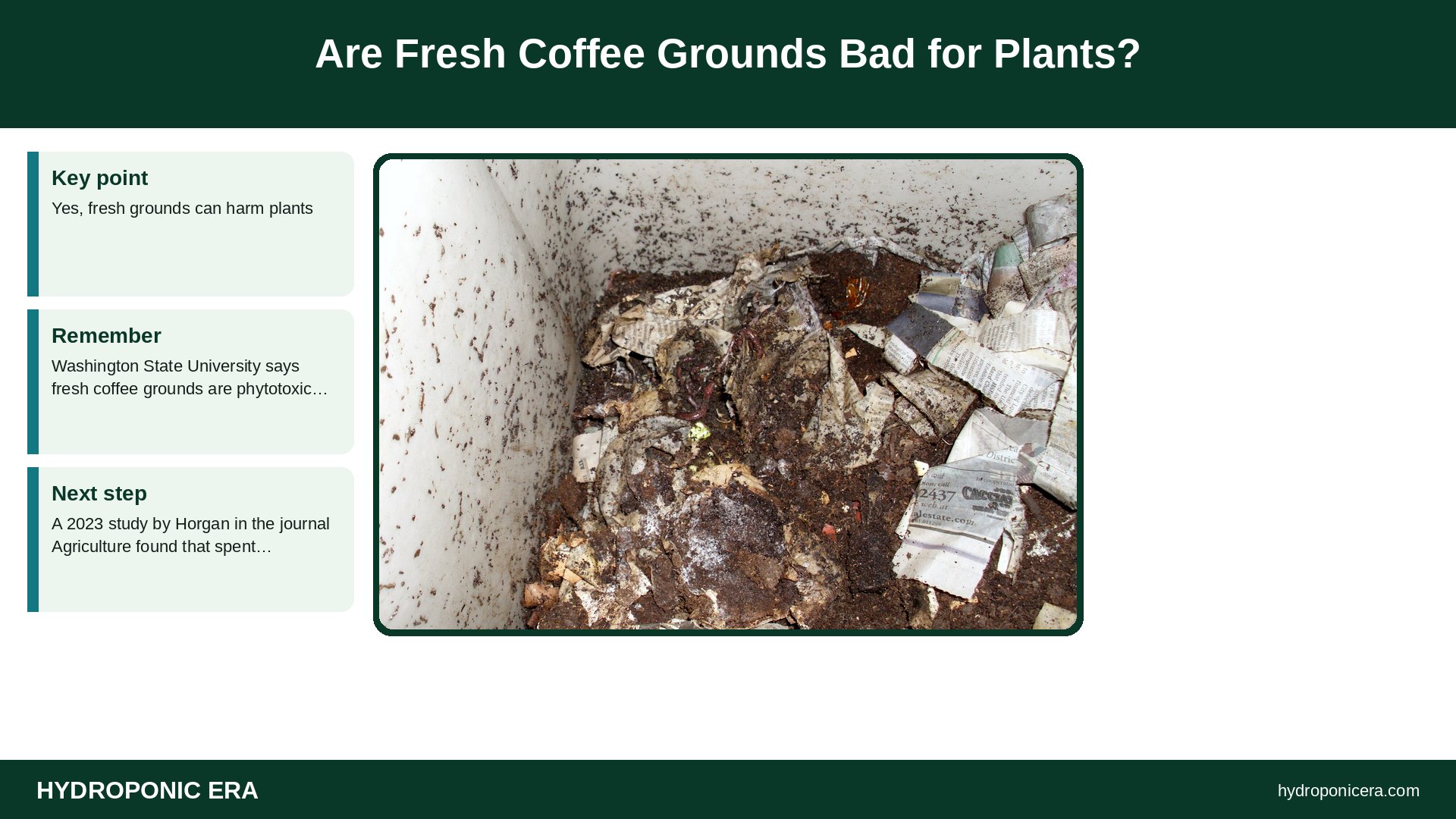
Yes, fresh grounds can harm plants. Washington State University says fresh coffee grounds are phytotoxic and should not be used where you are sowing seeds. A 2023 study by Horgan in the journal Agriculture found that spent grounds up to 7 months old inhibited radish and tomato growth when mixed into soil, while 14-month-old grounds promoted growth.
Age matters, because compounds that stunt growth break down over time. If you want to use them, compost them first.
How Do You Compost Coffee Grounds for Plants?
Mix coffee grounds into a compost pile at no more than 20% by volume, with plenty of brown material such as dry leaves, and turn the pile. WSU Extension gives this limit. Grounds count as a green, nitrogen-rich ingredient even though they look brown. A balanced pile finishes into dark, crumbly compost you can use anywhere.
- Collect grounds in a bucket, and add filters, which also compost.
- Layer them with dry leaves, straw or shredded paper.
- Keep the grounds at 20% of the pile or less.
- Keep the pile damp like a wrung-out sponge, and turn it.
- Use the finished compost as you would any compost.
For more on compost-based feeding, see our guide to compost tea in hydroponics.
Can You Use Coffee Grounds for Plants as Mulch?
You can, but keep it thin. WSU says to apply composted grounds in a layer no thicker than 1/2 inch (1.3 cm) and cover with about 4 inches (10 cm) of coarse mulch. Horgan’s 2023 study also found a thin top-dress of about 1 cm was acceptable. Thick layers of fresh grounds can mat and repel water.
- Keep the layer thin and mix with other mulch.
- Do not pile grounds against stems.
- Avoid fresh grounds around seedlings.
- Water well and watch for mold.
Do Coffee Grounds for Plants Change Soil pH?
Used coffee grounds are only slightly acidic, and Missouri Extension notes they can actually raise pH when added to soil. They are not a reliable way to acidify soil for blueberries or azaleas. Test your soil before changing it, and use a labeled acidifier such as sulfur if a soil test says you need it.
In water-based systems, avoid adding grounds directly. Organic debris breeds algae, bacteria and fungus gnats. See fungus gnats in hydroponics and Pythium root rot for what happens when organic matter rots in a reservoir.
Do Coffee Grounds for Plants Repel Slugs or Pests?
Oregon State Extension covers grounds and slugs in its article, but treat grounds as a minor extra rather than a main control. Results vary by garden. Use proven methods such as hand-picking, traps and dry soil surfaces, and treat grounds as a minor extra at best.
What Are Better Ways to Use Coffee Grounds for Plants?
Better uses are composting, vermicomposting in small amounts and adding thin layers to well-aged compost. Avoid heavy use around seedlings and in containers, since poor drainage worsens problems. If you want a nitrogen source, a balanced fertilizer is far more reliable, and our guide to growing media shows how mixes work.
How Can You Tell if Coffee Grounds Are Hurting Your Plants?
Warning signs include stunted seedlings, yellowing leaves, a hard crust on the soil and white or green mold. If you see these, scrape off the grounds, loosen the surface and let the soil dry between waterings. Move seedlings into fresh mix if they are failing. Coffee grounds for plants should never be a reason to skip a soil test or a proper fertilizer.
Some of the damage is simple physics. Fine grounds pack tightly, hold water and block air, so roots suffocate. Mixing them with coarse material and keeping layers thin avoids this. Grounds that have been composted for months behave very differently from fresh ones, which is why age is so important in research.
Can You Use Coffee Grounds for Plants in Containers and Houseplants?
In pots, coffee grounds for plants are riskier than outdoors, because containers drain less and show problems sooner. Skip fresh grounds on houseplants. If you want to use them, mix a small amount of composted grounds into fresh potting mix instead of top-dressing. Choose a light, well-draining mix from our growing media guide.
Keep a record of what you add and when. If plants decline within a few weeks, stop and flush the pot with plain water. A simple notebook makes it easy to see what helped and what hurt over a season.
FAQ About Coffee Grounds for Plants
Can I put coffee grounds directly on houseplants?
Not recommended. Fresh grounds can mold and harm roots. Compost them first.
Are coffee grounds a good fertilizer?
Not really. They hold about 1–2% nitrogen that is slow to become available.
Do coffee grounds make soil acidic?
Used grounds are only slightly acidic and may raise pH, so test your soil.
How much coffee grounds can go in compost?
WSU Extension suggests up to 20% by volume.
Are coffee grounds safe for seedlings?
No. Avoid fresh grounds where seeds are sown.
Sources
- Washington State University Extension — Using coffee grounds in gardens and landscapes
- Oregon State University Extension — Coffee grounds boost soil health, help control slugs
- University of Missouri Extension — Is trouble brewing in your garden?
- Horgan et al. (2023), Agriculture 13(2), 257 — Spent coffee grounds and plant growth study
- Photo credits (Wikimedia Commons, edited with titles): Palestinian women grinding coffee beans by Keystone View Company (Public domain); Worm composting 2 by Quadell (CC BY 3.0); Compost pile by Ksd5 (CC0); 5670Farm Ready Seedling Facility East West Seed Philippines 20 by Judgefloro (CC0)