
Does milk for plants really work? Milk for plants has real but limited evidence: studies show diluted milk sprays can reduce powdery mildew on cucurbits like zucchini and cucumber. It is not a proven cure for every disease or plant. WSU found no evidence it helps roses or ornamentals, and it can smell and encourage rot.
Key takeaway: Milk for plants is a mild, preventive spray that worked against powdery mildew in cucurbit studies, not a fertilizer and not a cure-all. Use diluted milk on squash, cucumber and similar crops, spray early and test on a few leaves first.
| Question | What research says | Takeaway |
|---|---|---|
| Powdery mildew on zucchini | Milk at 5–50% reduced severity (Bettiol, 1999) | Works as a preventive spray |
| Powdery mildew on tomato | 50% whole milk gave 0.2 vs 3.0 severity (CT Ag Station) | Best results with whole milk |
| Roses and ornamentals | No evidence found (WSU) | Do not rely on it |
| Fertilizer value | Not a nutrient source | Use real fertilizer |
What Is Milk for Plants Used For?
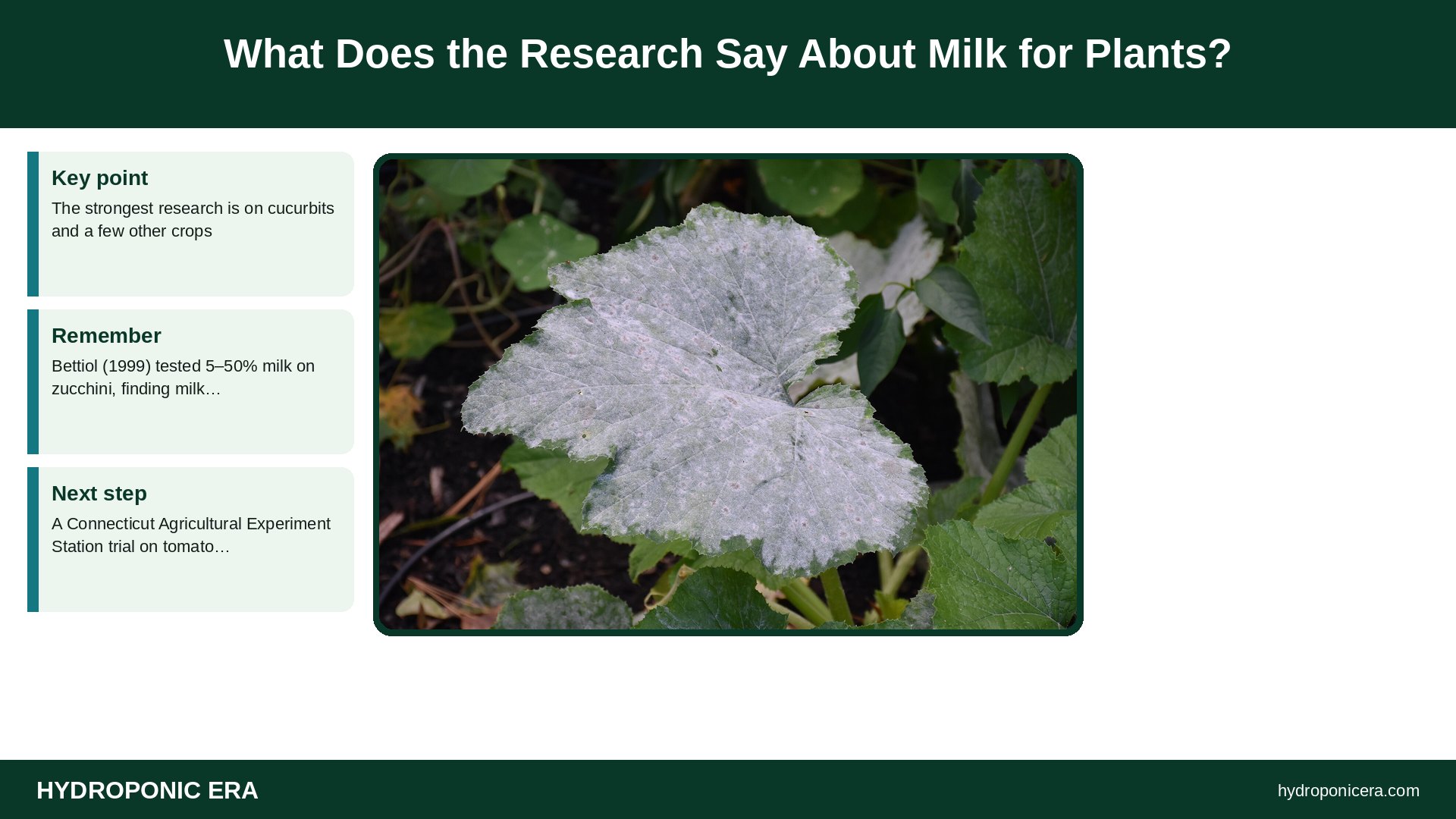
Milk for plants is sprayed diluted on leaves to fight powdery mildew, a white, dusty fungus that coats leaves. The idea comes from studies on cucurbit crops such as zucchini and cucumber. It is used as a preventive or early treatment, not as a fertilizer, and it works best when sprayed before disease takes hold.
Treat milk for plants as a low-cost experiment, not a guaranteed fix. If powdery mildew is severe, combine good airflow and sanitation with a labeled fungicide. See our guide to humidity and VPD for how moisture affects fungal problems.
What Does the Research Say About Milk for Plants?
The strongest research is on cucurbits and a few other crops. Bettiol (1999) tested 5–50% milk on zucchini, finding milk concentration negatively correlated with mildew. A Connecticut Agricultural Experiment Station trial on tomato reported a 50% whole milk spray gave severity of 0.2 versus 3.0 on unsprayed plants, and whole milk beat skim.
Washington State University reviewed the evidence in a Bugs, Bulbs and Blooms bulletin, noting greenhouse studies on cucurbits are positive but there is no evidence for roses or ornamentals. Ask Extension also notes that there is no solid scientific evidence that milk works as a general fungicide.
How Do You Make a Milk Spray for Plants?
Most studies used milk diluted with water in ratios from about 1 part milk to 9 parts water up to 1 to 1, though results varied by crop and disease. Start at the lower end. A mild starting point within the range tested is 1 part milk to 9 parts water, which is about 1 cup milk per 9 cups water (240 mL per 2.1 L).
- Choose whole milk for the best results seen in the tomato trial, or follow your recipe.
- Dilute it with clean water in a spray bottle, and shake gently.
- Test on a few leaves, and wait 2 to 3 days to check for damage.
- Spray the tops and undersides of leaves in the morning, when they can dry.
- Repeat every 7 to 10 days if it helps, and stop if you see rot or odor.
The concentrations are starting points from research and gardener reports, not a label rate. Use a fresh batch each time, since milk spoils quickly.
What Are the Risks of Using Milk for Plants?
Milk for plants can leave sticky residue, smell as it spoils and encourage other fungi or insects. WSU noted that dried skim milk caused rot on some crucifers. Too strong a mix can scorch leaves, and in a warm, humid grow room the sugars and fats can feed other microbes. Always test small, and rinse leaves if you see problems.
- Odor: milk fat can smell as it breaks down.
- Residue: a film may build up on leaves.
- Rot risk: reported on some crops with dried milk.
- No nutrient value: it will not fix a deficiency.
Which Plants Respond to Milk for Plants?
Zucchini, squash, cucumber and melons have the best evidence. Tomatoes showed good results in one trial. Do not expect it to help roses or heavily infected plants. Check leaves often, and remove badly infected leaves in a sealed bag to reduce spores.
What Are Better Alternatives to Milk for Plants With Powdery Mildew?
Better first steps are good airflow, spacing, resistant varieties and removing infected leaves. Labeled products such as neem oil, potassium bicarbonate and sulfur are also used, depending on the crop. Read each label and follow the rules for edible plants. Our guides on neem oil and hydroponic airflow and fans help.
For gray mold problems, see botrytis in hydroponics. Milk is a low-risk experiment at best, so do not wait on it when disease is spreading.
How Does Milk for Plants Compare With Garden Fungicides?
Research shows milk for plants can reduce mildew, but it is a mild, preventive tool. Commercial fungicides have tested rates, labels and safety instructions, while milk sprays rely on small trials and home experience. In a Connecticut tomato trial, whole milk gave a large reduction in severity, but trials differ in weather, variety and disease pressure.
Use milk for plants where you want a low-cost, low-toxicity option on edible cucurbits, and scout weekly. If mildew spreads, switch to a labeled product. Always follow label directions, harvest waiting periods and local rules for food crops.
How Should You Apply Milk for Plants Safely?
Spray in the morning so leaves dry before night, and avoid hot midday sun, which can scorch wet leaves. Cover both sides of the leaves, because powdery mildew grows on the undersides too. Start spraying before symptoms appear, since milk is a protectant that works best before the fungus is established.
Keep sprayers clean. Rinse the bottle with warm water after each use, because leftover milk sours and clogs nozzles. Store nothing mixed, and do not spray plants you plan to harvest within a day without washing the produce. Keep records of dates and dilutions so you can compare results over a season.
FAQ About Milk for Plants
Can I use milk as plant fertilizer?
No. Milk is not a reliable nutrient source, and it can spoil and smell.
Does skim or whole milk work better for plants?
One Connecticut trial found whole milk beat skim, but results vary.
How often can I spray milk on plants?
Studies used repeated sprays, often weekly. Start small and stop if leaves are damaged.
Does milk cure powdery mildew?
It can reduce it on some crops, but it is not a guaranteed cure.
Is milk spray safe for edible plants?
It is food, but wash produce before eating and avoid heavy residue.
Sources
- Washington State University — Milk and roses (Bugs, Bulbs and Blooms #65)
- Bettiol W. (1999) — Effectiveness of cow’s milk against zucchini squash powdery mildew
- Ask Extension — Does milk work as a fungicide?
- Photo credits (Wikimedia Commons, edited with titles): 2025.04.10 Milk Glass Sugar Bowl and Antique Glass Creamer by Illarion Kalashnikov (CC BY-SA 4.0); Powdery mildew 9 by Dmitry Brant (CC BY-SA 4.0); Neem oil plant by Ayyuha Sideeq (CC0); 5670Farm Ready Seedling Facility East West Seed Philippines 20 by Judgefloro (CC0)