
What is the best pond liner? The best pond liner for most backyard ponds is 45-mil EPDM rubber, which is flexible, fish-safe and typically lasts 20 years or more. PVC is cheaper but usually lasts only 5–10 years and stiffens in the cold. Size the liner as pond length plus twice the depth plus 2 feet.
Key takeaway: A pond liner decision comes down to material, thickness and size. Choose 45-mil EPDM for permanent ponds, use PVC mainly for small or temporary ones, protect the liner with geotextile underlayment and size it with length + (2 x depth) + 2 ft.
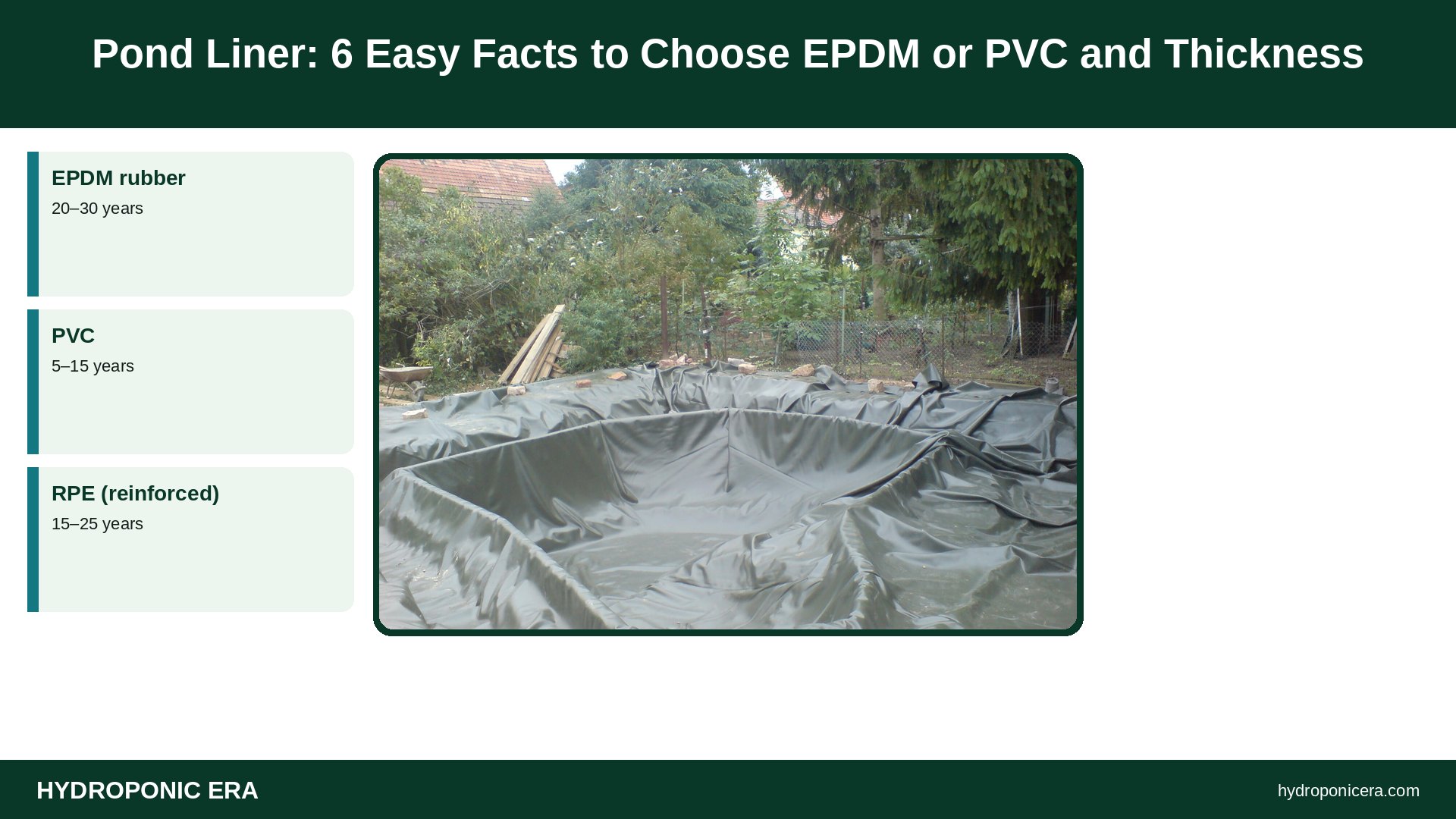
| Material | Typical thickness | Typical lifespan (vendor guides) |
|---|---|---|
| EPDM rubber | 45 mil (1.14 mm) | 20–30 years |
| PVC | 20–30 mil (0.5–0.76 mm) | 5–15 years |
| RPE (reinforced) | 20–30 mil | 15–25 years |
| HDPE | Varies | 15–20 years, rigid |
What Is a Pond Liner and Why Does It Matter?
A pond liner is a waterproof sheet that holds water in a pond, so the material and installation determine leaks and lifespan. Flexible liners such as EPDM and PVC follow the shape of the excavation, while rigid preformed shells have fixed shapes. A good liner is fish-safe, resists UV light and survives freezing.
NRCS conservation standards for lining ponds with geomembranes list 45-mil thickness as commonly specified for flexible membranes, and recommend a minimum of 30 mil for PVC in clear-water uses. Backyard ponds follow the same logic at smaller scale.
Which Is Better: EPDM or PVC Pond Liner?
EPDM is better for most permanent ponds. It is a flexible synthetic rubber that stretches around curves, resists UV and freezing and typically lasts 20 years or more. PVC is cheaper and thinner but stiffens in cold weather and usually needs replacement in 5–10 years, so it suits small or temporary ponds.
- EPDM: flexible, long life, higher cost, heavier.
- PVC: lower cost, easier to handle when warm, shorter life.
- RPE: reinforced polyethylene, light and puncture-resistant.
- HDPE: rigid and mostly used in large or commercial ponds.
Lifespan figures here come from pond-supply guides, so treat them as typical, not guaranteed.
How Thick Should a Pond Liner Be?
Forty-five mil (about 1.14 mm) is the common thickness for EPDM backyard pond liners. PVC liners are commonly 20–30 mil. Thicker liners resist punctures better but cost more and weigh more. NRCS lining standards likewise call out 45-mil as a commonly specified thickness and a 30-mil minimum for PVC in clear-water uses.
For very large ponds or sites with heavy rock work, some suppliers offer 60-mil EPDM. For most backyard water gardens, 45 mil is enough when paired with good underlayment.
How Do You Calculate Pond Liner Size?
Use pond length plus two times the maximum depth plus 2 feet for the liner length, and the same formula with width. The doubled depth covers both sides, and the extra 2 feet gives about 1 foot of overlap on each side. Always round up to the next available liner size, since too small a liner cannot be fixed.
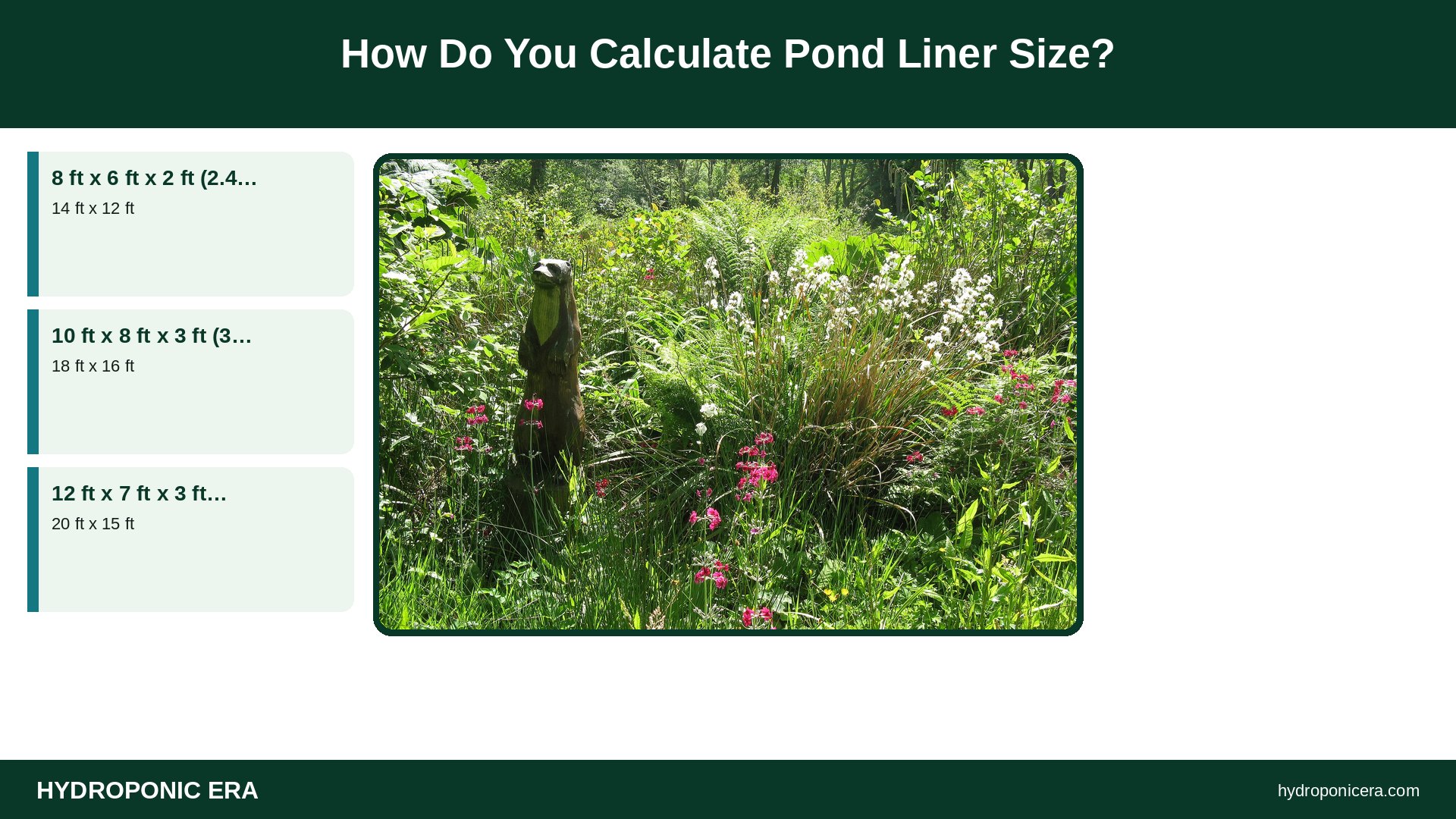
| Pond size (L x W x depth) | Liner formula | Liner needed |
|---|---|---|
| 8 ft x 6 ft x 2 ft (2.4 x 1.8 x 0.6 m) | (8+4+2) x (6+4+2) | 14 ft x 12 ft |
| 10 ft x 8 ft x 3 ft (3 x 2.4 x 0.9 m) | (10+6+2) x (8+6+2) | 18 ft x 16 ft |
| 12 ft x 7 ft x 3 ft (3.7 x 2.1 x 0.9 m) | (12+6+2) x (7+6+2) | 20 ft x 15 ft |
Measure the longest length, widest width and deepest point, even for irregular ponds, then apply the formula.
What Goes Under a Pond Liner?
Place geotextile underlayment or about 6 inches (15 cm) of sand under the liner to protect it from rocks and roots. NRCS and suppliers advise removing sharp stones and roots from the excavation. Underlayment extends liner life and is cheap compared with the cost of a leak, so do not skip it.
- Dig the pond to shape, with a level rim.
- Remove roots, rocks and sharp objects.
- Add sand or geotextile underlayment.
- Lay the liner on a warm day, since cold liners are stiff.
- Fold, do not cut, and let the weight of water settle the liner.
- Secure edges, and hide them with rocks or plants.
How Do You Install a Pond Liner Without Leaks?
Install on a warm, dry day when the liner is soft. Lay it loosely, with no tight stretch, then fill slowly with water and smooth wrinkles as it fills. Trim the extra only after the pond is full. Keep the edges above the water line and cover exposed liner, since UV light degrades it over time.
Plants can be placed in containers on shelves to protect the liner. See water lily containers and water lettuce. For mosquito control, consider mosquito fish.
How Do You Hide and Protect the Edges?
Edges are where most damage happens, because exposed material bakes in sunlight and can wick water out of the pond. Tuck the edge into a shallow trench, set flat stones on top and let plants soften the line. Keep the rim level so water does not run over it, and make sure soil on the outside never touches the water, since it acts like a wick.
Trim only what you do not need after the water has settled. Leave a margin for movement as the ground shifts and ice forms in winter.
How Do You Repair a Leaking Pond Liner?
First find the leak by watching where the water level stops dropping. Drain below that level, clean and dry the area, and patch with the manufacturer’s repair tape or patch kit. EPDM is generally easy to patch with tape, while PVC may need specific adhesives. If the leak is at the edge, check that the liner is not below the soil line wicking water out.
FAQ About Choosing a Pond Liner
How long does EPDM last?
Pond-supply guides report 20–30 years for EPDM.
Is PVC safe for fish?
Pond-grade PVC is sold as fish-safe, but check the label.
Do I need underlayment?
Yes. Use geotextile or sand to protect the liner.
How do I size it?
Length + 2 x depth + 2 ft, and the same for width.
What thickness is best?
45 mil is the common choice for EPDM backyard ponds.
Sources
- USDA NRCS — Conservation Practice Standard 521: Pond sealing or lining, geomembrane or geosynthetic clay liner
- Webb’s Water Gardens (retailer) — How much pond liner do I need?
- Natural Waterscapes (retailer) — Pond liner selection guide
- Photo credits (Wikimedia Commons, edited with titles): Teichbau2-Teichfolie by A.Fiebig (Public domain); Garden Pond 1 by Gilles San Martin (CC BY-SA 3.0); Pond-edge plants at Achamore Garden – geograph.org.uk – 5446824 by M J Richardson (CC BY-SA 2.0); Daubeny’s water lily at BBG (50824) by Rhododendrites (CC BY-SA 4.0)