
Can you grow cattails in a pond? Cattails grow well in ponds if you contain them. Common cattail (Typha latifolia) is a native emergent plant that tolerates flooding, grows in full sun to part shade and can stand up to about 30 inches (76 cm) of water, per NC State Extension. Plant it in a container, because it spreads aggressively.
Key takeaway: Cattails are tough, native emergent plants that clean water and shelter wildlife, but they spread fast. Grow cattails in a pond in sunken containers, keep water depth within about 30 inches (76 cm), thin them every year and check local rules.
| Factor | Guideline | Source |
|---|---|---|
| Light | Full sun to part shade | NC State Extension |
| Water depth | Up to about 30 in (76 cm) | NC State Extension |
| Spread | Aggressive, contain in pots | NC State, USDA NRCS |
| Nutrient uptake | One wetland study: 17% N, 9% P removed | Water Science and Technology |

What Are Cattails and Why Grow Them?
Cattails are tall, grass-like plants with brown, sausage-shaped seed heads that grow in shallow water and wet soil. Common cattail (Typha latifolia) is a native wetland plant. Gardeners grow them for height, wildlife cover and water filtration, and they suit larger water gardens, bog areas and pond edges.
The tradeoff is vigor. One plant becomes a patch quickly, so plan for containment from the start.
How Do You Grow Cattails in a Pond Without Taking Over?
Grow cattails in a pond in a sunken container, such as a large plastic pot or planting basket, so the roots cannot spread through the whole pond. NC State Extension and USDA NRCS describe cattails as aggressive spreaders. Use a pot with a heavy base, fill it with heavy garden soil and keep it in shallow water.
- Choose a large container, at least 12 inches (30 cm) wide.
- Fill it with heavy garden soil, not a lightweight potting mix.
- Plant the rhizome or small clump, and cover the soil with gravel.
- Set the pot on a shelf so the top of the soil is under a few inches of water.
- Check the pot yearly, and divide or trim roots that escape.
See our guide to water lily containers for similar pot and soil choices.

How Deep Should Water Be for Cattails?
Cattails tolerate flooded roots and can grow in water up to about 30 inches (76 cm), according to NC State Extension. For container plants, a shelf with the soil level 2–6 inches (5–15 cm) under water is typical. Water that is too deep can reduce growth and make the plants lean.
| Position | Water depth over soil | Notes |
|---|---|---|
| Bog edge | Wet soil to 2 in (5 cm) | Easiest, spreads quickly |
| Shelf in pond | 2–6 in (5–15 cm) | Good for pots |
| Deep zone | Up to 30 in (76 cm) | Upper limit |
What Light and Soil Do Cattails Need?
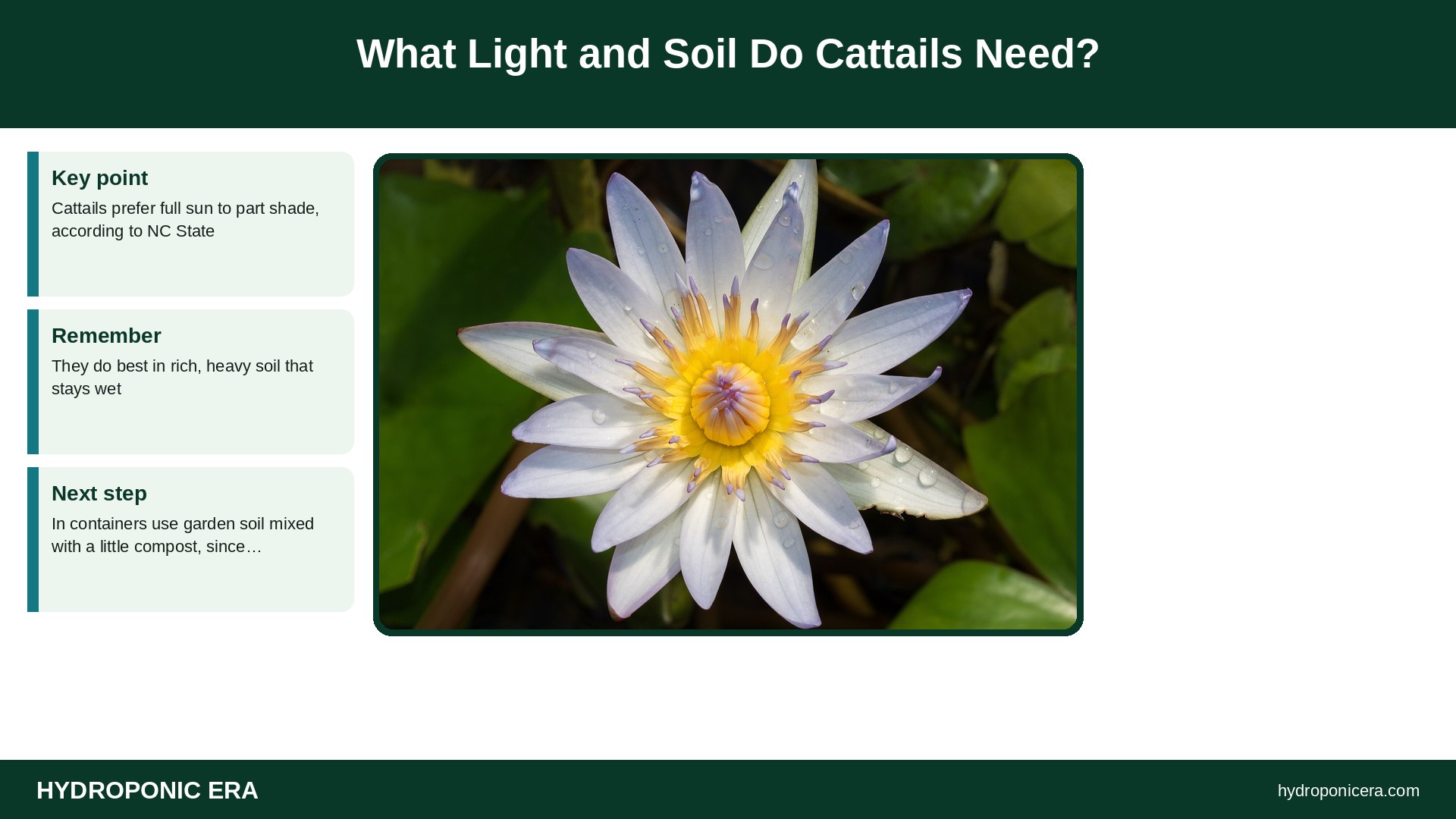
Cattails prefer full sun to part shade, according to NC State. They do best in rich, heavy soil that stays wet. In containers use garden soil mixed with a little compost, since light mixes float. Feed lightly in spring if growth is poor, but avoid heavy fertilizer that feeds algae.
Do Cattails Clean Pond Water?
These plants take up nutrients, but they are not a magic filter. A wetland treatment study reported them removing about 17% of nitrogen and 9% of phosphorus in a subsurface-flow system. Results depend on design, flow and season. Use them as one part of a plan, along with limiting fish waste and runoff.
For algae problems see our azolla guide and water lettuce guide for floating plants that shade water. They can work with emergents like cattails.
How Do You Control Cattails and Stop the Spread?
Cut seed heads before they burst, thin shoots each spring and lift pots every year or two to trim roots. If cattails escape, dig out rhizomes, since cutting shoots alone does not kill them. Dispose of material in the trash or a compost pile away from water, not in a natural waterway.
- Remove seed heads before they fluff.
- Divide clumps when they crowd the pot.
- Keep plants in pots, not in the pond bed.
- Do not dump plant material in streams or ponds.
Check local regulations too. Some cattail species or hybrids are considered invasive in some regions, so ask your state extension or natural resources agency.
How Do You Divide and Replant Cattails?
Divide cattails in early spring, before new shoots grow tall. Lift the pot, cut the rhizome mass into sections with a clean spade or knife and replant one or two healthy pieces with several shoots each. Discard the rest away from water. Fresh garden soil and a clean pot keep the plants vigorous and easier to manage.
Wear gloves, since the leaves are sharp-edged and the mud is messy. Replant at the same depth as before, and keep the new divisions moist until they root. A pot that is cramped and root-bound will show fewer shoots and weaker growth, which is a sign it is time to divide.
What Are Good Companion Plants for a Pond Edge?
Pair tall emergent plants with lower plants for balance. Water lilies cover the surface and shade water, while floating plants take up nutrients. Use a mix of heights, such as a few tall shoots at the back, medium irises or rushes in the middle and low marginal plants at the front. Avoid putting aggressive plants together, since one will crowd the others.
Keep at least a third of the water surface open for light, gas exchange and fish. Check that no plant shades the whole pond, and thin the stands each season.

Are Cattails Good for Wildlife and Mosquito Control?
The stands shelter birds, frogs and insects. Dense stands can also create still water where mosquitoes breed, so keep water moving or add predators such as mosquito fish where allowed. A balanced pond with open water and shaded areas supports more wildlife than one overgrown with a single plant.
FAQ About Growing Cattails in a Pond
Are they invasive?
They spread aggressively. Contain them in pots and check local rules.
How deep can the water be?
Up to about 30 inches (76 cm) of water, per NC State Extension.
Do they need full sun?
Full sun to part shade is best.
Can I plant them in a small pond?
Yes, but use a container and thin them often.
Do they clean water?
They take up some nutrients, but they do not replace good pond management.
Sources
- NC State Extension Plant Toolbox — Typha latifolia (common cattail)
- USDA NRCS — Plant guide: common cattail
- Water Science & Technology — Wetland treatment study, Water Sci. Technol. 71(7)
- Photo credits (Wikimedia Commons, edited with titles): Zaadpluizen grote lisdodde (Typha latifolia). (d.j.b.) by Dominicus Johannes Bergsma (CC BY-SA 4.0); Cattails at Two Ponds (15301169628) by USFWS Mountain-Prairie (Public domain); Daubeny’s water lily at BBG (50824) by Rhododendrites (CC BY-SA 4.0); Pond-edge plants at Achamore Garden – geograph.org.uk – 5446824 by M J Richardson (CC BY-SA 2.0)