
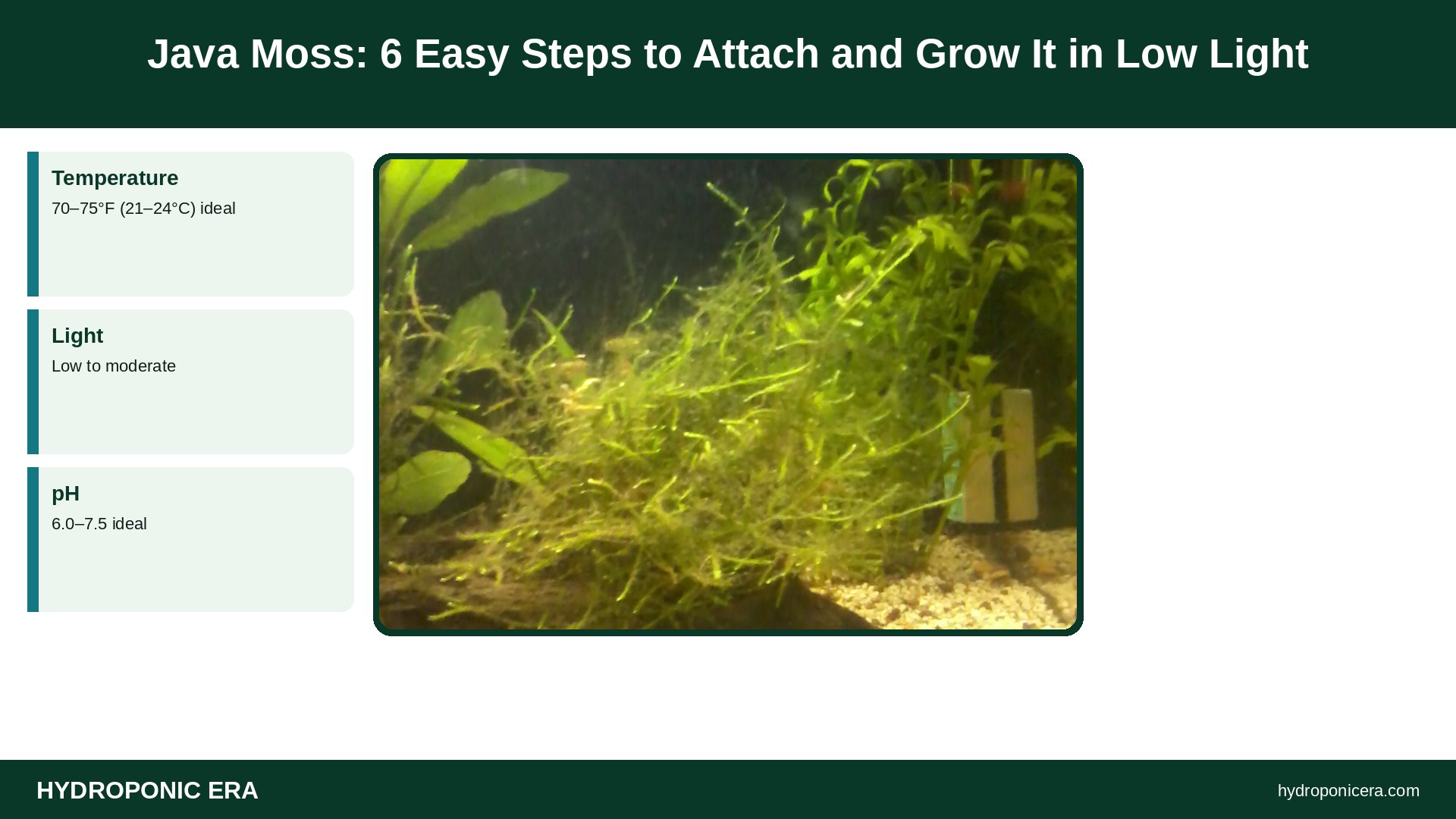
How do you grow java moss? Java moss is one of the easiest aquarium plants. Spread a thin layer over driftwood or rock, tie it down with dark cotton thread or fishing line, and give it low to moderate light. It tolerates temperatures of about 59–86°F (15–30°C), with 70–75°F (21–24°C) ideal, and needs no CO2.
Key takeaway: Java moss needs very little. Attach thin pieces to wood or rock with thread or glue gel, keep light low to moderate, trim often and avoid heavy fertilizer, which feeds algae. It attaches in about 3–6 weeks and can smother other plants if left alone.
| Need | Guideline | Notes |
|---|---|---|
| Temperature | 70–75°F (21–24°C) ideal | Tolerates 59–86°F (15–30°C) |
| Light | Low to moderate | About 20–40 PAR gives dense growth |
| pH | 6.0–7.5 ideal | Tolerates about 5.0–8.0 |
| CO2 | Not required | Growth is faster with it |
| Attachment time | About 3–6 weeks | Thread holds until rhizoids grip |
What Is Java Moss?
Java moss is a hardy freshwater aquatic moss, sold as Taxiphyllum barbieri or Vesicularia dubyana depending on the supplier. Tropical Fish Hobbyist calls it possibly the easiest common aquatic moss. It forms tangled green mats that attach to wood, rock and other surfaces, and it gives cover to fry and shrimp.
Because it spreads and clings, the moss is easy to shape into a carpet, wall or small tree. It also grows as a floating clump when left unattached.
How Do You Attach Java Moss to Driftwood or Rock?
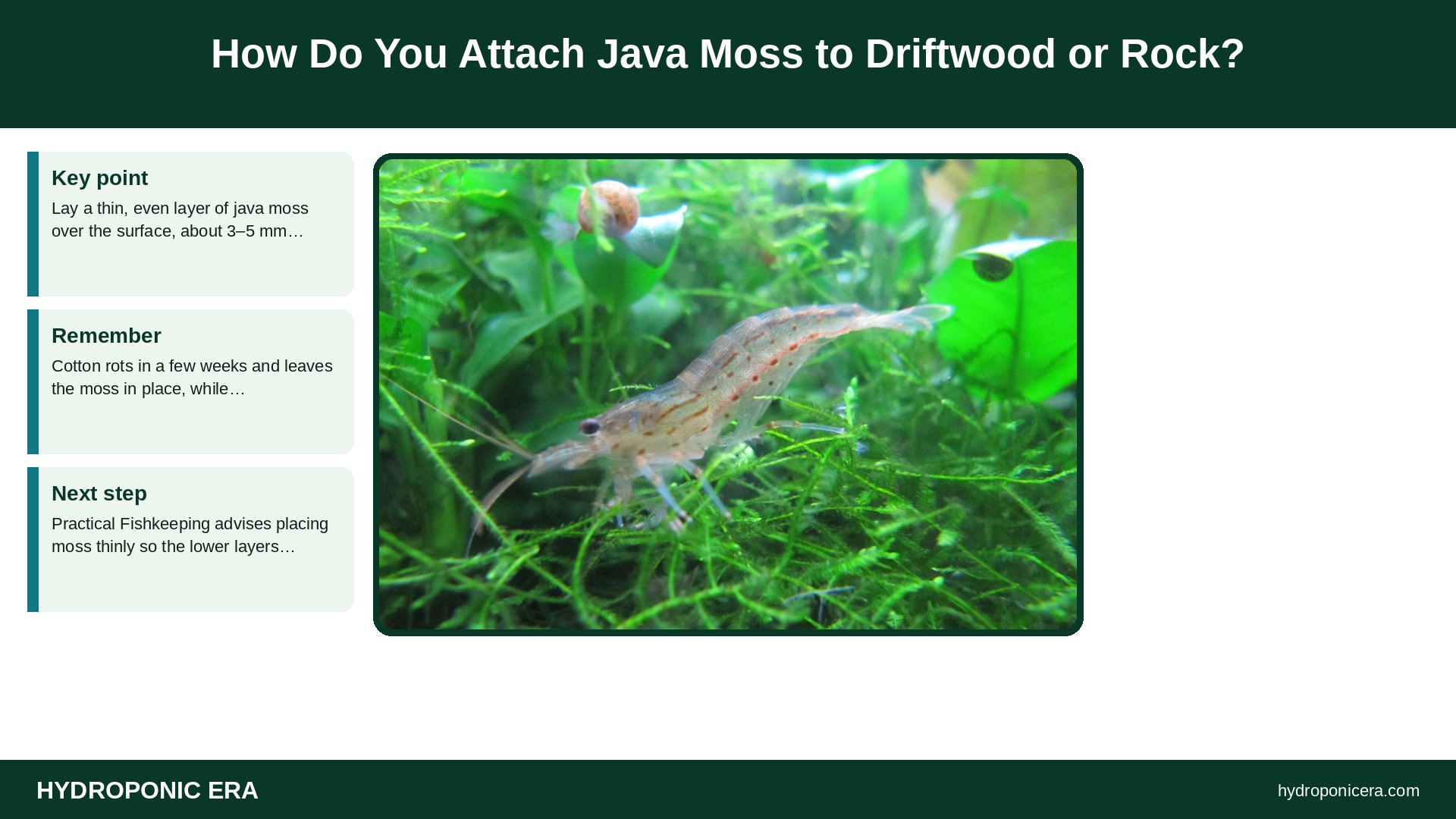
Lay a thin, even layer of java moss over the surface, about 3–5 mm thick, and tie it down with dark cotton thread or fishing line. Cotton rots in a few weeks and leaves the moss in place, while fishing line lasts longer. Practical Fishkeeping advises placing moss thinly so the lower layers do not die off.
- Pull the moss into thin pieces, and spread it on the wood or rock.
- Wrap thread loosely in a crisscross pattern about 1–2 cm apart.
- Tie a double knot, and trim the ends.
- Place it in the tank in moderate light.
- Leave the thread in place until the moss grips, usually 3–6 weeks.
Gel glue made for aquariums can also work. Press a small dot onto the surface, and hold for a few seconds.
How Much Light Does Java Moss Need?
Java moss grows in nearly any light, from very low to high. Low light gives slower, looser, darker growth, while moderate light of about 20–40 PAR gives denser, brighter moss. Too much light invites algae on the moss, which is hard to remove, so keep light moderate and the tank balanced.
The same light rules show up in pond and aquaponics work. See our guide to pothos in a fish tank and lucky bamboo in a fish tank for other low-effort plants.
What Water Does Java Moss Prefer?
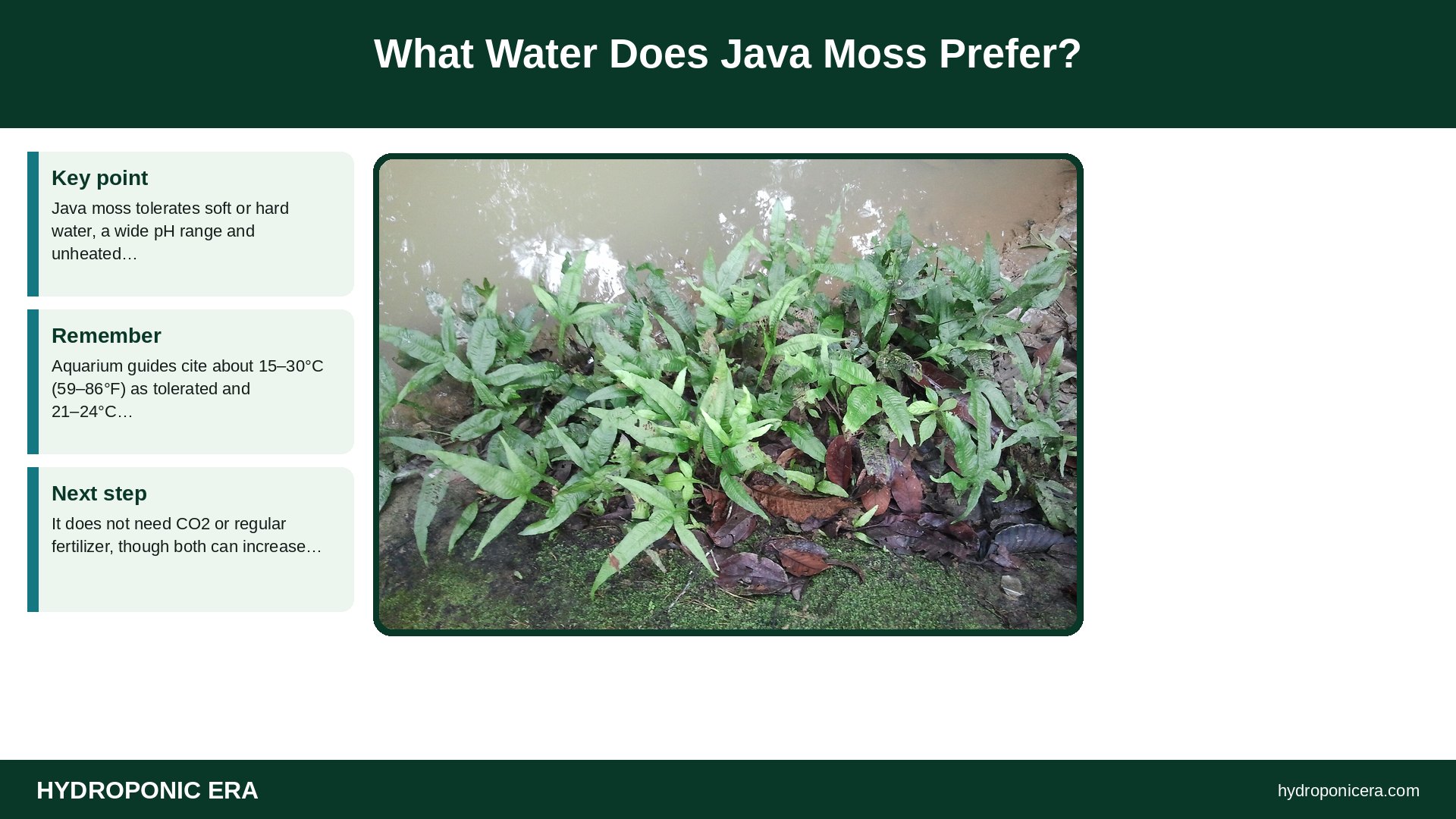
Java moss tolerates soft or hard water, a wide pH range and unheated tanks. Aquarium guides cite about 15–30°C (59–86°F) as tolerated and 21–24°C (70–75°F) as ideal, with growth slowing above about 80°F (27°C). It does not need CO2 or regular fertilizer, though both can increase growth.
How Do You Trim and Control Java Moss?
Trim regularly, since it will grow over and smother other plants if left unchecked. Hold a clump firmly and snip or tear away the excess, or pull strands out by hand. Vacuum loose bits so they do not clog filters. Thin dense areas, since the lowest layers die when light cannot reach them.
- Trim every few weeks.
- Keep fertilizer light to avoid algae.
- Rinse debris from the moss with a gentle turkey baster.
- Remove brown or dead patches.
Why Is My Java Moss Turning Brown?
Brown or yellow java moss usually means too little light, dying lower layers, trapped debris or algae. Trim the dead parts, rinse debris away, and adjust light up or down depending on what you see. Avoid over-fertilizing. If algae covers the moss, reduce light and nutrients, and remove severely affected pieces.
How Do You Make a Moss Wall or Carpet?
Sandwich thin java moss between two sheets of plastic mesh or craft canvas, then fix the panel to the back or side of the tank, or lay it flat on the substrate. The moss grows through the mesh and forms a dense wall or carpet. Trim the surface as it grows, and lift the panel to rinse trapped debris now and then.
A carpet needs enough light to reach the bottom layers, so keep the moss thin and trim often. Aim for even coverage so no single area becomes a thick, dark mat. If fish or shrimp are in the tank, the moss gives them cover and a place to graze on tiny organisms.
What Fish and Shrimp Like Java Moss?
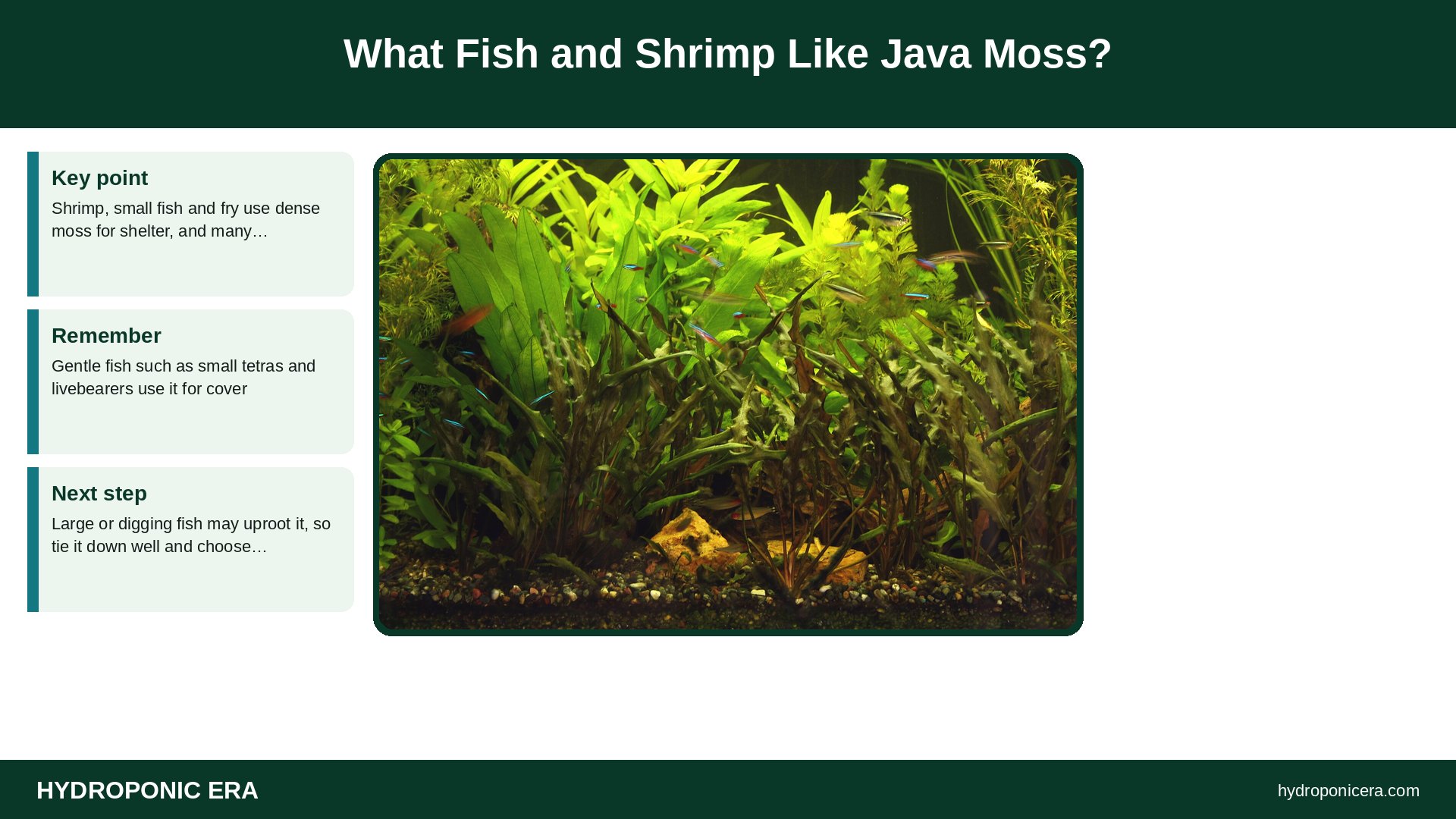
Shrimp, small fish and fry use dense moss for shelter, and many egg-scattering species spawn in it. Gentle fish such as small tetras and livebearers use it for cover. Large or digging fish may uproot it, so tie it down well and choose sturdy hardscape. Keep trimming so water can flow and waste does not collect inside the mat.
In a pond or outdoor tub, java moss can also float or attach to rocks during the warm months. Bring it indoors if water temperatures fall low, since it slows down in the cold and may rot if the water turns stagnant.
How Do You Add New Java Moss Safely?
New plants can bring snails, pests or disease into a tank. Rinse it in clean, dechlorinated water, inspect it closely and quarantine it first. See our quarantine guide for the same rule applied to fish. Never release aquarium plants or extras into natural waters.
FAQ About Java Moss
Does it need CO2?
No. It grows without CO2, though CO2 can speed growth.
Can it live in cold water?
It tolerates unheated tanks, with growth slowing at the cold end.
Does it need fertilizer?
Not much. Light dosing is enough, and too much feeds algae.
How long does it take to attach?
About 3–6 weeks to anchor to wood or rock.
Can it float?
Yes, it grows as a floating clump.
Sources
- Tropical Fish Hobbyist (Sep/Oct 2016) — Mosses and foreground plants
- Practical Fishkeeping — How to grow your own moss carpet
- World of Aquariums (hobby guide) — Java moss care guide
- AquaKeepers (hobby guide) — Tying plants to rocks and driftwood
- Photo credits (Wikimedia Commons, edited with titles): Javamos op kienhout by Arnoo15 (CC BY-SA 3.0); Crevette caridina multidentata (amano, japonica) by Sky99 (CC BY-SA 4.0); Java Fern (Microsorum pteropus) growing in the wild. by Fhurzan (CC BY-SA 3.0); Planted Tank 03 – Flickr – The Wandering Angel by The Wandering Angel from Makati City, Philippines (CC BY 2.0)