
Is salvinia legal to grow? Giant salvinia (S. molesta) is a federal noxious weed in the United States, so it cannot be imported or moved between states without a permit, and it should never be grown. Some other species are also restricted or invasive in places. Check your state’s rules before you buy.
Key takeaway: Salvinia is a floating fern that spreads fast and can choke waterways. The giant form is a federal noxious weed, species and state rules vary, and unwanted plants must go in a sealed bag in the trash, never into compost, a pond or a drain.
| Question | Answer | Source |
|---|---|---|
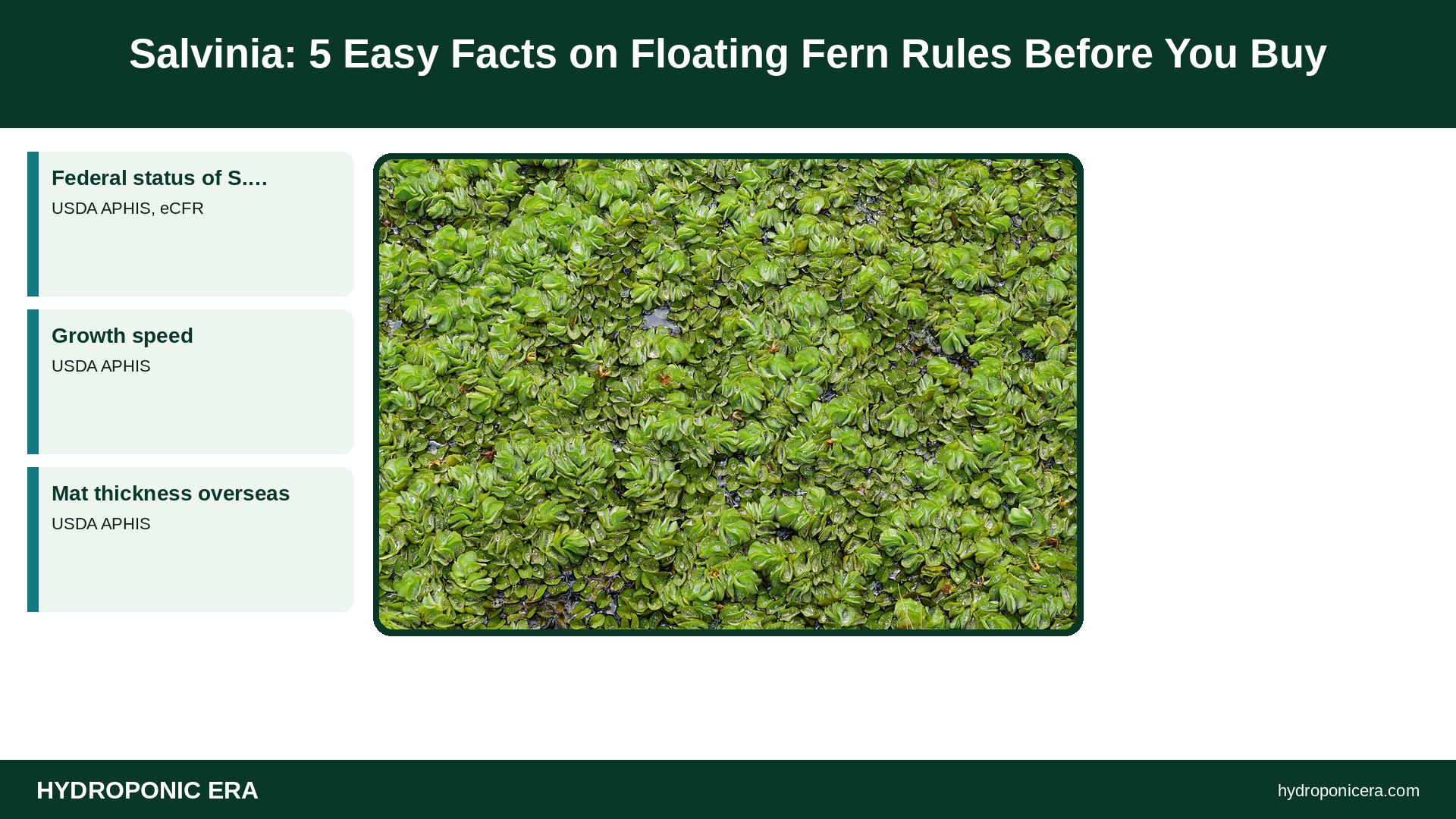
| Federal status of S. molesta | Noxious weed, 7 CFR 360.200 | USDA APHIS, eCFR |
| Growth speed | Mats can double in 7–10 days in good conditions | USDA APHIS |
| Mat thickness overseas | More than 2 ft (60 cm) | USDA APHIS |
| Disposal | Sealed bag in the trash, no compost | Minnesota DNR |
What Is Salvinia?
Salvinia is a genus of free-floating aquatic ferns. Giant salvinia, S. molesta, is native to South America and is considered invasive in the United States. Its leaves are covered in water-repelling hairs, and it forms dense mats that spread by fragments rather than spores. USDA APHIS first listed it as a noxious weed in 1983.
Smaller species are sold for aquariums and ponds, but identification is hard and labels are often wrong, so treat any of them with caution.
Is Salvinia a Noxious Weed in the US?
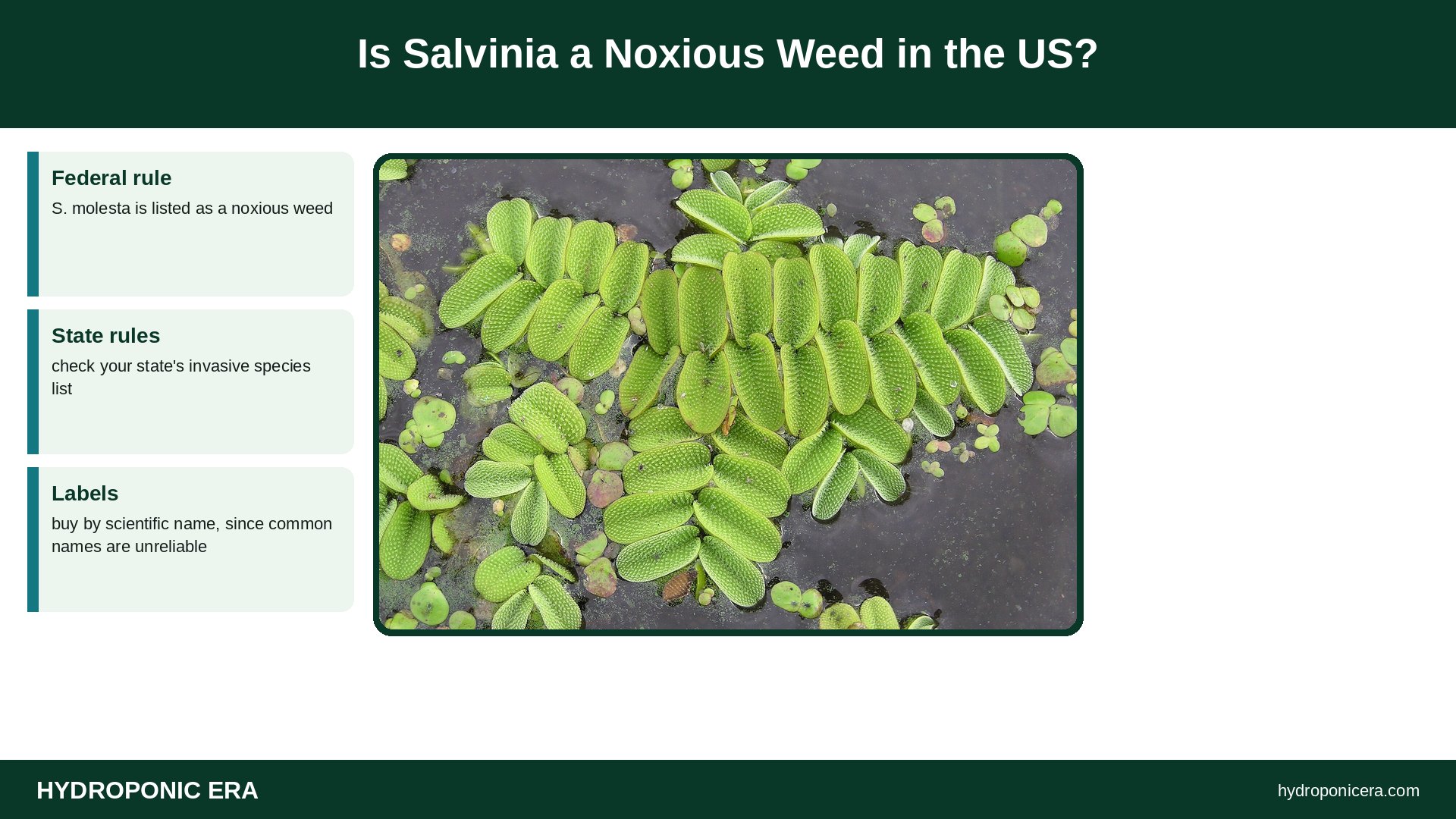
Yes, for the giant form. S. molesta is a federal noxious weed under 7 CFR 360.200, which means importing or moving it between states requires a permit. USDA APHIS warns that plants may still be sold by mistake and are sometimes a contaminant in other aquatic nursery stock. State rules vary and may cover other species.
- Federal rule: S. molesta is listed as a noxious weed.
- State rules: check your state’s invasive species list.
- Labels: buy by scientific name, since common names are unreliable.
- Contaminants: inspect new aquatic plants for hitchhikers.
Why Does Salvinia Spread So Fast?
It multiplies by fragments, and USDA APHIS reports that under favorable conditions the giant form can double its mats in 7 to 10 days. Mats can grow several feet thick overseas, blocking oxygen and light, killing native plants and algae and harming fish and other animals. Even a small piece on a boat or net can start a new colony.
This is why releasing even a small amount is risky. Our guides to water lettuce and azolla cover other floating plants that also need careful handling.
How Do You Dispose of Salvinia Safely?
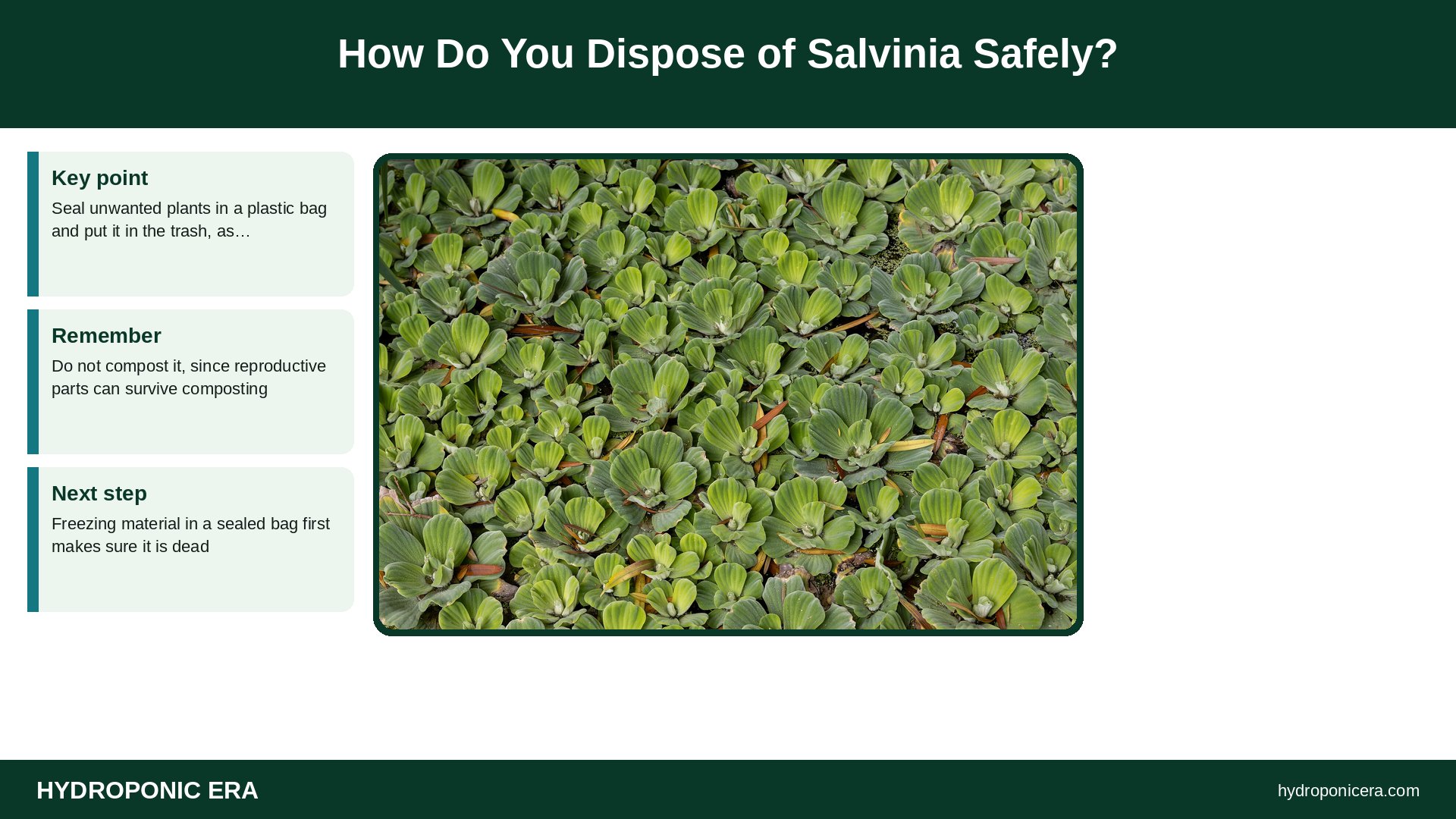
Seal unwanted plants in a plastic bag and put it in the trash, as Minnesota DNR advises for aquarium plants. Do not compost it, since reproductive parts can survive composting. Freezing material in a sealed bag first makes sure it is dead. Empty rinse water onto dry ground, not into a drain, pond or ditch.
- Remove all plant material, including tiny fragments.
- Seal it in a plastic bag, and optionally freeze it.
- Put the bag in household trash.
- Dump rinse water on dry land, away from storm drains.
- Clean nets and containers, and let them dry.
What Can You Grow Instead of Salvinia?
Choose plants that are legal and well behaved in your region. Floating options such as water lettuce and frogbit may also be restricted in some states, so check local lists. Safer choices often include native water lilies in pots and marginal plants. See our guide to water lilies in containers for a contained, ornamental option.
If you want to reduce algae or mosquitoes, shade from lilies and mosquito fish can help where allowed. See our mosquito fish guide.
Can Salvinia Be Controlled Once It Escapes?
It is hard. USDA APHIS says large infestations generally need herbicides in addition to biological control, such as a weevil used overseas. Home owners should never attempt to treat public waters. If you suspect it in a lake or pond, report it to your state natural resources agency, and keep boats and gear clean.
How Do You Identify Floating Ferns Before You Buy?
Floating ferns can look alike, and nursery labels are often wrong. Giant salvinia leaves are oblong, often green to gold or brown, and become upright as plants mature. Their surface has rows of tiny hairs topped with four branches joined at the tips, which gives a plush look and repels water. Underwater, rootlike structures hang below the mat, and they are modified leaves rather than true roots.
If you are unsure, do not buy or share the plant. Take a clear photo and send it to your county extension office or state invasive species coordinator. They can identify it and tell you what the rules are where you live.
Why Does Buying by Scientific Name Matter?
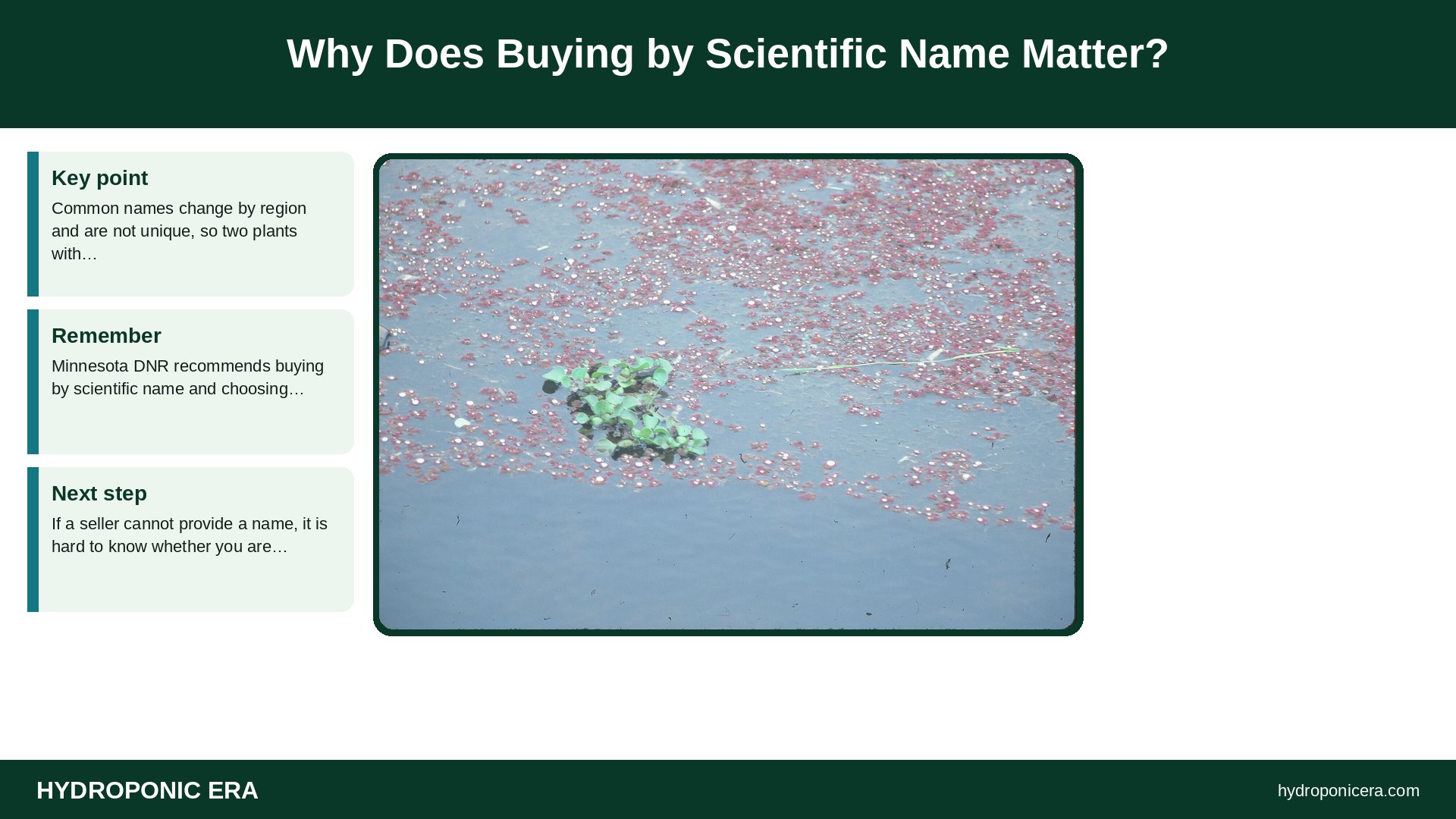
Common names change by region and are not unique, so two plants with the same label can be completely different species. Minnesota DNR recommends buying by scientific name and choosing sellers who list them. If a seller cannot provide a name, it is hard to know whether you are buying a restricted plant by mistake.
Also inspect every order for hitchhikers such as snails, seeds, plant fragments and eggs, rinse them off, seal them in a bag and put them in the trash. Report suspicious plants for sale to your state natural resources agency. Do not trade or give away plants you are unsure about, since that is how many invasive species spread between hobbyists. Keep a record of where each plant came from, so any problem can be traced back and handled quickly.
How Do You Check the Rules Before You Buy Salvinia?
Look up your state’s invasive or prohibited aquatic plant list, and search by scientific name. If a seller does not provide scientific names, choose another seller. Ask your state department of agriculture or natural resources when in doubt. Habitattitude and many state agencies publish buyer checklists for water gardeners and aquarium hobbyists.
FAQ About Salvinia
Is it illegal?
Giant salvinia is a federal noxious weed. Other species may be regulated by state.
Can I compost it?
No. Seal it in a bag and put it in the trash.
Can it survive winter?
APHIS says giant salvinia can overwinter in some parts of the US.
How fast does it grow?
Giant salvinia can double its mats in 7–10 days in good conditions.
What are safer alternatives?
Native water lilies in pots and well-behaved marginal plants.
Sources
- USDA APHIS — Giant salvinia pest alert
- eCFR — 7 CFR 360.200: Designation of noxious weeds
- Minnesota DNR — Aquarium owners: prevent invasive species
- Photo credits (Wikimedia Commons, edited with titles): Salvinia molesta 00904 by Vengolis (CC BY-SA 4.0); Salvinia natans (habitus) 1 by Le.Loup.Gris (CC BY-SA 3.0); At La Orotava 2023 130 by Photograph by Mike Peel (www.mikepeel.net). (CC BY-SA 4.0); Azolla sp Cattle Creek Ingham Queensland 1985 IMG 0040 by John Robert McPherson (CC BY-SA 4.0)