
How do you grow water wisteria? Water wisteria is an easy, fast stem plant. Plant stems 1–2 inches (2.5–5 cm) apart with the lowest node buried, give them medium light and a liquid fertilizer, and keep conditions stable so the leaves do not melt. Trim the tops and replant them to keep the plant bushy.
Key takeaway: Water wisteria grows fast but often melts after purchase, because store plants were grown above water. Plant stems 1–2 inches apart, give medium light and steady nutrients, trim the tops often and replant the healthy cuttings.
| Task | Guideline | Why |
|---|---|---|
| Plant spacing | 1–2 in (2.5–5 cm) apart | Room to root and anchor |
| Light | Medium for denser leaves | Low light causes thin stems |
| Fertilizer | All-in-one liquid, dosed steadily | Starving plants melt |
| Trimming | Cut the top half and replant | Keeps plants bushy and light reaching the base |
| Floating cover | No more than 50% of the surface | Prevents shade and low oxygen |
What Is Water Wisteria?
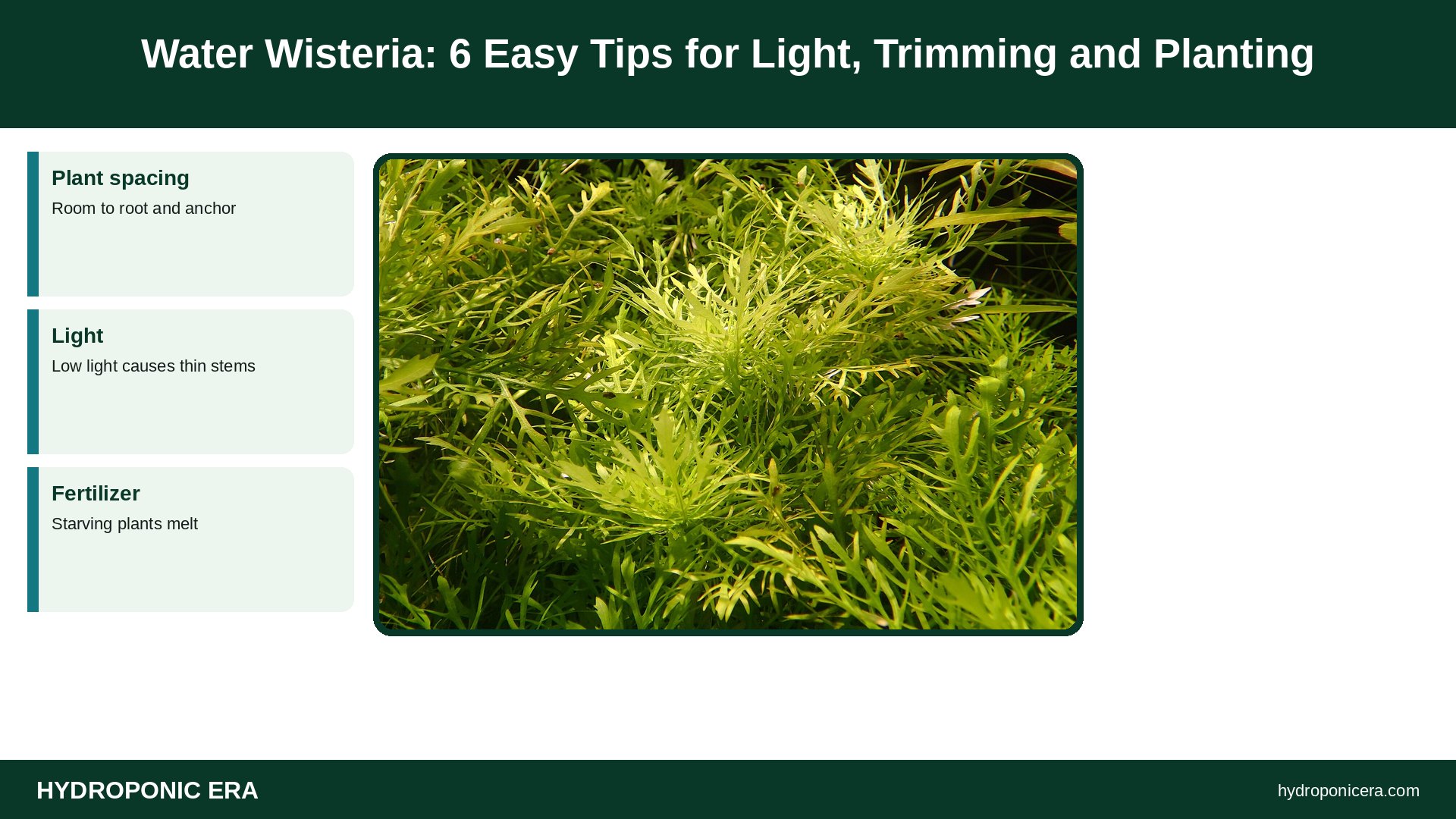
Water wisteria (Hygrophila difformis) is a stem plant from India to Thailand that can grow up to 20 inches (51 cm) tall and 10 inches (25 cm) across, according to Aquarium Co-Op. Its lacy, feathery leaves suit the background of a tank, and the plant also floats. It grows quickly and takes up nitrogen from the water, which can help limit algae.
The plant is easy to keep, but it is prone to melting soon after you buy it. That surprises many beginners, so it helps to know why.
Why Does Water Wisteria Melt After You Buy It?
Nurseries often grow water wisteria with the leaves above water, which makes thicker stems and wider leaves. Underwater, the plant must drop these emersed leaves and grow thinner, feathery submersed leaves. During the change, the old leaves yellow, brown and melt, usually halfway through the first week. Remove the dead leaves and replant the healthy green parts.
How Do You Plant Water Wisteria?
- Remove the stems from the rubber band, bundle or rock wool.
- Trim leaves or stems damaged in transit.
- Push the base of each stem into the substrate as deeply as you can with tweezers.
- Space the stems about 1–2 inches (2.5–5 cm) apart.
- Ring them with rocks or wood if your fish dig.
Do not keep moving the plants once they are planted, since disturbing the substrate pauses growth while they readjust. The same stems can also float, rising to the surface and growing long roots along the stem.
How Much Light and Fertilizer Does Water Wisteria Need?
It tolerates low light, but medium to high light gives denser, more finely divided leaves and speeds the change to underwater growth. Dose an all-in-one liquid fertilizer, and add a mineral supplement if your water is soft with low GH. CO2 is not required, but it can shorten the conversion. Keep light, nutrients and water stable, because sudden swings can melt the plant.
Learn how to read your water in our guide to GH and KH water tests, and see our iron deficiency guide if new leaves turn pale.
How Fast Does Water Wisteria Grow, and How Do You Trim It?
Once established, it can grow about 0.5–3 inches (1–8 cm) per day, according to Aquarium Co-Op. To stop it blocking light, cut off the top half of the stems and replant the cuttings. The bottom half can stay in the substrate and grow new leaves from the tip. If the base turns leggy, remove it and replant the healthy top half.
- Cut just above a node.
- Strip the lowest leaves from each cutting.
- Plant cuttings at least 1 inch (2.5 cm) deep.
- Remove melted stems so they do not rot.
How Do You Grow Water Wisteria Floating?
Floating works well for stems that will not convert or when you need cover for fry and shrimp. Stems rise to the surface and root along the stem. Do not let floating plants cover more than 50% of the water surface, or they shade other plants and can leave the water short of oxygen. Float healthy stems first, and replant once roots form.
How Do You Fix Holes and Algae on the Old Leaves?
The older, above-water leaves low on the stems often develop holes and algae as they age, while new underwater leaves at the tips stay bright green. Aquarium Co-Op advises cutting off the healthy tips once several inches of the new growth have formed, and replanting them to replace the old sections. Remove the old stem bases to keep the tank clean.
Check that stems are not growing out of the water, since tips that reach the air produce above-water leaves again. Lower the water level or trim them before they break the surface.
Where Should You Place It in the Tank?
Plant it toward the back or sides, where it can grow tall without shading smaller plants, or cut it shorter for the midground. Place it under the light, with no taller plants shading it. Group stems in small clumps so they look full, and leave a little space between clumps for water flow and easy trimming.
Dense stems also give shelter to fry and shrimp. Keep the thickest growth away from the filter intake so cuttings do not clog it, and check the filter after every major trim.
What Mistakes Cause Problems?
- Burying the leaves, which rot in the substrate.
- Planting too deeply or crowding stems.
- Moving plants around, which interrupts growth.
- Skipping fertilizer in a bright tank.
- Waiting too long to trim, which shades the lower stems.
What Is the Difference Between Water Wisteria and Water Sprite?
They look alike, but water sprite has thinner, needle-like leaves and is a fern that shoots from a central point at its base. Water wisteria is a stem plant with branches along the stem. Check the label before you buy. For another low-effort tank plant, see our guide to pothos in a fish tank.
FAQ About Water Wisteria
Is it easy to grow?
Yes, once it converts from above-water growth.
Does it need CO2?
No, though CO2 can speed conversion.
How often should I trim it?
Trim whenever it blocks light, and replant the tops.
Can it grow without substrate?
Yes. The stems can float and root in the water.
Why are the leaves melting?
Usually conversion stress, low light, low nutrients or unstable conditions.
Sources
- Aquarium Co-Op (hobby guide) — How to care for water wisteria
- Hydro Habitats (hobby guide) — Water wisteria care guide
- Flowgrow (plant database) — Hygrophila difformis
- Photo credits (Wikimedia Commons, edited with titles): Hygrophila difformis kz04 by Krzysztof Ziarnek, Kenraiz (CC BY-SA 4.0); Male whale shark at Georgia Aquarium by Zac Wolf (CC BY-SA 2.5); Egeria densa (22205195903) by harum.koh from Kobe city, Japan (CC BY-SA 2.0); Anubias barteri var. nana by Abhik.Mazumdar.73 (CC BY 4.0)