
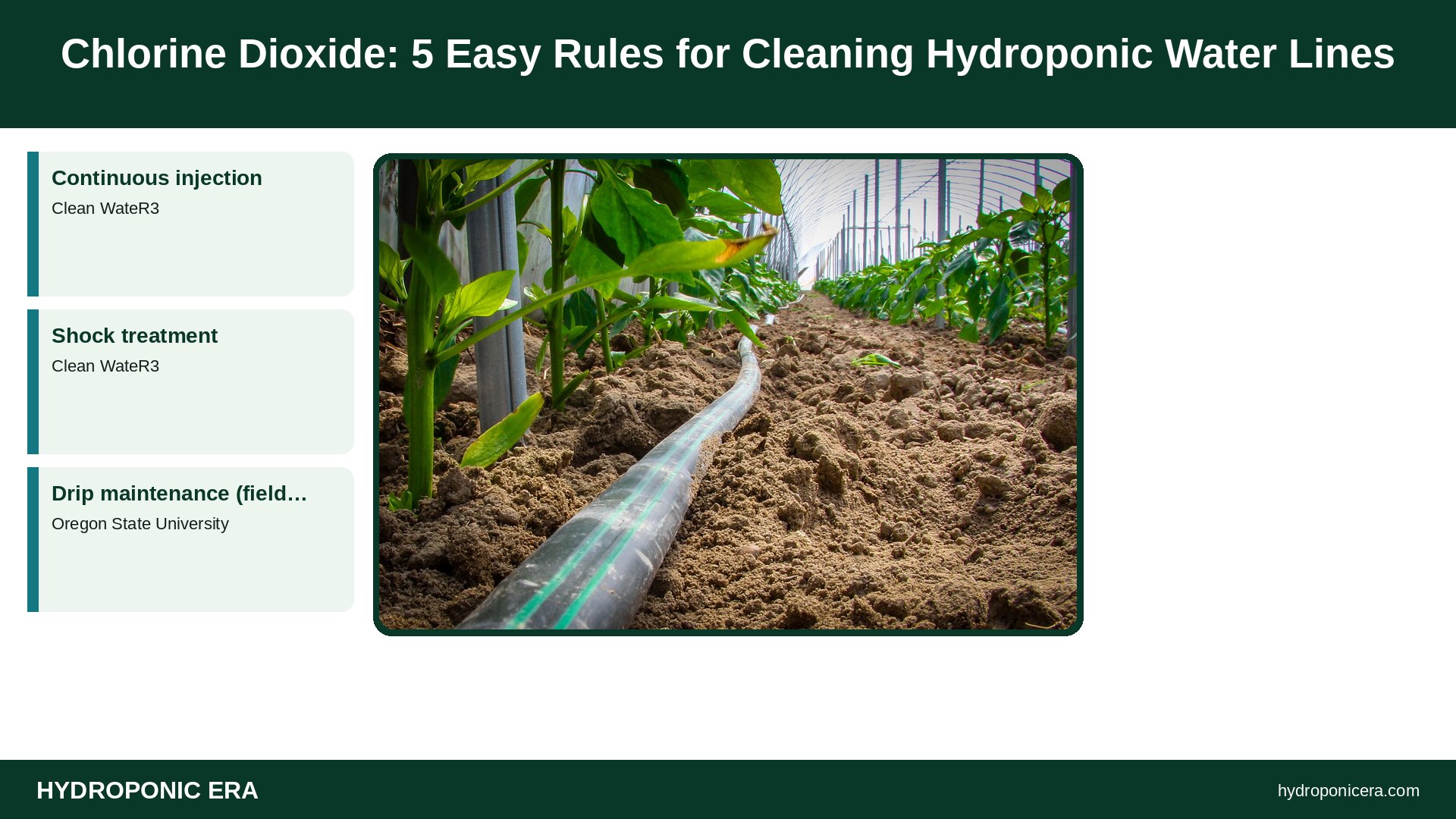
How is chlorine dioxide used to clean hydroponic water lines? Chlorine dioxide (ClO2) is an oxidizer used to remove biofilm and algae from irrigation lines. The Clean WateR3 project recommends a continuous residual of 0.25 ppm at the water outlet, or a shock treatment of lines and tanks at 20–50 ppm twice a year, depending on the product label.
Key takeaway: ClO2 works across pH 4–10 and holds a residual better than other chlorine forms. Use a registered product, follow its label, flush after shocks, and protect stock solutions from sunlight and heat.
| Use | Rate or rule | Source |
|---|---|---|
| Continuous injection | 0.25 ppm residual at the outlet | Clean WateR3 |
| Shock treatment | 20–50 ppm, twice a year, by product | Clean WateR3 |
| Drip maintenance (field trial) | 1 and 3 ppm, 3 ppm the standard | Oregon State University |
| Effective pH range | 4–10 | Clean WateR3 |
| Stock solution life | Use within 7–10 days | Clean WateR3 |
| Air limit for workers | 0.1 ppm, 8-hour shift (OSHA) | ATSDR |
What Is Chlorine Dioxide?
ATSDR describes it as a yellow to reddish-yellow manufactured gas that does not occur naturally. It is used to disinfect drinking water and to bleach paper. When added to water it forms chlorite ion. Clean WateR3 notes ClO2 is a strong oxidizer whose water chemistry differs from bleach and other chlorine forms.
That difference matters. Our guide to chlorine and chloramine in tap water explains the forms already in municipal water.
Why Use Chlorine Dioxide in Irrigation Lines?
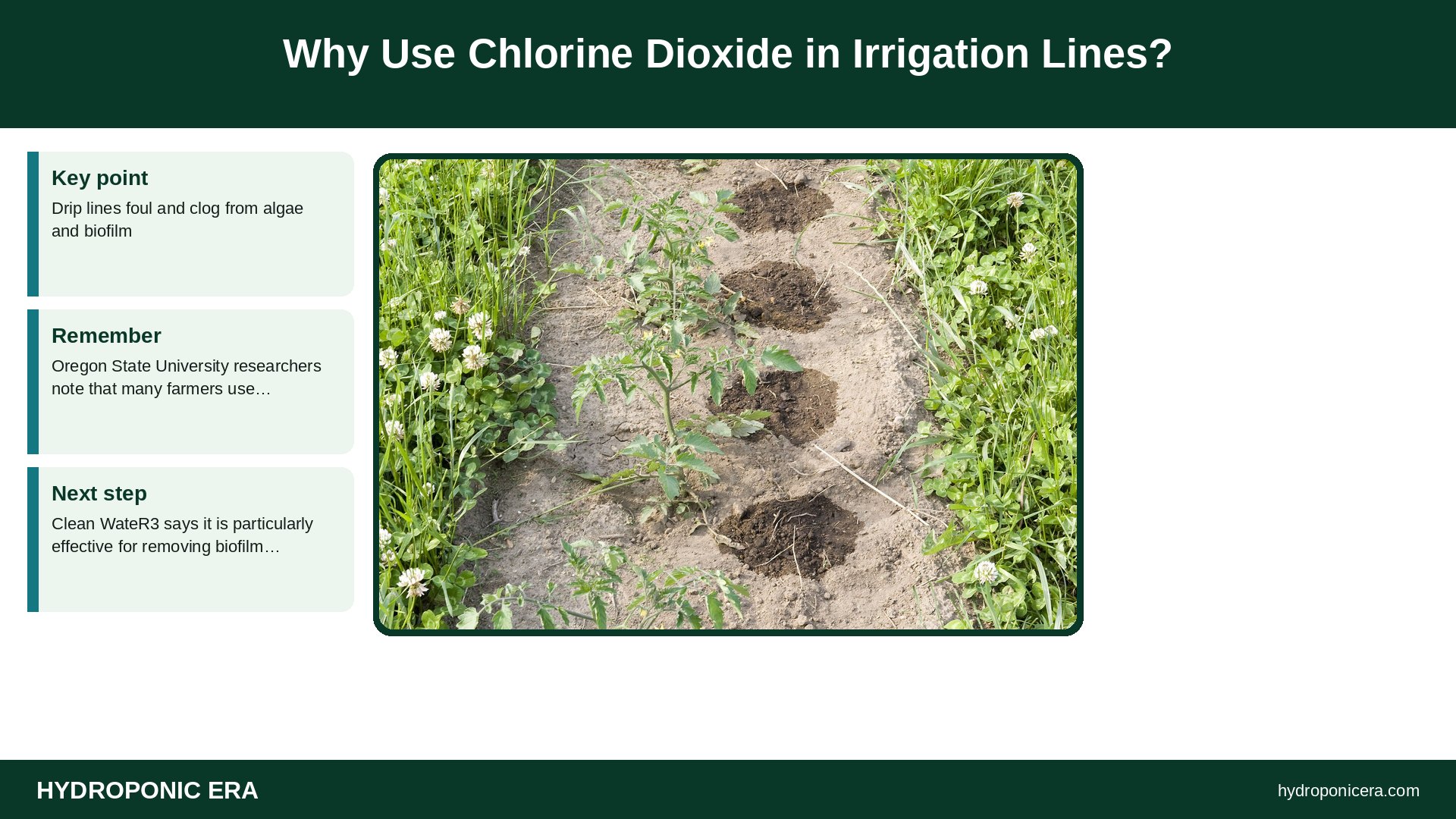
Drip lines foul and clog from algae and biofilm. Oregon State University researchers note that many farmers use chlorine dioxide to keep irrigation lines clean because it is a strong oxidizer and a more potent bactericide than chlorine. Clean WateR3 says it is particularly effective for removing biofilm as a shock, or for sanitation at a continuous low rate.
For slime in tanks, also read biofilm in hydroponic reservoirs.
What Concentration Should You Use?
For continuous use, Clean WateR3 says to aim for a residual of 0.25 ppm at the water outlet. For a periodic shock, treat lines or tanks at 20–50 ppm twice a year, depending on the product. In an Oregon State field trial on drip-irrigated onions, 1 and 3 ppm were tested, with 3 ppm described as the current standard maintenance concentration.
- Read the product label; rates vary by brand.
- Inject at the source and test at the farthest emitter.
- Run a ClO2 shock between crop cycles, with no plants connected.
- Flush lines thoroughly with clean water before replanting.
How Do You Test the Residual?
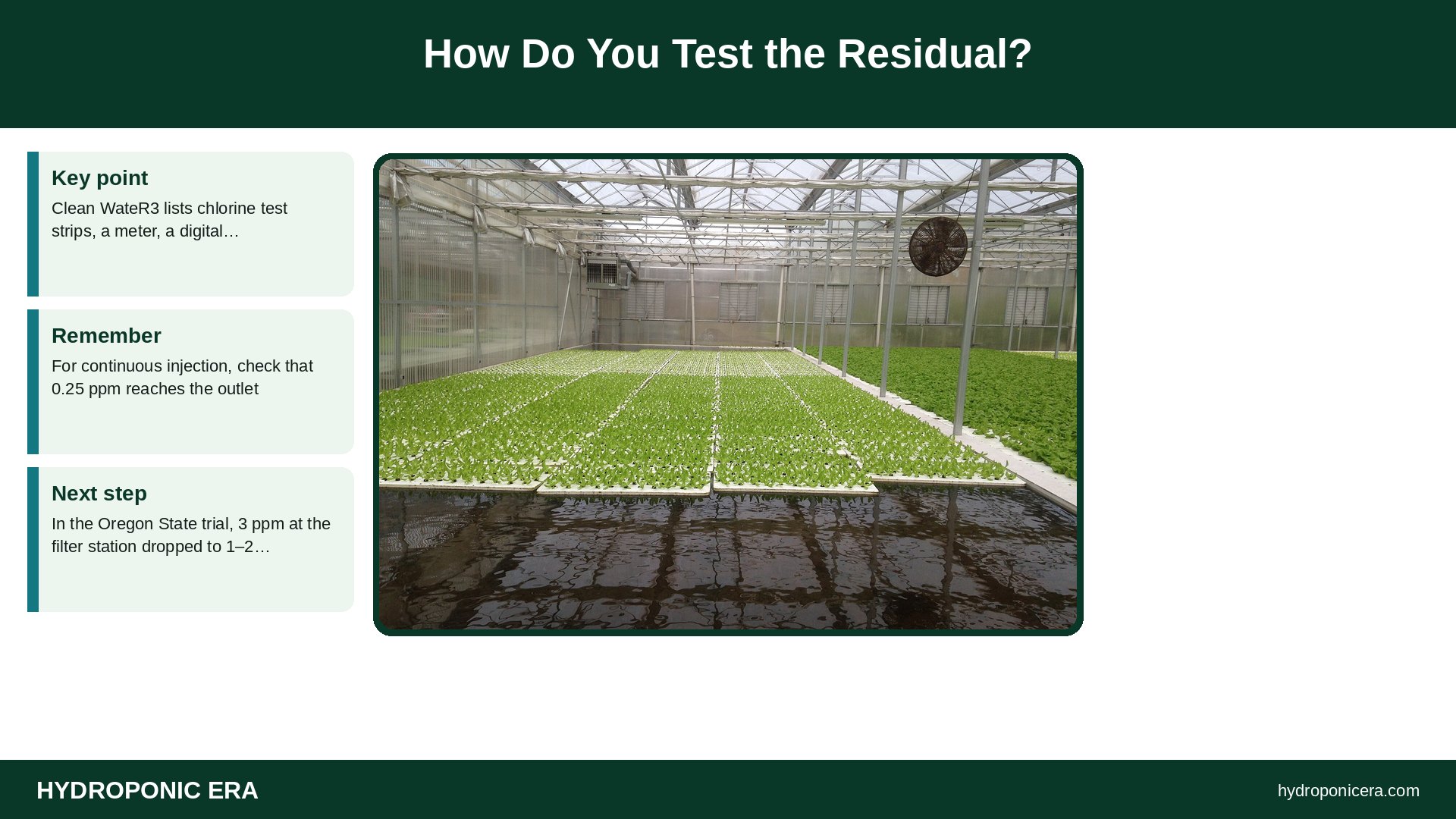
Clean WateR3 lists chlorine test strips, a meter, a digital colorimeter or an in-line ClO2 monitor. For continuous injection, check that 0.25 ppm reaches the outlet. In the Oregon State trial, 3 ppm at the filter station dropped to 1–2 ppm across the field, so readings at the end of the line are what count.
- Test at the injector and at the last emitter.
- Log readings so you can spot sudden demand from organic matter.
- Pair dosing with inline screen filters to cut the organic load.
Can Chlorine Dioxide Harm Plants or Nutrients?
Yes, if misused. Clean WateR3 warns of potential oxidation of micronutrients and chelates in a recirculating solution. It also precipitates iron and manganese, which then need filtering. A USDA study listed by Clean WateR3 found chlorine and hydrogen dioxides used for foliar disease management can damage treated plants, so stick to label rates and avoid spraying leaves.
Keep shocks away from roots, and keep your drip emitters and manifolds flushed after treatment.
How Do You Store and Handle ClO2 Safely?
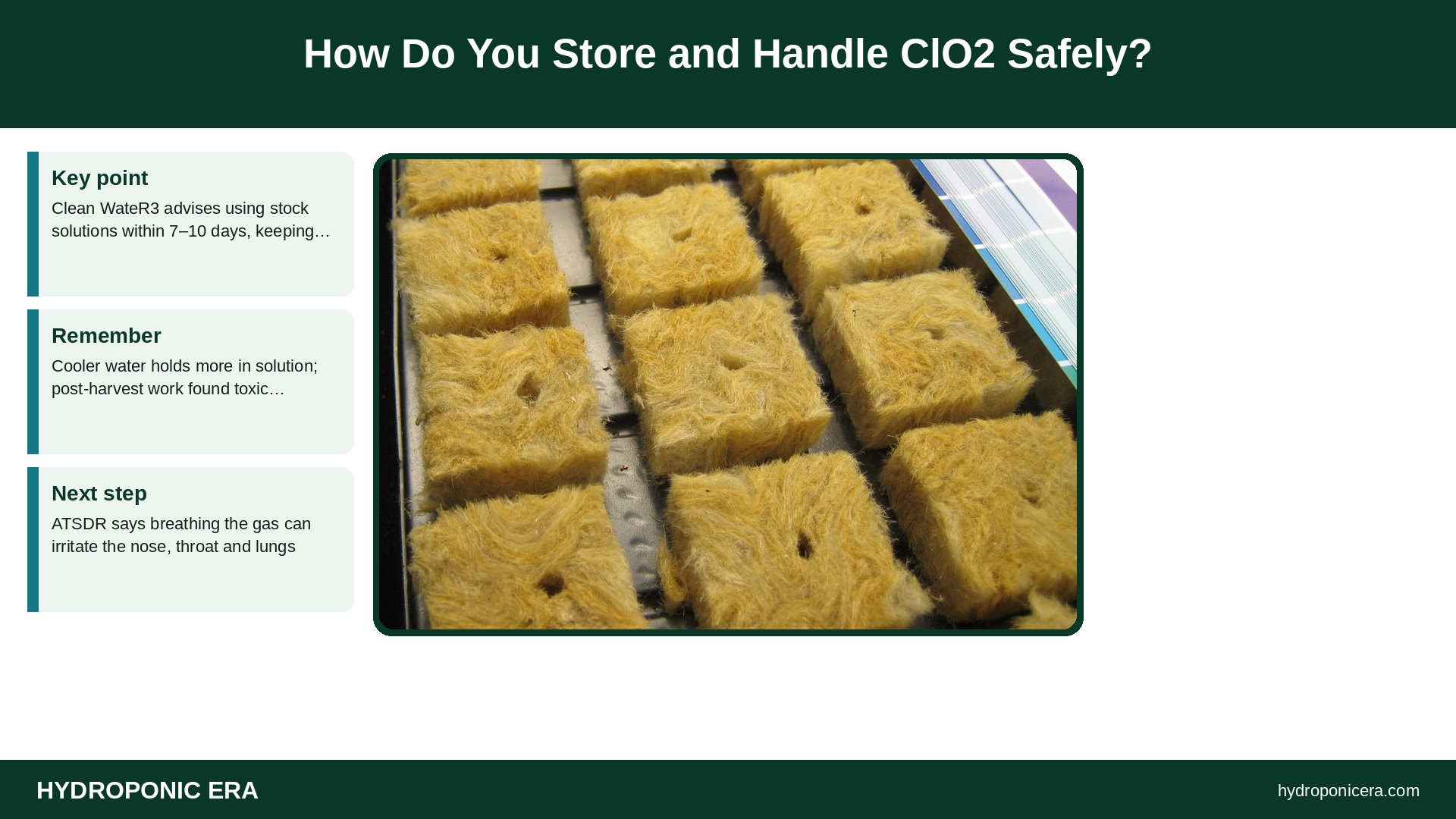
Clean WateR3 advises using stock solutions within 7–10 days, keeping them in a tank with a floating lid, and limiting exposure to UV and sunlight, which break chlorine dioxide down. Cooler water holds more in solution; post-harvest work found toxic off-gassing above 80°F (27°C). ATSDR says breathing the gas can irritate the nose, throat and lungs.
- OSHA’s workplace limit is 0.1 ppm in air over an 8-hour shift, per ATSDR.
- Mix and inject in a ventilated area.
- Use UV-protected tubing and containers.
- Wear eye and skin protection when handling concentrates.
Is Chlorine Dioxide Better Than Bleach?
For lines, it often is. Clean WateR3 says its residual is less affected by organic matter than other chlorine forms and it works across pH 4–10. Oregon State notes it is more effective than chlorine when water carries high organic matter or ammonia. Bleach remains fine for cleaning empty, rinsed equipment.
For a full teardown routine, follow our cleaning and sterilizing guide.
FAQ About ClO2 for Hydroponics
Is chlorine dioxide safe in drinking water?
EPA limits chlorine dioxide to 0.8 mg/L in drinking water, according to ATSDR.
How often should I shock irrigation lines?
Clean WateR3 suggests twice a year at 20–50 ppm, depending on product.
Does ClO2 kill E. coli in irrigation water?
In an Oregon State trial, 1 and 3 ppm substantially reduced E. coli counts across the field.
Why does my ClO2 stock lose strength?
It volatilizes and breaks down in light; use it within 7–10 days.
Can I use it in a recirculating reservoir?
Carefully; it can oxidize micronutrients and chelates.
Sources
- Clean WateR3 (USDA SCRI project) — Water treatment technologies: key information
- Oregon State University, Malheur Experiment Station — Chlorine dioxide injection through drip irrigation reduces E. coli
- ATSDR (CDC) — Chlorine Dioxide and Chlorite ToxFAQs
- Photo credits (Wikimedia Commons, edited with titles): Application of IrritecTape-drip-tape by MajaGra (CC BY-SA 4.0); Drip irrigation (2552390830) by Dwight Sipler from Stow, MA, USA (CC BY 2.0); Deep water culture by ArcadiYay (CC BY-SA 4.0); Rockwool cubes-inlay PNr°0091 by D-Kuru (CC BY-SA 3.0 at)