
How do you root elderberry cuttings? Take hardwood elderberry cuttings in late winter before bud break, each with at least two nodes. UF IFAS Extension sets them in rooting medium with the bottom nodes 1.5 to 2 inches (4 to 5 cm) deep, and UC ANR recommends cuttings at least 10 inches (25 cm) long from last season’s wood.
Key takeaway: Elderberry (Sambucus) is usually propagated from hardwood cuttings because it is cheap and fairly easy. Cut dormant, two-node pieces, bury the lower node, keep the medium moist and handle the new roots gently. Blue elderberry roots less reliably than American or European types.
| Step | What to do | Source |
|---|---|---|
| 1. Time it | Late winter, before bud break | UF IFAS |
| 2. Choose wood | Last season’s growth | UC ANR |
| 3. Cut | At least 10 in (25 cm), 2+ nodes | UC ANR, UF IFAS |
| 4. Treat | Optional rooting compound on the base | UC ANR |
| 5. Plant | Lower nodes 1.5 to 2 in (4 to 5 cm) deep | UF IFAS |
| 6. Care | Keep moist; move roots gently | UC ANR |

When Should You Take Elderberry Cuttings?
Take hardwood elderberry cuttings while plants are dormant. UF IFAS Extension says 8 to 10 hardwood cuttings can come from a typical cane in late winter (January to March in Florida) before bud break. UC ANR adds that blue elderberry may root better from cuttings taken during bloom than in winter dormancy.
Elderberries can also be propagated from semi-hardwood cuttings, softwood cuttings, suckers and root cuttings, according to UC ANR, so the season you pick depends on the wood you have. Hardwood is the most common choice because, as UF IFAS notes, it is easy and low cost.
Which Type of Elderberry Cuttings Works Best?
Hardwood elderberry cuttings are recommended most often. UF IFAS Extension says hardwood cuttings are favored for their relative ease and low cost, while seed is not preferred commercially because seedlings vary. UC ANR notes cuttings give genetically identical plants, which makes growth and yield more predictable than seed.
| Method | Best for | Notes |
|---|---|---|
| Hardwood cuttings | Most growers | Dormant, two-node pieces |
| Softwood or semi-hardwood | Summer propagation | Listed by UC ANR |
| Suckers or stolons | Established plants | UF IFAS plants stolons 1.5 to 2 in (4 to 5 cm) deep |
| Seed | Breeding, wild stands | Variable plants; needs cold treatment |
Species matters. UC ANR reports that blue elderberry is harder to root than European or American elderberry, so plan for lower success with it.

How Do You Cut and Prepare Elderberry Cuttings?
Cut pieces from wood grown during the last season. UC ANR recommends cuttings at least 10 inches (25 cm) long that include at least two nodes, and UF IFAS uses two-node cuttings. Nodes are where roots and buds form, so keep track of which end is the base.
- Choose healthy, pencil-thick stems from last season’s growth.
- Cut just below a node at the base and above a node at the top.
- Make each piece at least 10 in (25 cm) with two or more nodes.
- Keep them right side up; the base points toward the roots.
- Dip the base in rooting compound if you like.
UC ANR says heel cuttings, which keep a sliver of older wood, may root more readily. See how nodes work in our plant node guide.
How Deep Do You Plant Elderberry Cuttings?
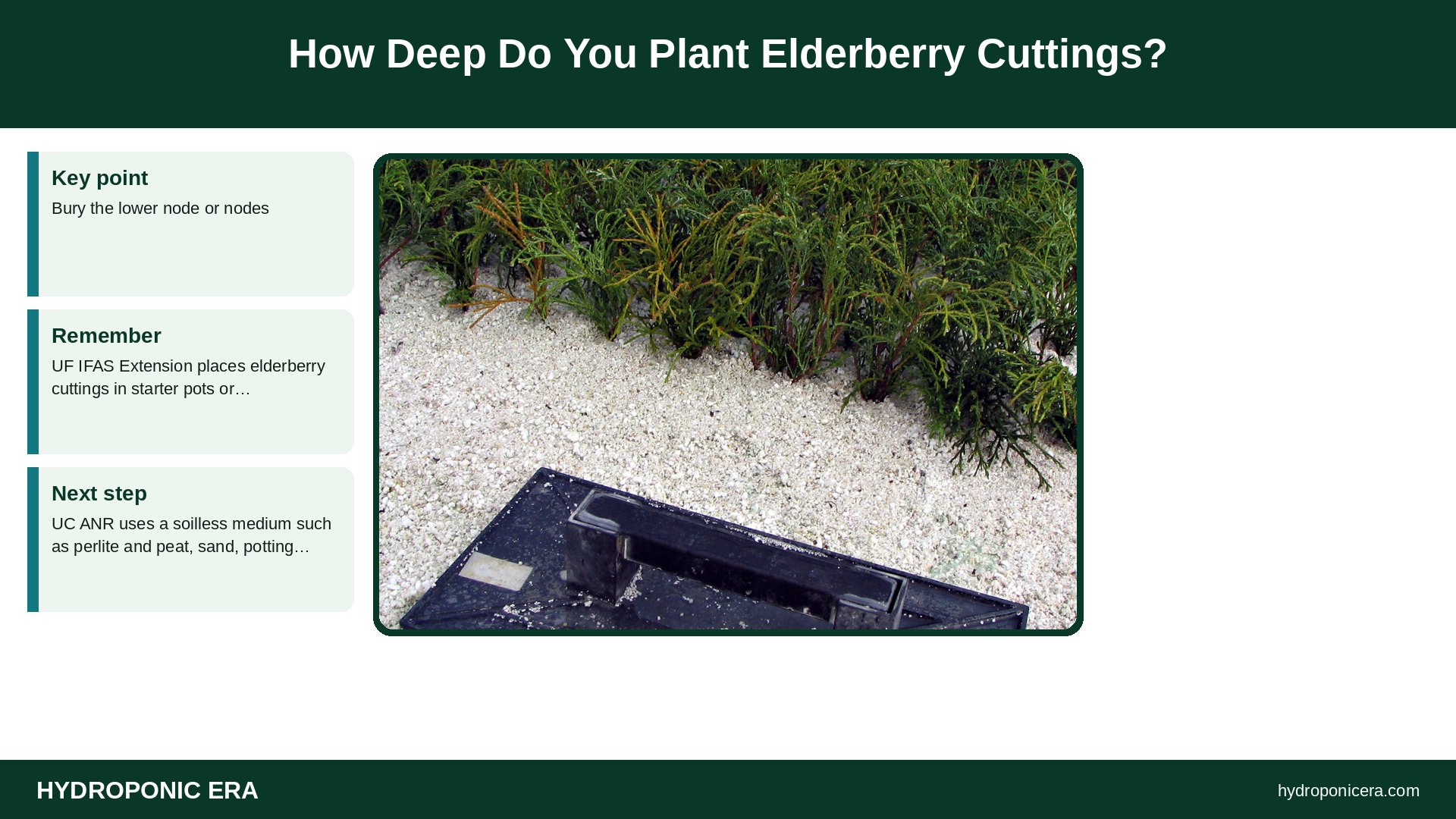
Bury the lower node or nodes. UF IFAS Extension places elderberry cuttings in starter pots or directly in the ground under drip irrigation, with the bottom nodes 1.5 to 2 inches (4 to 5 cm) under the surface. UC ANR uses a soilless medium such as perlite and peat, sand, potting soil or a prepared bed.
- Fill pots with moist perlite-peat mix or potting soil.
- Insert each cutting so the lower node sits 1.5 to 2 in (4 to 5 cm) deep.
- Firm the medium and water well.
- Keep the medium moist until roots form.
- Transplant carefully; young roots are very fragile.
Fast-draining perlite suits many woody cuttings; see our perlite propagation guide.
Can You Root Elderberry Cuttings in Water?
The extension guides we checked root elderberry cuttings in a medium, not water. UC ANR uses perlite and peat, sand or soil, and UF IFAS uses rooting medium or the ground. A jar may grow roots on soft stems, but those roots must adjust to soil later, so medium is the safer route.
If you experiment, change the water often and pot up early. Compare the trade-offs in water propagation vs soil propagation and read about rooting hormone.
Do Elderberry Cuttings Need Rooting Hormone or Cold Storage?
Neither is required, but both can help hard-to-root types. UC ANR suggests treating the base with rooting compound and notes that cold callusing, storing blue elderberry hardwood cuttings in the refrigerator for 14 to 18 weeks before rooting, may raise success rates.
How Do You Care for Rooted Elderberry Cuttings?
Plant rooted elderberry in full sun and fertile, well-drained soil. Utah State University Extension says elderberry tolerates some shade but needs full sun for best fruiting, and that its shallow roots are easily damaged by cultivation. Penn State Extension recommends 5 to 7 feet (1.5 to 2.1 m) between plants.
| Need | Guideline | Source |
|---|---|---|
| Light | Full sun for best fruit | USU |
| Soil pH | 6.8 to 7.2 ideal | Penn State |
| Spacing | 5 to 7 ft (1.5 to 2.1 m) | Penn State |
| Water | 1 to 2 in (2.5 to 5 cm) per week in dry spells | UF IFAS |
Is Elderberry Safe to Eat From Your New Plants?
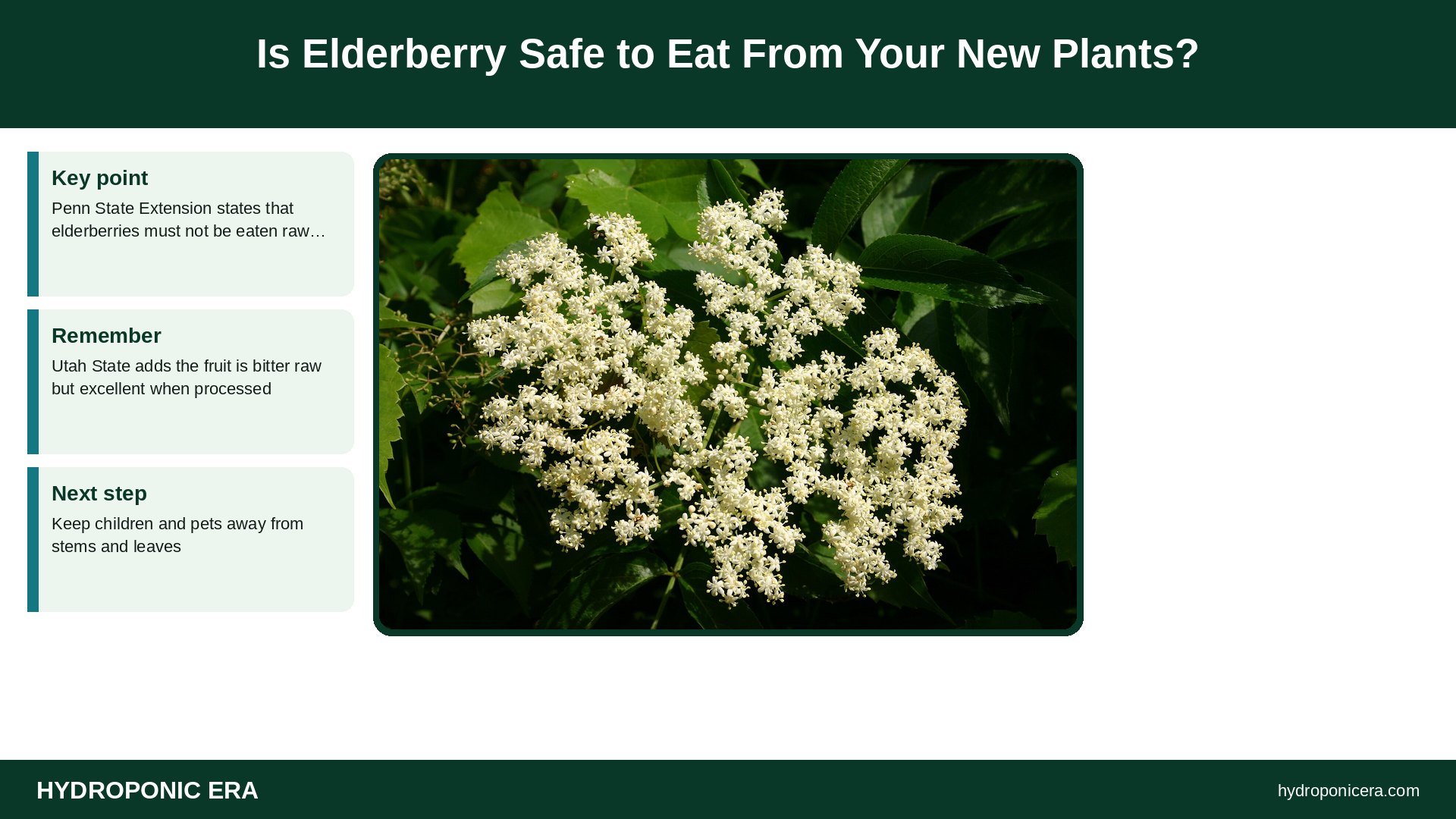
Only cooked ripe berries. Penn State Extension states that elderberries must not be eaten raw and that the leaves, twigs and roots are toxic when consumed. Utah State adds the fruit is bitter raw but excellent when processed. Keep children and pets away from stems and leaves.
FAQ About Elderberry Cuttings
How long should elderberry cuttings be?
UC ANR recommends at least 10 in (25 cm) with at least two nodes.
Can I take elderberry cuttings in fall?
Hardwood cuttings come from dormant wood; UF IFAS takes them in late winter before bud break.
Why won’t my blue elderberry cuttings root?
UC ANR says blue elderberry roots poorly; try bloom-time cuttings or cold callusing.
Can I grow elderberry from seed?
Yes, but UC ANR notes seedlings vary and seeds need cold stratification.
Sources
- UC ANR California Elderberries. How to Propagate Blue Elderberry.
- UF IFAS Extension. HS1390 Elderberry and Elderflower (Sambucus spp.): A Cultivation Guide for Florida.
- Penn State Extension. Elderberry in the Garden and the Kitchen.
- Utah State University Extension. How to Grow Elderberry in Your Garden.
- Photo credits (Wikimedia Commons, edited with titles): Sambucus canadensis inflorescence 001 by User:SB_Johnny (CC BY-SA 3.0); Bloemknoppen van een vlier (Sambucus serenade). 14-04-2021 (actm.) 01 by Agnes Monkelbaan (CC BY-SA 4.0); Perlite as a medium for rooting of cuttings by Gmihail at Serbian Wikipedia (CC BY-SA 3.0 rs)