
Can you grow an olive tree indoors? Yes, in your brightest spot. Grow an olive tree indoors in a pot with drainage holes, let the soil dry somewhat between waterings, and add a grow light for about 12 hours a day in winter. For flowers and fruit, give it at least two months below 50°F (10°C), ideally at 40–50°F (4–10°C).
Key takeaway: Olive trees are drought-tolerant Mediterranean evergreens. Indoors, low light and warm winters are the main reasons they drop leaves and fail to fruit.
| Growth factor | Target | Source |
|---|---|---|
| Light | Brightest window plus grow light (about 12 h in winter) | Ask Extension (Colorado) |
| Watering | Let soil dry somewhat; no “wet feet” | Ask Extension (Colorado) |
| Winter rest for flowering | 2+ months below 50°F (10°C) | Ask Extension (Oregon) |
| Chill hours | 200–300 hours under 45°F (7°C) | UC Master Gardeners, Napa |
| Hardiness outdoors | USDA Zones 8–10 | Ask Extension (Oregon) |
| Dwarf height | 6–8 ft (1.8–2.4 m) | UC Master Gardeners, Napa |
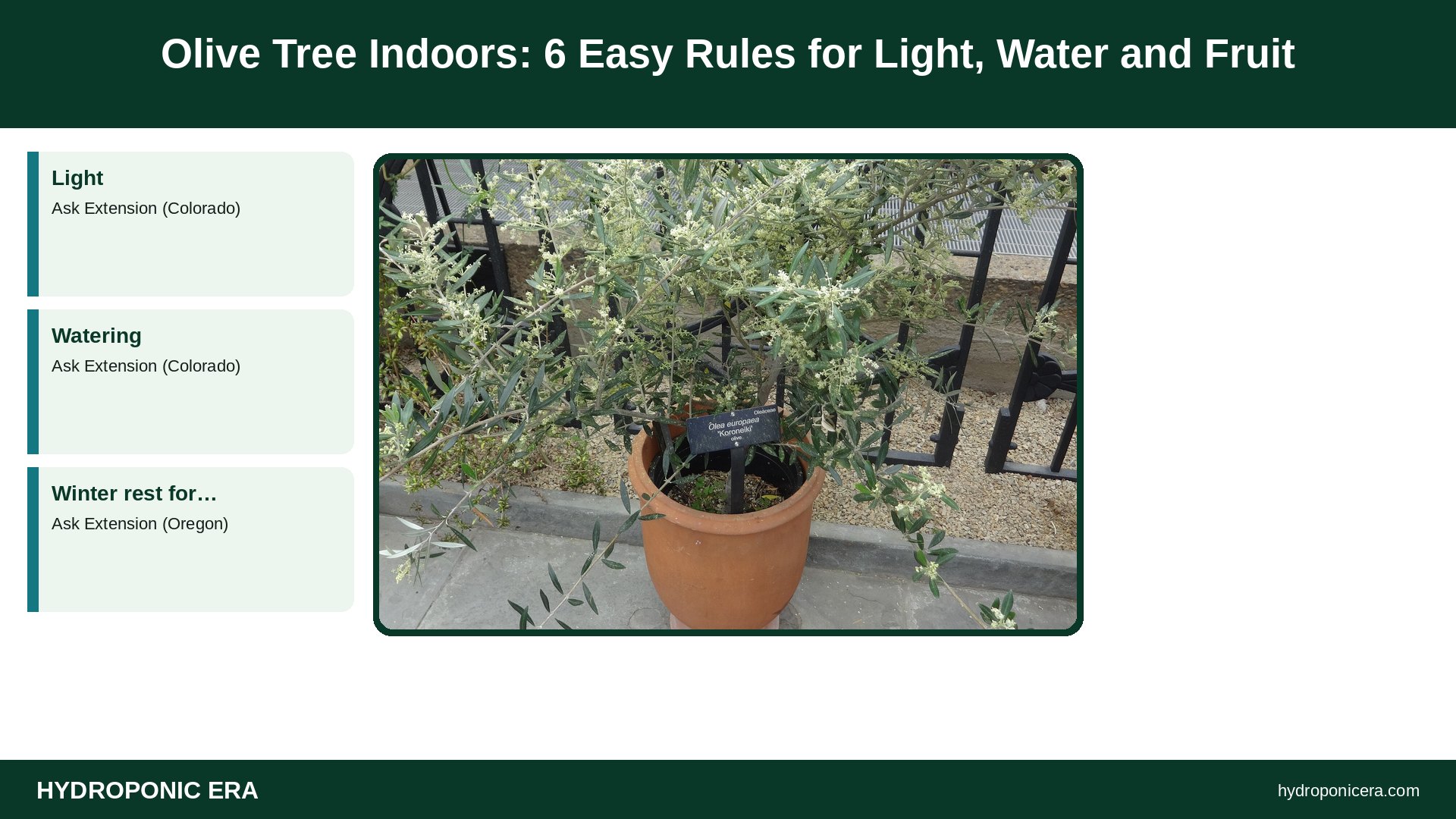
Is an Olive Tree a Good Houseplant?
An olive tree indoors can work, but it is not easy. Ask Extension experts in Oregon, quoting the Missouri Botanical Garden, warn that growing olives as houseplants or bringing containers indoors in winter can be difficult. The tree (Olea europaea) evolved in sunny, dry Mediterranean climates, and standard varieties can reach 30 ft (9 m) outdoors.
UC Master Gardeners of Napa County say the evergreen, low-care olive makes a good patio container tree, and dwarf varieties reach 6–8 ft (1.8–2.4 m). Choose a dwarf if you plan to keep it inside. Our dwarf fruit trees guide compares compact options.
How Much Light Does an Olive Tree Indoors Need?
An olive tree indoors needs as much light as you can give. Even a sunny room may offer only a few hours of direct winter sun. In that situation, an Ask Extension expert in Colorado recommends an affordable LED grow light run about 12 hours a day on a simple timer. A south-facing window plus a light works best.
Learn more about natural versus artificial light in our guide on whether hydroponic plants need sunlight.
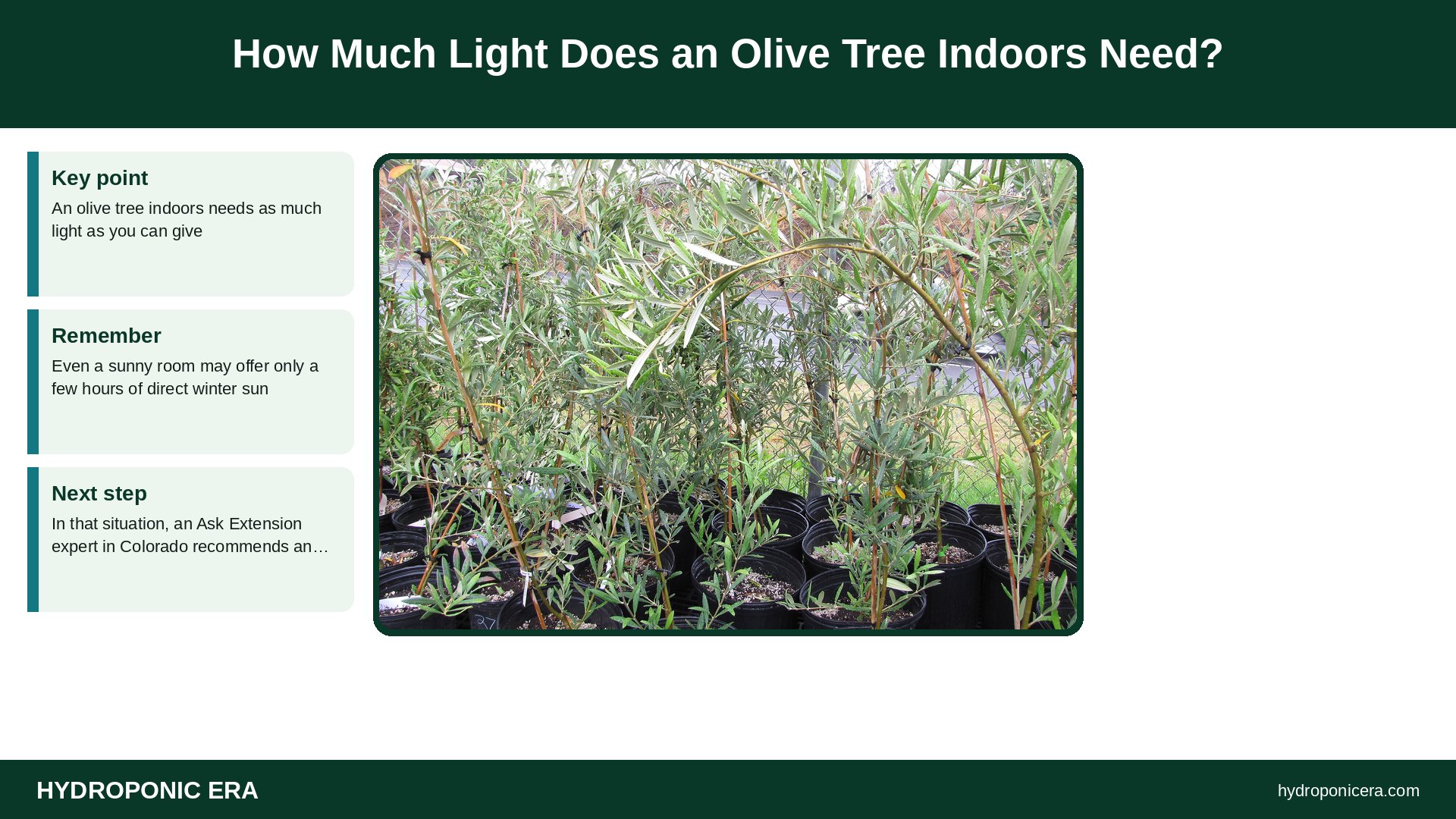
How Often Should You Water an Olive Tree Indoors?
Water when the soil feels mostly dry or barely damp, then water thoroughly. Ask Extension advises that olives “definitely don’t like to have wet feet,” so letting the soil dry somewhat between waterings is wise. Use a pot with drainage holes. UC Master Gardeners note that container olives need regular watering because their root zone is limited.
- Push a finger into the soil to check moisture.
- Water deeply when the top layer is dry.
- Let excess water drain away completely.
- Empty the saucer so roots never sit in water.
- Water less in a cool winter rest.
Why Is My Indoor Olive Tree Dropping Leaves?
When an olive tree indoors drops leaves, light and temperature changes are the usual cause. When a new tree dropped five or six leaves a day after moving indoors, the Colorado Ask Extension expert said the loss was likely due to differences in light and temperature from the nursery, and suggested a small grow light. Overwatering is the other common cause.
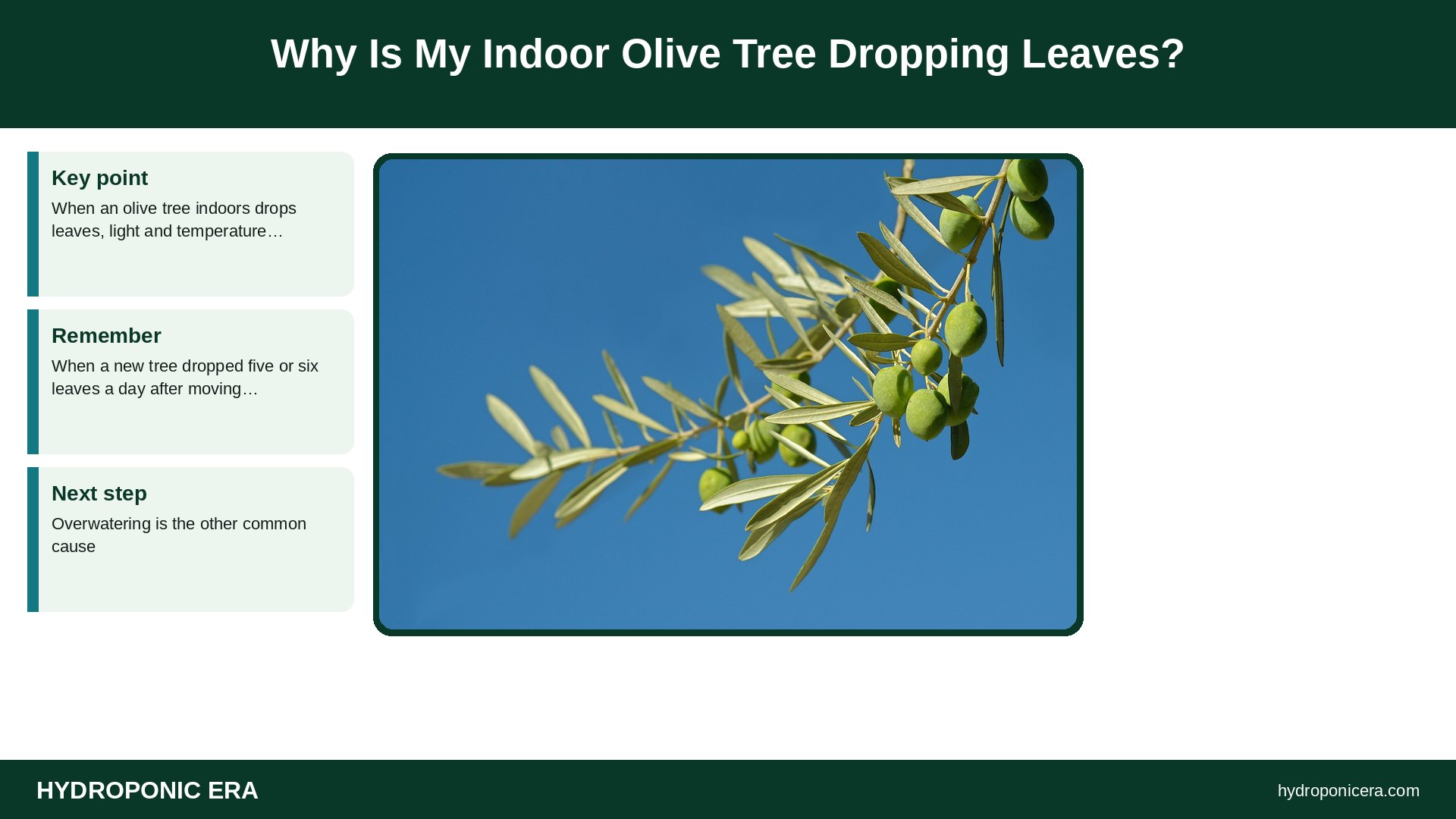
Will an Olive Tree Indoors Produce Fruit?
An olive tree indoors fruits only after a cool winter. Ask Extension (Oregon) says trees need at least two months of winter temperatures under 50°F (10°C) to flower, and containers brought inside should stay at 40–50°F (4–10°C). UC Master Gardeners of Napa describe 200–300 chill hours under 45°F (7°C). A warm living room all winter usually means no olives.
A cool, bright sunroom, enclosed porch or unheated room that stays above freezing can supply this rest. Move the tree back to warmer, brighter conditions in spring.
Which Varieties Suit an Olive Tree Indoors?
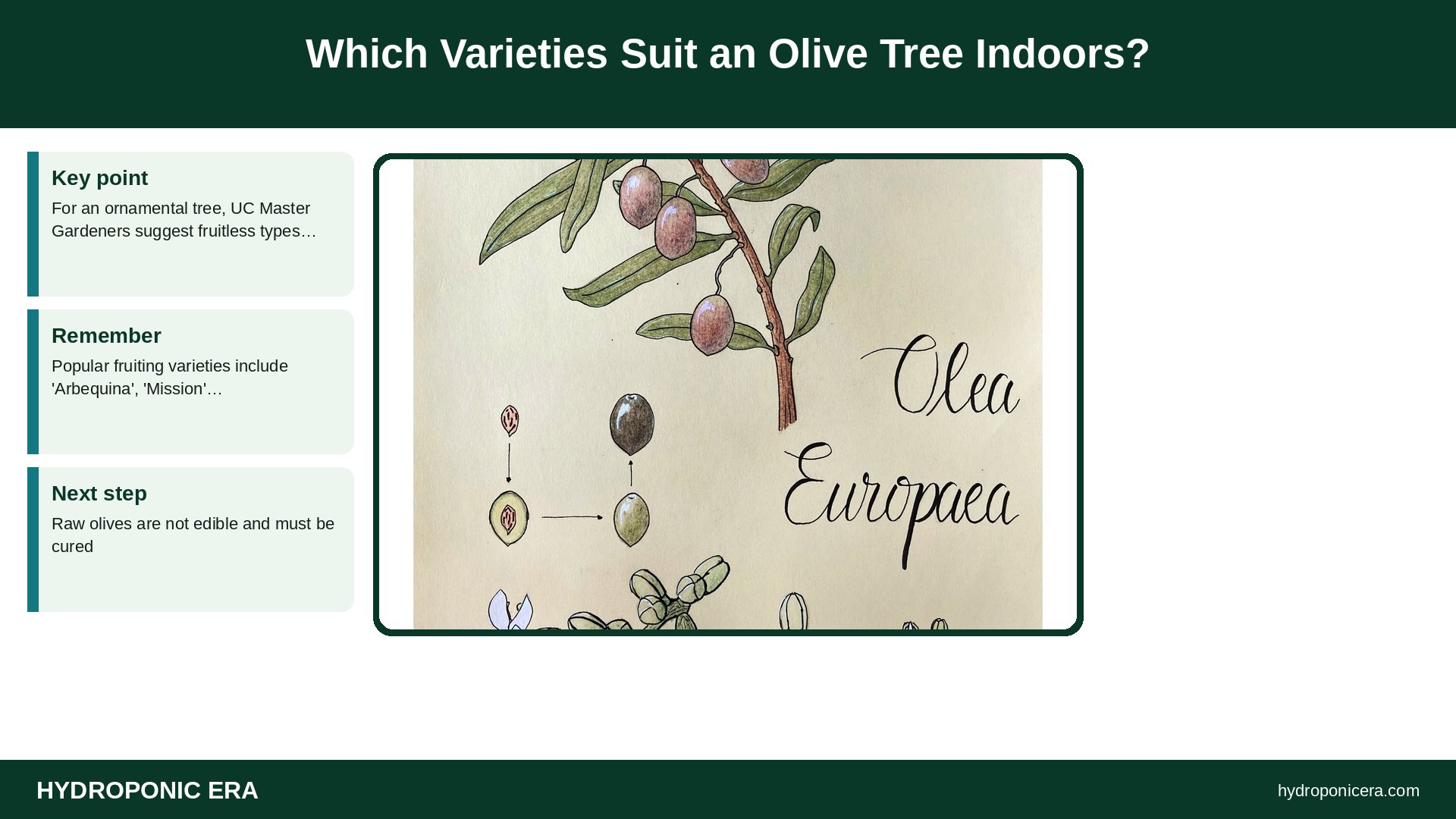
Pick by your goal. For an ornamental tree, UC Master Gardeners suggest fruitless types such as ‘Little Ollie’, a dwarf that tops out around 8 ft (2.4 m), or ‘Swan Hill’, which produces neither pollen nor fruit. Popular fruiting varieties include ‘Arbequina’, ‘Mission’, ‘Manzanillo’ and ‘Frantoio’. Raw olives are not edible and must be cured.
How Do You Care for an Olive Tree Indoors Through the Year?
Care for an olive tree indoors follows the seasons. Ask Extension notes olives adapt well to containers but need periodic fertilizing. Outdoors, the Oregon expert says olives tolerate USDA Zones 8–10, and containers expose roots to more cold than the ground. Many growers move the pot outside after frost, then indoors before cold weather returns.
- Spring and summer: feed lightly and give full sun outside if possible.
- Fall: bring the pot in before frost.
- Winter: keep it cool, bright and on the dry side.
- As roots fill the pot: move up a size, as with a potted lemon tree.
What Pests Should You Watch For on a Potted Olive?
Indoors, check leaves and stems for common houseplant pests such as scale, mealybugs and spider mites, which thrive in warm, dry rooms. Outdoors in California, UC Master Gardeners name olive fruit fly as the most common pest, laying eggs in the fruit and making olives unusable. Discard damaged fruit rather than composting it.
- Inspect leaf undersides every week or two.
- Wipe off small pest groups with a damp cloth.
- See our aphid and mite guide for control steps.
FAQ About Growing Olive Trees in Pots
Can olive trees live indoors all year?
They can survive, but fruit needs a cool winter and bright light.
How tall do indoor olive trees get?
Dwarf types reach about 6–8 ft (1.8–2.4 m).
How cold can an olive tree get?
UC Master Gardeners say established trees withstand about 15°F (-9°C) outdoors.
Do olive trees need a grow light?
In most homes, yes, especially in winter.
Can I eat olives from my tree?
Not raw; they must be cured first.
Sources
- UC Master Gardeners of Napa County — Growing Olive Trees in Napa County
- Ask Extension (Colorado) — Caring for an Indoor Olive Tree
- Ask Extension (Oregon) — Olive Trees in Pots
- Photo credits (Wikimedia Commons, edited with titles): Olea europaea – Mediterranean – US Botanic Gardens 23 by Bohemian Baltimore (CC BY-SA 4.0); Starr-120620-7584-Olea europaea subsp europaea-for sale in pots-Kula Agriculture Park-Maui (25145949165) by Forest and Kim Starr (CC BY 3.0 us); Air Olive 1 by Ввласенко (CC BY-SA 3.0); Olea europaea details by Polymathie (CC BY-SA 4.0)