
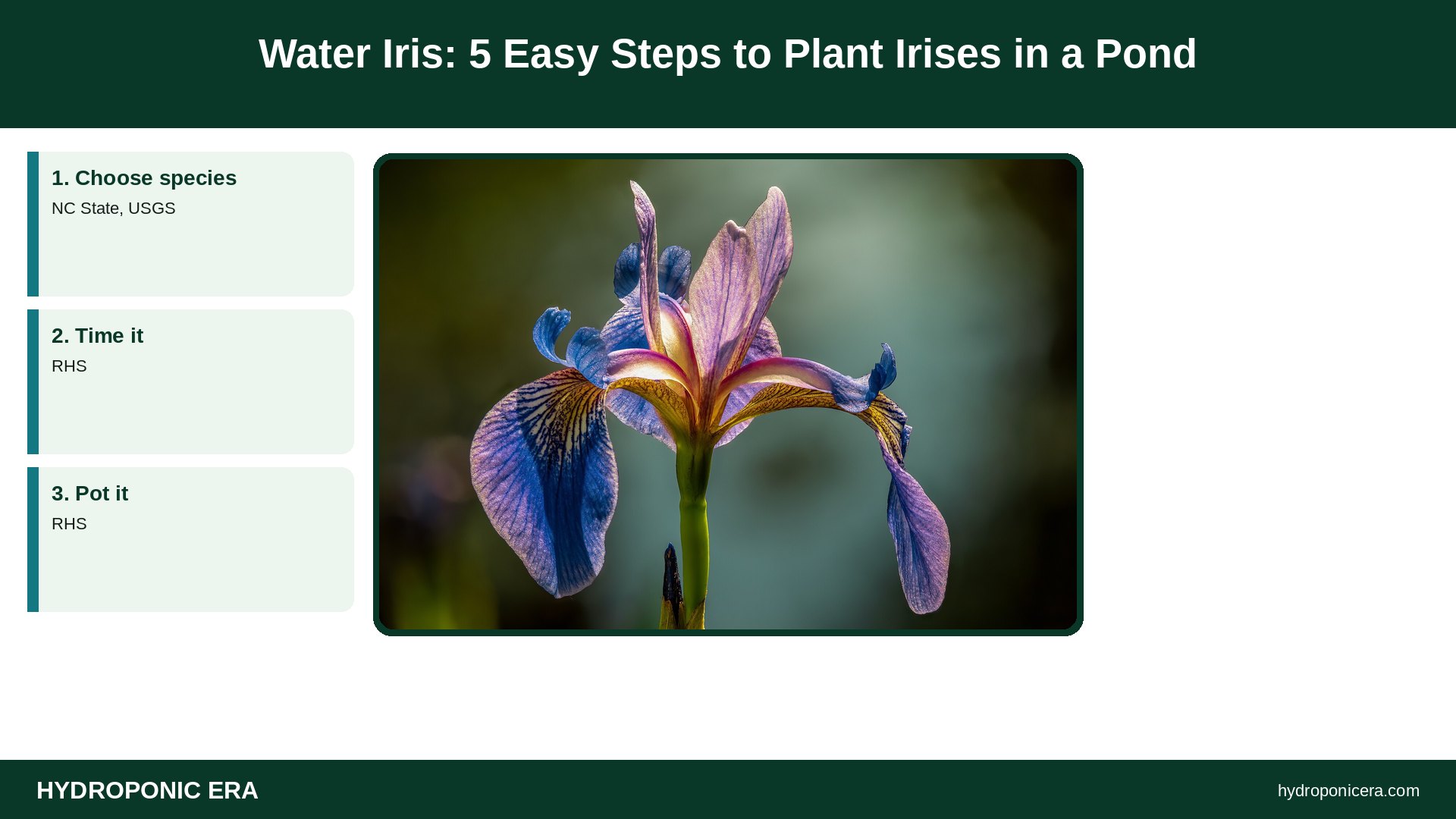
How do you plant water iris in a pond? Plant a water iris in an aquatic basket on the pond’s shallow inside edge, with the rhizome just above the soil surface. Give it full sun to part shade and wet, acid to neutral soil. In North America, choose native blue flag (Iris versicolor), not invasive yellow flag.
Key takeaway: A water iris is a marginal plant for wet pond edges. Native blue flag (Iris versicolor) grows 2–3 feet (60–90 cm) tall in full sun to part shade and tolerates standing water. Plant mid-spring to early summer, set rhizomes just above the soil, and divide clumps in late summer. Avoid invasive yellow flag iris.
| Step | What to do | Source |
|---|---|---|
| 1. Choose species | Native blue flag; avoid yellow flag | NC State, USGS |
| 2. Time it | Mid-spring to early summer | RHS |
| 3. Pot it | Aquatic basket lined with fabric | RHS |
| 4. Set rhizome | Just above soil surface; add grit on top | RHS |
| 5. Place it | Shallow inside edge or bog garden | RHS |
What Is a Water Iris?
A water iris is any iris that grows in wet soil or shallow water at a pond edge. NC State Extension describes larger blue flag (Iris versicolor) as a perennial native from eastern Canada to the northeastern United States, with blue to purple flowers 3–6 inches (8–15 cm) across in late spring to early summer, growing 2–3 feet (60–90 cm) tall.
NC State lists it for USDA zones 3a to 9b and for soils with frequent standing water, occasional flooding or moist conditions. RHS describes it as suitable for pond edges and bog gardens.
Which Water Iris Should You Choose?
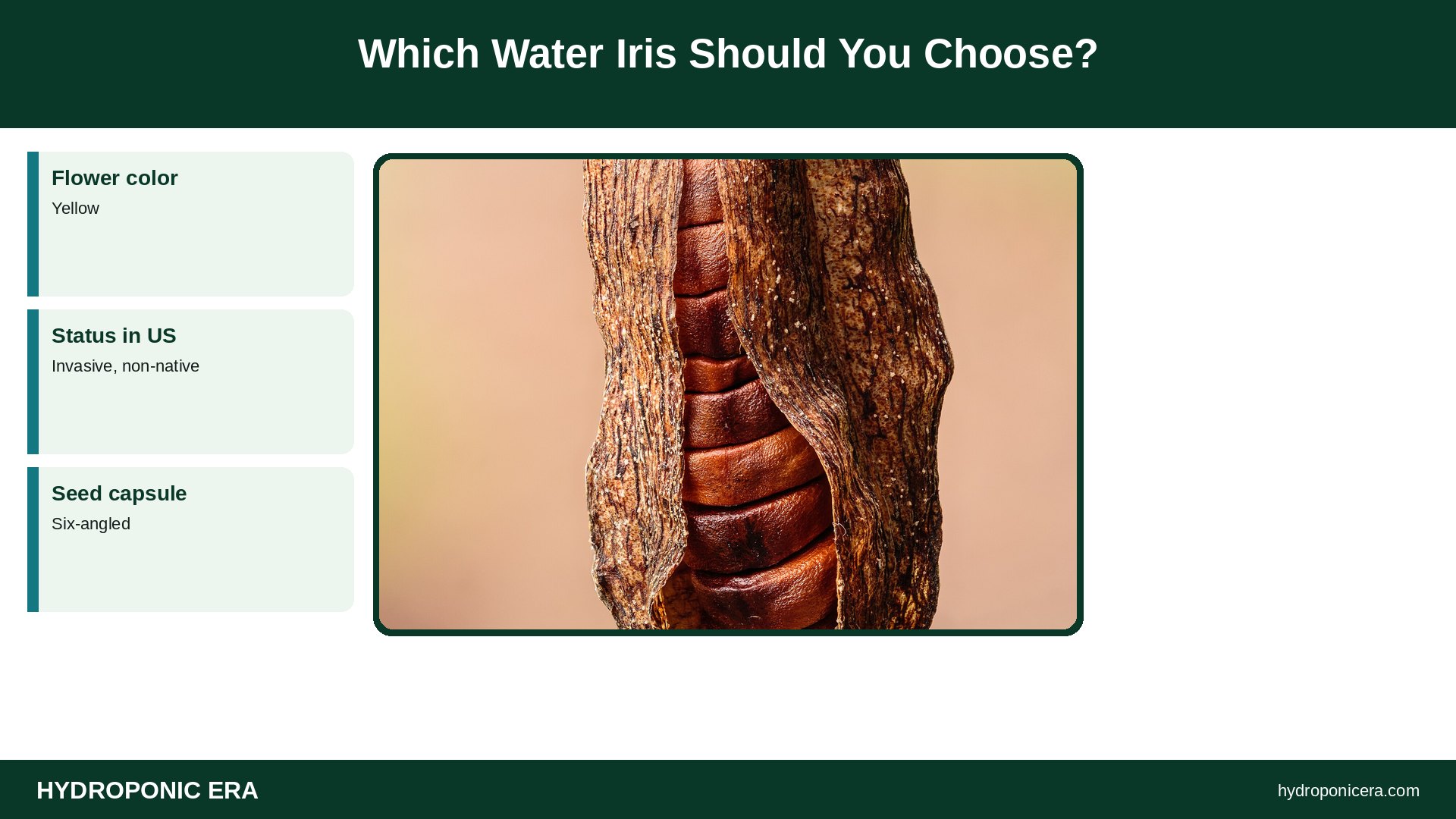
Choose a water iris that is native and non-invasive where you live. In North America, blue flag is a common native choice. Yellow flag (Iris pseudacorus) is a non-native iris that USGS reports spreading along waterways and once growing to the complete exclusion of cattails and other native marsh plants on California’s Merced River.
| Trait | Blue flag (I. versicolor) | Yellow flag (I. pseudacorus) |
|---|---|---|
| Flower color | Blue to purple | Yellow |
| Status in US | Native | Invasive, non-native |
| Seed capsule | Three-angled | Six-angled |
| Spread | Clumps by rhizomes | Dense mats; floating seeds |
USGS notes the seed capsule shape helps tell them apart when not in bloom. Oregon State says yellow flag seed pods float and carry seeds to new locations.
How Do You Plant a Water Iris Step by Step?
Plant a water iris in mid-spring to early summer, which RHS calls the best time for new aquatics. Use an aquatic basket with lattice sides, lined with hessian or polypropylene fabric so soil does not wash out. Position rhizomatous plants so the rhizome sits just above the soil surface, then firm them in well.
- Line an aquatic basket with fabric.
- Fill with heavy garden soil or aquatic compost.
- Lay the rhizome so it sits just above the soil.
- Firm the plant in and top with grit or fine gravel.
- Water the basket, then lower it onto a shallow marginal shelf.
RHS says the grit layer stops fish from stirring up the soil, which matters in koi pond plants setups.
Where Should a Water Iris Go in a Pond?
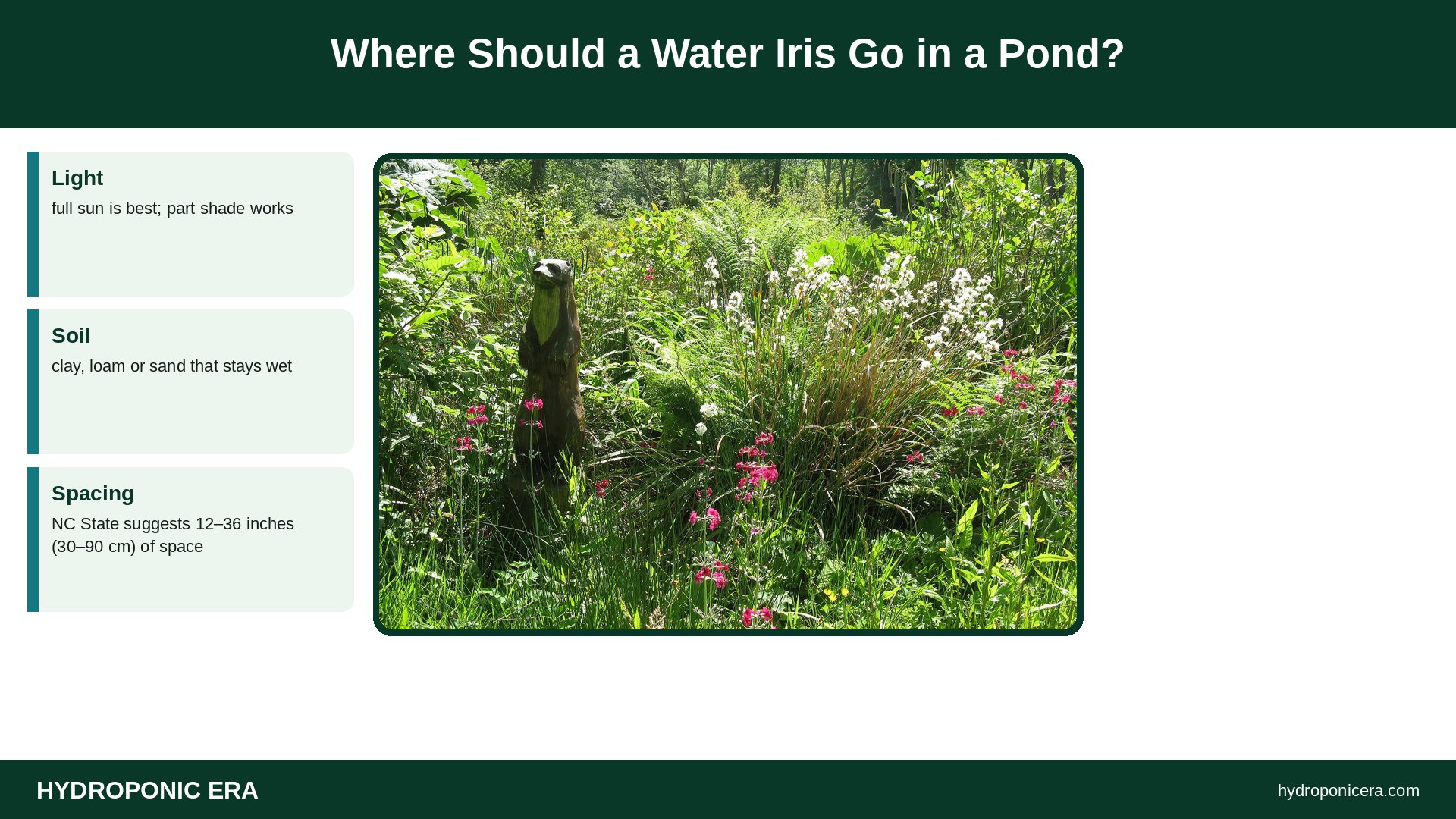
A water iris belongs on the pond’s inside edge or in a bog garden. RHS groups marginals as plants grown on the inside edge of the pond or in boggy ground, and lists blue flag for full sun with poorly drained, acid or neutral soil. NC State adds that it tolerates partial shade with 2–6 hours of direct sun.
- Light: full sun is best; part shade works.
- Soil: clay, loam or sand that stays wet.
- Spacing: NC State suggests 12–36 inches (30–90 cm) of space.
Iris clumps also pair well with a bog filter, where roots sit in constantly wet gravel.
How Do You Care for a Water Iris?
Water iris care is light once the plant settles. RHS says no pruning is required and recommends division from midsummer to early autumn. NC State rates maintenance as low and lists division as the main propagation method. Remove spent flower stalks if you want a tidier look or to stop seed from forming.
- Divide crowded clumps every few years in late summer.
- Lift and repot when roots fill the basket.
- Watch for slugs, snails and thrips, which RHS lists as pests.
- Remove leaves showing soft rot or grey mold.
RHS also lists aphid-borne viruses, bacterial soft rot and grey molds among possible diseases.
Is a Water Iris Toxic or Invasive?
Treat a water iris with care around pets and kids. NC State lists blue flag as having low-severity poison characteristics, and Oregon State says yellow flag iris can irritate or blister skin and is toxic to livestock. Wear gloves when dividing rhizomes, and never let yellow flag seed into nearby waterways.
- Wear gloves; USGS notes broken yellow flag rhizomes release black sap.
- Cut seed pods before they ripen on any non-native iris.
- Report yellow flag in the wild to your local weed program.
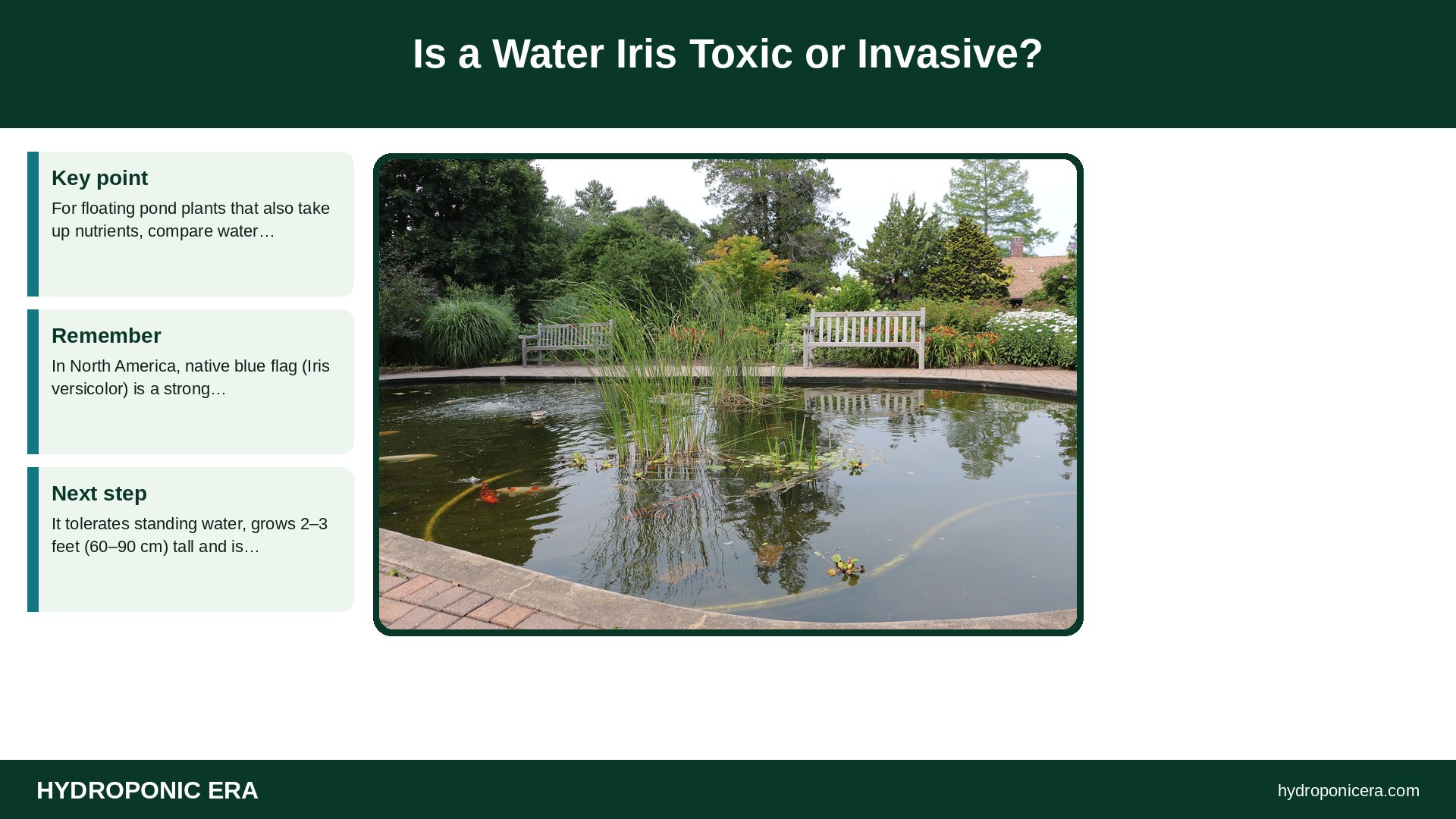
For floating pond plants that also take up nutrients, compare water lettuce.
What is the best water iris for a pond?
In North America, native blue flag (Iris versicolor) is a strong choice. It tolerates standing water, grows 2–3 feet (60–90 cm) tall and is hardy in USDA zones 3a to 9b, per NC State.
Can a water iris grow in standing water?
Yes. NC State lists blue flag for frequent standing water, occasional flooding and moist soil, which suits a shallow pond shelf.
When should I plant a water iris?
RHS recommends mid-spring through early summer for planting new aquatic plants, when they can establish before winter.
Is yellow flag iris invasive?
Yes, in much of the US. USGS reports it crowding out native marsh plants, and Oregon State calls it a rapidly spreading weed.
How do I divide a water iris?
Lift the basket, cut the rhizome into sections with healthy leaves and roots, and replant. RHS suggests dividing from midsummer to early autumn.
Sources
- NC State Extension Gardener Plant Toolbox. Iris versicolor.
- Royal Horticultural Society. Iris versicolor, blue flag.
- Royal Horticultural Society. Aquatic Plants: Planting Guide.
- USGS Nonindigenous Aquatic Species. Yellow iris (Iris pseudacorus) Species Profile.
- Oregon State University. Yellow Flag Iris.
- Photo credits (Wikimedia Commons, edited with titles): Verschiedenfarbige Schwertlilie (Iris versicolor)-20200603-RM-100257 by Ermell (CC BY-SA 4.0); Zaden van een Gele lis (Iris pseudacorus). 06-03-2024. (d.j.b.) by Dominicus Johannes Bergsma (CC BY-SA 4.0); Pond-edge plants at Achamore Garden – geograph.org.uk – 5446824 by M J Richardson (CC BY-SA 2.0); Deep Cut Gardens Koi Pond by FossilDS (CC0)