
How much aquarium CO2 do planted tanks need? Aquarium CO2 needs depend on your plants. Tropica says “Easy” plants grow without added CO2, “Medium” plants need about 10–15 mg/L, and “Advanced” plants need 15–30 mg/L. Even 3–5 mg/L helps. Inject compressed CO2 during the light period, track pH against carbonate hardness, and watch fish for stress.
Key takeaway: Aquarium CO2 is the main limit on plant growth in a planted tank, according to Tropica. Easy plants manage on CO2 from fish and bacteria, while medium and advanced plants need injection. Dose gradually, run it only while lights are on, and remember SRAC’s warning that high CO2 makes it harder for fish blood to carry oxygen.
| Plant category | Tropica CO2 target | Injection needed? |
|---|---|---|
| Easy | Natural levels; a little extra helps | No |
| Medium | About 10–15 mg/L | Yes |
| Advanced | About 15–30 mg/L | Yes |
| Any tank | 3–5 mg/L “better than nothing” | Optional |

Why Does Aquarium CO2 Matter for Plants?
Aquarium CO2 matters because plants need it for photosynthesis. Tropica calls CO2 the most important nutrient for aquarium plants and the main factor that limits growth. Without extra CO2, plants rely on what fish and bacteria release, which Tropica says is inadequate for its Medium and Advanced plant categories.
Tropica’s CO2 page also warns that algae can thrive when plants are CO2-starved, so balanced CO2, light and nutrients work together.
Does Your Tank Need Aquarium CO2 Injection?
Your tank needs aquarium CO2 injection only if you grow demanding plants. Tropica says tanks with only “Easy” plants do not need extra CO2, though those plants do better with a little. Low-light species such as anubias, java fern and floating plants usually grow fine without it, while red stem plants and carpets often need injection.
- Skip CO2: anubias, java fern, mosses, floaters.
- Consider CO2: fast stem plants under medium light.
- Need CO2: carpets and advanced red plants under strong light.
Strong light raises CO2 demand; see our grow light for aquarium guide.

How Do You Set Up Aquarium CO2 Injection?
Set up aquarium CO2 injection with compressed CO2, which Tropica recommends. A pressurized system uses a cylinder, regulator, needle valve, bubble counter, check valve and diffuser. Start with a low bubble rate, then raise it slowly over several days while checking pH and watching fish behavior closely.
- Test carbonate hardness (KH) with a drip kit.
- Fit the regulator, needle valve and check valve to the cylinder.
- Connect the bubble counter and a fine diffuser near filter outflow.
- Set a solenoid timer to match your light period.
- Increase the bubble rate slowly until pH reaches your target.
The check valve stops tank water from siphoning back into the regulator.
How Do You Measure Aquarium CO2 With pH and KH?
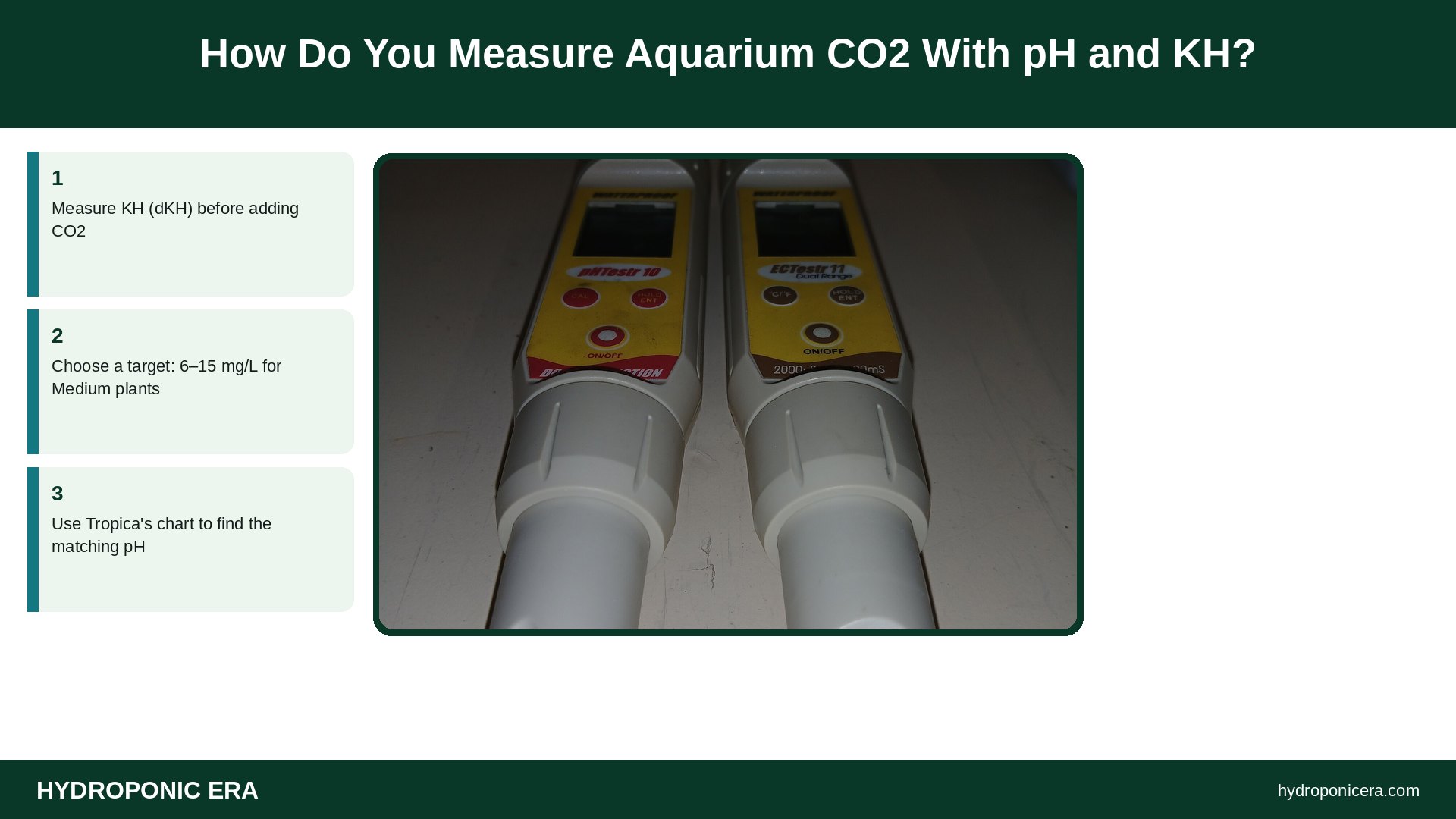
You measure aquarium CO2 indirectly through pH and carbonate hardness. Tropica explains that adding CO2 lowers pH and that the right pH depends on your water’s KH and the CO2 level you want. In Tropica’s example, water at 12 dKH needs a pH of about 7.5–7.8 to reach its recommended level for Medium plants.
| Step | Action |
|---|---|
| 1 | Measure KH (dKH) before adding CO2 |
| 2 | Choose a target: 6–15 mg/L for Medium plants |
| 3 | Use Tropica’s chart to find the matching pH |
| 4 | Adjust the bubble rate until pH holds there |
Use a reliable test kit or a calibrated pH meter, and test at the same time of day. Our GH and KH water tests guide explains KH testing.
Is Aquarium CO2 Safe for Fish?
Aquarium CO2 is safe for fish only within limits. SRAC explains that when CO2 in water is high, fish struggle to release CO2 through their gills, and the buildup reduces the ability of hemoglobin in their blood to carry oxygen. That can cause stress similar to suffocation. Fish gasping at the surface signal an overdose.
- Turn CO2 off at night; SRAC notes CO2 builds up overnight as organisms respire.
- Keep surface agitation so oxygen stays up; an aquaponics air pump can help at night.
- Raise CO2 slowly and stop if fish gasp.
- Never run CO2 without a check valve.
In ponds, SRAC reports CO2 usually peaks around 10–15 mg/L at dawn and treats 20 mg/L as a critical concentration, a useful reminder that fish tanks can overshoot too.
What Are DIY Alternatives to Aquarium CO2 Cylinders?
DIY aquarium CO2 alternatives include yeast-and-sugar reactors and liquid carbon products, but they are less precise than compressed gas. Tropica recommends compressed CO2, which lets you adjust the dose against pH. For small tanks, a small kit is simpler, and for easy plants, skipping CO2 entirely is often the safest choice.
For CO2 in hydroponic grow rooms instead of tanks, see CO2 enrichment for home hydroponics.
What Mistakes Cause Aquarium CO2 Problems?
Most aquarium CO2 problems come from raising the dose too fast or running gas at night. Other mistakes include poor circulation, which leaves pockets of low CO2, and adding CO2 without enough nutrients. Tropica says plants also need nitrogen, phosphorus, iron and manganese, so CO2 alone will not fix weak growth.
How many mg/L of aquarium CO2 do plants need?
Tropica recommends about 10–15 mg/L for Medium plants and 15–30 mg/L for Advanced plants. Easy plants grow without extra CO2.
Should I turn off CO2 at night?
Yes. Plants stop photosynthesis in darkness, and SRAC notes CO2 accumulates overnight as fish and other organisms respire.
Does CO2 lower pH in an aquarium?
Yes. Tropica explains that adding CO2 lowers pH, and the pH you need depends on your carbonate hardness (KH).
Can too much CO2 kill fish?
Yes. SRAC says high CO2 reduces the oxygen-carrying ability of fish blood, causing stress similar to suffocation.
Do I need CO2 for java fern or anubias?
Usually not. Tropica rates java fern low for CO2 and says anubias nana thrives in all conditions.
Sources
- Tropica Aquarium Plants. Fertiliser and CO2 for Your Aquarium.
- Tropica Aquarium Plants. CO2.
- Southern Regional Aquaculture Center. SRAC 468: Carbon Dioxide in Fish Ponds.
- Photo credits (Wikimedia Commons, edited with titles): Nature Aquarium Aquascape by Dileepkumardr (CC0); Planted Tank 03 – Flickr – The Wandering Angel by The Wandering Angel from Makati City, Philippines (CC BY 2.0); PH- und Leitfähigkeitsmessgeräte by Rotkaeppchen68 (CC0); Glow light tetra by Jim Zamichieli (CC BY-SA 3.0)
1 thought on “Aquarium CO2: 5 Easy Rules for Planted Tank Injection”