
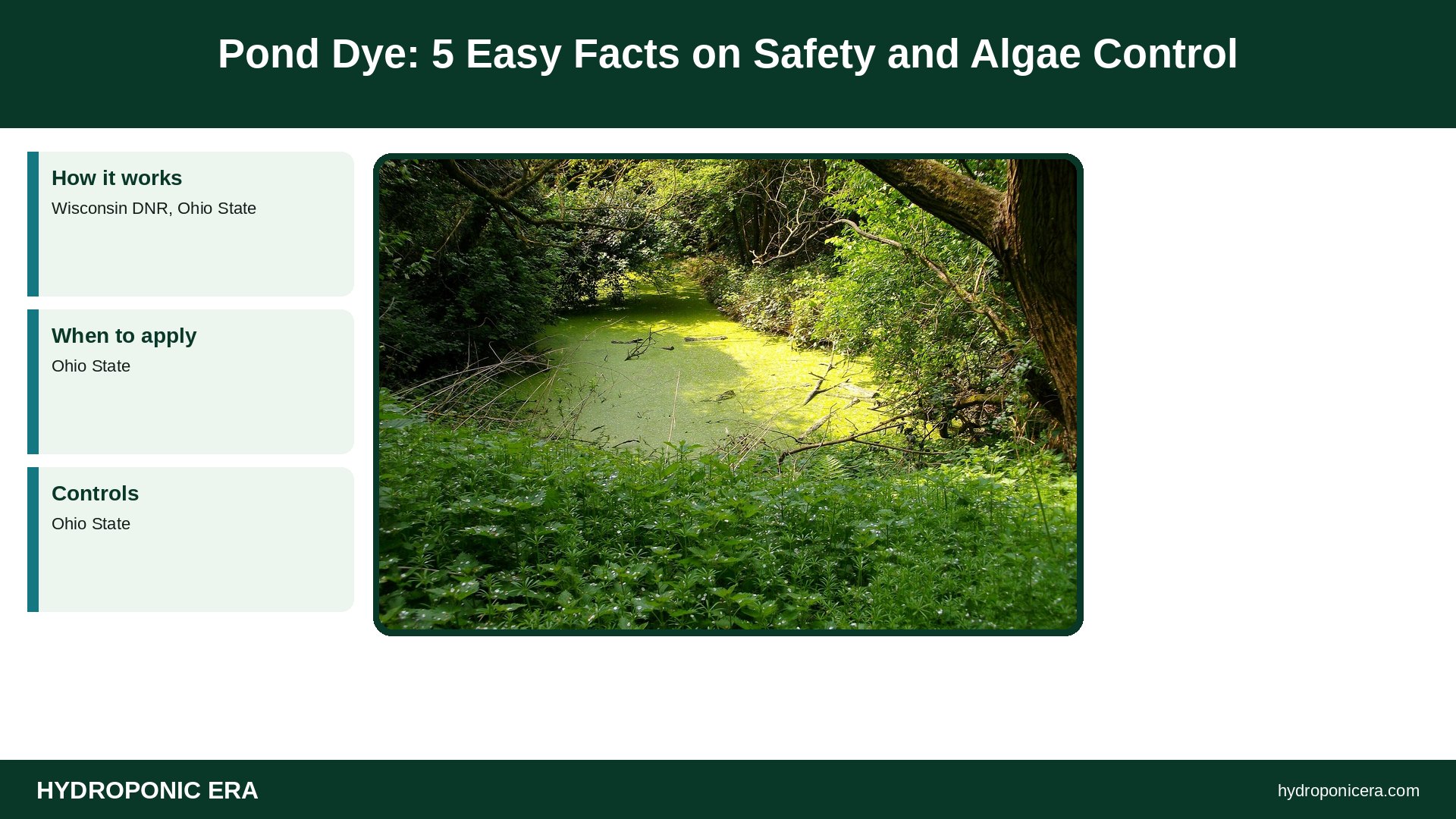
Does pond dye really control algae? Pond dye limits algae and submerged weeds by tinting water blue or black, which blocks the sunlight they need. Ohio State and Oklahoma State extension say it works best as prevention in early spring, in ponds with little overflow. It does not stop cattails or floating plants, and it needs reapplying as color fades.
Key takeaway: Pond dye shades the water so submerged plants and algae cannot grow in deeper areas. Apply it in early spring before growth starts, keep the color steady with a simple white-disk test, avoid ponds that overflow often, and never dye a pond already choked with weeds, because decaying plants can cause a low-oxygen fish kill.
| Question | Pond dye answer | Source |
|---|---|---|
| How it works | Blocks light needed for photosynthesis | Wisconsin DNR, Ohio State |
| When to apply | March or early April, before plants grow | Ohio State |
| Controls | Submerged weeds, filamentous and planktonic algae | Ohio State |
| Does not control | Cattails, lilies, duckweed on the surface | Ohio State |
| Reapply when | Visibility depth rises 25% | Ohio State, Oklahoma State |
| Fading | Half-life about 4 weeks (Aquashade) | Wisconsin DNR |
| Not for | Drinking water, streams, overflowing ponds | Wisconsin DNR, Oklahoma State |
How Does Pond Dye Work?
Pond dye works by reducing light. Wisconsin DNR explains that light-attenuating dyes block light transmission through the water column, lowering photosynthesis. Ohio State Extension adds that submerged plants grow only where enough light reaches the bottom, and blue dye shrinks that zone so growth is limited to the shallowest edges of the pond.
Some products are registered with the US EPA as aquatic pesticides. Wisconsin DNR notes that Aquashade blends blue and yellow dyes chosen to absorb wavelengths that plants need most. Always read and follow the label.
Is Pond Dye Safe for Fish?
Pond dye is generally considered low risk for fish when used as labeled. Wisconsin DNR reports that manufacturer tests found low toxicity to bluegill, rainbow trout and Daphnia, though little independent data exists. Oklahoma State says fish from dyed ponds are safe to eat, and swimming, livestock watering and irrigation are allowed once the dye has fully dispersed.
- Not for drinking: Ohio State says dyed ponds should not supply drinking water for people.
- Food web: Oklahoma State warns lower light reduces insects and other fish food, so skip dye where fishing matters.
- Handling: concentrate stains skin and clothes and can irritate eyes.
When Should You Apply Pond Dye?
Apply pond dye in early spring, before submerged plants and algae start growing. Ohio State Extension says application must happen in March or early April, because the goal is to prevent germination. Late doses after weeds have grown several feet off the bottom give poor results, since light still reaches the tops of the plants.
- Test that the pond has little inflow or overflow.
- Pour the labeled amount into the water; it spreads on its own within hours.
- Wait 48 hours, then lower a weighted white object and note the depth where it disappears.
- Re-check every two weeks at the same spot and time of day.
- Add dye when that depth increases by about 25%.
Ohio State gives an example: a baseline of 24 inches (61 cm) rising to 30 inches (76 cm) in May means it is time to add more.
What Does Pond Dye Not Control?
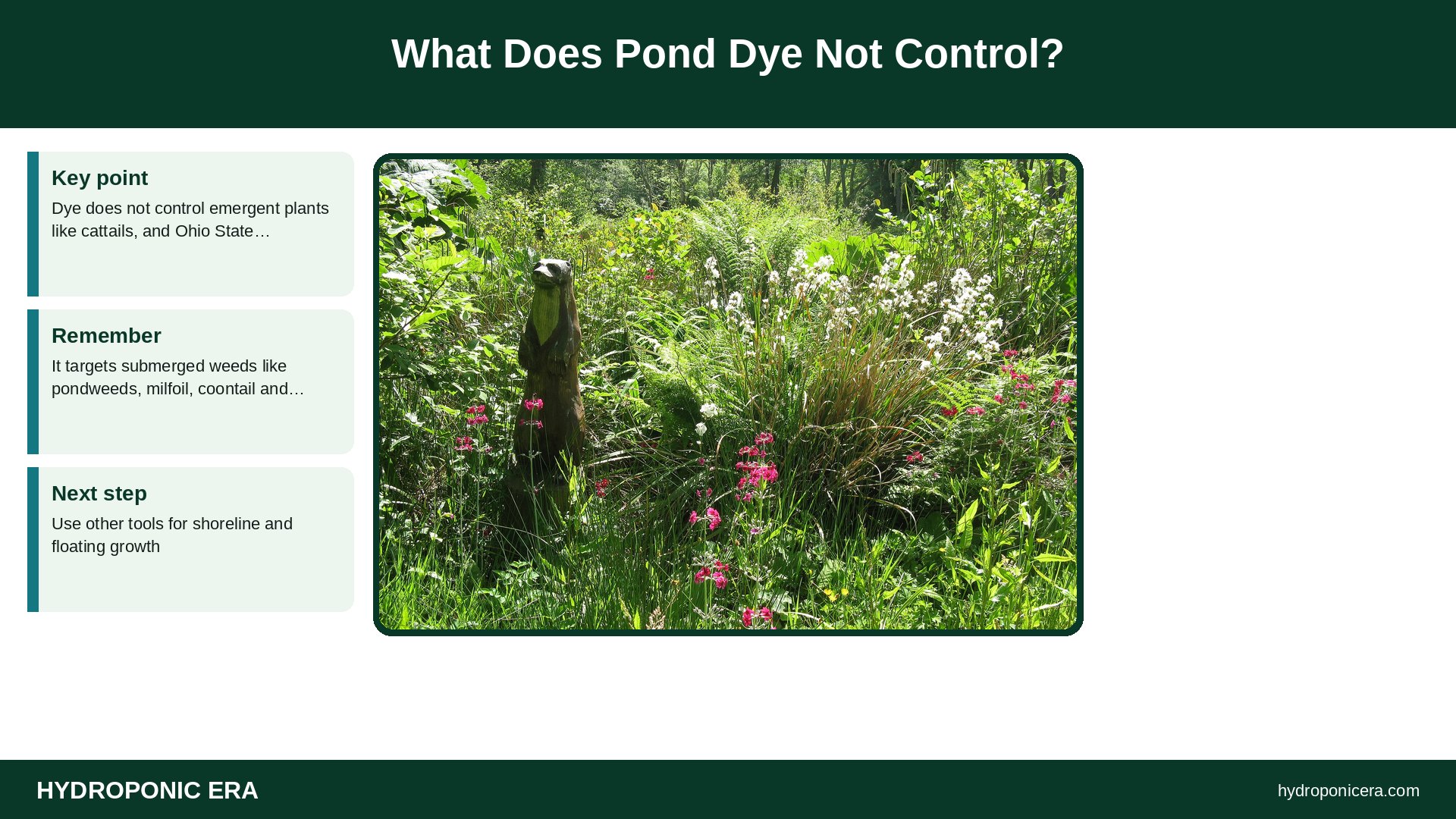
Dye does not control emergent plants like cattails, and Ohio State says it is not effective on floating-leaved plants such as duckweed and water lilies once their leaves reach the surface. It targets submerged weeds like pondweeds, milfoil, coontail and elodea, plus filamentous and planktonic algae. Use other tools for shoreline and floating growth.
For a natural approach in small water gardens, see our aquaponics algae control guide and our list of koi pond plants that shade the surface.
Why Is Pond Dye Not Working?
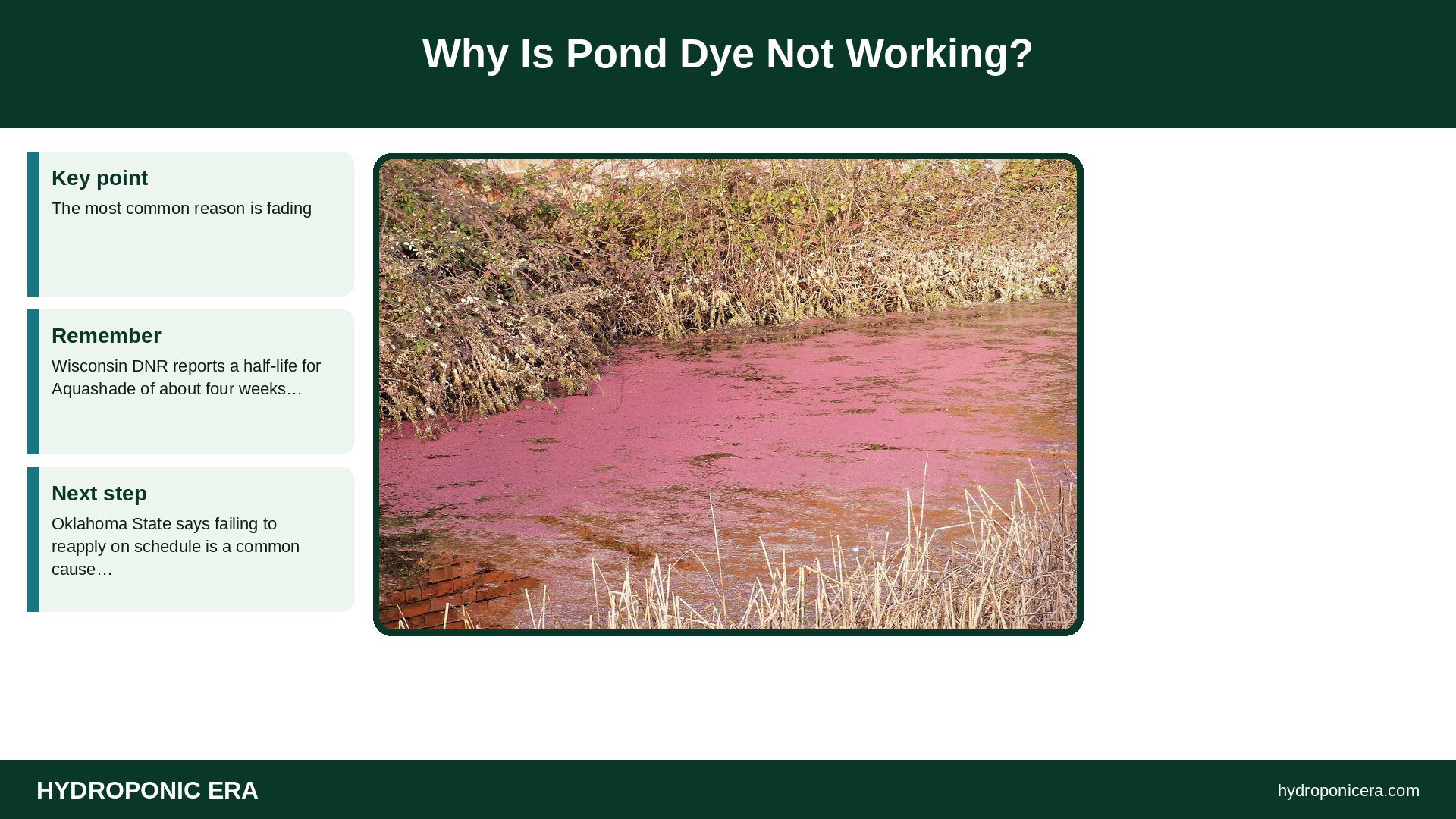
The most common reason is fading. Wisconsin DNR reports a half-life for Aquashade of about four weeks, as rain dilution, sunlight and microbes break it down. Oklahoma State says failing to reapply on schedule is a common cause of complaints, and ponds that overflow often lose dye too fast to keep the color.
- Ohio State notes that dye fading in late spring can trigger a late-summer algae or weed problem.
- Embankment ponds with large watersheds are poor candidates.
- Excavated ponds with little runoff respond best.
Dye is also a poor match for systems where you want plants to grow in the water, such as pond aquaponics. There, the goal is to feed useful plants with fish waste rather than block their light, so filters, shade from floating leaves and careful feeding usually do more good.
When Should You Not Use Pond Dye?
Do not use pond dye in a pond already full of weeds or with dense green algae. Oklahoma State warns this can cause algal scums and a low-oxygen fish kill as the plants decay. Wisconsin DNR says Aquashade should not be applied to streams, natural waters or water used for human consumption. For small backyard ponds, a bog filter and plants are often a better fit.
Does pond dye kill fish?
Used as labeled, it is considered low toxicity to fish, per manufacturer data cited by Wisconsin DNR. The bigger risk is oxygen loss if you dye a pond full of plants.
How long does pond dye last?
Wisconsin DNR reports a half-life of about four weeks for Aquashade. Plan to reapply as the label directs.
Can you swim in a pond with dye?
Yes. Oklahoma State and Ohio State say swimming is allowed after the dye has dispersed.
Blue or black pond dye?
Both block light. Ohio State describes blue dye shrinking the zone where plants can grow; pick the shade that suits your pond and follow the label.
Does pond dye kill existing algae?
It is mainly preventive. Oklahoma State says do not apply when submerged plants or algae are already abundant.
Sources
- Wisconsin Department of Natural Resources. Light-Attenuating Dyes (Colorants) Chemical Fact Sheet.
- Ohio State University Extension. Dyes and Aquatic Plant Management (A-16-06).
- Oklahoma Cooperative Extension Service. Dyes for Pond Weed Management (NREM-9224).
- Photo credits (Wikimedia Commons, edited with titles): Pond covered with green algae – geograph.org.uk – 2371127 by Stephen Rogerson (CC BY-SA 2.0); MareLambersart small pond Underwater03 by Lamiot (CC BY-SA 3.0); Pond-edge plants at Achamore Garden – geograph.org.uk – 5446824 by M J Richardson (CC BY-SA 2.0); Red Algae bloom on pond (51942054908) by gailhampshire (CC BY 2.0)