
Can you grow lovage hydroponically? Yes. Lovage hydroponics works best as a young-leaf crop: start lovage (Levisticum officinale) from seed in plugs, grow it in a Dutch bucket or deep water culture, and keep cutting the tender leaves. Mature lovage is a large perennial that Illinois Extension says grows 4–6 feet (1.2–1.8 m) tall, so indoor growers harvest it young or move it outdoors later.
Key takeaway: Lovage tastes like strong, sweet celery. Indoors, treat it as a cut-and-come-again herb in a large container system, give it at least 14–16 hours of grow light, and harvest young leaves often. Plan to divide, replant or move plants outdoors once they get big.
| Factor | What sources report | Source |
|---|---|---|
| Plant type | Hardy herbaceous perennial | RHS |
| Flavor | Celery-like, stronger and sweeter | Illinois Extension |
| Mature size | 4–6 feet (1.2–1.8 m) tall, about 3 feet (0.9 m) wide | Illinois Extension; NC State |
| Light | Full sun to partial shade; light shade improves quality | UC Master Gardeners; Illinois Extension |
| Indoor lighting | Grow lights 14–16 hours a day in winter | University of Maryland |
| Best harvest | Young leaves, picked often | Illinois Extension; UC Master Gardeners |
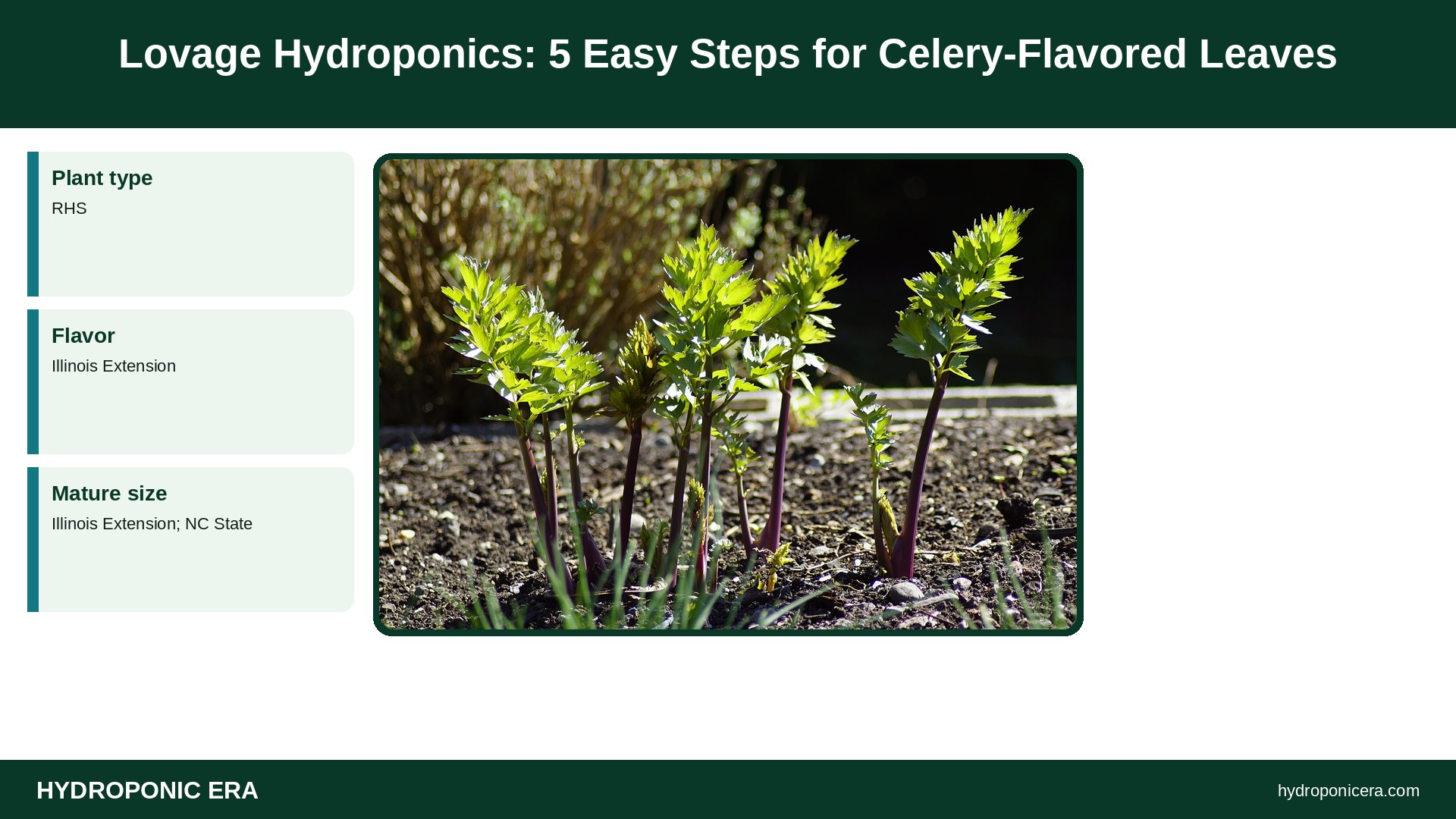
What Is Lovage?
Lovage is Levisticum officinale, a hardy herbaceous perennial in the celery and parsley family. The RHS says its leaves have a sweet celery flavor with a hint of aniseed and can be eaten raw or cooked. Illinois Extension notes the leaves, stems, roots and seeds are all edible.
Outdoors it forms a large clump and sends up flower stalks that the RHS says can reach 6 feet (2 m) by mid to late summer. NC State lists it for USDA zones 4–9. That size is the main challenge for indoor lovage hydroponics.
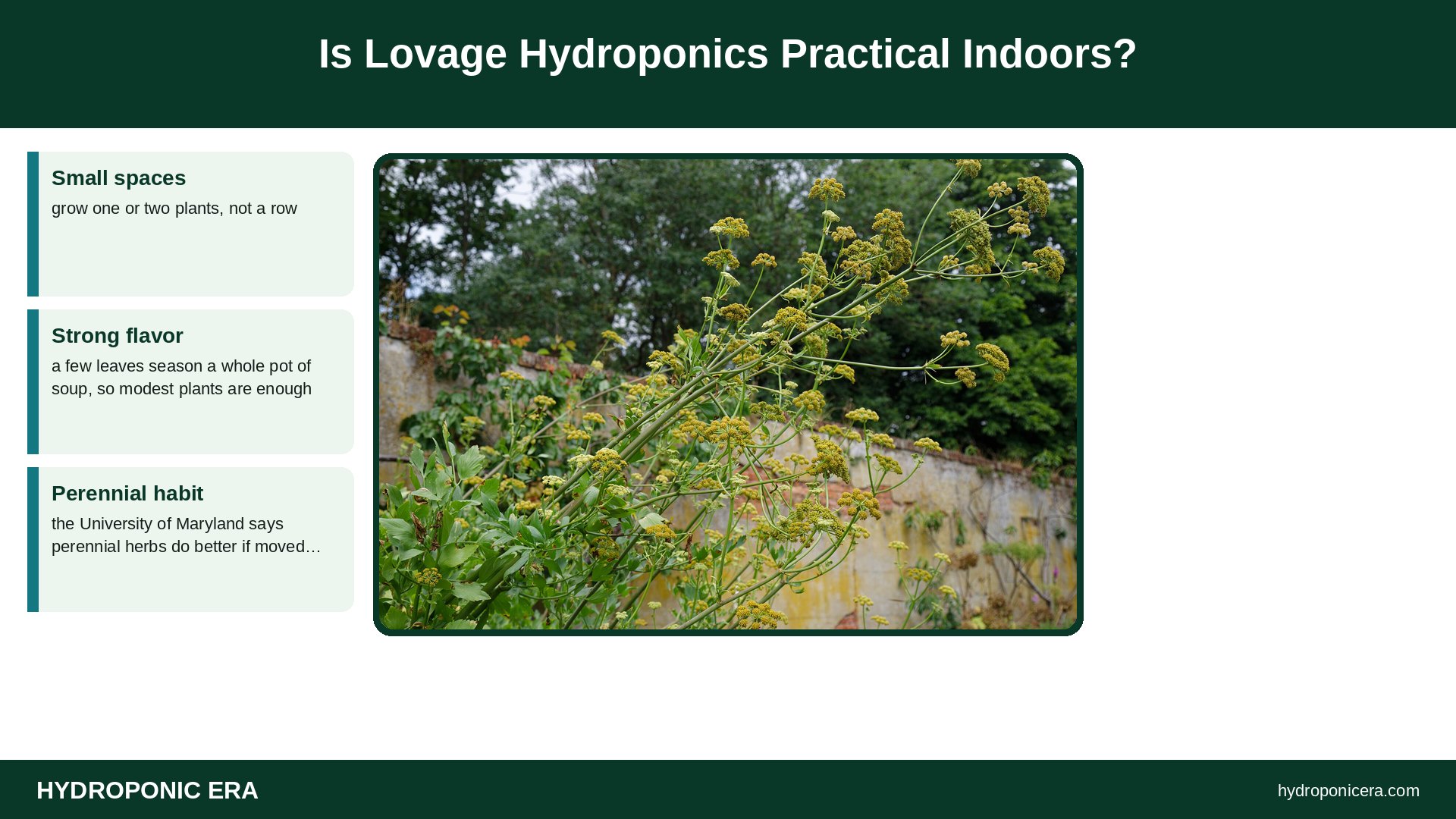
Is Lovage Hydroponics Practical Indoors?
Lovage hydroponics is practical if you grow it for young leaves rather than a full-size plant. A single plant in a 3–5 gallon (11–19 L) Dutch bucket or deep water culture tub can supply celery-flavored leaves for months. Regular cutting keeps it compact, and NC State notes the plant needs pruning to keep producing fresh leaves.
- Small spaces: grow one or two plants, not a row.
- Strong flavor: a few leaves season a whole pot of soup, so modest plants are enough.
- Perennial habit: the University of Maryland says perennial herbs do better if moved outdoors in summer.
If you are choosing a system, our DWC vs NFT vs Dutch bucket comparison explains which suits large herbs.
How Do You Start Lovage From Seed for Hydroponics?
Start lovage hydroponics from seed in spring in rockwool or coco plugs. The RHS recommends sowing lovage indoors in spring, and UC Master Gardeners say seed can be sown in spring or fall. Keep plugs evenly moist and warm, then move seedlings into net cups once roots appear.
- Sow 2–3 seeds per plug and cover lightly.
- Keep plugs moist and out of direct heat until seedlings emerge.
- Thin to the strongest seedling.
- Transplant into a Dutch bucket, large DWC tub or deep Kratky container.
- Start with a mild herb nutrient solution and increase strength as leaves expand.
Illinois Extension notes lovage can also be grown from division, so a piece of an existing garden clump is another starting point. See hydroponic nutrients for herbs for feeding guidance.
How Much Light Does Lovage Need Indoors?
Give lovage bright light for most of the day. UC Master Gardeners list full sun to partial shade, and Illinois Extension says light shade improves leaf quality. Indoors, the University of Maryland recommends at least 5 hours of sun or grow lights running 14–16 hours a day in winter.
Slightly softer light suits lovage hydroponics because leaf quality matters more than flowering. Read how much light herbs need to set your fixture height and timer.
How Do You Harvest Lovage?
Harvest lovage by picking young leaves and stems as needed. Illinois Extension notes young leaves are more tender, and UC Master Gardeners advise harvesting frequently to encourage new growth. Cut outer stems near the base and leave the center to keep producing. Remove flower stalks if you want leaves.
Use lovage leaves like celery leaves in soups, stews, salads and potato dishes. The RHS adds that young stalks can be blanched like celery or candied like angelica. A small handful is plenty, because the flavor is strong.
What Problems Affect Lovage Hydroponics?
The usual problems are plants outgrowing the system, hollow or tough stems on older growth and root crowding in small containers. Illinois Extension describes lovage as a vigorous plant, so plan space and container size before you start lovage hydroponics. Fresh cuttings and frequent pruning solve most issues.
- Too large: cut back hard, divide, or move the plant outdoors.
- Tough leaves: harvest younger growth more often.
- Crowded roots: use a bigger bucket or trim roots when dividing.
- Pale growth: raise light hours or nutrient strength slightly.
Hollow stems are normal in lovage, so do not mistake them for a disease.
What Is the Best System for Lovage Hydroponics?
The best system for lovage hydroponics is a Dutch bucket or a large deep water culture tub, because the plant builds a big root system. Small Kratky jars are fine for seedlings but run dry quickly once lovage grows. Lovage hydroponics in a 5 gallon (19 L) container gives roots room and keeps the reservoir stable.
| System | Fit for lovage hydroponics | Notes |
|---|---|---|
| Dutch bucket | Excellent | Perlite or clay pebbles anchor roots |
| Large DWC tub | Very good | Needs strong aeration |
| Kratky jar | Seedlings only | Move up as plants grow |
| NFT channel | Poor | Roots soon block the channel |
Lovage hydroponics also pairs well with other large herbs in a multi-bucket system, such as celery. Read how to grow celery hydroponically for a related crop with similar feeding needs. Check the reservoir weekly, top up with fresh solution and trim roots if they start circling the bucket.
FAQ About Lovage Hydroponics
Does lovage taste like celery?
Yes. Illinois Extension describes it as like celery, only stronger and sweeter.
Can lovage grow indoors year-round?
It can for a while, but the University of Maryland notes perennial herbs do better if moved outdoors in summer.
How big does lovage get?
About 4–6 feet (1.2–1.8 m) tall outdoors according to Illinois Extension.
Which parts of lovage are edible?
Leaves, stems, roots and seeds.
How do I keep lovage small?
Harvest often and remove flower stalks.
Sources
- Royal Horticultural Society — How to grow lovage
- University of Illinois Extension — Lovage
- NC State Extension — Levisticum officinale
- University of Maryland Extension — Growing herbs in containers and indoors
- UC Master Gardeners of Santa Clara County — Lovage
- Photo credits (Wikimedia Commons, edited with titles): Junger Liebstöckel by Dompett (CC BY-SA 4.0); Lovage Levisticum officinale Easton Lodge Gardens walled garden by Acabashi (CC BY-SA 4.0)