
Can tomato spotted wilt virus infect hydroponic plants? Yes. Tomato spotted wilt virus is spread by thrips, not by soil or water, so hydroponic tomatoes, peppers, lettuce and herbs are just as exposed as soil crops. UMass notes that western flower thrips are the most important greenhouse vector. Controlling thrips and removing infected plants are the core defenses.
Key takeaway: Tomato spotted wilt virus (TSWV) causes bronzed young leaves with small brown spots, dieback of growing tips and ringspots on fruit. Thrips carry it from plant to plant, and there is no cure for infected plants. Screen out thrips, inspect new plants, use resistant varieties and pull infected plants early.
| Factor | What sources report | Source |
|---|---|---|
| Vector | Thrips, mainly western flower thrips | UMass; UC IPM |
| Host range | More than 1,000 plant species | NC State Extension |
| Acquisition | Larval thrips feeding on infected plants | UMass; UC IPM |
| Latent period | 3–18 days before thrips transmit | UMass |
| Tomato resistance | Sw-5 gene | UC IPM; NC State |
| Pepper resistance | Tsw gene | NC State Extension |
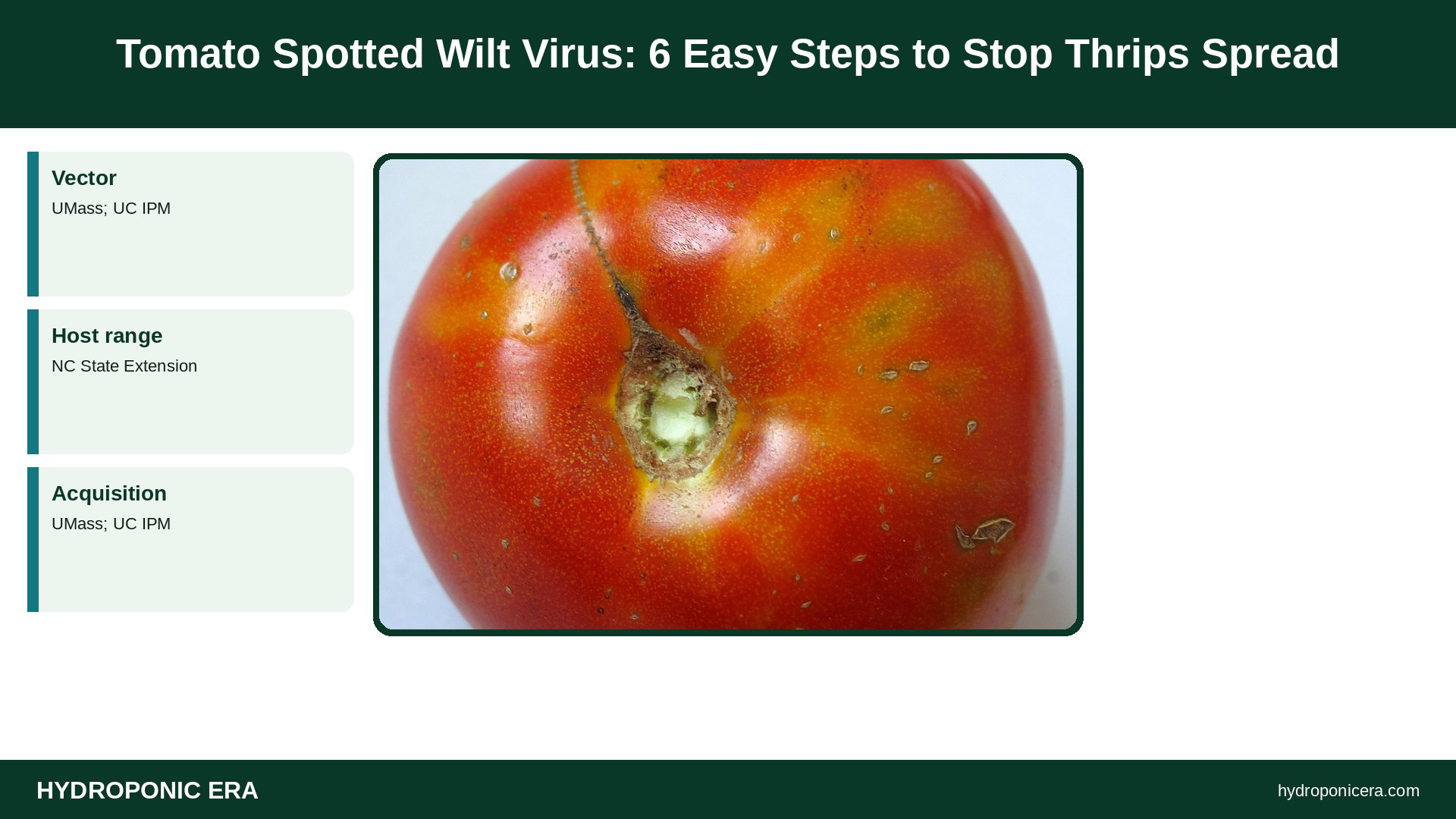
What Is Tomato Spotted Wilt Virus?
Tomato spotted wilt virus is an orthotospovirus that thrips spread between plants. NC State Extension says it infects more than 1,000 plant species, including tomatoes, peppers, lettuce, spinach, onions, eggplant and peppermint, along with many bedding plants. UMass notes almost all greenhouse crops are susceptible except poinsettias and roses.
The name comes from tomato symptoms: spotting followed by wilt. UMass also says the virus can spread through vegetative propagation of infected plants, so cuttings from an infected mother plant carry it too.
How Do You Identify Tomato Spotted Wilt Virus?
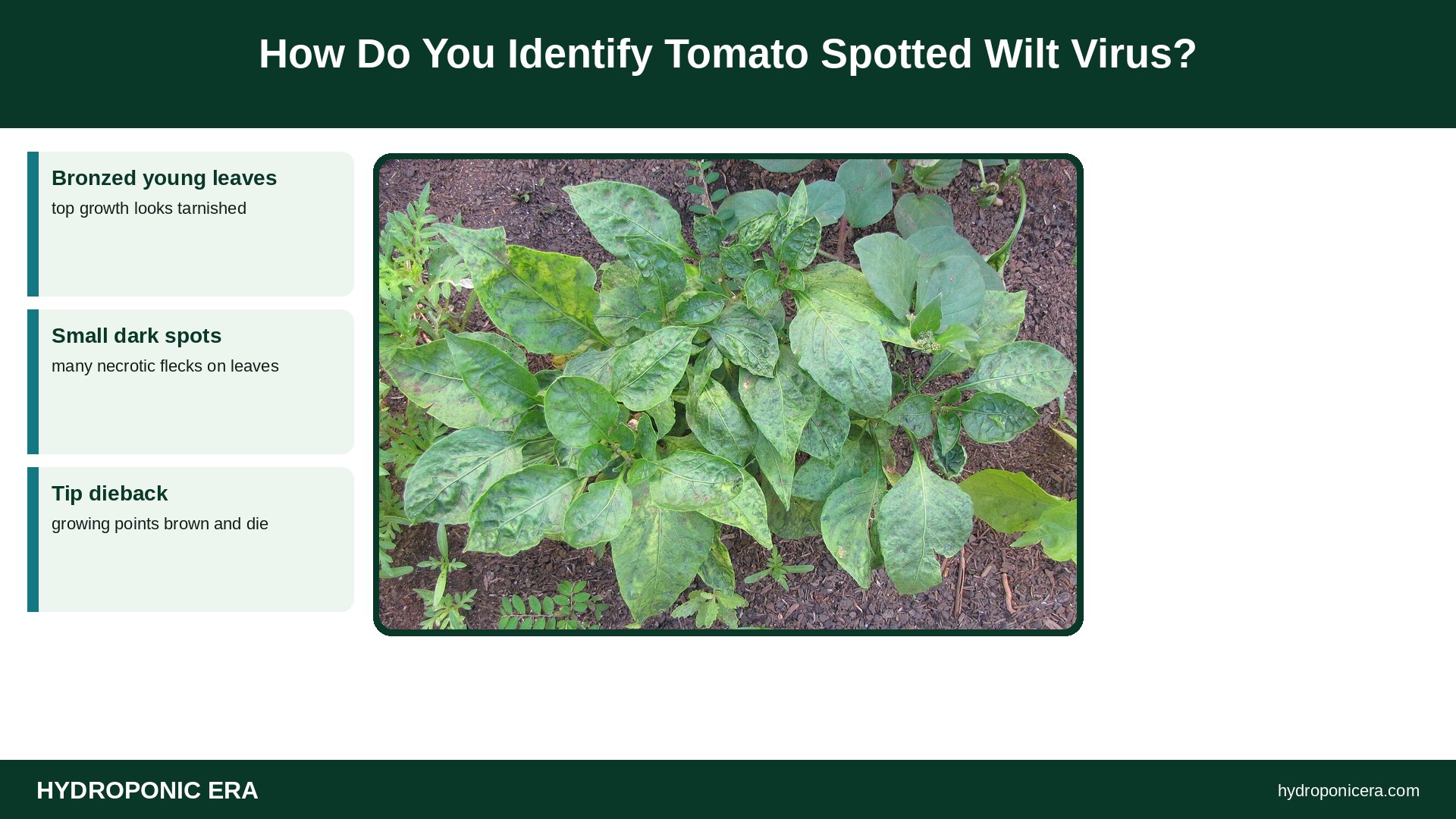
On tomatoes, identify tomato spotted wilt virus by bronzing on the upper side of young leaves that develops small brown or black spots, often with downward cupping and tip dieback. UC IPM says ripe fruit show yellow blotches with concentric rings. On peppers, NC State describes brown spots, ringspots and sunken fruit rings.
- Bronzed young leaves: top growth looks tarnished.
- Small dark spots: many necrotic flecks on leaves.
- Tip dieback: growing points brown and die.
- Ringspots on fruit: yellow rings or blotches.
NC State warns that symptoms overlap with other viruses, so get a lab diagnosis. Compare with our page on tomato yellow leaf curl virus, which is spread by whiteflies instead.
How Do Thrips Spread Tomato Spotted Wilt Virus?
Thrips pick up the virus only as larvae feeding on infected plants, then carry it for life, according to UMass and UC IPM. UMass says thrips acquire it after about 30 minutes of feeding, and after a 3 to 18 day latent period can transmit it to any susceptible plant. Adults do most spreading because they fly.
The virus does not pass through thrips eggs, UC IPM notes, so each new generation must feed on an infected plant first. In a hydroponic room, one infected plant plus a thrips population can spread the virus quickly. Learn the pest side in our guide to thrips in hydroponics.
How Do You Prevent Tomato Spotted Wilt Virus in Hydroponics?
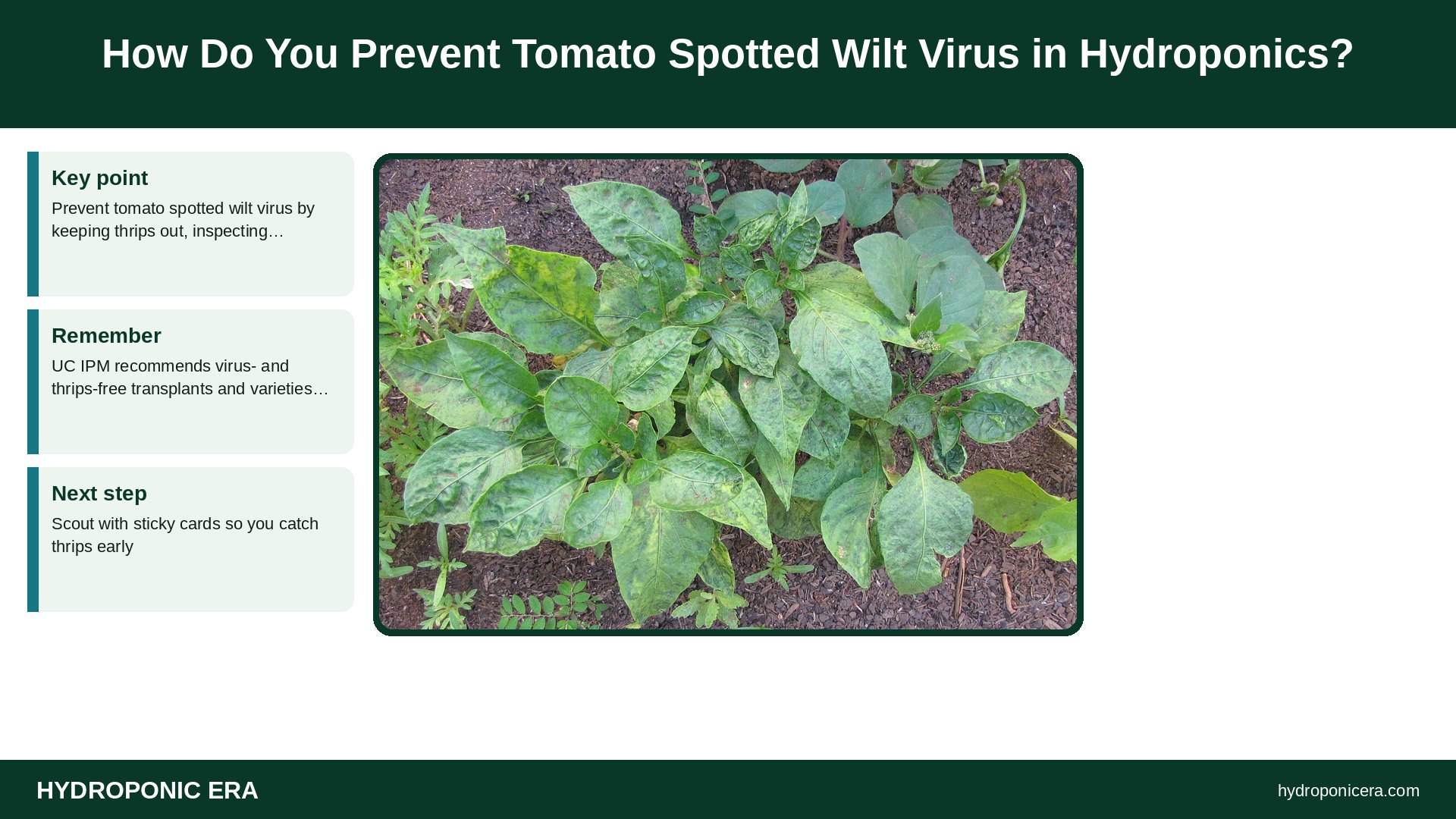
Prevent tomato spotted wilt virus by keeping thrips out, inspecting and quarantining new plants, choosing resistant varieties and removing weeds or ornamentals that host the virus. UC IPM recommends virus- and thrips-free transplants and varieties with the Sw-5 gene. Scout with sticky cards so you catch thrips early.
- Buy transplants from growers that manage thrips.
- Quarantine and inspect all new plants and cuttings.
- Choose Sw-5 tomatoes and Tsw peppers where available.
- Monitor thrips with sticky traps, as UMass advises.
- Keep bedding plants and weeds away from vegetable crops.
- Remove plants with symptoms right away.
See our guides to quarantining new plants and clones and sticky trap placement.
Can You Cure Tomato Spotted Wilt Virus?
No. Infected plants cannot be cured, so remove and destroy them, then manage thrips to stop further spread. UC IPM advises removing infected plants at the seedling stage and controlling thrips when symptoms appear. Bag plants before carrying them through the room so thrips do not fly off onto healthy crops.
| Action | Purpose | Source |
|---|---|---|
| Lab diagnosis | Rule out other viruses | NC State Extension |
| Remove infected plants | Remove virus source | UC IPM |
| Control thrips | Stop new infections | UC IPM; UMass |
| Clear old crops after harvest | Break the cycle | UC IPM |
Does Resistance Stop Tomato Spotted Wilt Virus?
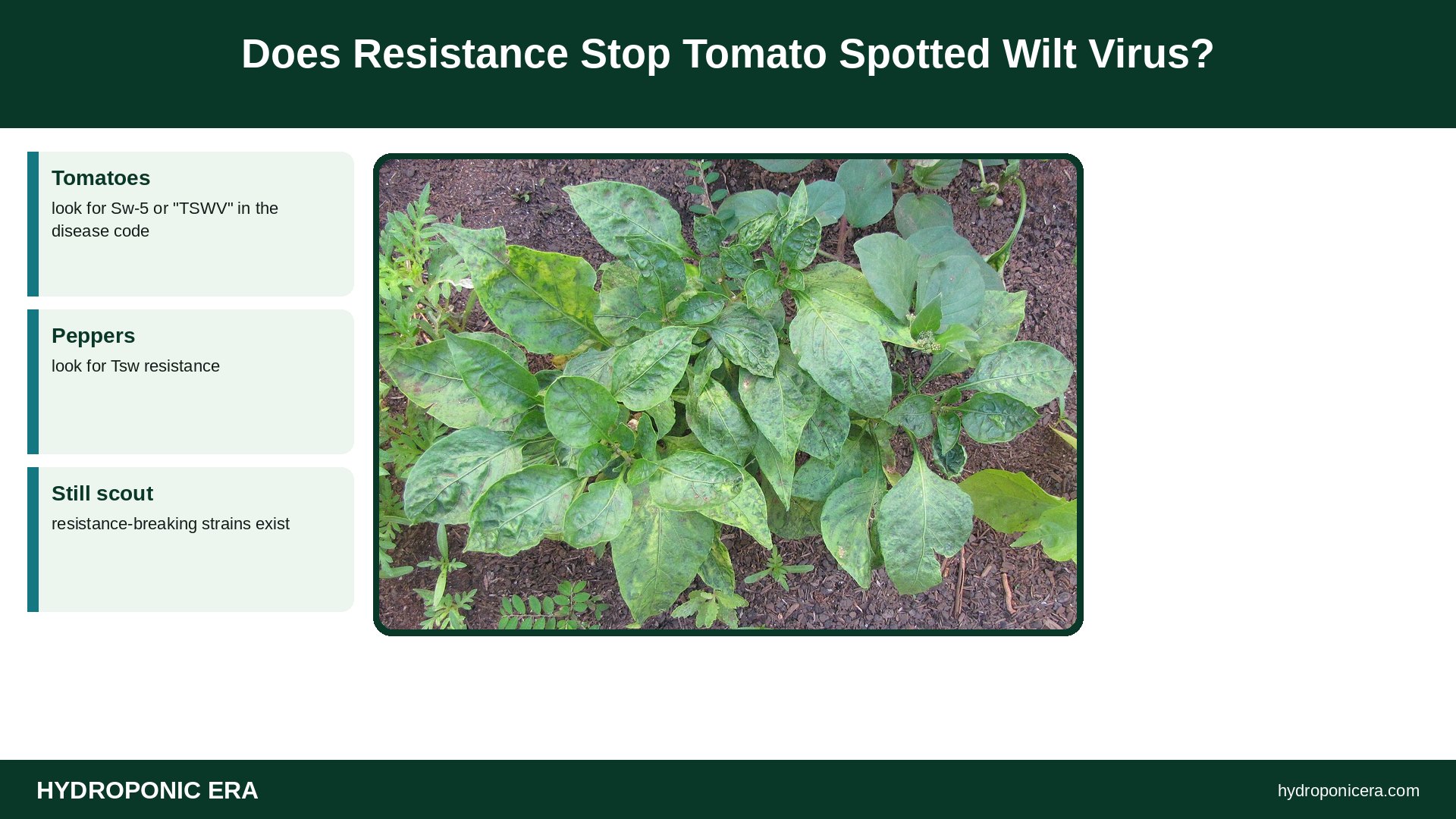
Resistance helps but is not perfect. NC State Extension reports resistance-breaking variants found on Sw-5 tomatoes in North Carolina in 2022. It also notes resistance genes are expressed only in foliage, not flowers or fruit, so a resistant plant can still show fruit symptoms. Combine resistant varieties with thrips control.
- Tomatoes: look for Sw-5 or “TSWV” in the disease code.
- Peppers: look for Tsw resistance.
- Still scout: resistance-breaking strains exist.
Which Hydroponic Crops Are at Risk?
Most of them. NC State lists tomatoes, peppers, lettuce, spinach, onions, eggplant and herbs such as peppermint as hosts, and UMass says many bedding plants are susceptible. UMass advises not growing vegetable transplants in the same greenhouse as susceptible ornamentals, so keep flowers and food crops apart where you can.
How Do You Reduce Thrips in a Hydroponic Grow Room?
Reducing thrips is the most practical way to protect plants from this virus. UMass notes that only a small number of infected thrips is needed to start an epidemic, so the goal is thorough control. Monitoring with sticky traps shows when numbers rise, and quick action keeps adult thrips from spreading the virus around the room.
- Monitor weekly: count thrips on sticky traps and record numbers.
- Check flowers: thrips hide in blossoms and growing tips.
- Separate crops: keep ornamentals and vegetable transplants apart.
- Clean between crops: remove all old plants and weeds.
Biological controls such as predatory mites and labeled insecticides are options for commercial growers. Pick a method based on your crop, and rotate insecticide groups to avoid resistance.
FAQ About Tomato Spotted Wilt Virus
Does tomato spotted wilt virus spread through nutrient solution?
No. Sources describe spread by thrips and by propagating infected plants.
Can lettuce get tomato spotted wilt virus?
Yes. NC State lists lettuce among its hosts.
Are tomatoes with spotted wilt safe to eat?
The virus infects plants, not people; spotted fruit is a quality loss.
How fast do thrips spread tomato spotted wilt virus?
UMass gives a 3–18 day latent period before infected thrips transmit.
Can I take cuttings from an infected plant?
No. UMass says vegetative propagation spreads the virus.
Sources
- UC IPM — Tomato spotted wilt
- NC State Extension — Tomato spotted wilt virus on tomato and pepper
- UMass Amherst — Impatiens necrotic spot virus and tomato spotted wilt virus
- Photo credits (Wikimedia Commons, edited with titles): Tomato with Tomato Spotted Wilt Virus by Downtowngal (CC0); Pepper infected with tomato spotted wilt virus by Carlos Gonzalez (CC BY-SA 3.0)