
Do rove beetles control fungus gnats in hydroponics? Yes, in media-based systems. The rove beetle Dalotia coriaria (formerly Atheta) lives in moist growing media and eats fungus gnat larvae, shore fly larvae and thrips pupae. UConn Extension says adults are best released in the evening and that, once established, populations can persist year-round. They need media, so they will not help in bare-root DWC or NFT.
Key takeaway: Dalotia coriaria is a small, glossy black beetle about 1/8 inch (3–4 mm) long, sold to greenhouse growers as a soil-dwelling predator. Kansas State University reports females can lay up to 114 eggs over a lifespan of about 50 days. UConn lists 65–80°F (18–27°C) and 50–85% relative humidity as optimum conditions for survival.
| Fact | What sources report | Source |
|---|---|---|
| Name | Dalotia (formerly Atheta) coriaria | K-State; UNH |
| Adult size | About 1/8 in (3–4 mm) | K-State; UConn |
| Prey | Fungus gnat larvae, shore fly larvae, thrips pupae | K-State; UConn |
| Life cycle | About 17 days at 79°F (26°C) | UConn Extension |
| Optimum | 65–80°F (18–27°C), 50–85% RH | UConn Extension |
| Release time | Evening; adults are nocturnal | UConn Extension |
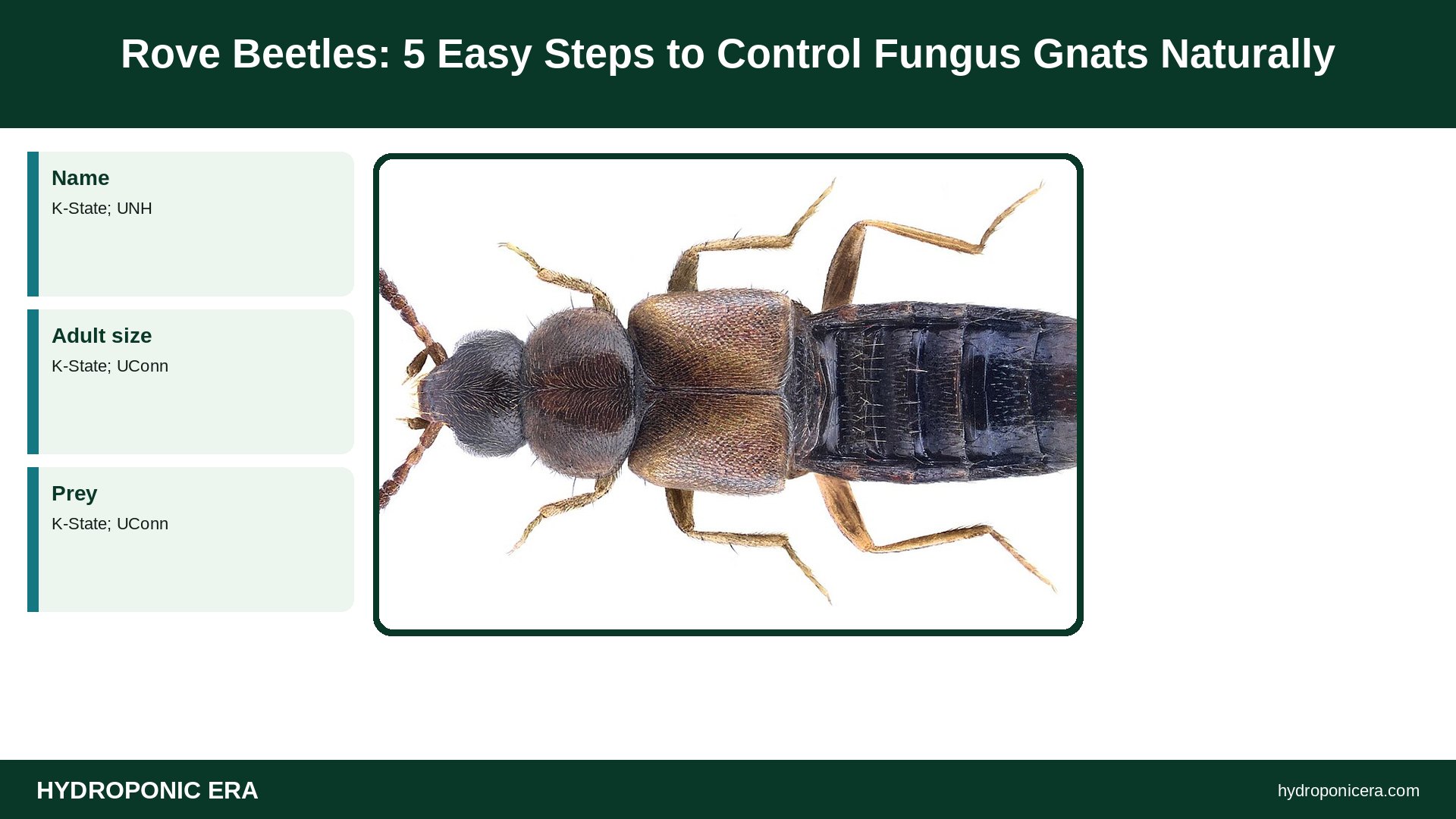
What Are Rove Beetles?
Rove beetles used for pest control are Dalotia coriaria, slender beetles whose short wing covers are much shorter than the body. K-State describes adults as glossy, black and hairy, about 1/8 inch (3–4 mm) long. Larvae are white when young and turn light brown with age. Adults can fly but spend most of their time in the growing medium.
K-State says the life cycle runs egg, larva, pupa and adult, and pupae are covered in media particles held together by silk. UConn notes females live about 48 days and males about 60 days.
What Do Rove Beetles Eat?
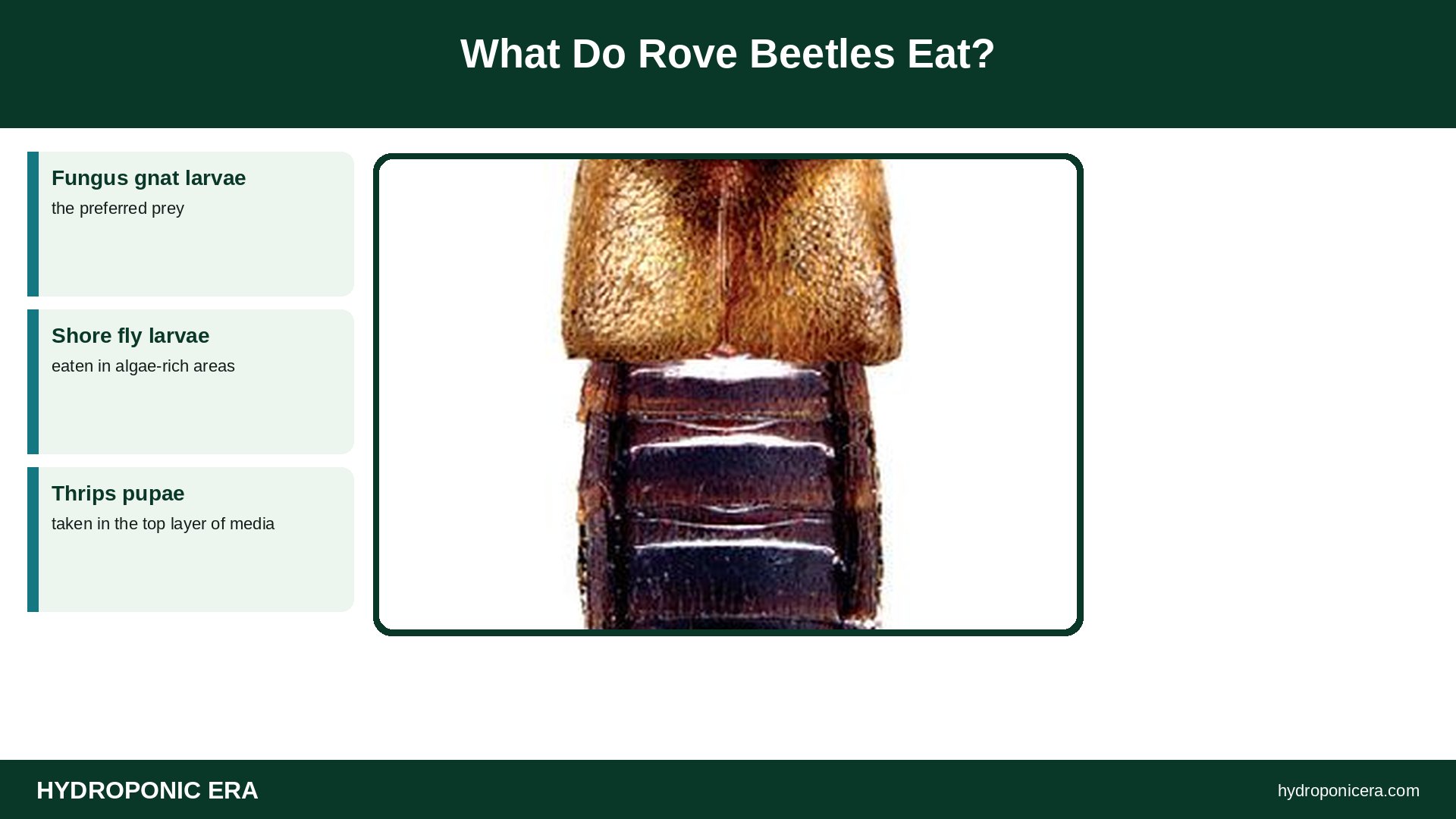
They eat soil-stage pests in moist media. K-State says adults and larvae feed on fungus gnat larvae and thrips pupae and will also feed on organic matter and mold. UConn adds shore fly larvae but says they prefer fungus gnat larvae. Larvae will not develop into pupae without prey, so beetles need pests or a supplied food source.
- Fungus gnat larvae: the preferred prey.
- Shore fly larvae: eaten in algae-rich areas.
- Thrips pupae: taken in the top layer of media.
- Organic matter and mold: backup food.
Learn to tell the pests apart in our guide to shore flies vs fungus gnats.
Do Rove Beetles Work in Hydroponic Systems?
They work where there is moist media. K-State says adults and larvae move on the media surface but tend to stay just below it, and UConn says both stages hide in cracks and crevices of the growing medium. Coco coir, soilless mixes and wet floors under benches suit them. Bare-root deep water culture and NFT give them nowhere to live.
| System | Suitable? | Reason |
|---|---|---|
| Coco or peat-based pots | Yes | Moist media holds prey and beetles |
| Ebb-and-flow media beds | Often | Moist surface between floods |
| Wet floors under benches | Yes | UNH notes gnats breed there |
| DWC and NFT | No | No media layer |
How Do You Release Rove Beetles?
Release them in the evening onto moist media. UConn says adults are nocturnal, so evening releases work best, and suppliers ship adults and larvae mixed in inert material. Some suppliers offer breeding buckets with media and food that let beetles exit gradually; UConn says these go in shaded areas under benches. Moisten the media before release.
- Moisten the growing media first.
- Release in the evening.
- Place small piles of carrier material near infested pots.
- Put breeder buckets in shade under benches.
- Ask your supplier for release rates.
How Many Rove Beetles Do You Need?
Rates vary, so start with supplier guidance. K-State research found fungus gnat larva consumption increased as beetle numbers rose up to four adults per 4-inch (10 cm) container. For thrips pupae, K-State recommends four adults per 6-inch (15 cm) container and says a 1:15 predator-to-prey ratio is sufficient. K-State also warns crowding can lead to cannibalism.
Track adult gnats with sticky traps to judge whether populations are falling.
Can Rove Beetles Be Used With Other Biocontrols?
Yes, with care. UConn says rove beetles are compatible with beneficial nematodes, and UNH notes rove beetles control larvae but take longer to establish than predatory mites. K-State’s Stratiolaelaps fact sheet warns that Dalotia feeds on Stratiolaelaps mites, so avoid releasing both together. Nematodes are the safer partner. See beneficial nematodes and fungus gnats in hydroponics.
What Is the Rove Beetle Life Cycle?
Rove beetles develop quickly in warm media. UConn says the life cycle from egg to adult takes about 17 days at 79°F (26°C), eggs hatch in three to four days, and there are three larval stages. Females lay an average of about 90 eggs, according to UConn, while K-State reports up to 114 eggs and a 1:1 female-to-male ratio.
| Stage | Detail | Source |
|---|---|---|
| Egg hatch | 3–4 days | UConn Extension |
| Larval stages | Three | K-State; UConn |
| Egg to adult | About 17 days at 79°F (26°C) | UConn Extension |
| Adult life | About 48 days (females), 60 (males) | UConn Extension |
K-State notes longer-lived adults keep hunting and laying eggs for weeks, which improves control.
How Can You Rear Rove Beetles at Home?
K-State gives a simple rearing method: a plastic container of moist, mostly peat-based media, heated in a microwave and cooled, with moistened oats on top as food. Keep it dark, check twice a week, keep the media moist and add new oats weekly. Collect adults and place the vial on the media surface to release them.
FAQ About Rove Beetles
Are rove beetles harmful to plants?
No; they feed on small pests, organic matter and mold.
Can rove beetles fly?
Yes; adults fly, which helps them spread from release sites.
Why can’t I find rove beetles after release?
UConn says they hide in cracks in the media.
Do rove beetles eat predatory mites?
K-State says Dalotia feeds on Stratiolaelaps mites.
How long do rove beetles live?
K-State reports about 50 days for adult females.
Sources
- Kansas State University — Rove beetle, MF3614
- UConn Extension — Biological control of fungus gnats
- UNH Extension — Fungus gnats fact sheet
- Kansas State University — Stratiolaelaps scimitus, MF3632
- Photo credits (Wikimedia Commons, edited with titles): Dalotia coriaria (Kraatz, 1856) by URSchmidt (CC BY-SA 4.0); Dalotia coriaria by Reginald Webster, Jan Klimaszewski, Georges Pelletier, Karine Savard (CC BY 3.0)