
Can you use copper fungicide on hydroponic plants? Yes, on labeled crops, but carefully. Copper fungicide protects leaves against many fungal and bacterial diseases, yet Cornell notes lettuce, crucifers and strawberry are sensitive to copper injury. Use fixed-copper products at label rates, keep spray out of the nutrient solution and avoid acidic tank mixes, which release more copper ions and raise the risk of leaf damage.
Key takeaway: Copper fungicide works because copper ions damage microbes on the leaf surface before they infect. Oregon State’s Pacific Northwest handbook says copper products are protectants against bacterial, fungal and oomycete diseases. The same ions can burn sensitive plants, so formulation, spray pH, wet leaves and young tissue all affect the risk of injury.
| Fact | What sources report | Source |
|---|---|---|
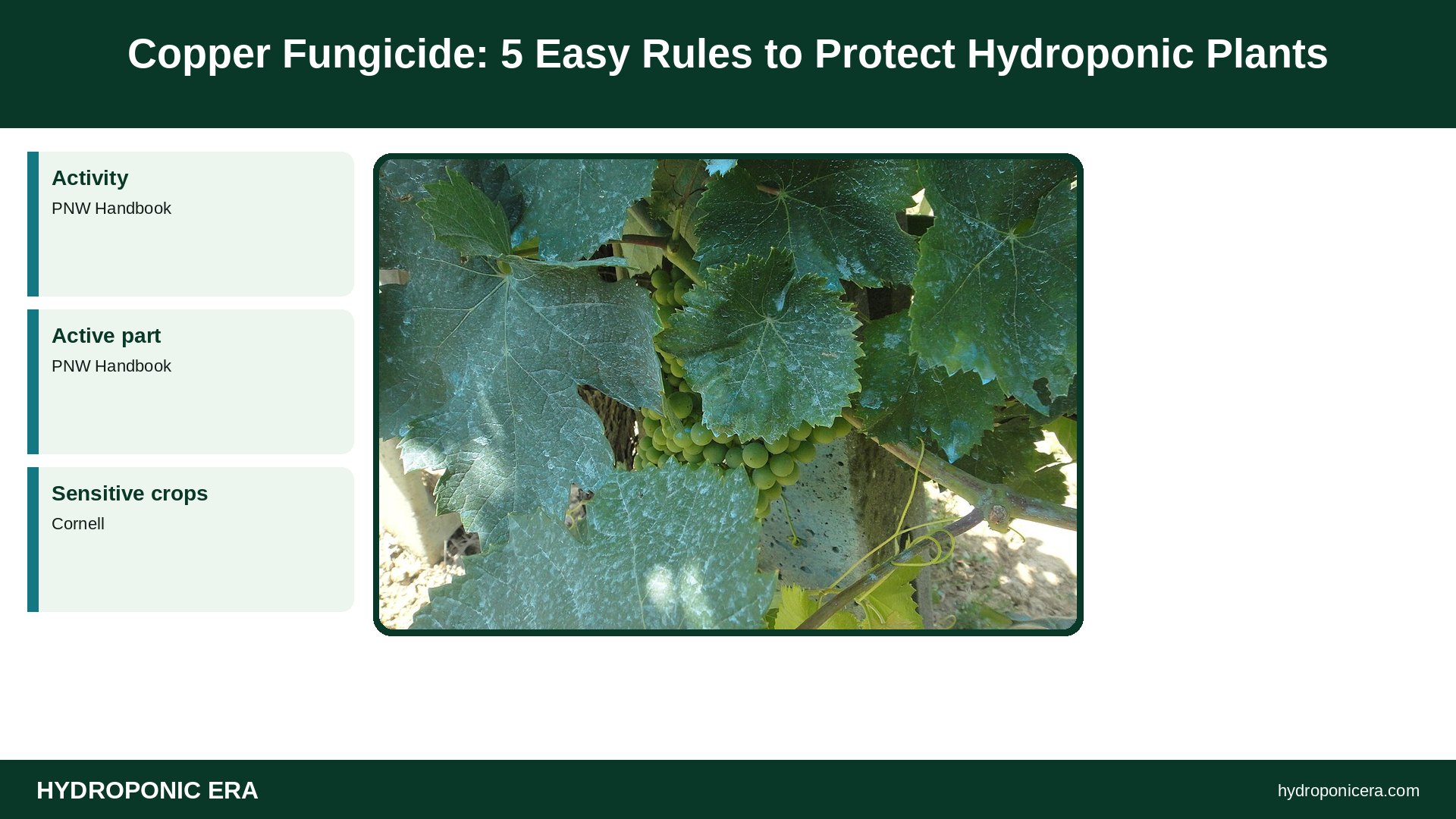
| Activity | Protectant against fungi, bacteria, oomycetes | PNW Handbook |
| Active part | Copper ion (Cu2+) | PNW Handbook |
| Sensitive crops | Lettuce, crucifers, strawberry | Cornell |
| Typical injury | Tiny black spots on outer leaves | Cornell |
| Raises injury risk | Low spray pH, wet leaves, young tissue | Cornell |
| Organic status | Listed among organic fungicides | Purdue Extension |
What Is Copper Fungicide?
Copper fungicide is a group of products whose active ingredient is the copper ion. The Pacific Northwest Plant Disease Handbook explains that copper interacts with nucleic acids, energy transport and cell membranes in microbes, giving broad activity against bacteria, fungi and water molds such as downy mildews. Common forms include copper hydroxide, copper oxychloride, copper octanoate and fixed copper sulfate.
Purdue Extension lists copper among the main organic fungicides, alongside sulfur, oils and bicarbonates, and says copper fungicides kill fungi and bacteria but must be used with care to avoid damaging the host plant.
What Diseases Does Copper Fungicide Control?
It prevents many leaf diseases rather than curing them. The PNW handbook calls copper products protectants for bacterial, fungal and oomycete diseases. In hydroponic greens and fruiting crops, that can include bacterial leaf spots and downy mildew, if the product label lists your crop and disease. Purdue notes Bordeaux mixture is also bactericidal, unlike sulfur.
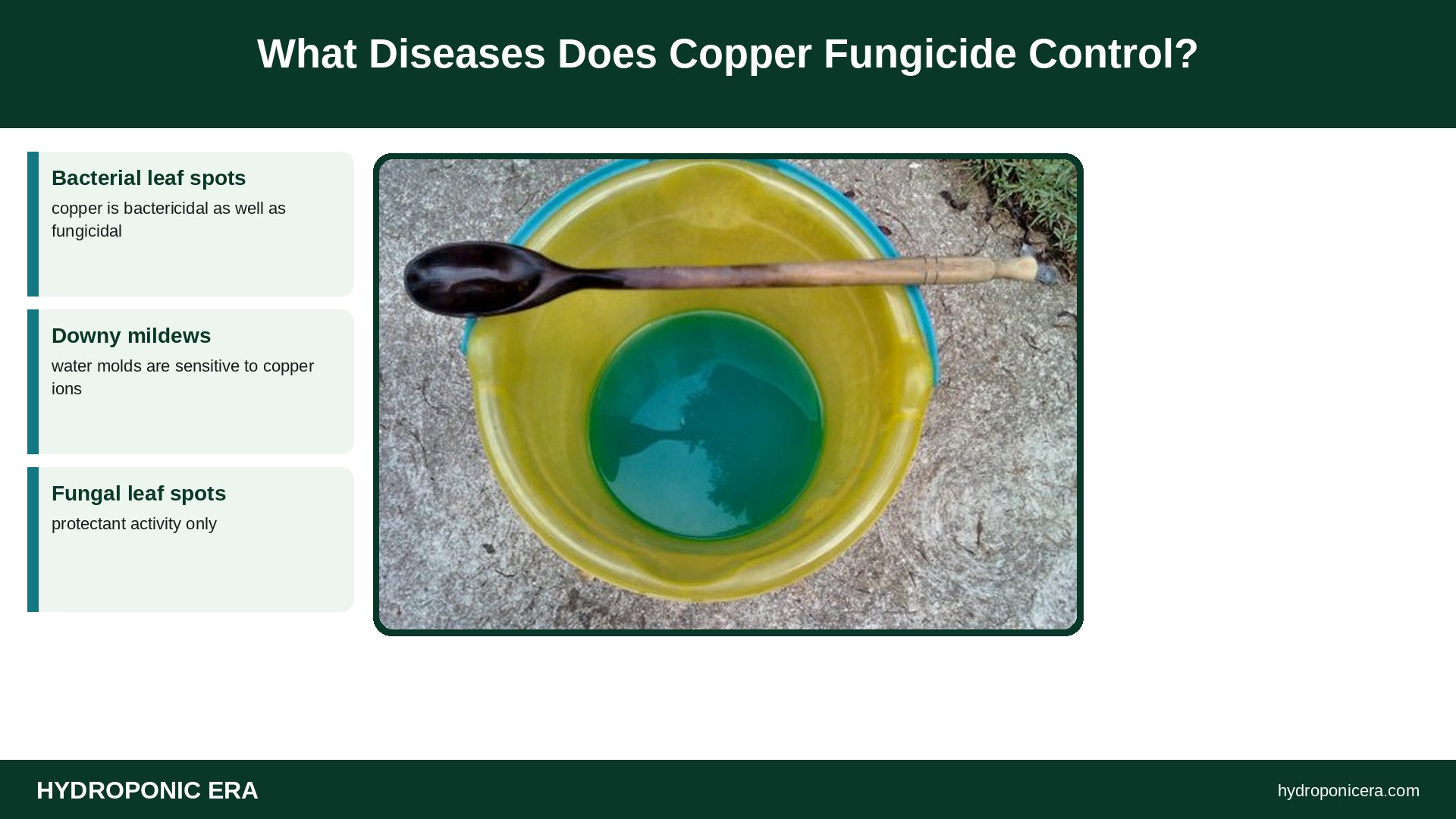
- Bacterial leaf spots: copper is bactericidal as well as fungicidal.
- Downy mildews: water molds are sensitive to copper ions.
- Fungal leaf spots: protectant activity only.
- Root diseases: foliar copper is not a root treatment.
The PNW handbook notes copper is one of the oldest fungicide classes (FRAC group M1) and is still widely used because it has broad activity, holds up in wet weather and costs little. It also discusses copper resistance in some bacterial pathogens, which is one reason to rotate tactics rather than rely on copper alone.
See our guides to bacterial leaf spot on lettuce and downy mildew on hydroponic greens.
Is Copper Fungicide Safe for Lettuce and Leafy Greens?
Use extra caution. Cornell’s vegetable program says crucifers, lettuce and strawberry are sensitive to copper. The most common injury is tiny black spots on outer leaves, which get the best spray coverage. Cornell explains that injury spots appear all at once, look sunken with a sharp border under a hand lens, and do not spread over time like disease.
| Sign | Copper injury | Disease spot |
|---|---|---|
| Location | Outer, best-sprayed leaves | Often inner, humid canopy |
| Timing | Appears all at once | Develops gradually |
| Look | Small, sunken, sharp border | Varies; may spread |
| Source | Cornell | Cornell |
What Causes Copper Fungicide Injury?
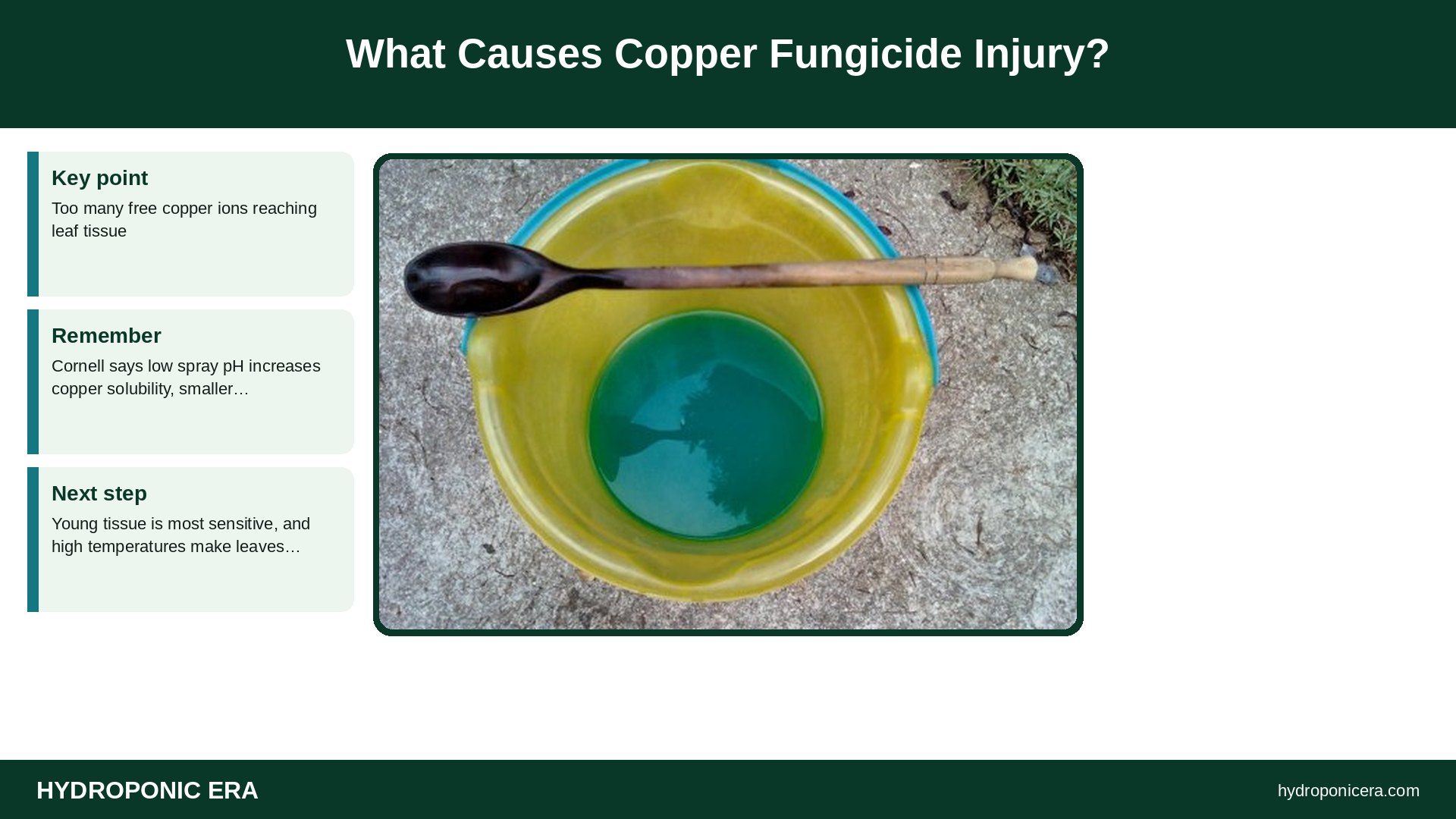
Too many free copper ions reaching leaf tissue. Cornell says low spray pH increases copper solubility, smaller particles release more ions, and wet leaves let ions move into tissue. Young tissue is most sensitive, and high temperatures make leaves more prone. The PNW handbook adds that acidic tank mixes release more copper ion.
- Check spray water pH; avoid acidic mixes.
- Choose fixed-copper formulations listed for your crop.
- Spray when leaves can dry quickly.
- Avoid heavy sprays on young, tender growth.
- Never exceed the label rate or frequency.
Can Copper Fungicide Get Into a Hydroponic Reservoir?
It can if spray drips off leaves, so prevent it. Copper is also a plant micronutrient, and a sudden extra dose in the nutrient solution is a different problem from the trace amounts a balanced fertilizer supplies. Cover net cups and channels while spraying, or move plants away from the system. The PNW handbook notes aquatic organisms are especially sensitive to copper ions, so in aquaponics keep copper sprays far from fish tanks.
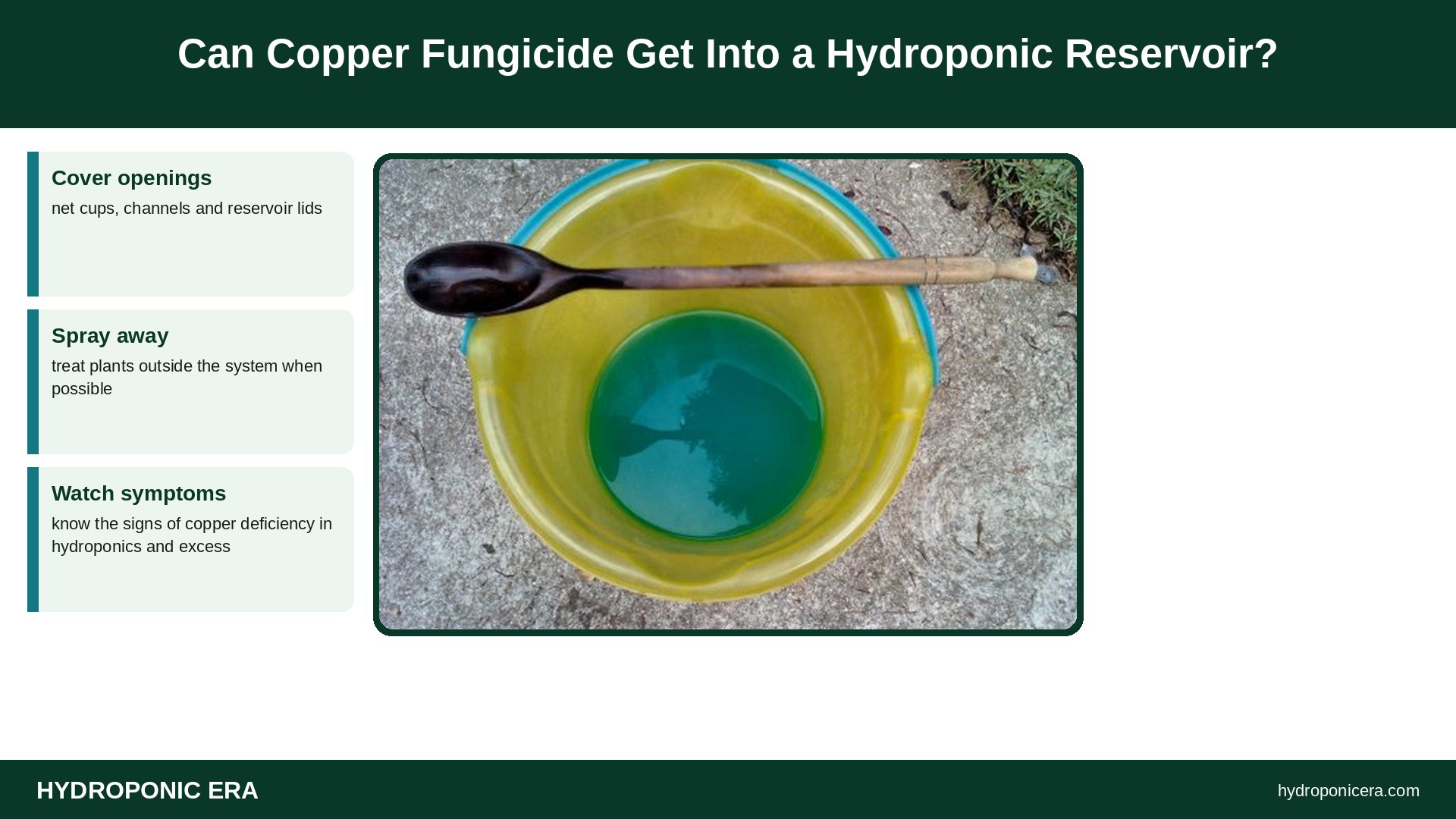
- Cover openings: net cups, channels and reservoir lids.
- Spray away: treat plants outside the system when possible.
- Watch symptoms: know the signs of copper deficiency in hydroponics and excess.
How Do You Read a Copper Fungicide Label?
Look for the metallic copper equivalent (MCE). Cornell says MCE is listed below the active ingredient and that products with lower metallic content have less potential for injury. The PNW handbook cautions that MCE does not directly predict how much copper ion is released, which varies by formulation. Newer, purer formulations are generally less likely to cause injury, per Cornell.
- Active ingredient: hydroxide, oxychloride, octanoate or sulfate.
- MCE: lower metallic content means lower injury potential.
- Crop list: use only on crops named on the label.
- Warnings: read restrictions on mixes and sensitive crops.
Cornell also notes some highly micronized and chelated coppers may be taken up more easily and carry a higher injury risk.
What Is the Difference Between Copper Sulfate and Fixed Copper?
Copper sulfate (bluestone) dissolves and releases a high concentration of copper ions that the PNW handbook says is toxic to actively growing plants. Mixing it with hydrated lime makes Bordeaux mixture, which ties up most free ions. Fixed coppers such as copper hydroxide and oxychloride are formulated to release low, steady doses. Purdue calls lime a safener in Bordeaux mixture.
| Form | Copper ion release | Source |
|---|---|---|
| Copper sulfate alone | High; toxic to growing plants | PNW Handbook |
| Bordeaux mixture | Most ions tied up by lime | PNW; Purdue |
| Copper hydroxide | Small particles, fast release | Cornell |
| Copper oxychloride | Larger particles, slower release | Cornell |
FAQ About Copper Fungicide
Is copper fungicide organic?
Purdue lists copper among organic fungicide options; check product certification.
Does copper fungicide cure infected leaves?
No; it is a protectant that works before infection.
Can copper fungicide burn plants?
Yes; Cornell notes black-spot injury, especially on sensitive crops.
Why does spray pH matter for copper fungicide?
Low pH increases copper solubility and injury risk, per Cornell.
Can bacteria become resistant to copper fungicide?
Yes; the PNW handbook discusses resistance in some bacterial pathogens.
Can copper fungicide be mixed with other products?
Only as the label allows; acidic mixes raise copper ion levels.
Sources
- Pacific Northwest Plant Disease Handbook (Oregon State) — Copper-based bactericides and fungicides
- Cornell Vegetable Program — Minimizing injury from copper fungicides
- Purdue Extension — Using organic fungicides, BP-69-W
- Photo credits (Wikimedia Commons, edited with titles): Bourdeaux mixture by Pg1945 (CC BY-SA 3.0); Calda Bordalesa by Matias Pocobi (Public domain)