
Does potassium bicarbonate work on powdery mildew in hydroponics? Yes. Potassium bicarbonate is a contact fungicide that kills powdery mildew it touches, and UC IPM says it has some eradicant activity, unlike most preventive fungicides. It leaves no lasting residue on leaves, so repeat sprays are needed. Use it early, follow the label rate and never spray plants with advanced mildew, which UC IPM warns can be badly injured.
Key takeaway: Potassium bicarbonate is a salt sold in fungicide products such as MilStop and Kaligreen. UC IPM describes it as a potassium-based contact fungicide that disrupts fungal cells. Purdue Extension recommends potassium or ammonium bicarbonate over baking soda, because those salts leave useful nutrients behind while baking soda leaves sodium that can build up to toxic levels.
| Fact | What sources report | Source |
|---|---|---|
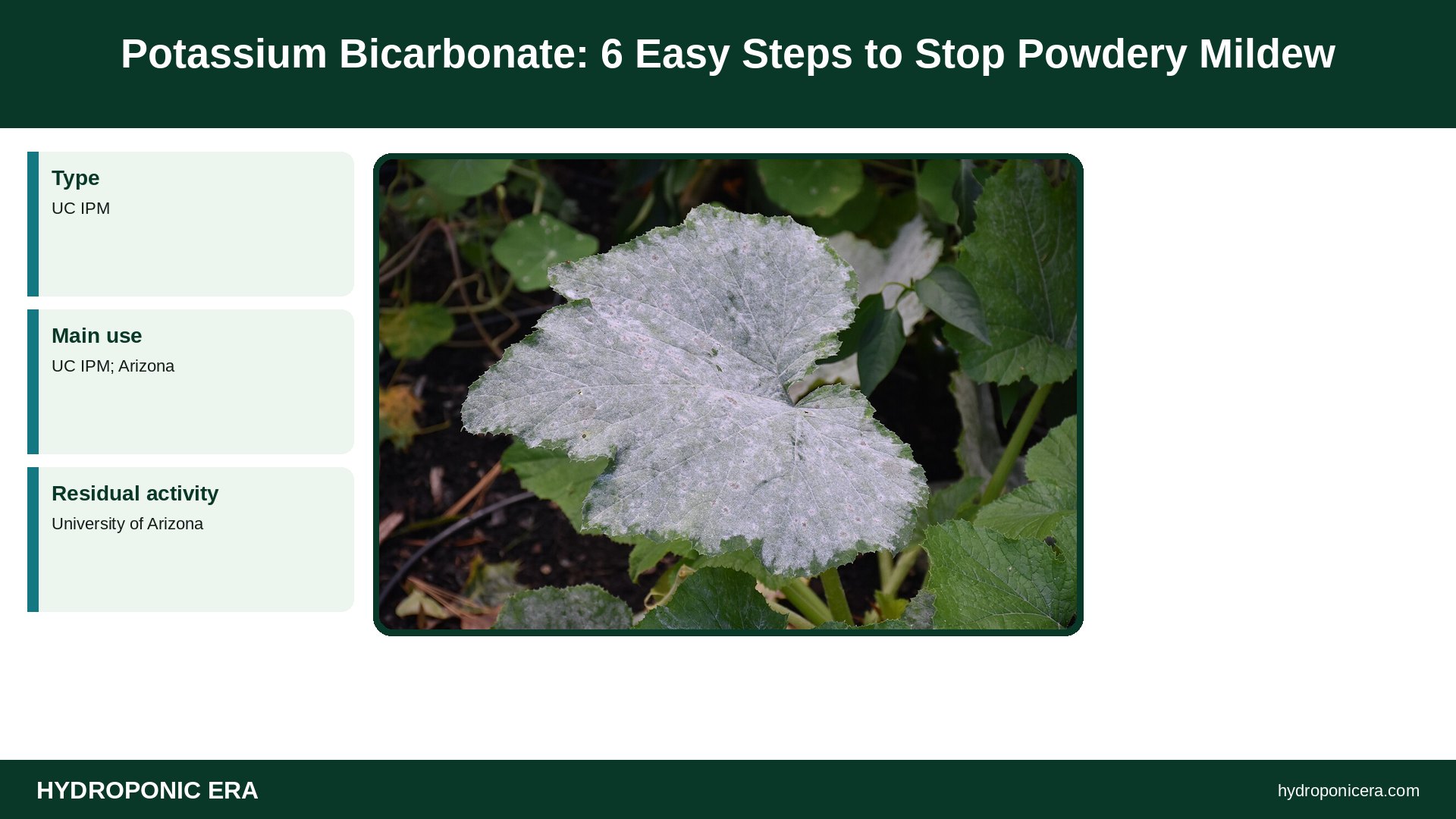
| Type | Contact fungicide | UC IPM |
| Main use | Powdery mildew | UC IPM; Arizona |
| Residual activity | None; repeat applications | University of Arizona |
| Advanced infections | Risk of severe phytotoxicity | UC IPM |
| Vs. baking soda | Preferred; no sodium buildup | Purdue Extension |
| Rate | Follow the product label | Arizona; Purdue |
What Is Potassium Bicarbonate Fungicide?
Potassium bicarbonate fungicide is a potassium salt formulated to control fungal leaf diseases, mainly powdery mildew. UC IPM’s active ingredient database calls it a potassium-based contact fungicide that disrupts cellular processes in fungal cells and inhibits their growth. Professional products named by UC IPM include Kaligreen and MilStop.
Because it acts on contact, it only affects the mildew it reaches. The University of Arizona lists it as an effective contact treatment with no residual activity, which is why coverage and timing matter more than strength.
Does Potassium Bicarbonate Kill Powdery Mildew?
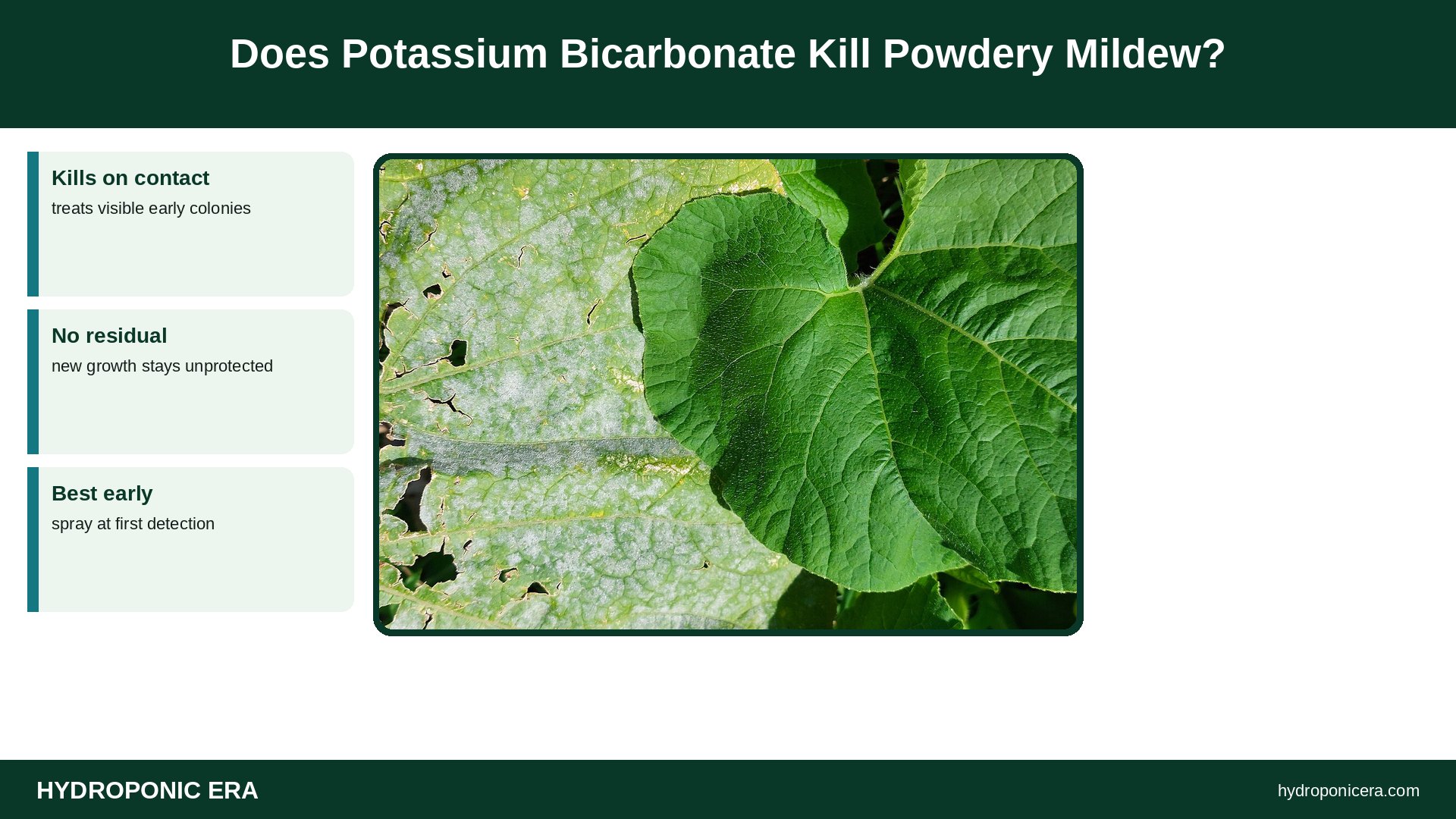
Yes, on contact. UC IPM says products containing potassium bicarbonate effectively eradicate powdery mildew fungi, and that most other less-toxic fungicides are mainly preventive. That makes it useful when you first spot white patches. It will not protect new leaves that grow after the spray, so plan repeat applications.
- Kills on contact: treats visible early colonies.
- No residual: new growth stays unprotected.
- Best early: spray at first detection.
- Not a cure-all: fix humidity and airflow too.
Confirm it is really mildew first with our guide to white leaf residue vs powdery mildew.
Is Potassium Bicarbonate Better Than Baking Soda?
Yes, according to Purdue Extension. Purdue reports better control and plant health with potassium and ammonium bicarbonate, says baking soda without oil is ineffective against most diseases, and warns that the sodium in baking soda can build up and become toxic. Arizona adds that baking soda can burn leaves and needs frequent repeats.
| Feature | Potassium bicarbonate | Baking soda |
|---|---|---|
| Leftover element | Potassium (a nutrient) | Sodium (can build up) |
| Effectiveness | Effective contact treatment | Weak without oil |
| Leaf burn risk | At high rates or late disease | Can burn leaves |
| Source | Purdue; Arizona | Purdue; Arizona |
Purdue notes baking soda has been used as a fungicide since 1933 and can work when combined with oil, but its sodium can build up. Arizona lists baking soda at 1 tablespoon per gallon (about 4 mL per liter) as an effective contact treatment that can burn leaves, while potassium bicarbonate is used at the label rate. In recirculating hydroponics, avoiding sodium buildup is another reason to choose potassium.
How Do You Use Potassium Bicarbonate on Hydroponic Plants?
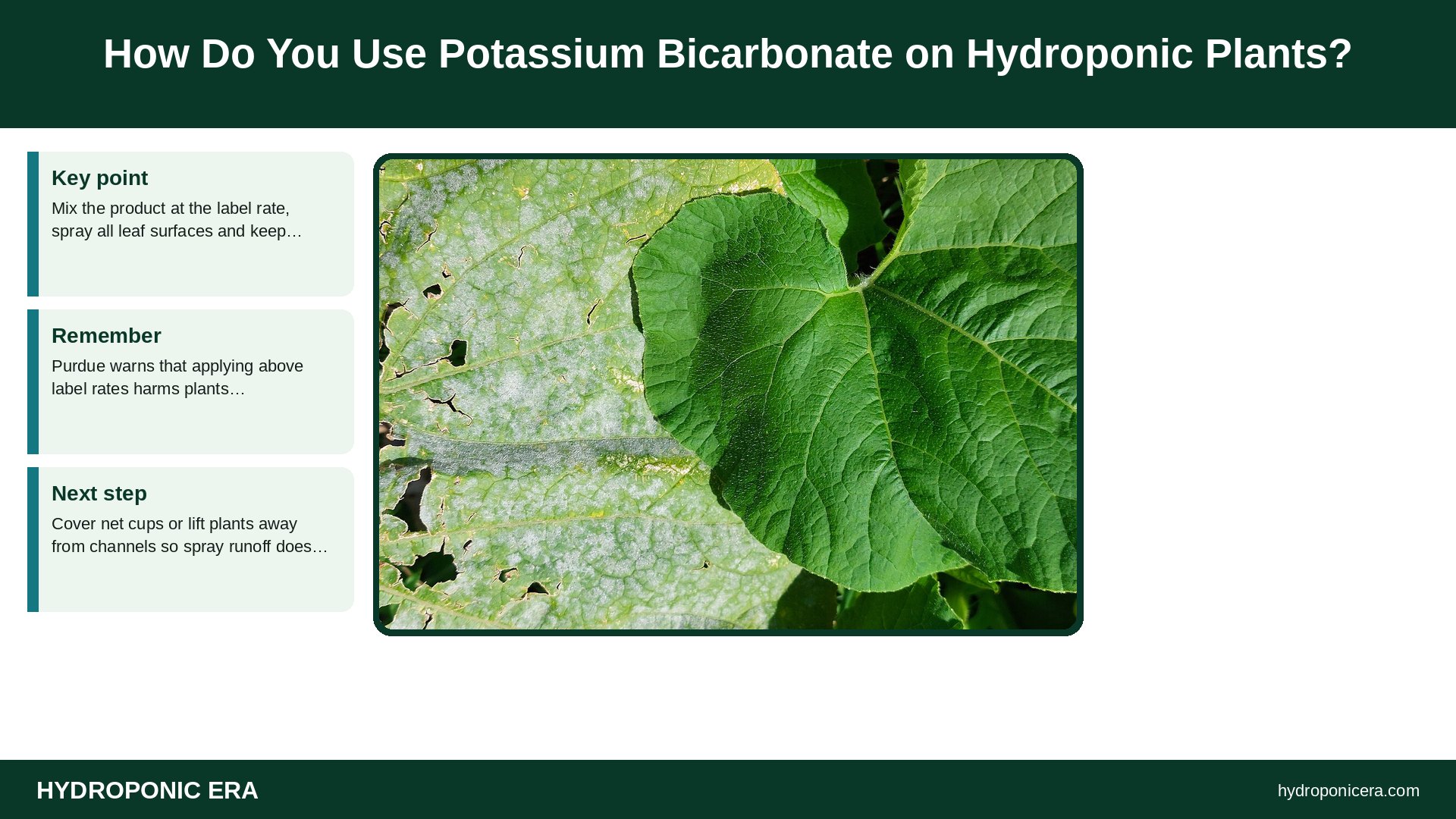
Mix the product at the label rate, spray all leaf surfaces and keep spray out of the reservoir. Purdue warns that applying above label rates harms plants, applicators and the environment. Cover net cups or lift plants away from channels so spray runoff does not drip into your nutrient solution.
- Confirm powdery mildew on a few leaves.
- Mix at the label rate; never stronger.
- Test on a few plants and check after 1–2 days.
- Spray tops and undersides until evenly wet.
- Repeat as the label directs while mildew is active.
- Lower humidity and improve airflow at the same time.
When Should You Not Use Potassium Bicarbonate?
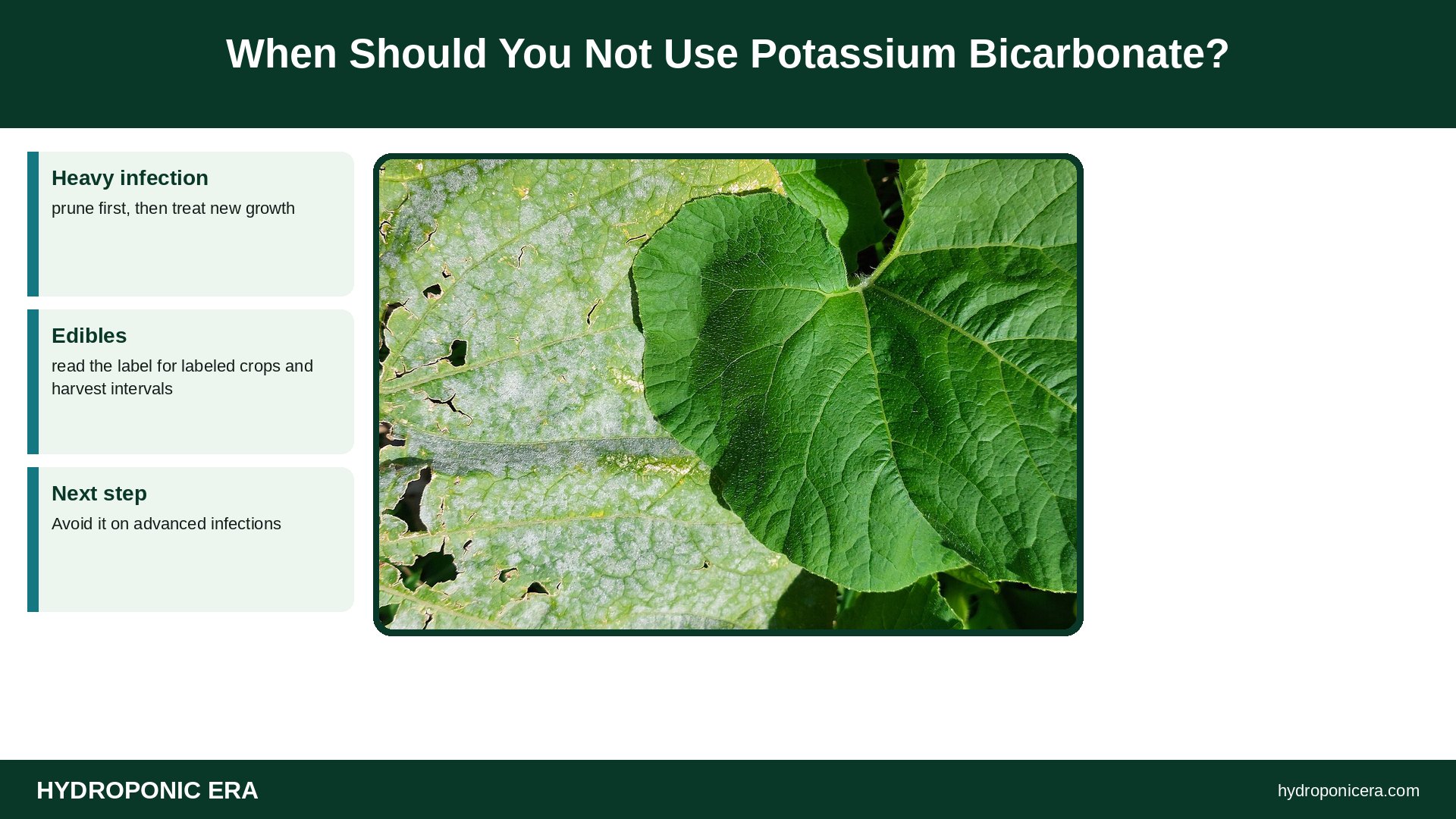
Avoid it on advanced infections. UC IPM warns that potassium bicarbonate can injure mildew-infected plants and that phytotoxicity will be severe if it is used on advanced stages of powdery mildew. For heavily infected leaves, remove them first. Arizona notes that mildew is favored by moderate to high humidity, low light and poor airflow, so fix those too.
- Heavy infection: prune first, then treat new growth.
- Edibles: read the label for labeled crops and harvest intervals.
For whole-system prevention, see our guide to powdery mildew in hydroponics.
What Conditions Make Potassium Bicarbonate Necessary?
Powdery mildew thrives in conditions common in indoor grows. The University of Arizona says it is favored by warm temperatures, moderate to high humidity, no overhead watering, low light and poor airflow. Each mildew species infects only certain plant groups; Arizona notes cucurbit mildew does not infect roses. UC IPM adds that extensive mildew is hard to control with any fungicide.
- Humidity: keep it in the target range for your crop.
- Airflow: move air through and under the canopy.
- Light: low light favors mildew, per Arizona.
- Spacing: avoid crowded, stagnant canopies.
Our guide to humidity and VPD indoors explains how to keep rooms in range.
How Does Potassium Bicarbonate Compare With Other Organic Fungicides?
Purdue lists sulfur, copper, oils and bicarbonates as the main organic fungicide groups. UC IPM says sulfur and most others are mainly preventive, while oils work best as eradicants and potassium bicarbonate has some eradicant activity. Do not combine treatments casually: UC IPM warns not to apply sulfur within two weeks of an oil spray.
| Option | Main role | Source |
|---|---|---|
| Potassium bicarbonate | Contact, some eradicant activity | UC IPM |
| Sulfur | Preventive | UC IPM; Purdue |
| Horticultural oil | Eradicant, limited protectant | UC IPM |
| Neem oil | Kills mildew spores at 70% neem oil | Purdue |
Read more in our guide to neem oil for plants.
FAQ About Potassium Bicarbonate
Is potassium bicarbonate safe for edible hydroponic crops?
Use only products labeled for your crop, and follow label intervals.
How often should I spray potassium bicarbonate?
Follow the label; it has no residual, so repeats are needed.
Can potassium bicarbonate prevent powdery mildew?
It mainly kills on contact; humidity and airflow prevent mildew.
Can I add potassium bicarbonate to my nutrient solution?
No; it is a foliar fungicide, not a nutrient additive.
Is potassium bicarbonate the same as baking soda?
No; baking soda is sodium bicarbonate, which Purdue says leaves sodium behind.
Does potassium bicarbonate work on downy mildew?
Labels and sources focus on powdery mildew; check your product label.
Sources
- UC IPM — Potassium bicarbonate active ingredient details
- UC IPM — Powdery mildew on ornamentals
- Purdue Extension — Using organic fungicides, BP-69-W
- University of Arizona Extension — Powdery mildew, AZ1033
- Photo credits (Wikimedia Commons, edited with titles): Powdery mildew 9 by Dmitry Brant (CC BY-SA 4.0); Kürbis-Cucurbita-Echter Mehltau-Golovinomyces-4-JS by Schlaghecken Josef (CC BY-SA 4.0)