
Does Beauveria bassiana work on hydroponic pests? Yes. Beauveria bassiana is an insect-killing fungus sold as a spray for whiteflies, aphids, thrips and mealybugs, and it works on hydroponic crops when sprayed on foliage. UConn Extension says it infects by contact, needs thorough coverage and repeat sprays every five to seven days, and should not be applied to water because it may be toxic to fish.
Key takeaway: Beauveria bassiana causes white muscadine disease in insects. Its spores attach to the insect’s skin, grow through it and kill the pest from the inside, so the insect does not have to eat anything. It is preventive rather than a fast knockdown, and it works best with humidity above 60% and leaf temperatures in a moderate range.
| Fact | What sources report | Source |
|---|---|---|
| Type | Insect-killing (entomopathogenic) fungus | UConn Extension |
| Main targets | Whiteflies, aphids, thrips, mealybugs | UConn; UMass |
| Spray interval | Every 5–7 days in greenhouses | UConn Extension |
| Favorable humidity | Above 60% RH for GHA strain | UConn Extension |
| Favorable temperature | 68–80°F (20–27°C) for GHA strain | UConn Extension |
| Fish safety | Do not apply to water | UConn Extension |
What Is Beauveria Bassiana?
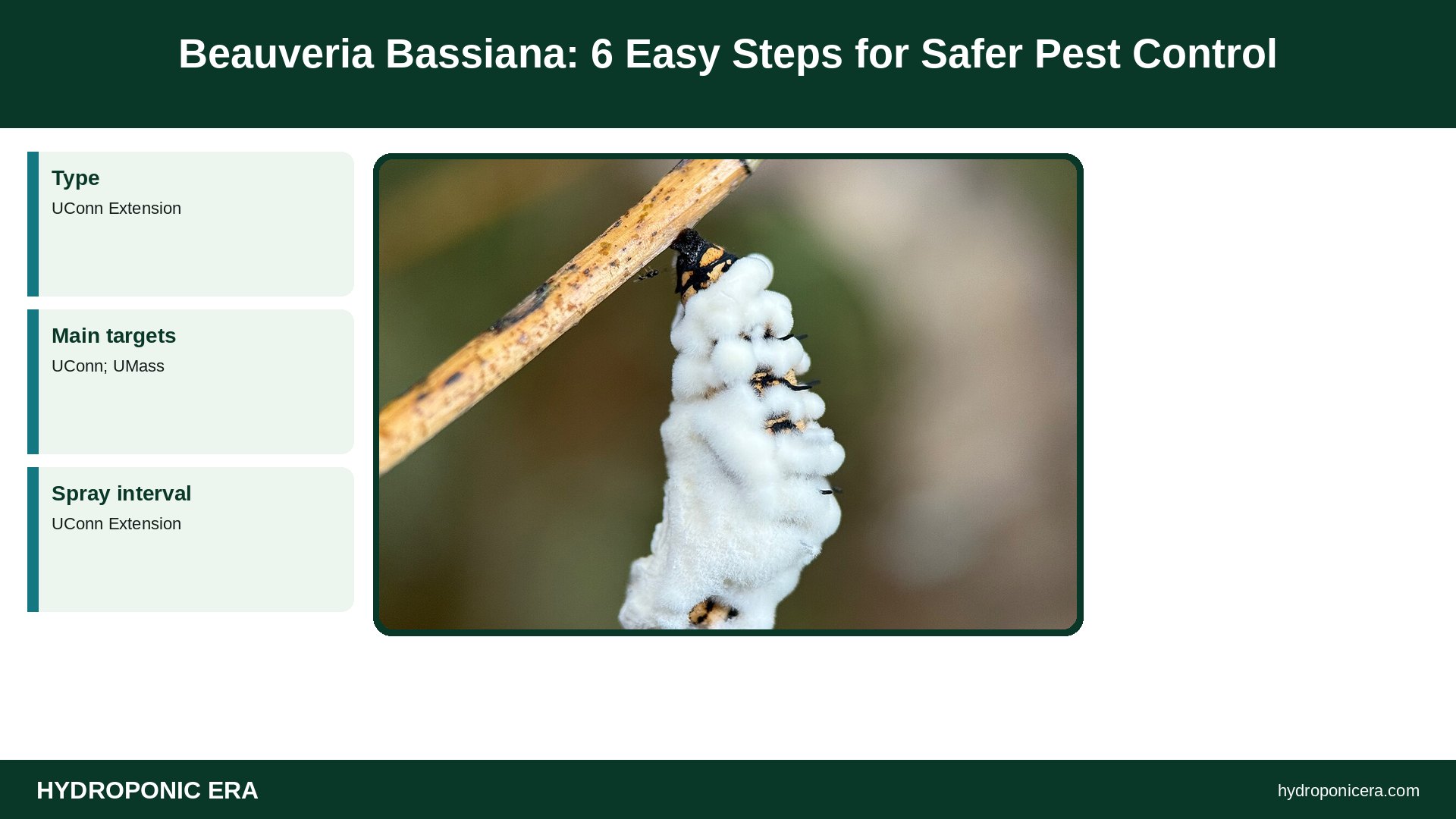
Beauveria bassiana is a naturally occurring soil fungus that infects and kills insects. UConn Extension explains that when its spores touch an insect’s cuticle, they germinate, grow into the body, multiply and drain the host. After death the fungus may grow back out and cover the insect in white mold, which gives the disease its name, white muscadine.
Commercial strains such as GHA are sold as sprayable spores. UConn notes these products are reduced-risk pesticides with a 0-day preharvest interval, which is why they appeal to growers of leafy greens and herbs.
Which Pests Does Beauveria Bassiana Control?
It targets soft-bodied foliage pests. UConn lists whiteflies, aphids, thrips and mealybugs on product labels, and UMass Extension says it may help manage whiteflies, aphids and mealybugs in greenhouses. Results vary with humidity, pest life stage, coverage, light, season and temperature, so expect partial suppression rather than total control.
- Whiteflies: spray leaf undersides to reach nymphs.
- Thrips and aphids: repeated sprays are needed.
- Mealybugs: listed on several labels.
- Root pests: not the main target of foliar products.
Compare other options in our guides to whiteflies in hydroponics and thrips in hydroponics.
How Do You Apply Beauveria Bassiana in Hydroponics?
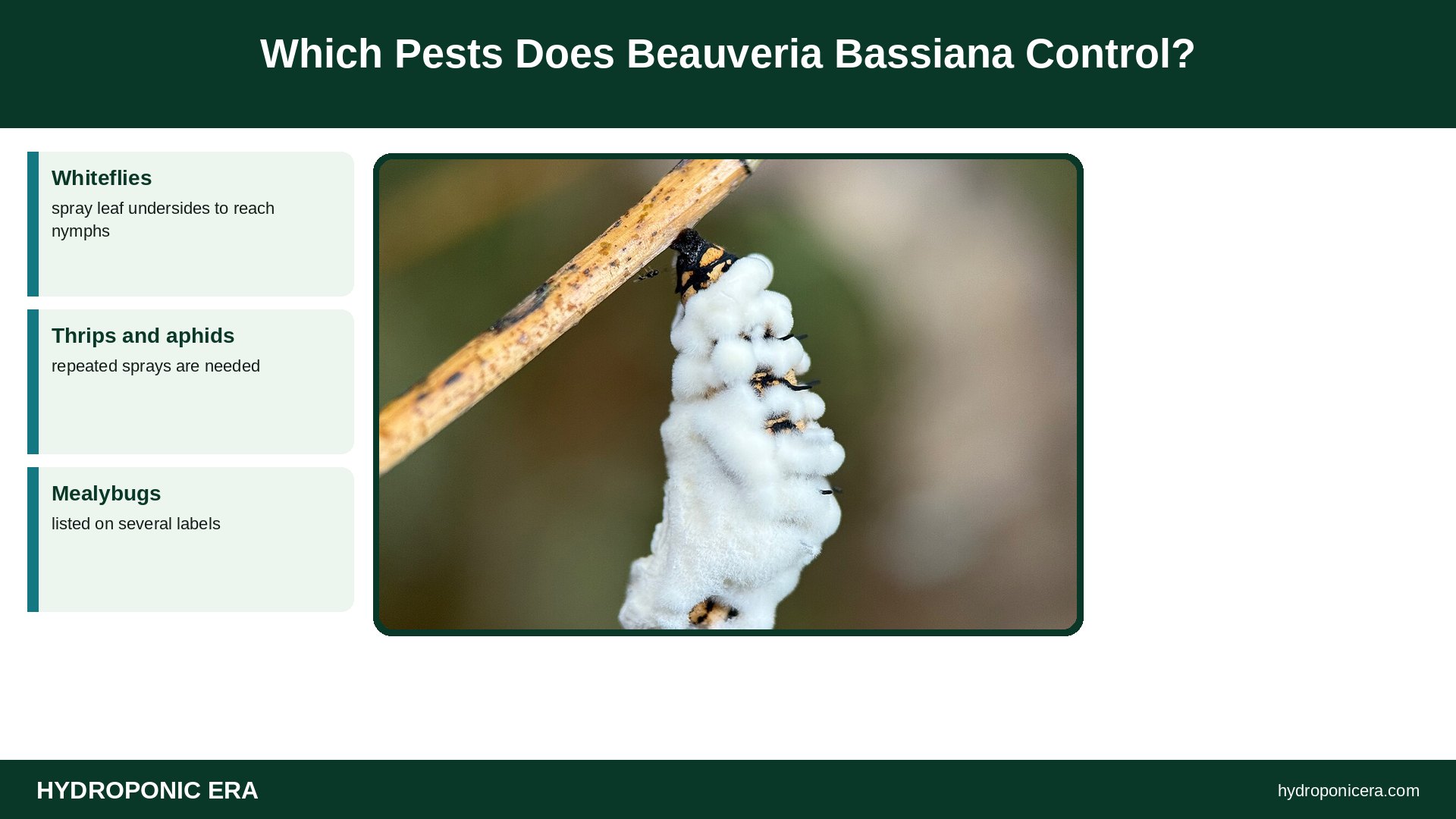
Spray foliage until it is wet but not dripping, and keep the spray out of the nutrient solution. UConn advises spraying soon after mixing because spores lose viability overnight, covering leaf undersides, and applying in the evening or on cloudy days because sunlight inactivates the spores. It also warns that Beauveria products should not be applied to water.
- Check the manufacture date; dead spores cannot infect pests.
- Cover or lift net cups so spray does not drip into the reservoir.
- Spray leaf undersides to glisten, not to run off.
- Apply late in the day, when light is low.
- Repeat every 5–7 days while pests are present.
In aquaponics, keep all spray away from fish tanks and sumps. Our aquaponics pest control guide covers fish-safe tactics.
What Conditions Does Beauveria Bassiana Need?
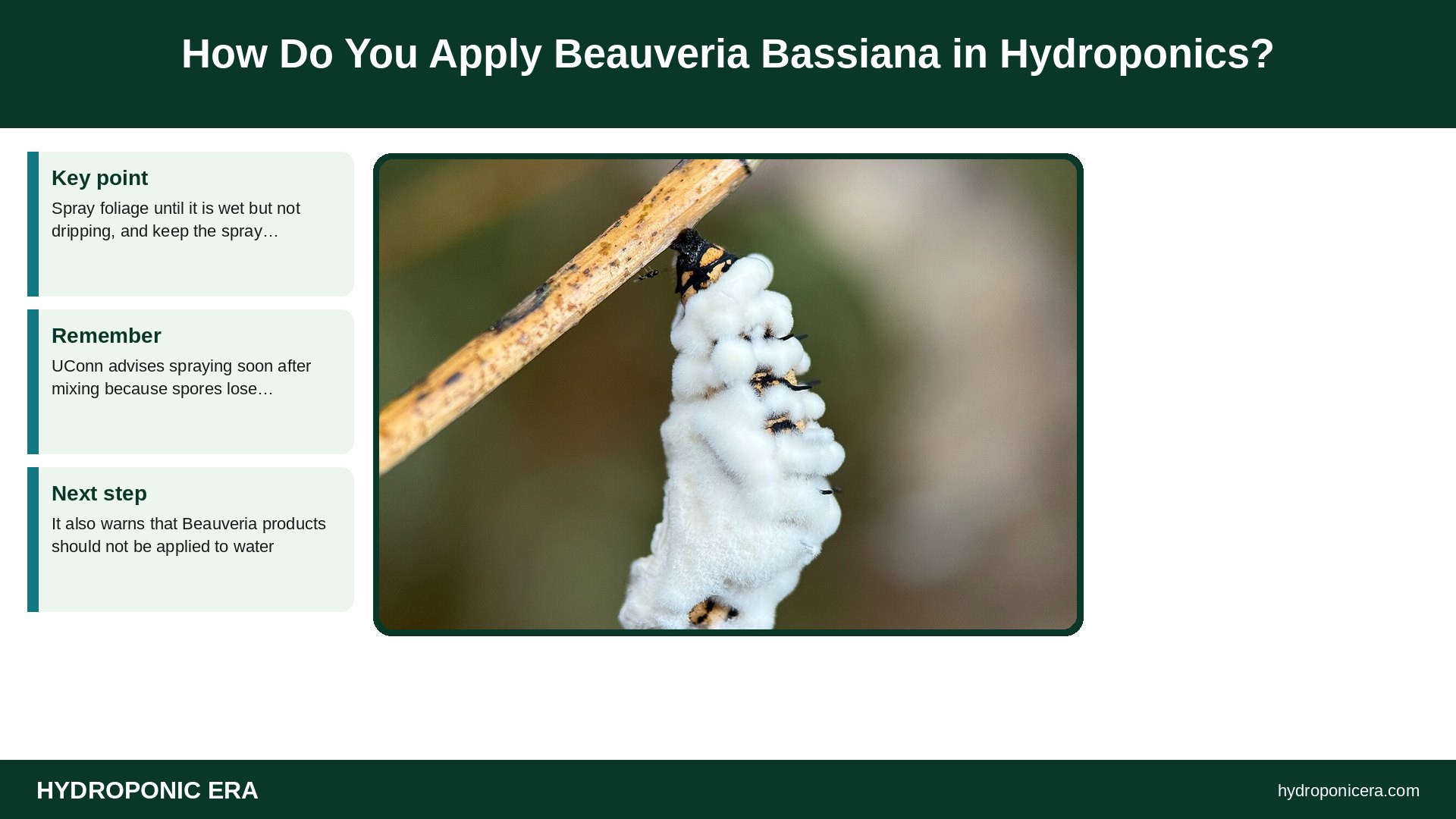
Humid, moderate conditions. UConn lists favorable conditions of relative humidity above 60% and 68–80°F (20–27°C) for the GHA strain. UMass notes humidity above 80% helps spores germinate on whiteflies. Spores are also harmed by high storage temperatures and by sitting in water for more than 24 hours, according to UConn.
| Factor | Guideline | Source |
|---|---|---|
| Humidity | Above 60%; higher helps | UConn; UMass |
| Temperature | 68–80°F (20–27°C), GHA | UConn Extension |
| Light | Spray late in the day | UConn Extension |
| Mixed spray | Use the same day | UConn Extension |
If your grow room runs dry, see our guide to humidity and VPD indoors before relying on fungal sprays.
Is Beauveria Bassiana Safe With Beneficial Insects?
Partly. UConn’s 2023 fact sheet says entomopathogenic fungi may be more compatible with biological control than many insecticides, but Beauveria is not compatible with ladybird beetles or minute pirate bugs (Orius). The GHA wettable powder is listed as compatible with the predatory mites Neoseiulus cucumeris and Amblyseius swirskii. Avoid spraying where bees are foraging.
Can You Use Fungicides With Beauveria Bassiana?
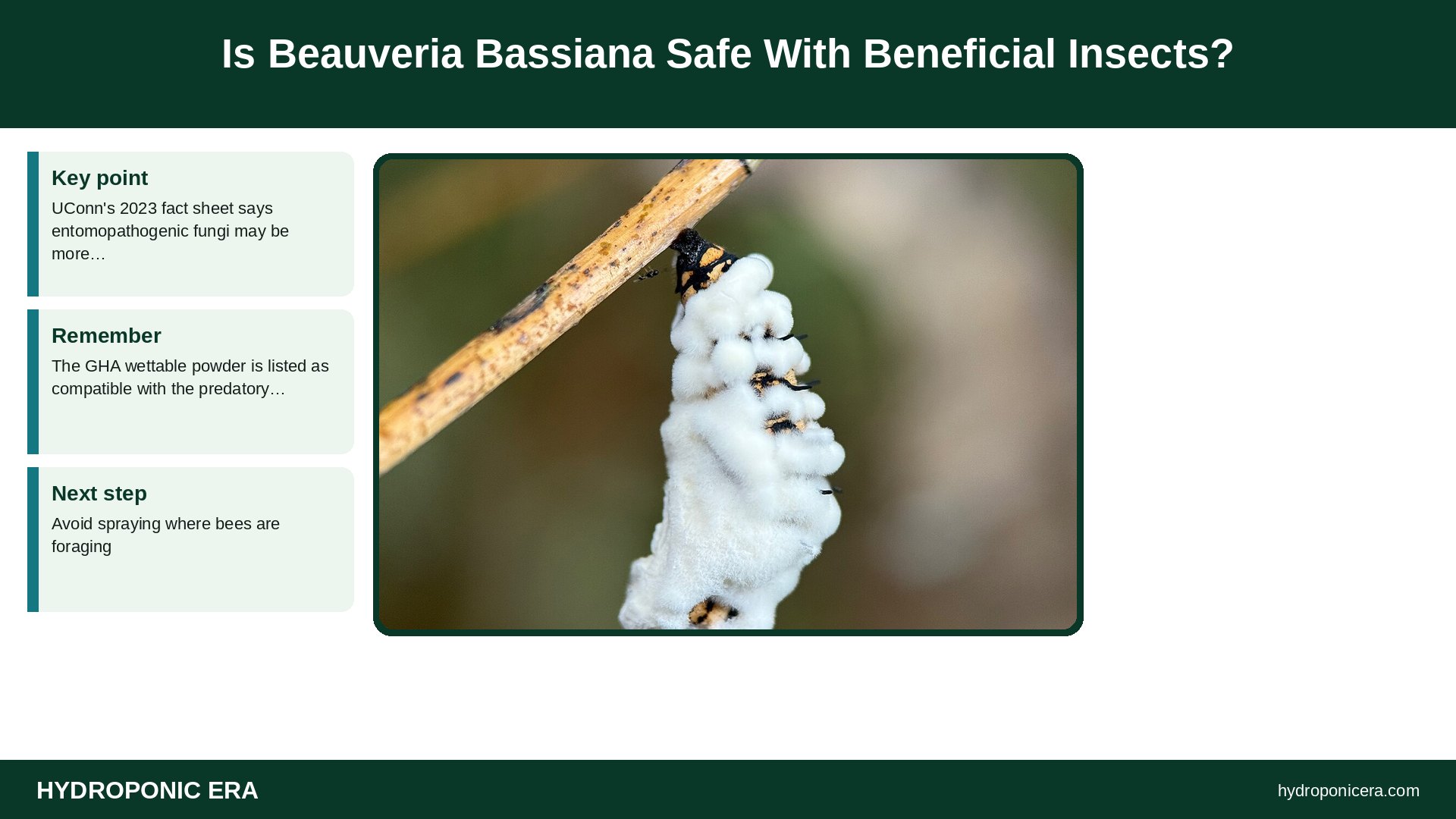
Usually not at the same time. UConn’s insect management page says Beauveria products should not be tank-mixed with fungicides and that fungicides should not be applied within 24 hours, while its 2023 fact sheet says to wait four to five days before or after a fungicide. Use the longer gap unless the label or manufacturer states compatibility.
How Should You Store and Handle Beauveria Bassiana?
Treat it as a living product. UConn’s 2023 table lists BotaniGard storage between 40 and 85°F (4–29°C), with a 12-month shelf life for the wettable powder and 18 months for the emulsifiable suspension; other strains need refrigeration. UConn advises checking the manufacture date because dead spores cannot infect pests, and following each label’s storage rules.
| Item | Guideline | Source |
|---|---|---|
| BotaniGard storage | 40–85°F (4–29°C) | UConn Extension |
| Shelf life | WP 12 months; ES 18 months | UConn Extension |
| Re-entry interval | 4 hours (ES), 12 hours (WP) | UConn Extension |
| Protective gear | Long sleeves, gloves; respirator for WP | UConn Extension |
Wear the protective equipment listed on the label, even though these are reduced-risk products.
How Do You Know Beauveria Bassiana Is Working?
Look for dead, discolored or motionless pests. UConn says that in greenhouses you often will not see the white cottony growth on dead insects, but the targets are still killed. Expect a reduction in pests after two to three applications, and keep monitoring with sticky cards and leaf checks between sprays.
FAQ About Beauveria Bassiana
Is Beauveria bassiana safe for edible plants?
UConn lists a 0-day preharvest interval for labeled products.
How fast does Beauveria bassiana kill insects?
UConn reports 3–5 days for small potato beetle larvae at 72°F (22°C).
Can Beauveria bassiana go in the reservoir?
No; UConn says do not apply it to water.
Does Beauveria bassiana spread on its own indoors?
UConn says it does not establish in greenhouses, so repeat sprays.
Does Beauveria bassiana harm minute pirate bugs?
UConn lists Beauveria as incompatible with Orius.
How should Beauveria bassiana be stored?
Follow the label; storage ranges differ by product.
Sources
- UConn Extension — Using Beauveria bassiana for insect management
- UConn Extension — The use of entomopathogenic fungi in the greenhouse
- UMass Extension — Biological control: greenhouse pests and their natural enemies
- Photo credits (Wikimedia Commons, edited with titles): Beauveria bassiana on a pupa by Bealeiderman (CC BY-SA 4.0)