
Does Stratiolaelaps scimitus work in hydroponics? Stratiolaelaps scimitus works in media-based hydroponics, such as coco coir or soilless mixes, where fungus gnat larvae live. It is a soil-dwelling predatory mite that hunts in the top layer of moist media. UConn Extension says it does not survive in standing water, so it is not useful in deep water culture or NFT channels.
Key takeaway: Stratiolaelaps scimitus, formerly sold as Hypoaspis miles, eats fungus gnat larvae and thrips pupae in growing media. Kansas State University says one application can establish a population for a whole season, but the mite alone rarely solves an infestation. Release it early onto moist, not wet, media and combine it with sanitation and careful watering.
| Fact | What sources report | Source |
|---|---|---|
| Old name | Hypoaspis miles | K-State; Penn State |
| Adult size | About 1/64 in (0.4 mm) | Kansas State University |
| Prey | Fungus gnat larvae, thrips pupae, shore fly larvae | K-State; UConn |
| Daily kill | Up to 30 prey | Kansas State University |
| Habitat | Top 1/2–1 in (1.3–2.5 cm) of media | UConn; K-State |
| Best temperature | 59–86°F (15–30°C) | Kansas State University |
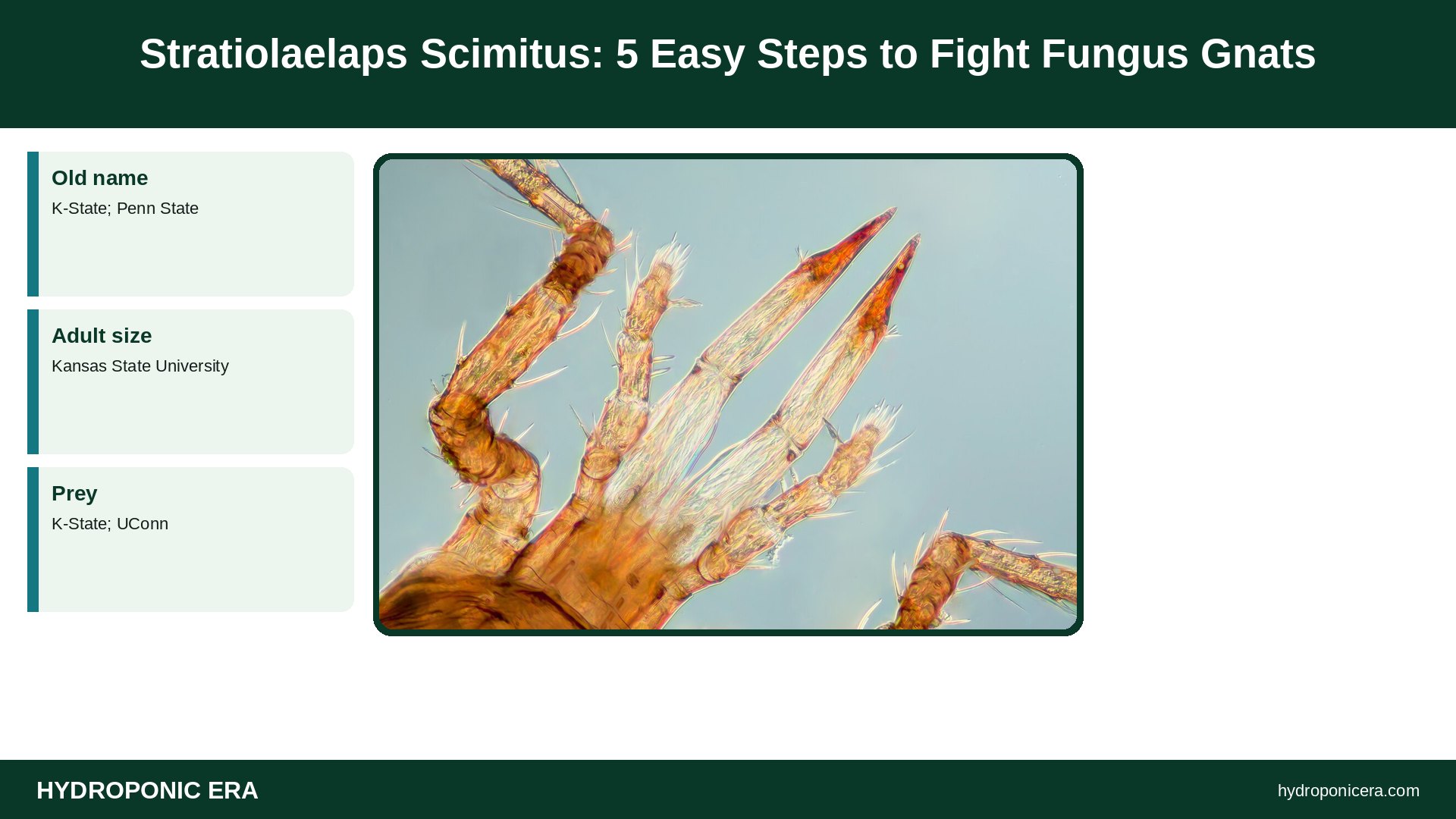
What Is Stratiolaelaps Scimitus?
Stratiolaelaps scimitus is a light-brown predatory mite about 1/64 inch (0.4 mm) long that lives in growing media. Kansas State University says it feeds on fungus gnat larvae and the pupae of western flower thrips. UConn Extension adds springtails and shore fly larvae, and notes it scavenges algae and plant debris when prey is scarce.
Penn State describes these mites as non-visual predators that likely find prey through vibration, and says they are strongly repelled by light. That is why they stay inside the media rather than on leaves.
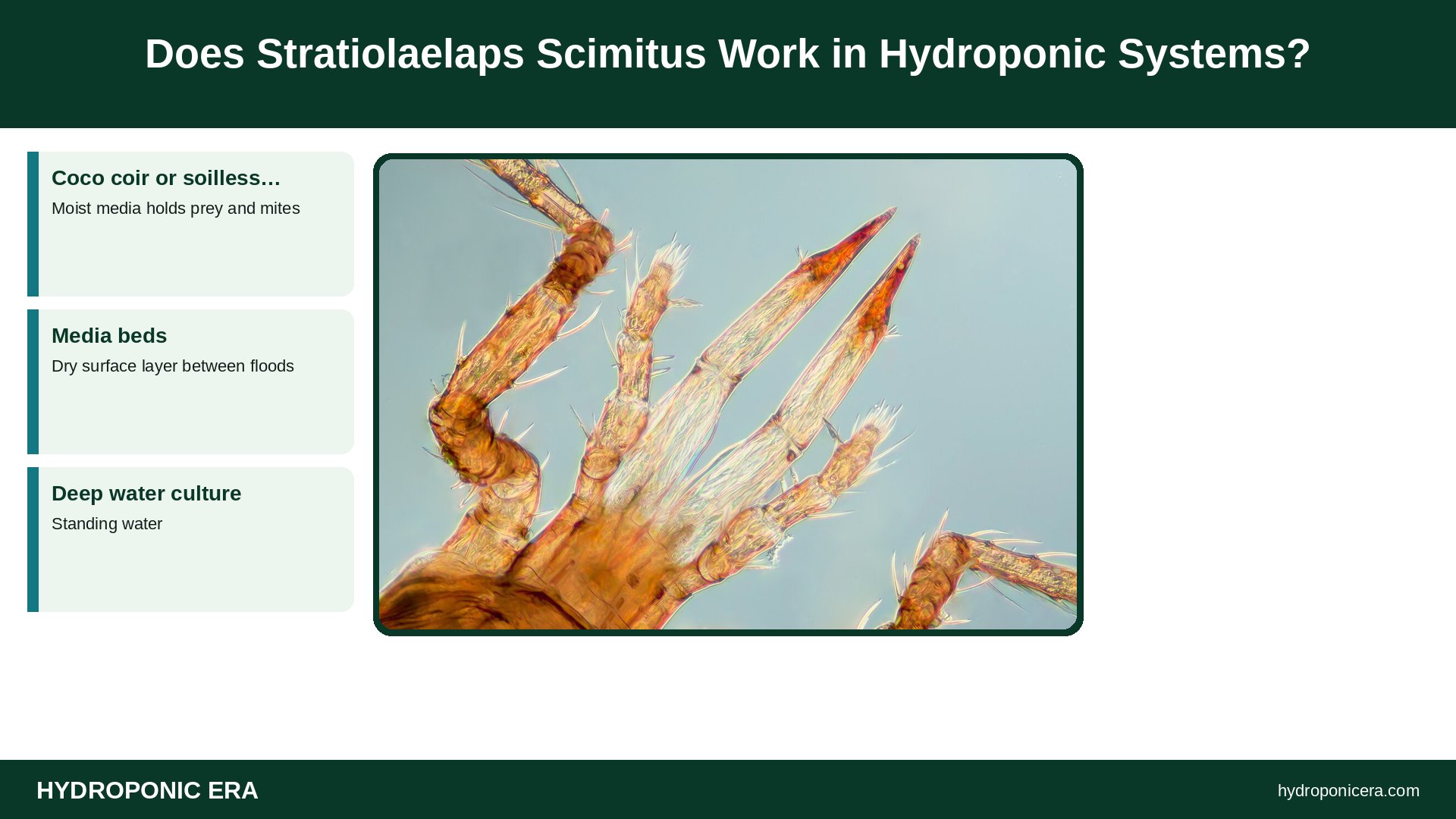
Does Stratiolaelaps Scimitus Work in Hydroponic Systems?
Only where there is moist growing media. UConn says the mite inhabits the top 1/2 inch (1.3 cm) of soil and does not survive in standing water. K-State gives the top 1 inch (2.5 cm) of media. Coco coir pots, soilless mixes and media beds suit it; deep water culture, NFT and aeroponics do not.
| System | Suitable? | Reason |
|---|---|---|
| Coco coir or soilless pots | Yes | Moist media holds prey and mites |
| Media beds | Yes, if not flooded | Dry surface layer between floods |
| Deep water culture | No | Standing water |
| NFT and aeroponics | No | No media layer to live in |
Our guide to fungus gnats in hydroponics explains where gnats breed in each system.
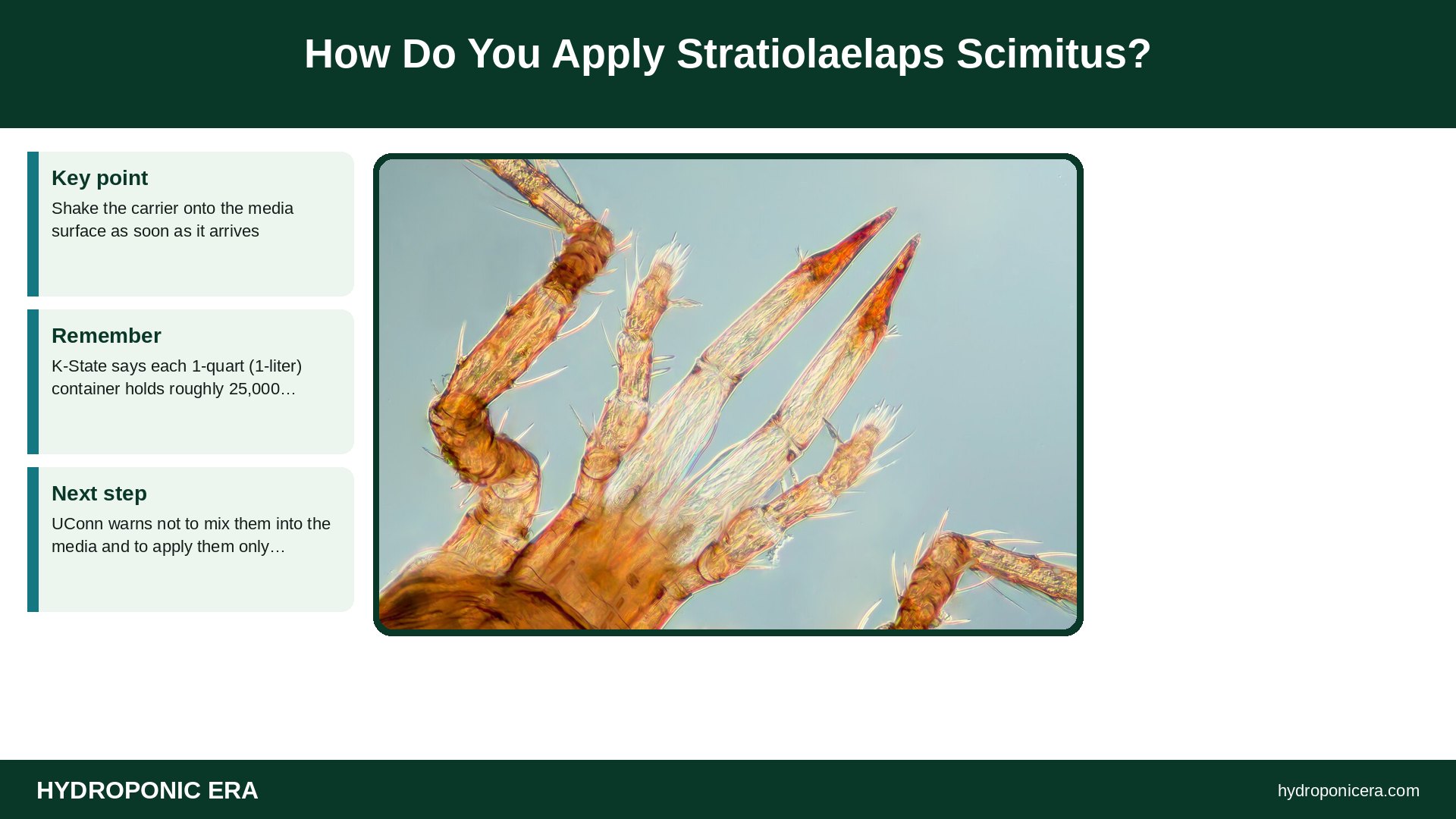
How Do You Apply Stratiolaelaps Scimitus?
Shake the carrier onto the media surface as soon as it arrives. K-State says each 1-quart (1-liter) container holds roughly 25,000 mites in peat or sawdust, and that mites can also go on soil or gravel floors under benches. UConn warns not to mix them into the media and to apply them only when the media is moist.
- Release immediately on arrival; UConn says they store poorly.
- Moisten the media first, but avoid soggy surfaces.
- Sprinkle the carrier evenly on the media surface.
- Treat wet floors under benches too.
- Release early, while pest numbers are low.
K-State says to consult your supplier for release rates.
What Pests Does Stratiolaelaps Scimitus Eat?
It eats small soil-dwelling pests. K-State lists fungus gnat larvae and western flower thrips pupae, with each mite eating up to 30 prey a day. UConn adds springtails and shore fly larvae. When prey runs short, the mites feed on algae and plant debris, which helps them persist in the media between pest outbreaks.
| Prey | Eaten? | Source |
|---|---|---|
| Fungus gnat larvae | Yes | K-State; UConn |
| Thrips pupae in media | Yes | K-State; UConn |
| Shore fly larvae | Yes | UConn Extension |
| Springtails | Yes | UConn Extension |
| Foliage pests | No; it stays in media | Penn State |
UNH lists other fungus gnat biocontrols that can complement the mites, including Bacillus thuringiensis israelensis and the nematode Steinernema feltiae.
How Effective Is Stratiolaelaps Scimitus Alone?
It helps, but rarely solves a problem alone. K-State states that, in most cases, using Stratiolaelaps scimitus alone will not manage fungus gnat and thrips populations, so pair it with sanitation, proper watering and, where needed, other controls. UConn says cultural controls such as avoiding overwatering and controlling algae come before any biological program.
- Fix watering: let media surfaces dry slightly.
- Remove algae: cover wet surfaces and clean puddles.
- Add other biocontrols: see beneficial nematodes.
- Monitor adults: yellow sticky cards show gnat trends.
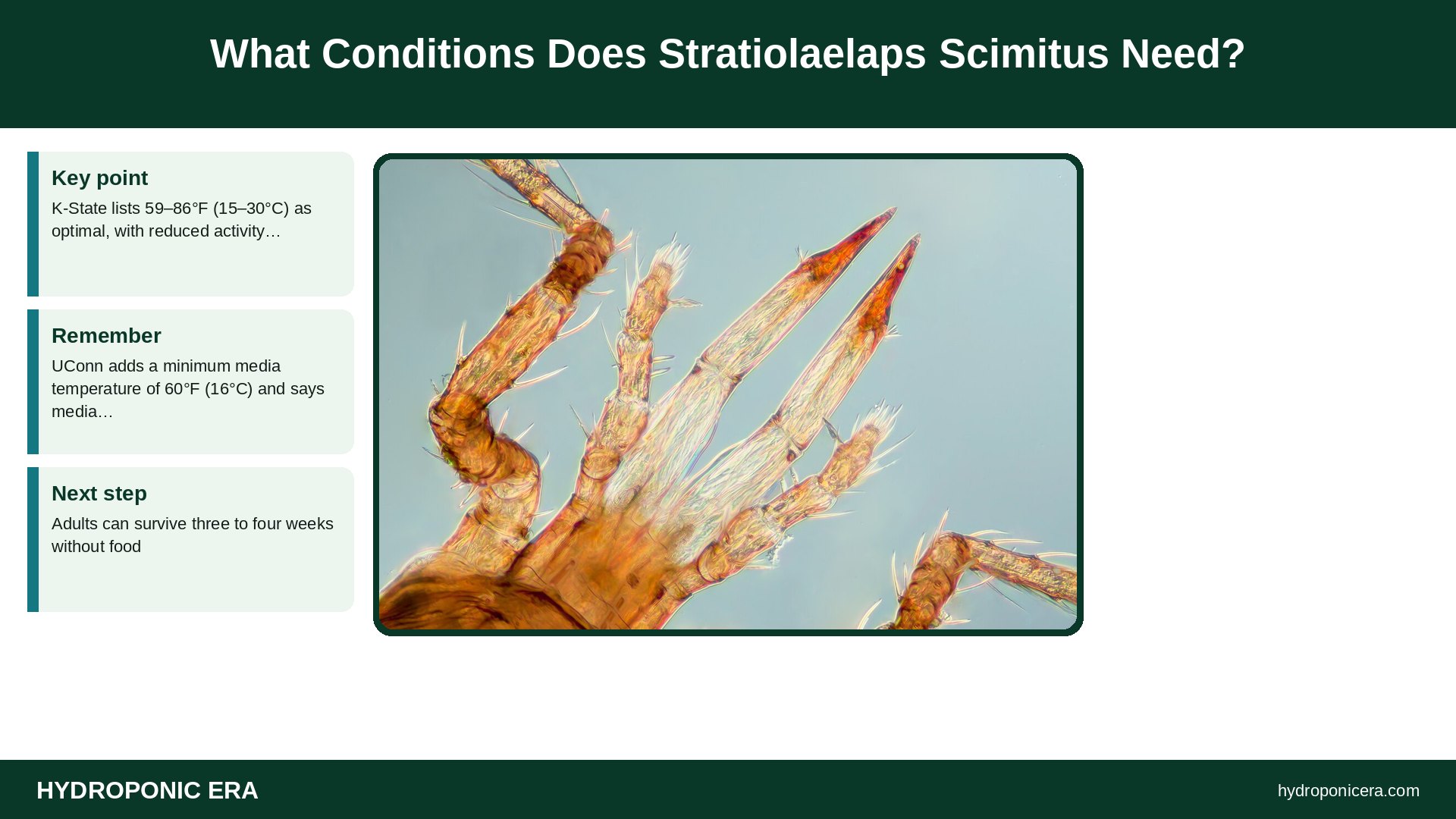
What Conditions Does Stratiolaelaps Scimitus Need?
Warm, moist media. K-State lists 59–86°F (15–30°C) as optimal, with reduced activity below 57°F (14°C), and egg-to-adult development in 10 days at 82°F (28°C) or 34 days at 59°F (15°C). UConn adds a minimum media temperature of 60°F (16°C) and says media should be moist, not wet. Adults can survive three to four weeks without food.
K-State warns that the rove beetle Dalotia coriaria feeds on Stratiolaelaps, so avoid releasing both at the same time.
How Does Stratiolaelaps Scimitus Compare With Other Predatory Mites?
Most thrips predatory mites, such as Neoseiulus cucumeris, live on foliage, while Stratiolaelaps lives in media and targets soil-stage pests. Using both covers foliage and media. Read our overview of predatory mites and our guide to shore flies vs fungus gnats.
How Long Does Stratiolaelaps Scimitus Control Last?
UNH Extension says Stratiolaelaps scimitus showed excellent control in university trials when introduced at planting, applied twice a week apart, with control lasting six to eight weeks. K-State adds that one application can establish a population for the growing season. Penn State reports individual mites can live more than 70 days.
- Timing: release at planting or transplanting.
- Repeat: UNH suggests two applications a week apart.
- Duration: about 6–8 weeks of control per UNH.
- Rate: ask the supplier, as UNH and K-State advise.
FAQ About Stratiolaelaps Scimitus
Is Stratiolaelaps scimitus the same as Hypoaspis miles?
Yes; it was formerly sold under the name Hypoaspis miles.
Will Stratiolaelaps scimitus harm my plants?
No; it feeds on small arthropods, algae and plant debris.
Can Stratiolaelaps scimitus live in rockwool?
It needs a moist, not wet, media surface to hunt in.
How long does Stratiolaelaps scimitus last?
K-State says one release can establish for a season.
Can I store Stratiolaelaps scimitus?
UConn says do not refrigerate; release soon after arrival.
Can Stratiolaelaps scimitus be used with nematodes?
UNH lists nematodes and Bti as other fungus gnat biocontrols to pair with mites.
Sources
- Kansas State University — Stratiolaelaps scimitus, MF3632
- UConn Extension — Biological control of fungus gnats
- UNH Extension — Fungus gnats fact sheet
- Penn State Extension — All about Stratiolaelaps scimitus predatory mites
- Photo credits (Wikimedia Commons, edited with titles): Hypoaspis miles by Captainpixel (CC BY-SA 4.0)