
Do minute pirate bugs control thrips in hydroponics? Yes. Minute pirate bugs (Orius insidiosus) eat both larval and adult thrips, plus aphids, spider mites and whiteflies. Kansas State University says nymphs and adults can each eat more than 20 western flower thrips a day. They establish slowly, so release them early and support them with flowering banker plants.
Key takeaway: Minute pirate bugs are small predatory bugs sold as adults for greenhouse thrips control. They feed on thrips larvae and adults, unlike predatory mites that only take young larvae. UConn notes it can take eight to 10 weeks before populations are high enough to affect thrips, so treat them as a long-term, preventive tool.
| Fact | What sources report | Source |
|---|---|---|
| Adult size | About 1/8 in (3 mm) | Kansas State University |
| Prey | Thrips, aphids, spider mites, whiteflies | K-State; UConn |
| Daily kill | More than 20 western flower thrips | Kansas State University |
| Egg to adult | About 15 days at 77°F (25°C) | Kansas State University |
| Optimum activity | 59–77°F (15–25°C) | Michigan State University |
| Time to impact | 8–10 weeks after release | UConn Extension |
What Are Minute Pirate Bugs?
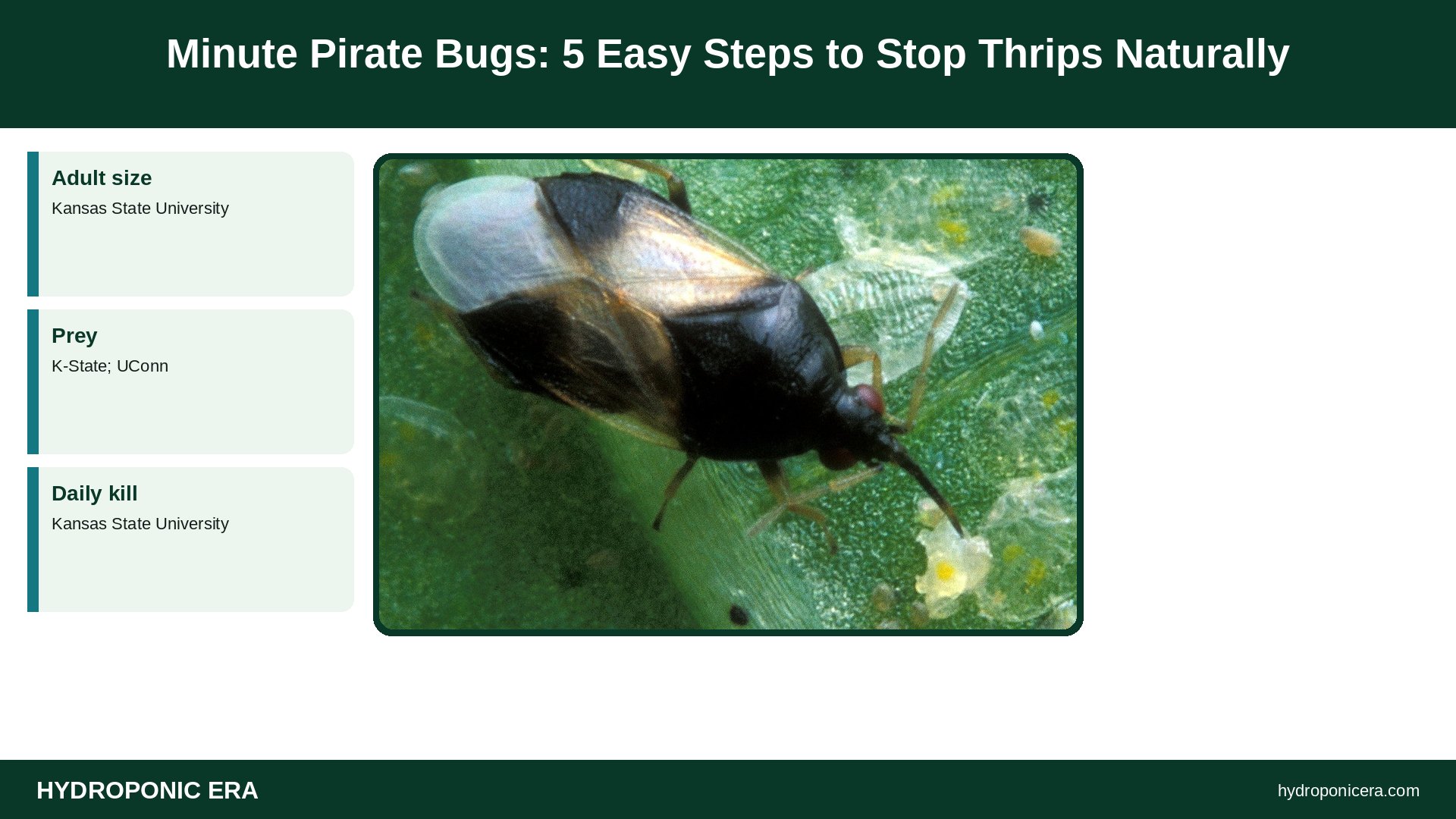
Minute pirate bugs are tiny predatory bugs in the genus Orius. Kansas State University describes Orius insidiosus adults as about 1/8 inch (3 mm) long, black and flattened, with black-and-white patterned wings. Nymphs are light to dark brown with bright red eyes. Both nymphs and adults are predators, and K-State notes there are five nymphal stages.
Females lay two to three eggs per day inside plant stems, leaves and leaf petioles, up to 130 eggs in a lifetime, according to K-State. Adults live up to 28 days.
What Do Minute Pirate Bugs Eat?
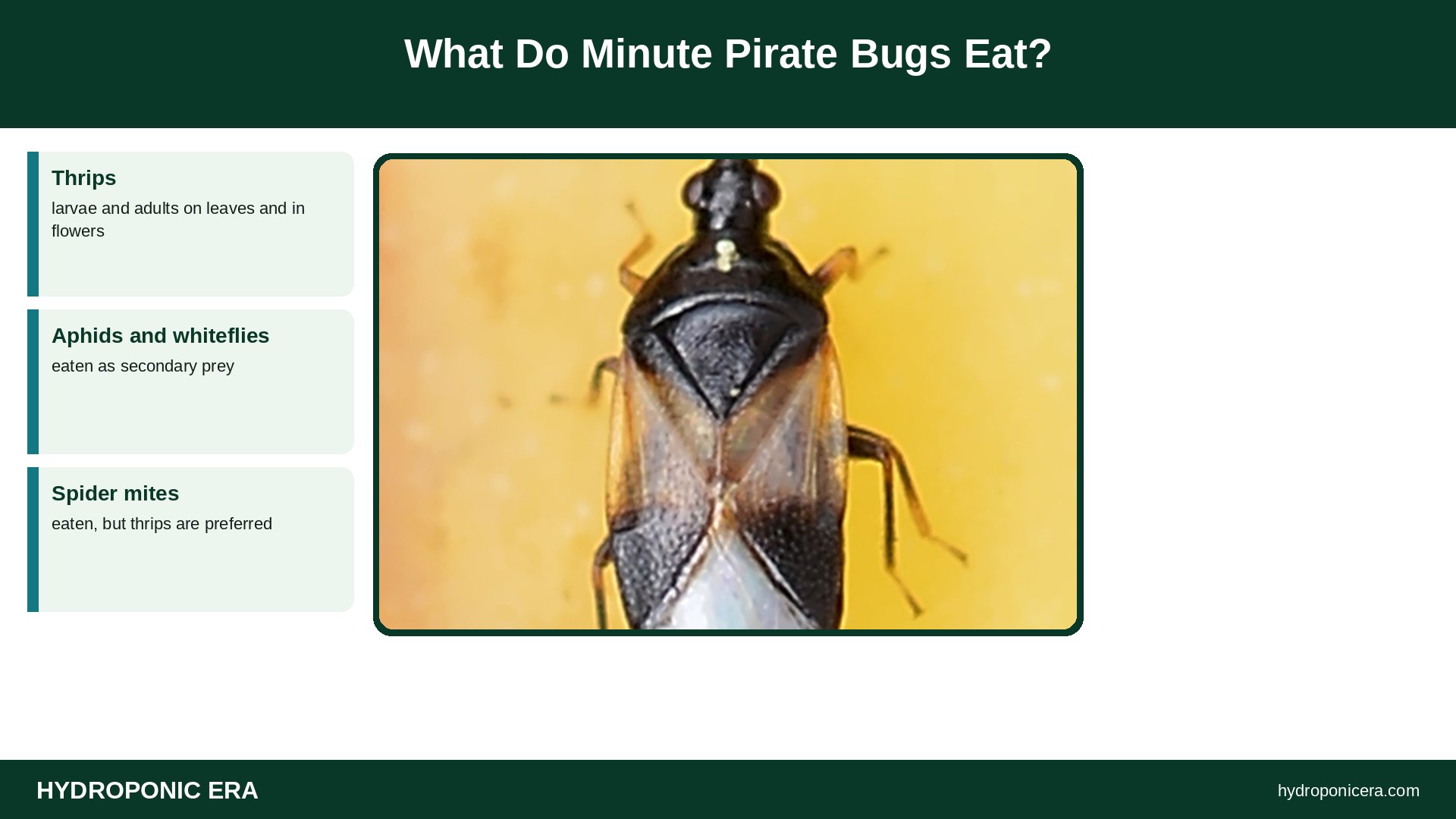
They eat thrips first, plus other small pests. K-State says Orius feeds on aphids, spider mites, thrips and whiteflies but prefers western flower thrips when several pests are present. When prey is scarce, adults feed on plant fluids and pollen, which helps them stay in a crop between pest outbreaks.
- Thrips: larvae and adults on leaves and in flowers.
- Aphids and whiteflies: eaten as secondary prey.
- Spider mites: eaten, but thrips are preferred.
- Pollen: backup food when prey is scarce.
Our guide to thrips in hydroponics explains thrips damage and scouting.
Are Minute Pirate Bugs Better Than Predatory Mites?
They attack more thrips stages. UConn and K-State both note that Orius eats thrips larvae and adults, while the predatory mites Neoseiulus cucumeris and Amblyseius swirskii feed only on first-instar larvae. Because each covers different thrips stages, the two can be combined; K-State notes Orius works alone or with predatory mites. Learn more in our guide to predatory mites.
| Feature | Minute pirate bugs | Thrips predatory mites |
|---|---|---|
| Thrips stages eaten | Larvae and adults | First-instar larvae |
| Other prey | Aphids, mites, whiteflies | Varies by species |
| Backup food | Pollen, plant fluids | Pollen (some species) |
How Do You Release Minute Pirate Bugs?
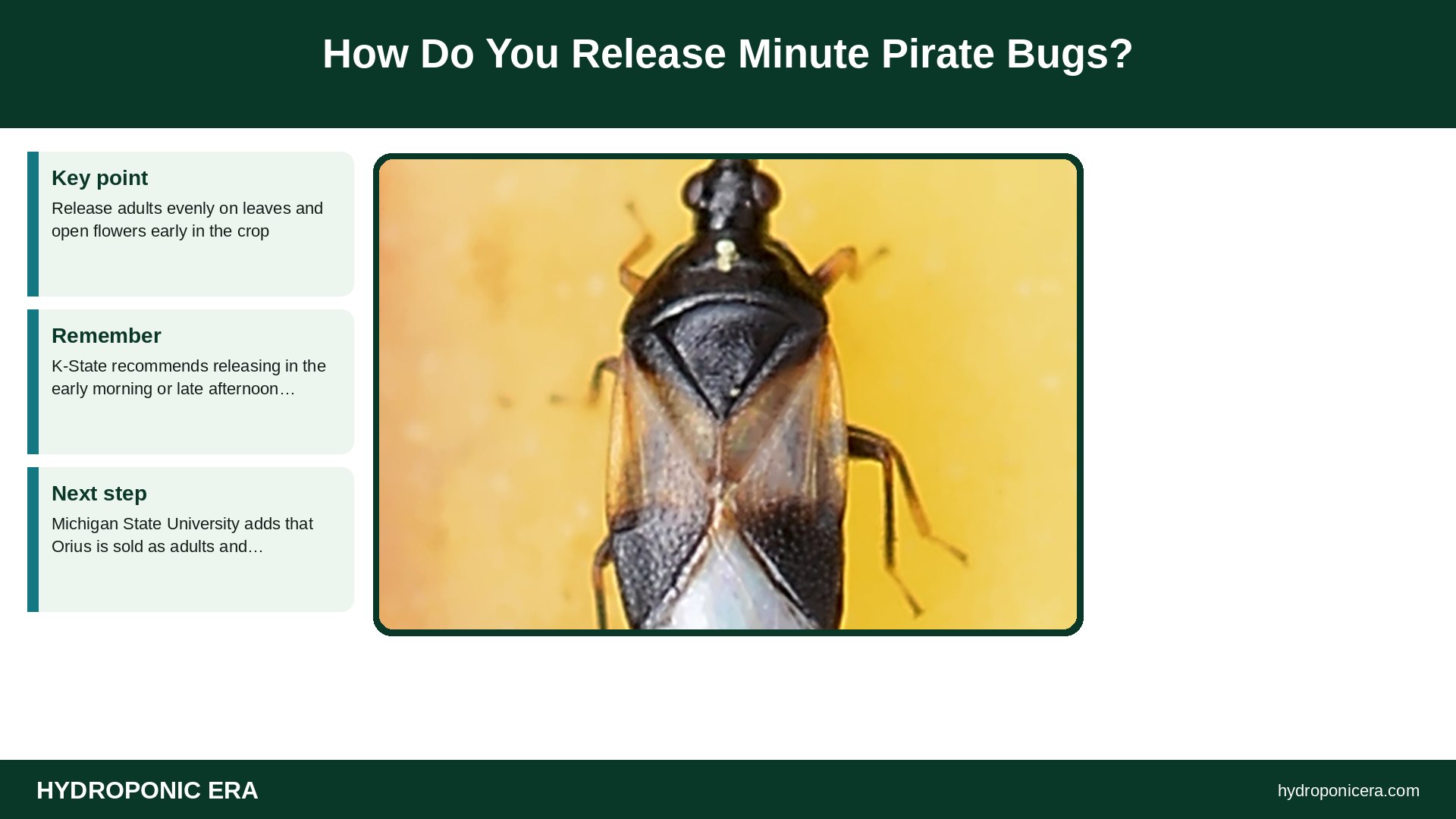
Release adults evenly on leaves and open flowers early in the crop. K-State recommends releasing in the early morning or late afternoon and says Mediterranean flour moth eggs can be offered as supplemental food to keep adults on the crop. Michigan State University adds that Orius is sold as adults and should be released early in production.
- Release as soon as the crop is established.
- Sprinkle adults onto leaves and open flowers.
- Release in early morning or late afternoon.
- Offer supplemental food or flowering banker plants.
- Check supplier catalogs for release rates.
How Do Banker Plants Help Minute Pirate Bugs?
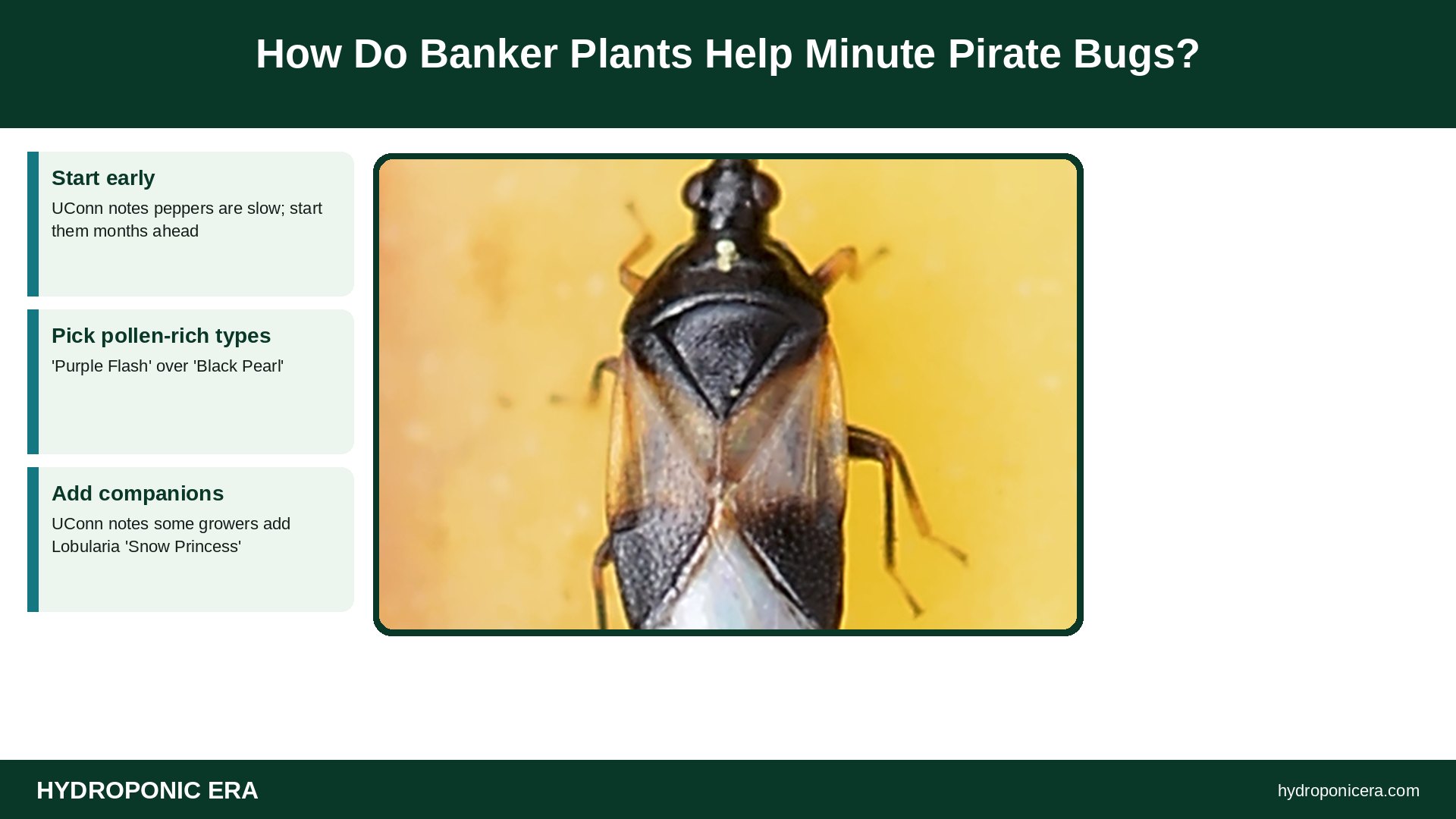
Flowering banker plants give minute pirate bugs pollen and egg-laying sites before thrips build up. UConn says ornamental pepper ‘Purple Flash’ works better than ‘Black Pearl’ because it produces more pollen, and that suppliers suggest 80–100 pots per acre with three pepper plugs per pot. Release Orius onto the flowering banker plants and never spray them.
- Start early: UConn notes peppers are slow; start them months ahead.
- Pick pollen-rich types: ‘Purple Flash’ over ‘Black Pearl’.
- Add companions: UConn notes some growers add Lobularia ‘Snow Princess’.
- Keep them flowering: UConn suggests removing pepper fruits about once a month.
Place banker pots beside your system, then use sticky trap placement to track thrips numbers.
What Is the Minute Pirate Bug Life Cycle?
Minute pirate bugs develop from egg to adult in about 15 days at 77°F (25°C), according to K-State. Nymphs hatch in four to five days, pass through five nymphal stages and become adults in 15 to 20 days. UConn reports a slower pace in cooler greenhouses, about 30 days from egg to adult at 65°F (18°C), which is why patience matters.
| Stage | Timing | Source |
|---|---|---|
| Egg hatch | 4–5 days | Kansas State University |
| Egg to adult | About 15 days at 77°F (25°C) | Kansas State University |
| Egg to adult, cool | About 30 days at 65°F (18°C) | UConn Extension |
| Adult life | Up to 28 days | Kansas State University |
Because each female lays only two to three eggs a day, populations build gradually. UConn says it may take up to two months for Orius to establish, so begin releases before thrips are obvious.
When Do Minute Pirate Bugs Work Best?
They work best in moderate warmth with longer establishment time. Michigan State lists an optimum of 59–77°F (15–25°C) and notes Orius may not establish from October to March, although it can still be released then. K-State reports that short or long day lengths do not affect feeding. Plan on weeks, not days, for results.
How Do You Know Minute Pirate Bugs Are Working?
Look for them where they hunt. UConn says orange-to-brown nymphs are found on leaves and adults in open flowers, and that all stages move quickly. Adults are good flyers that spread through a growing area to find prey. Track thrips on sticky cards; a slow decline after eight to 10 weeks is the expected pattern.
- Nymphs: orange to brown, red-eyed, fast-moving on leaves.
- Adults: black with patterned wings, often inside flowers.
- Thrips counts: compare weekly sticky-card totals.
- Warmth: UConn says Orius is most effective at 68–85°F (20–29°C).
FAQ About Minute Pirate Bugs
Are minute pirate bugs sold as eggs or adults?
Michigan State and K-State say they are shipped as adults.
How fast do minute pirate bugs reduce thrips?
UConn says 8–10 weeks after release before a real impact.
Can minute pirate bugs survive without thrips?
Yes, for a time; adults feed on pollen and plant fluids.
Should I use minute pirate bugs with predatory mites?
Yes; mites take young larvae while Orius takes larvae and adults.
Where do minute pirate bugs lay eggs?
Inside plant stems, leaves and petioles, per K-State.
Sources
- Kansas State University — Insidious flower bug, MF3616
- UConn Extension — Thrips banker plants
- Michigan State University Extension — Commercially available biological control agents, E3299
- Photo credits (Wikimedia Commons, edited with titles): Orius insidiosus from USDA 2 (cropped) by Orius_insidiosus_from_USDA_2.jpg: Photo by Jack Dykinga (uploaded by –gian_d 22 (Public domain); Insidious Flower Bug (Orius insidiosus) – Guelph, Ontario 2017-06-17 (01) by Ryan Hodnett (CC BY-SA 4.0)