
How do you root boxwood cuttings? Take 4 to 6 inch (10–15 cm) boxwood cuttings in early to mid summer, when new growth is beginning to firm, strip the lower leaves, dip in rooting hormone, and root them in a gritty mix under cover. The RHS says boxwood cuttings root in about eight weeks in a heated propagator, but about eight months in a cold frame.
Key takeaway: Boxwood (Buxus) is very easy to propagate by cuttings, according to the Royal Horticultural Society, and University of Kentucky nursery specialists note that common box readily roots from softwood, semi-hardwood and hardwood cuttings. The trade-off is patience: box is slow compared with many shrubs, especially without bottom heat.
| Factor | Guideline | Source |
|---|---|---|
| Best timing for boxwood cuttings | Early to mid summer (semi-ripe) | RHS |
| Other windows | Softwood spring–summer; hardwood in winter | University of Kentucky |
| Cutting length | 4–6 in (10–15 cm) | RHS semi-ripe guide |
| Rooting hormone (IBA) | 1,000 ppm, or 2,500–5,000 ppm | University of Kentucky |
| Heated propagator | About 8 weeks to root | RHS |
| Cold frame | About 8 months to root | RHS |

When Should You Take Boxwood Cuttings?
The RHS recommends semi-ripe boxwood cuttings in early to mid summer, when new growth is beginning to become firm. University of Kentucky nursery crop specialists add that common box roots from softwood cuttings in spring or summer, semi-hardwood cuttings in late summer or fall, and hardwood cuttings in winter. Mississippi State University Extension lists boxwood among softwood plants cut in summer.
- Softwood: spring to summer.
- Semi-ripe: early to mid summer, the RHS pick.
- Hardwood: winter, per University of Kentucky.
How Do You Take Boxwood Cuttings?
Cut healthy shoots of current-season growth and trim them to about 4 to 6 inches (10–15 cm) just below a leaf node, as the RHS semi-ripe guide describes. Mississippi State suggests a slanted cut about 1/2 inch (1.3 cm) below a node, removing foliage from the bottom half, and lightly shaving the bark at the base to expose the green layer.
- Choose vigorous, non-flowering shoots.
- Trim to 4–6 inches (10–15 cm) below a node.
- Strip leaves from the lower half.
- Lightly wound the base to expose green tissue.
- Dip in rooting hormone.
- Stick in a gritty, free-draining mix.

Which Shoots Make the Best Boxwood Cuttings?
Pick healthy, typical shoots. The RHS semi-ripe guide says to avoid damaged, unhealthy, over-vigorous or atypical material and to favor shoots that are more horizontal in habit with short gaps between the leaves. Pot the prepared cuttings within 12 hours, remove the lowest leaves and the soft tip, and leave about four leaves on each one.
- Choose: short-jointed, healthy current-season shoots.
- Avoid: spotted, bare or extra-vigorous stems.
- Timing: pot within 12 hours of cutting.
Why Wound the Base of a Cutting?
Mississippi State Extension says exposing the green layer under the bark helps with rooting, and that the remaining foliage supplies the cutting with nutrients that enhance rooting. The RHS describes wounding as removing a sliver of bark about 1 inch (2.5 cm) long from one side of the stem base. Combine it with rooting hormone so the treated tissue touches the wound.
What Rooting Hormone Strength Do Boxwood Cuttings Need?
Box responds to IBA, the common active ingredient in rooting powders. University of Kentucky cites 1,000 ppm IBA from Dirr, or 2,500 to 5,000 ppm from Hartmann and colleagues. Home products list their strength on the label, so pick one in that range. Our rooting hormone guide explains how strengths are labeled.
What Mix Should You Use for Boxwood Cuttings?
Use a gritty, free-draining mix. The RHS semi-ripe guide suggests 50 percent free-draining potting compost with 50 percent sharp sand or grit, and Mississippi State says sand or soil both work. University of Missouri Extension notes perlite works best mixed 1:1 with peat or vermiculite. Our perlite propagation guide shows how to mix one.
Do Boxwood Cuttings Need Bottom Heat?
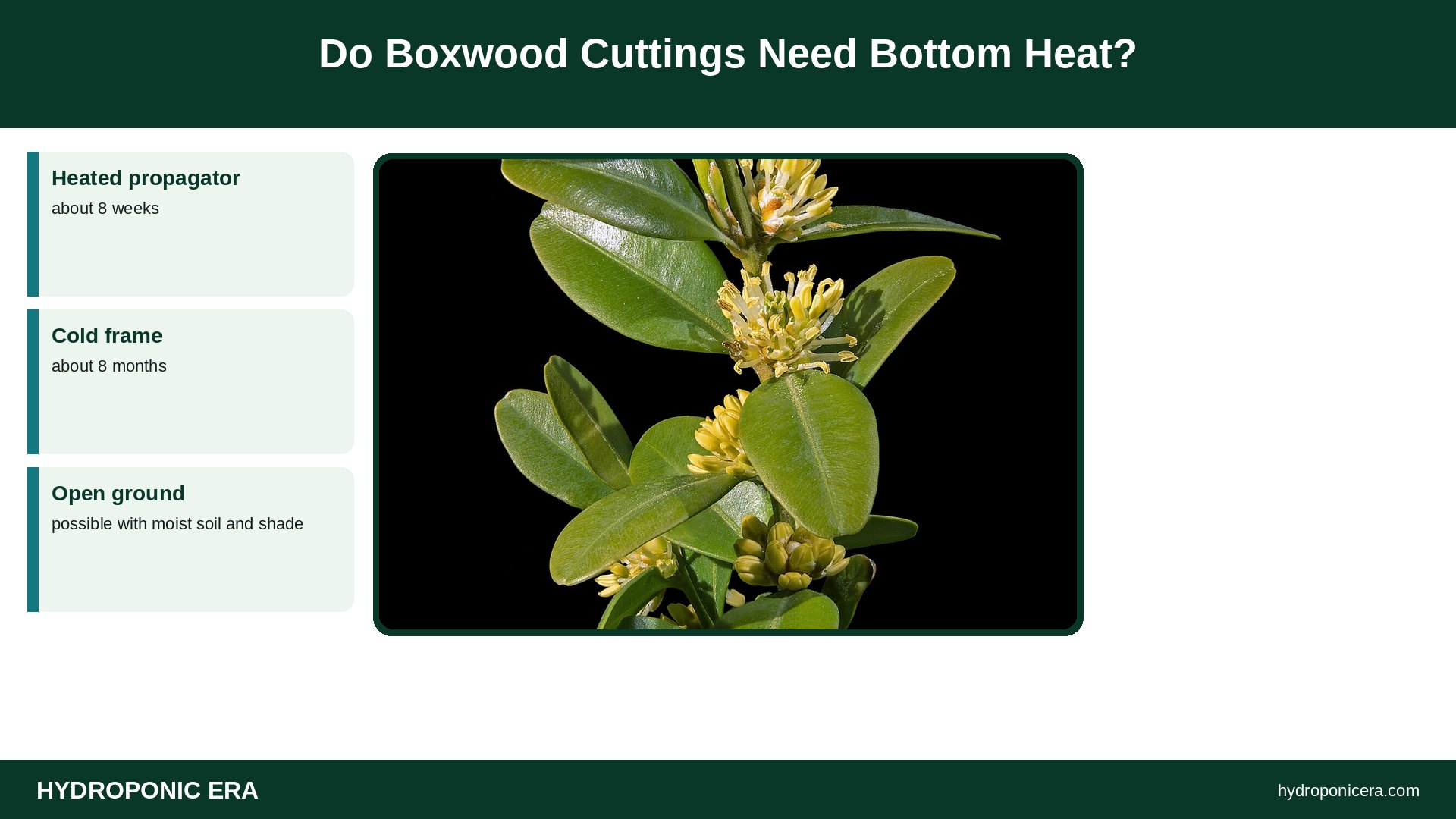
Heat makes a big difference. The RHS says cuttings in a heated propagator root fast, taking about eight weeks, while those in a cold frame or unheated greenhouse should be well rooted in about eight months. Cuttings will also root in open ground if the soil stays moist and shaded. Our heat mats and humidity domes guide covers simple setups.
- Heated propagator: about 8 weeks.
- Cold frame: about 8 months.
- Open ground: possible with moist soil and shade.
How Long Do Boxwood Cuttings Take to Root?
Rooting ranges from about two months to most of a year. Besides the RHS figures above, Mississippi State notes most cuttings take two to four months for roots to appear and stresses patience. Keep the cover on, mist rather than drench, and resist pulling cuttings to look. Fresh new growth at the tips is a good sign roots have formed.
How Do You Grow On Rooted Boxwood Cuttings?
Once the cuttings start to sprout, the RHS says to pinch out the shoot tips regularly for bushy growth. In autumn, plant them in a sheltered spare patch 12 to 18 inches (30–45 cm) apart to grow on. After three or four years, they will be large enough for their final position, in sun or shade with soil that does not dry out.

What Problems Affect Boxwood Cuttings?
Start with clean material. The RHS warns that box blight fungus and box tree caterpillar can seriously damage boxwood, so take cuttings only from healthy plants with no leaf spotting or bare patches. Under cover, good ventilation and removing fallen or dead leaves help prevent mold. A propagation box with vents makes airflow easier to manage.
FAQ About Boxwood Cuttings
When should you take boxwood cuttings?
Early to mid summer for semi-ripe cuttings.
How long should boxwood cuttings be?
About 4 to 6 inches (10–15 cm).
How long do boxwood cuttings take to root?
About 8 weeks with heat; up to 8 months without.
What IBA strength do boxwood cuttings need?
About 1,000 to 5,000 ppm.
Can boxwood cuttings root in the ground?
Yes, in moist, shaded soil.
How long until boxwood cuttings are full size?
About three to four years to plant out.
Sources
- Royal Horticultural Society — How to grow box
- University of Kentucky — Buxus sempervirens ‘Dee Runk’
- Mississippi State University Extension — How to Propagate Plants from Cuttings
- Royal Horticultural Society — Cuttings: semi-ripe
- University of Missouri Extension — Home Propagation of Garden and Landscape Plants (G6970)
- Photo credits (Wikimedia Commons, edited with titles): Buxus sempervirens RF by Robert Flogaus-Faust (CC BY 4.0); Gewöhnlicher Buchsbaum, Buxus sempervirens by Feel free to use my photos, but please mention me as the author and if you want (CC BY-SA 3.0 at); Buisfleurs by Didier Descouens (CC BY-SA 3.0)