
How do you root honeysuckle cuttings? Take honeysuckle cuttings from current-season growth in summer, cut just above a pair of leaves and about halfway to the next leaf joint below, and insert them in a 50:50 mix of potting compost and sharp sand under a clear cover with bottom heat. The RHS says climbers like Lonicera usually root in six to eight weeks.
Key takeaway: Honeysuckle (Lonicera) is one of the easier climbers to multiply. The RHS lists Lonicera among climbers that do well from cuttings, and the University of New Hampshire Extension includes honeysuckle among shrubs grown from softwood cuttings. Before you propagate, make sure you have a non-invasive species: University of Maryland Extension classifies Japanese honeysuckle as invasive.
| Factor | Guideline | Source |
|---|---|---|
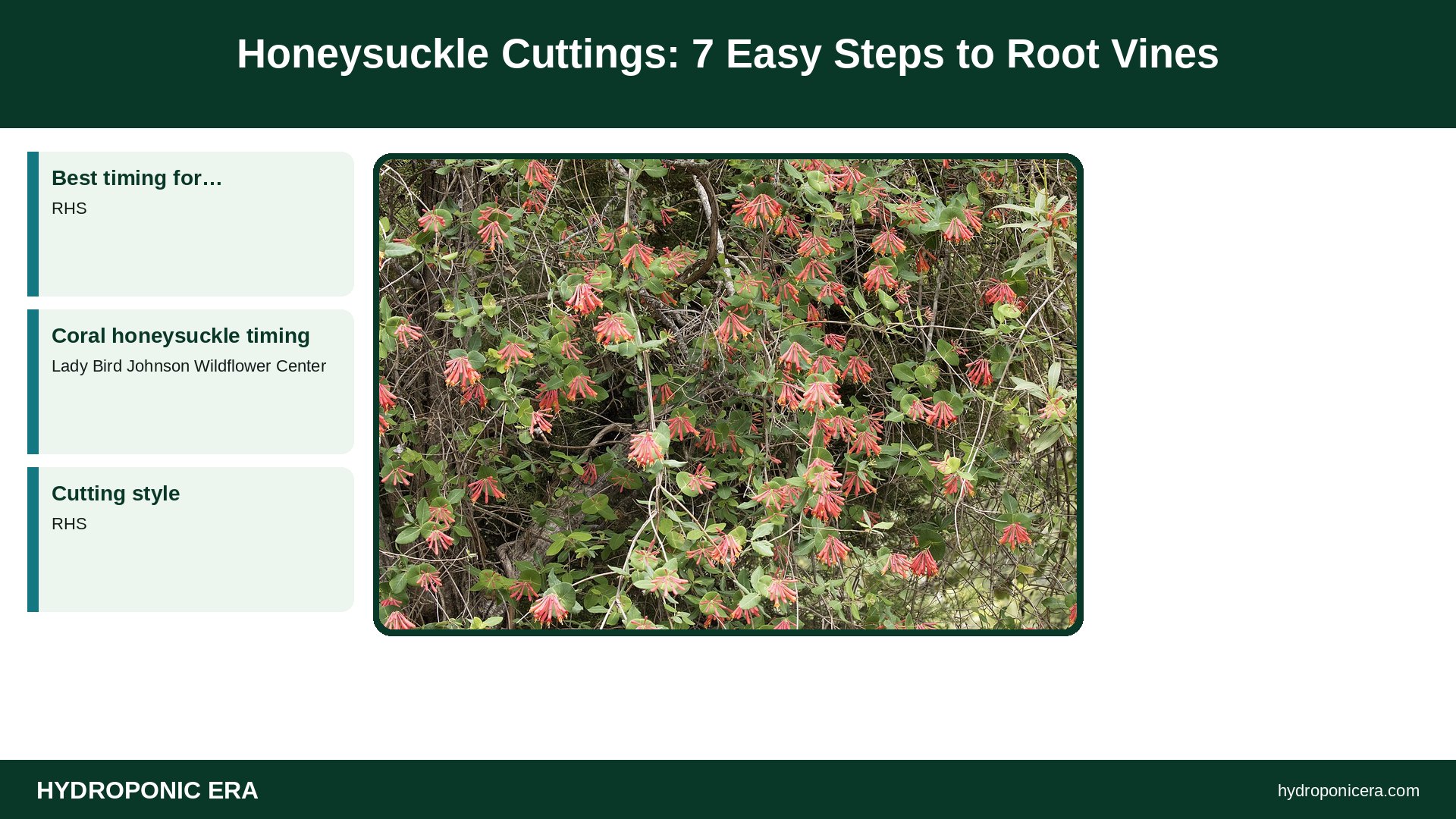
| Best timing for honeysuckle cuttings | Late summer to mid-autumn (semi-ripe) | RHS |
| Coral honeysuckle timing | Summer to fall (softwood or semi-hardwood) | Lady Bird Johnson Wildflower Center |
| Cutting style | Leaf-bud cutting: above a leaf pair, halfway down to next node | RHS |
| Rooting mix | 50% potting compost, 50% sharp sand or grit | RHS |
| Rooting time | About 6–8 weeks | RHS |
| Invasive species | Japanese honeysuckle (Lonicera japonica) | University of Maryland Extension |
When Should You Take Honeysuckle Cuttings?
Summer into early autumn. The RHS says most climbers do well from semi-ripe cuttings of current-season growth with a hard base and soft tip, available in late summer and often until mid-autumn. For native coral honeysuckle, the Lady Bird Johnson Wildflower Center says the easiest method is softwood or semi-hardwood cuttings taken from summer to fall.
- Softwood: early summer, soft new shoots.
- Semi-ripe: late summer to mid-autumn.
- Morning: water the plant thoroughly the night before.
Which Honeysuckle Should You Propagate?
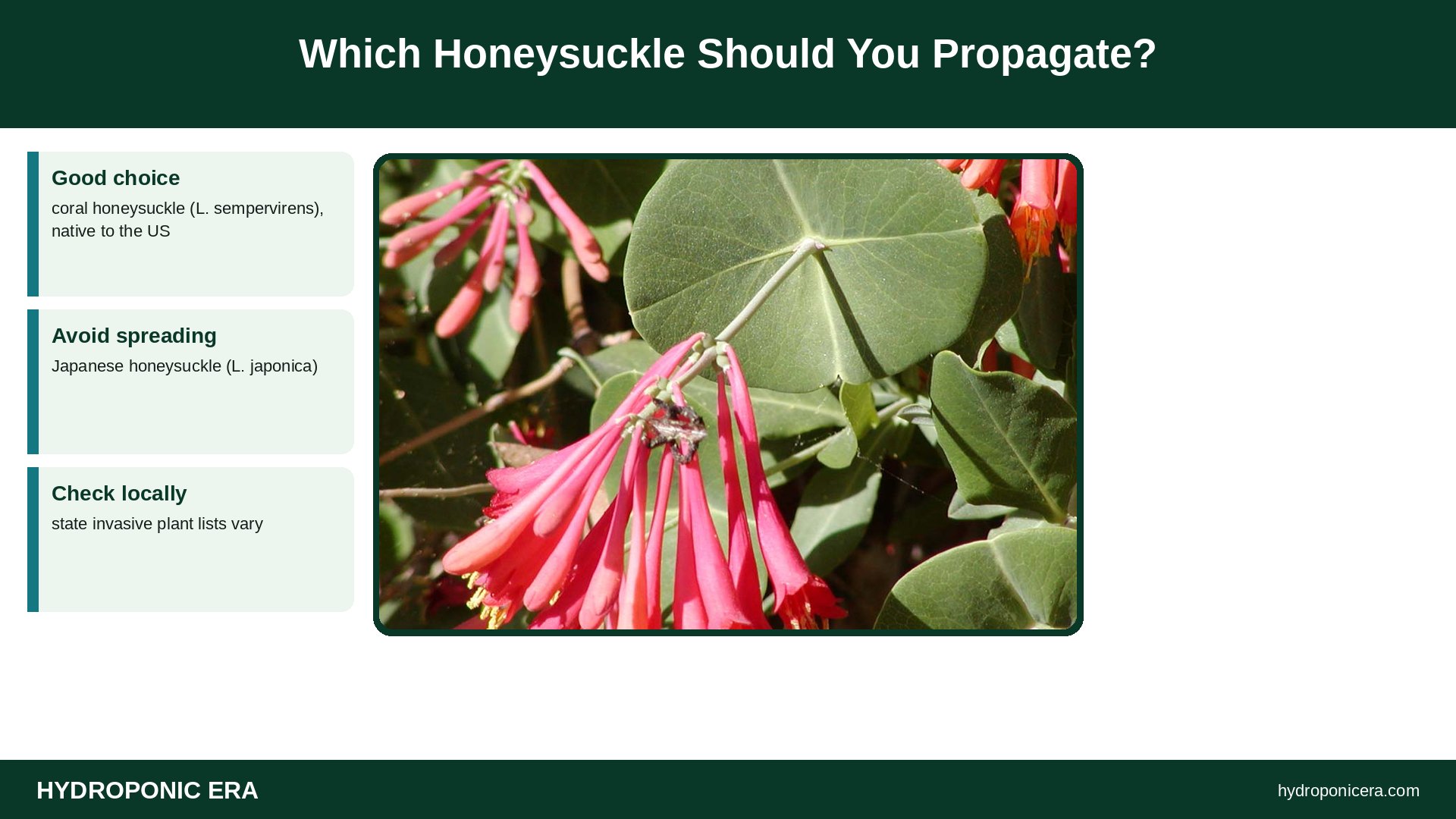
Choose a native or non-invasive type. University of Maryland Extension says Japanese honeysuckle (Lonicera japonica) is an invasive vine native to Eastern Asia and that every honeysuckle in Maryland other than its three native species is a non-native invasive. It names trumpet or coral honeysuckle (Lonicera sempervirens) as the predominant native vine, which hummingbirds frequently visit, according to the Wildflower Center.
- Good choice: coral honeysuckle (L. sempervirens), native to the US.
- Avoid spreading: Japanese honeysuckle (L. japonica).
- Check locally: state invasive plant lists vary.
How Do You Take Honeysuckle Cuttings Step by Step?
Use the RHS leaf-bud method for climbers. Water the parent plant the night before, then cut non-flowering shoots and keep them cool in a plastic bag. Make the top cut directly above a pair of leaves and the lower cut about halfway between that leaf joint and the next. On large-leaved climbers, the RHS suggests halving the leaves.
- Water the parent plant the evening before.
- Cut healthy, non-flowering shoots and bag them.
- Cut just above a leaf pair.
- Make the lower cut halfway to the next leaf joint.
- Dip the base in rooting hormone if desired.
- Insert into a compost and sharp sand mix.
- Cover and place in bright, indirect light.
How Many Honeysuckle Cuttings Should You Take?
Take extras. An Ask Extension expert answer suggests two to three stem cuttings for each new plant you want, so you can keep the strongest. It describes summer tip cuttings roughly 6 to 8 inches (15–20 cm) long with two leaves near the tip, a quick-draining mix of equal parts peat moss, perlite and coarse sand, and roots in about two to three weeks.
Do Honeysuckle Cuttings Need Rooting Hormone?
It helps. UNH Extension recommends dipping softwood cuttings in rooting hormone for faster and better rooting, and the Florida Native Plant Society suggests applying root hormone to the cut face of coral honeysuckle cuttings. Our rooting hormone guide compares powders, gels and liquids for honeysuckle cuttings and other vines.
What Rooting Mix Do Honeysuckle Cuttings Need?
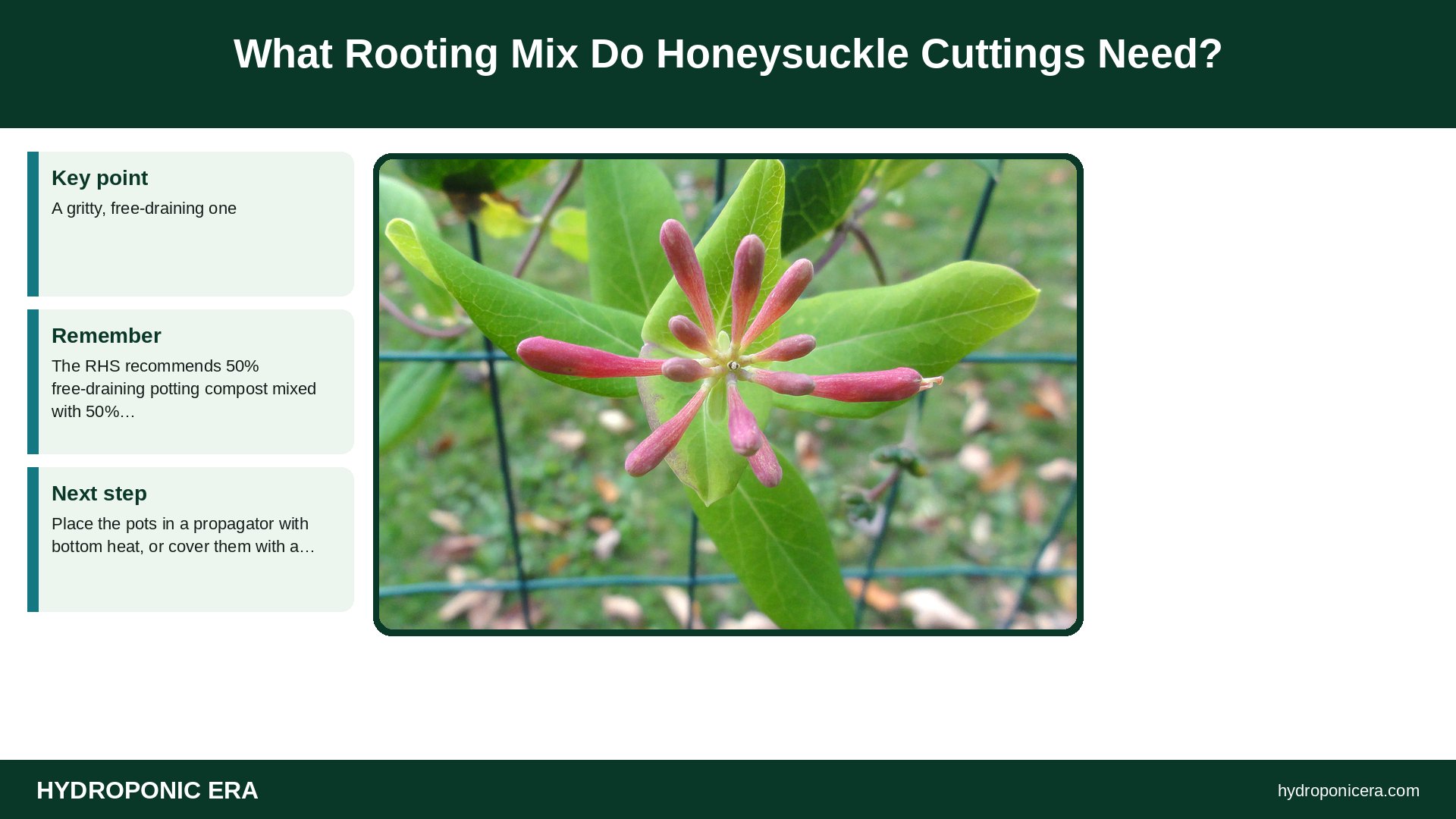
A gritty, free-draining one. The RHS recommends 50% free-draining potting compost mixed with 50% sharp sand or grit. Place the pots in a propagator with bottom heat, or cover them with a plastic bag in a warm, light spot out of direct sun. Wipe away excess condensation but keep the compost damp.
A seedling heat mat and humidity dome gives you bottom heat and a cover in one setup.
How Long Do Honeysuckle Cuttings Take to Root?
About six to eight weeks. The RHS says rooting of climber cuttings is usually quick, at six to eight weeks, but recommends leaving the cuttings in an unheated greenhouse or cold frame until spring before potting them separately. UNH Extension says most shrubs root within 3 to 6 weeks, so soft summer cuttings can be faster.
Can You Layer Honeysuckle Instead of Taking Cuttings?
Yes. The Lady Bird Johnson Wildflower Center lists layering as another way to propagate coral honeysuckle. Pin a low stem to the soil where a leaf joint touches the ground, keep it moist, and sever it once roots form. Because the stem stays attached to the parent while it roots, layering is a low-effort backup to honeysuckle cuttings.
Can You Root Honeysuckle Cuttings in Water?
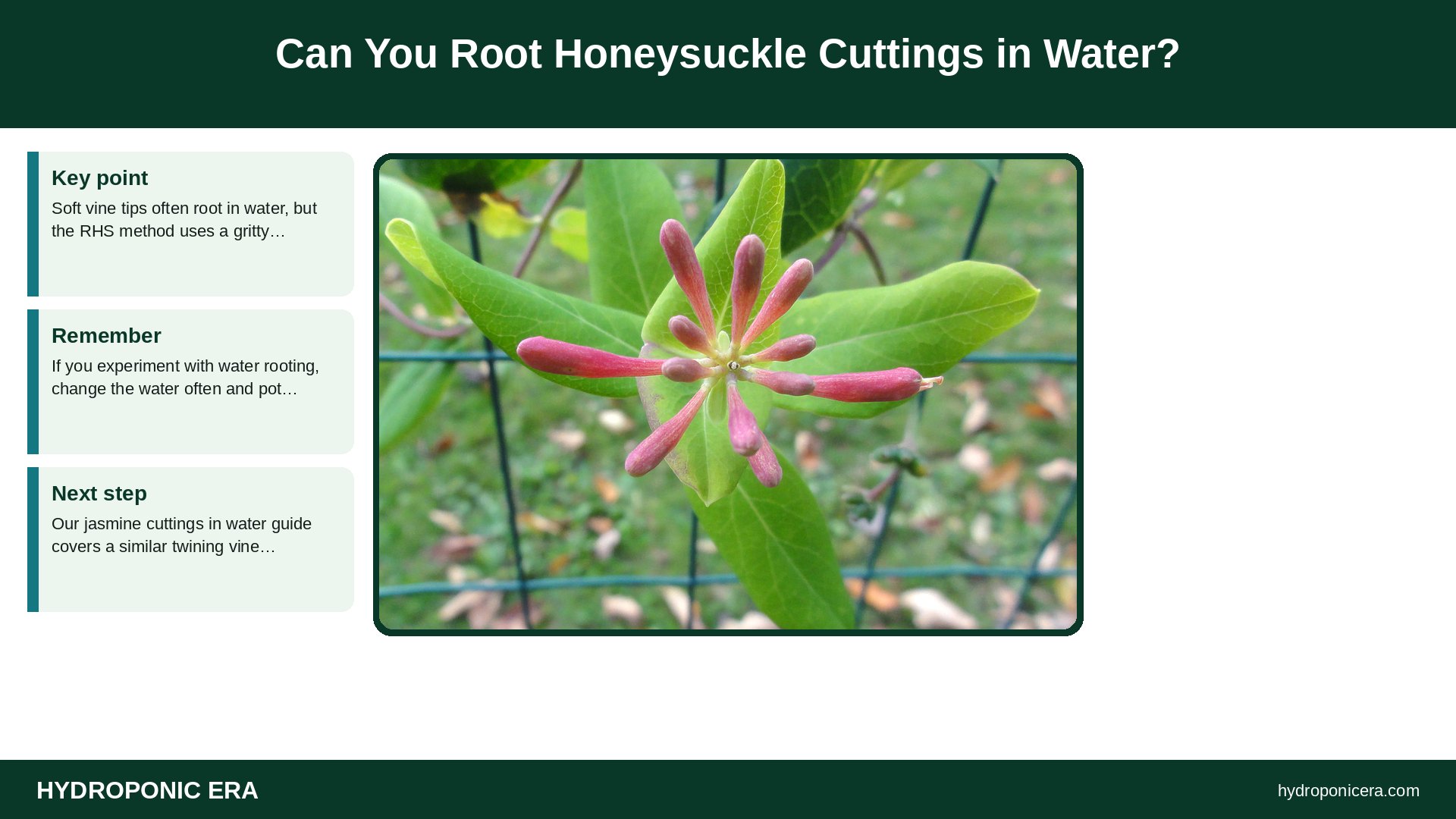
Soft vine tips often root in water, but the RHS method uses a gritty compost mix, so the roots form in the medium they will grow in. If you experiment with water rooting, change the water often and pot up promptly. Our jasmine cuttings in water guide covers a similar twining vine, and the water vs soil propagation guide explains the tradeoffs.
How Do You Care for Rooted Honeysuckle Cuttings?
Keep the compost moist until cuttings are well rooted, and shade them in hot weather, as the RHS advises. Remove dead or diseased cuttings. In spring, pot each one separately and give it a trellis or fence to climb. The Wildflower Center notes coral honeysuckle needs light, good air circulation and drainage to prevent powdery mildew.
FAQ About Honeysuckle Cuttings
When do you take honeysuckle cuttings?
Summer to mid-autumn, using semi-ripe current-season growth.
How long do honeysuckle cuttings take to root?
About six to eight weeks, per the RHS.
What mix should I use?
Half potting compost, half sharp sand or grit.
Is honeysuckle invasive?
Japanese honeysuckle is; native coral honeysuckle is not.
Do honeysuckle cuttings need rooting hormone?
Not required, but it improves rooting.
Can honeysuckle be layered?
Yes, layering also works for coral honeysuckle.
Sources
- Royal Horticultural Society — Climbers: taking cuttings
- University of Maryland Extension — Japanese Honeysuckle
- Lady Bird Johnson Wildflower Center — Lonicera sempervirens
- University of New Hampshire Extension — The Art of Making More
- Ask Extension — Honeysuckle propagation (#755952)
- Florida Native Plant Society — Lonicera sempervirens
- Photo credits (Wikimedia Commons, edited with titles): Lonicera sempervirens – Coral honeysuckle 01 by Zeynel Cebeci (CC BY-SA 4.0); Lonicera sempervirens close by Stan Shebs (CC BY-SA 3.0); Lonicera sempervirens 05155 by R. A. Nonenmacher (CC BY-SA 4.0)