
Can you root jasmine cuttings in water? Yes. University of Vermont Extension lists jasmine (Jasminum polyanthum) among vining plants that are easy to root in water. Take a 3–6 in (8–15 cm) semi-ripe tip, strip the lower leaves, set it in room-temperature water in bright, indirect light, and pot it up once roots pass 2–3 in (5–8 cm).
Key takeaway: Jasmine cuttings in water root best from healthy, half-woody summer growth kept warm and out of direct sun. Change cloudy water, be patient for several weeks, and move rooted cuttings to well-drained potting mix before the roots get long and tangled.
| Step | What to do | Tip |
|---|---|---|
| Timing | Late spring to late summer | Semi-ripe stems root more reliably |
| Cutting size | 3–6 in (8–15 cm), several nodes | Cut just below a node |
| Water | Room temperature, leaves above the surface | Replace when cloudy |
| Light | Bright, indirect | No hot direct sun on the jar |
| Pot up | Roots 2–3 in (5–8 cm) | Use a well-drained mix |
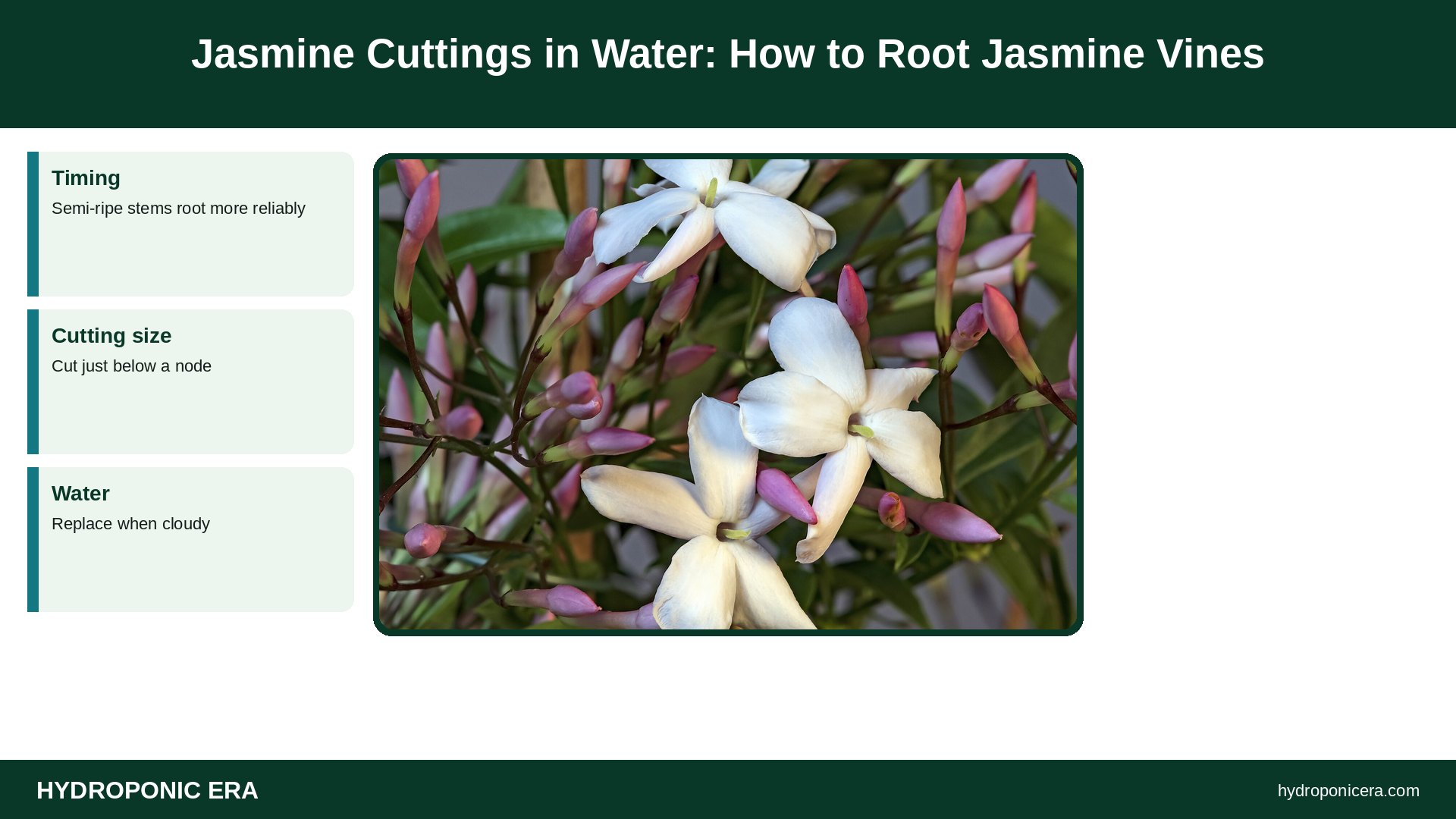
Which Jasmine Can You Root in Water?
Most common indoor and patio jasmines can be tried as jasmine cuttings in water. UVM Extension names pink jasmine, Jasminum polyanthum, as easy to root this way. Arabian jasmine (J. sambac) and common jasmine (J. officinale) also root from semi-ripe stems, though woody types may root more slowly.
Star jasmine, Trachelospermum jasminoides, is not a true jasmine, but it also roots from semi-ripe cuttings. NC State Extension lists jasmine among plants propagated from semi-hardwood cuttings, which are taken from partly matured new growth in summer.
When Should You Take Jasmine Cuttings?
Take jasmine cuttings in late spring through late summer, when new shoots have started to firm up but still bend. The Royal Horticultural Society suggests softwood or semi-ripe cuttings for tender jasmines in spring and summer, while hardy outdoor types can also be propagated from hardwood cuttings in winter or by layering.
- Best time of day: early morning, when stems are full of water.
- Best stems: healthy, non-flowering side shoots.
- Avoid: very soft tips that wilt fast, or thick old wood.
How Do You Root Jasmine Cuttings in Water Step by Step?
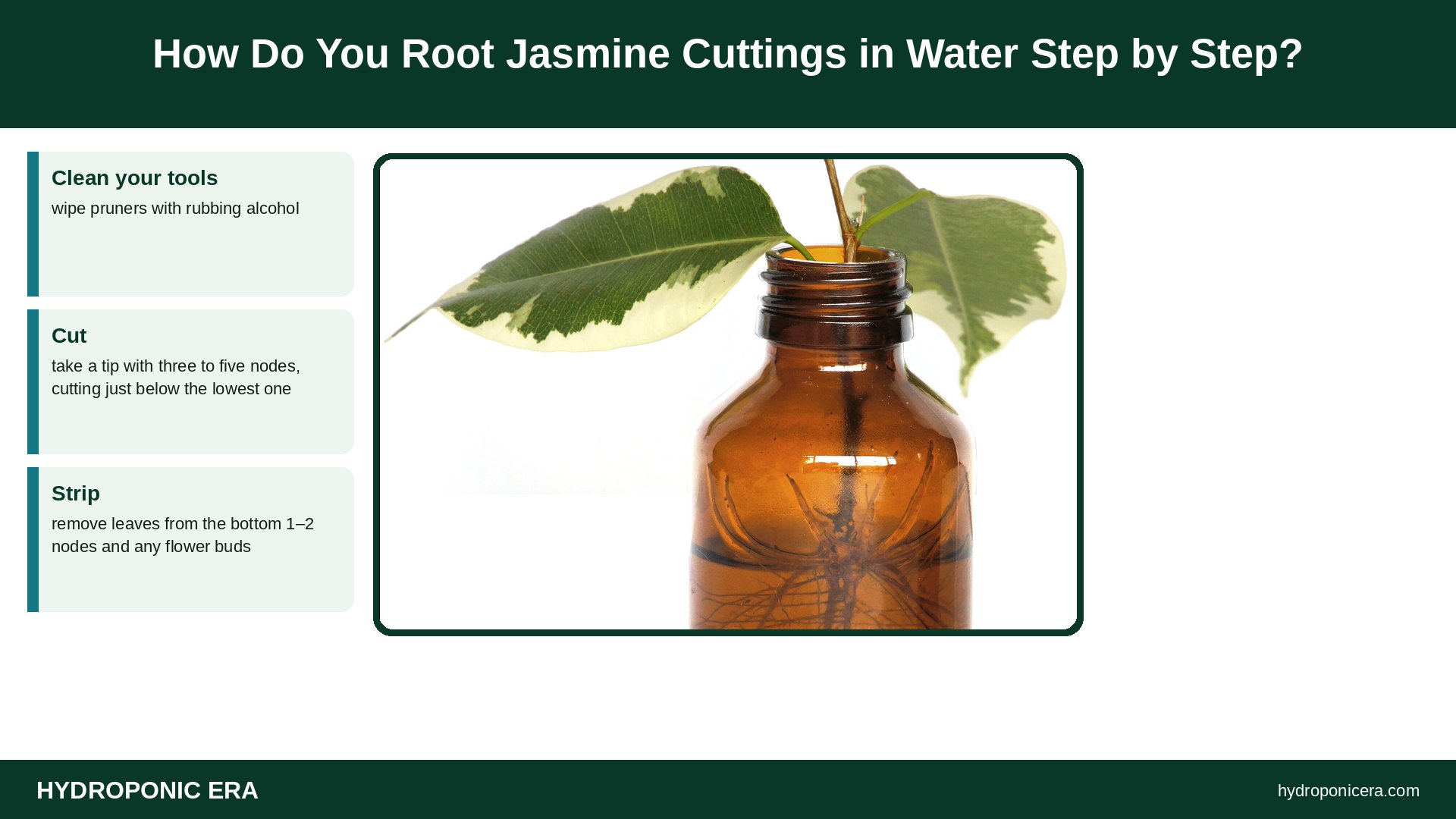
To root jasmine cuttings in water, cut a 3–6 in (8–15 cm) tip below a node, remove leaves from the lower one or two nodes, and stand it in a clean jar of room-temperature water. Keep it in bright, indirect light at about 65–75°F (18–24°C) and make sure no leaves sit underwater.
- Clean your tools: wipe pruners with rubbing alcohol.
- Cut: take a tip with three to five nodes, cutting just below the lowest one.
- Strip: remove leaves from the bottom 1–2 nodes and any flower buds.
- Fill a jar: use a narrow glass or bottle so the stem stands upright.
- Submerge nodes: one or two bare nodes under water, leaves above.
- Place: bright, indirect light, away from heaters and drafts.
- Refresh: replace the water when it turns cloudy, or about weekly.
- Wait: roots may take a few weeks or longer, so be patient.
Our cuttings and cloning guide covers the basics for many plants.
How Long Do Jasmine Cuttings Take to Root in Water?
Jasmine cuttings in water usually show roots in about three to six weeks, but woody stems or cool rooms can take longer. UVM Extension notes that rooting in water can take days, weeks or sometimes months. As long as the cutting stays green and firm, keep waiting and keep the water fresh.
Warmth speeds things up. A spot near 70–75°F (21–24°C) is better than a cool windowsill in fall. Bottom heat from a seedling mat under the jar can help slow cultivars. Many of the same rules apply to pothos in water and other vining cuttings, so if you have rooted those, jasmine cuttings in water will feel familiar.
Does Rooting Hormone Help Jasmine Cuttings in Water?
Rooting hormone is optional for jasmine cuttings in water, and most powders are made for soil or media. If you want to use hormone, a better plan is to dip the cut end and root it in moist perlite or seed-starting mix instead. Some gardeners use willow water, but evidence for home use is limited.
If you try both, start a few cuttings in water and a few in mix. You’ll learn which suits your jasmine and conditions. See our humidity dome guide for rooting in media.
Why Are My Jasmine Cuttings in Water Not Rooting?
Jasmine cuttings in water fail to root when stems are too soft or too old, the room is cold, light is weak, or the water goes stale. Rot starts at the base and turns it black and slimy. Cut above any rot, use fresh water and a clean jar, and move the cutting somewhere warmer and brighter.
| Problem | Likely cause | Fix |
|---|---|---|
| Black, mushy base | Rot from stale or warm water | Recut, clean jar, change water more often |
| Leaves drop | Stress or too many leaves | Trim to the top 2–4 leaves |
| No roots after 8 weeks | Cold, low light or hard wood | Add warmth; try semi-ripe stems |
| Algae in the jar | Light hitting the water | Use a dark or covered jar |
How Do You Transplant Rooted Jasmine Cuttings?
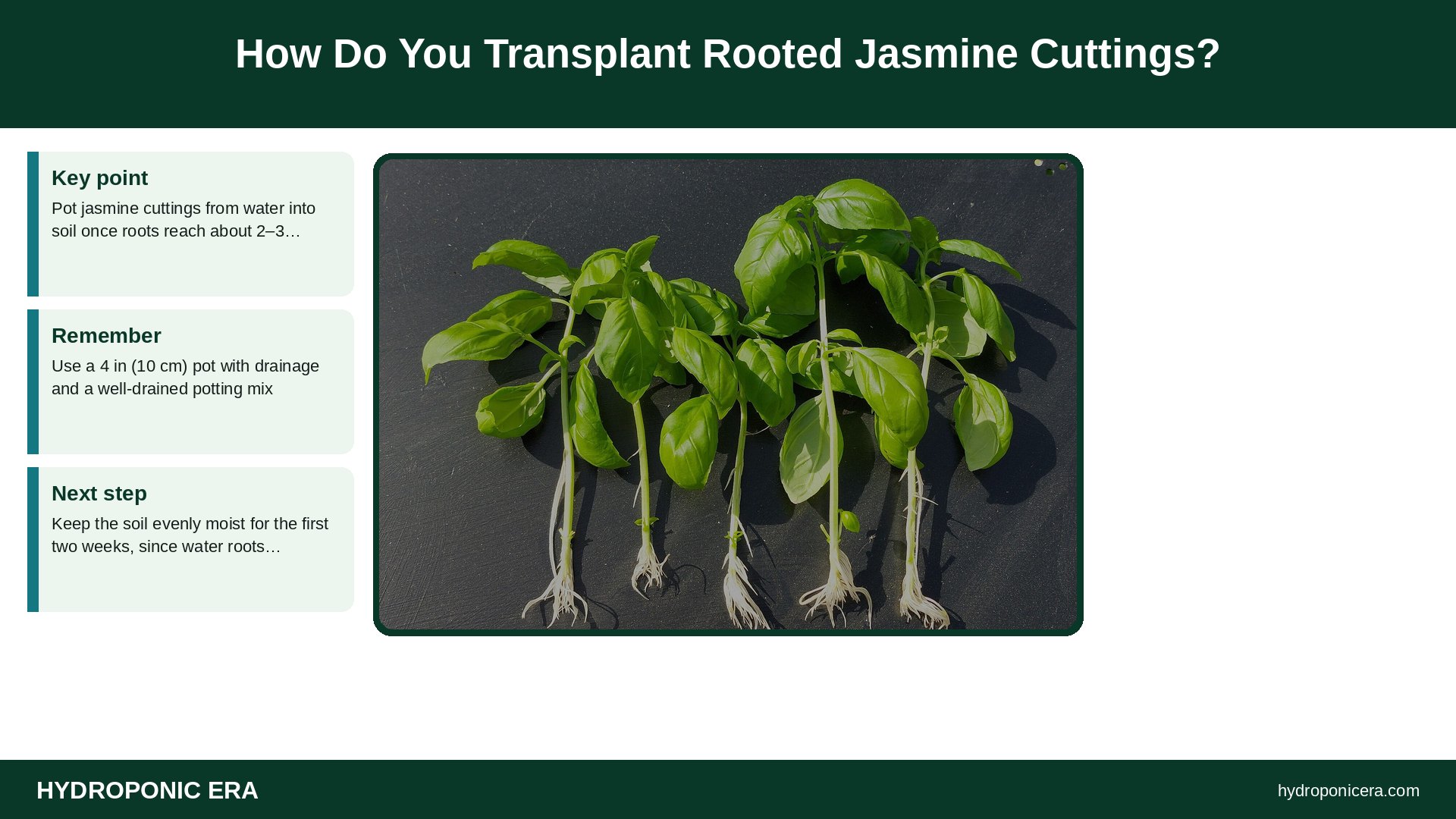
Pot jasmine cuttings from water into soil once roots reach about 2–3 in (5–8 cm), as UVM Extension advises. Use a 4 in (10 cm) pot with drainage and a well-drained potting mix. Keep the soil evenly moist for the first two weeks, since water roots must adapt to soil.
- Plant at the same depth the stem sat in the water.
- Keep it in bright, indirect light for a week, then increase light gradually.
- Pinch the tips once new growth starts to encourage branching.
- Give climbing types a small stake or trellis early.
Want to keep it in water longer? Our guide to plants that grow in water lists better long-term choices.
FAQ About Jasmine Cuttings in Water
Can jasmine live in water permanently?
It is not ideal. Jasmine grows best in soil once rooted.
Should I put jasmine cuttings in the sun?
No. Use bright, indirect light; direct sun overheats the jar.
How many cuttings should I take?
Take several, since not every cutting roots.
Can I root jasmine from a flowering stem?
You can, but remove flowers and buds so the cutting puts energy into roots.
Is layering easier than cuttings?
For outdoor jasmine, layering a low stem into soil is often very reliable.
Sources
- University of Vermont Extension — More, Please: Propagating Houseplants
- N.C. State Extension — Plant Propagation by Stem Cuttings
- Royal Horticultural Society — How to Grow Jasmine
- Penn State Extension — Propagating Houseplants
- Photo credits (Wikimedia Commons, edited with titles): (MHNT) Jasminum polyanthum – flowers and buds by Didier Descouens (CC BY-SA 4.0); Ficus cuttings with roots in a bottle, White background by Biusch (CC BY-SA 3.0); Autographa gamma en Trachelospermum jasminoides – 01 by Carlos Delgado (CC BY-SA 3.0); Basilikum (Ocimum basilicum) Stecklinge — Josef Schlaghecken by Schlaghecken Josef (CC BY-SA 4.0)