
What is tote hydroponics? Tote hydroponics is a simple deep water culture system built from an opaque plastic storage tote. You fill the tote with nutrient solution, cut holes in the lid for net pots, add an air pump and air stone, and let plant roots hang in oxygenated water. It suits lettuce, herbs and other leafy greens.
Key takeaway: Cornell’s home hydroponics guide notes that plastic storage boxes work as well as bus tubs for deep water culture, as long as the container is opaque. Keep pH at 5.5–6.0, aerate the water, and top off as plants drink.
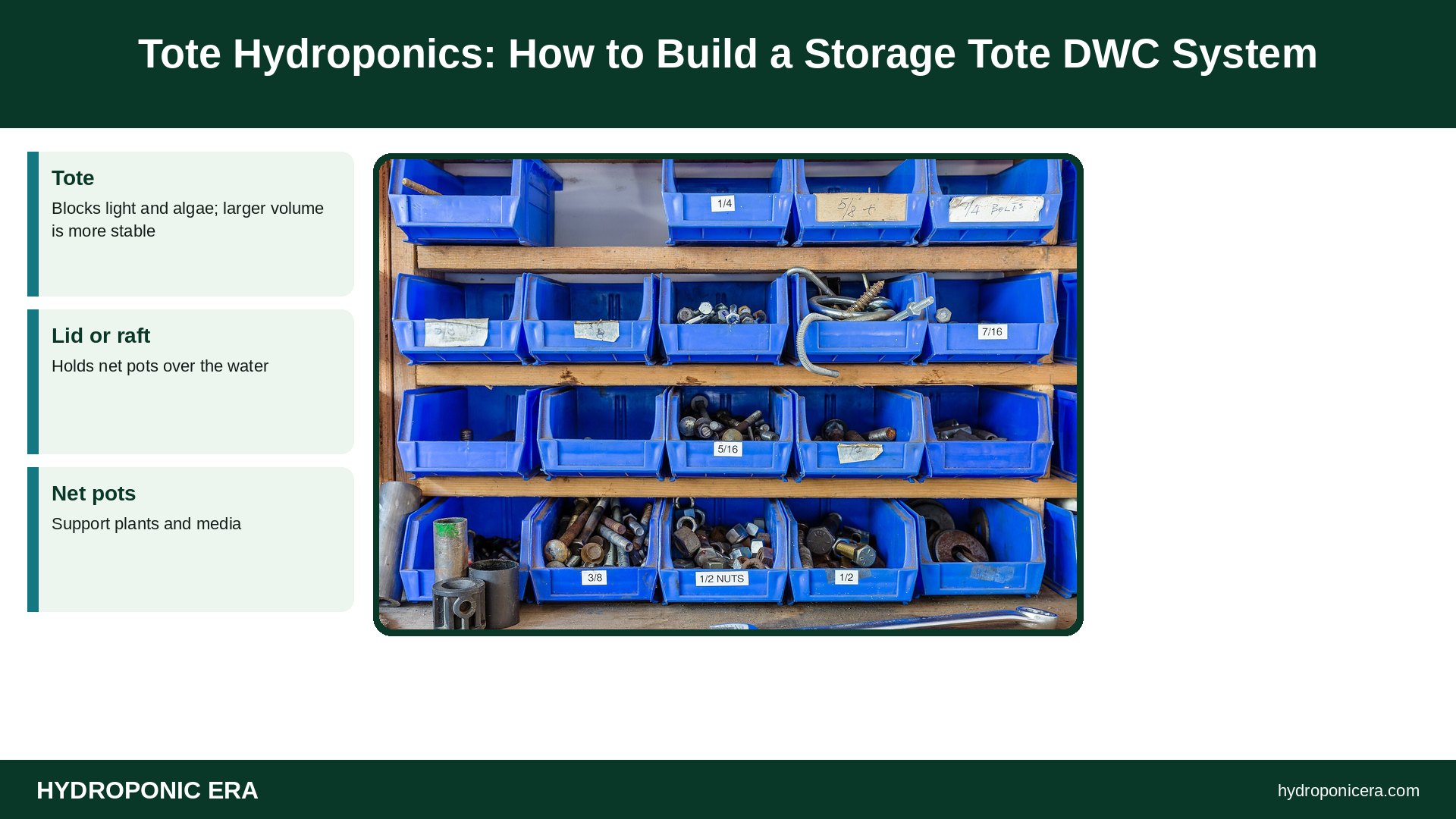
| Part | What to use | Why it matters |
|---|---|---|
| Tote | Opaque, 10–27 gal (38–102 L), food-safe plastic such as #2 HDPE or #5 PP | Blocks light and algae; larger volume is more stable |
| Lid or raft | Tote lid or 1 in (2.5 cm) foam board | Holds net pots over the water |
| Net pots | 2–3 in (5–8 cm) | Support plants and media |
| Air pump and stone | Sized to tote volume | Supplies dissolved oxygen to roots |
| Meters | pH pen and EC meter | Keep the solution in range |
How Does Tote Hydroponics Work?
Tote hydroponics works on the deep water culture principle: roots sit in a reservoir of nutrient solution while an air stone keeps it oxygenated. Cornell’s guide describes DWC as a reservoir, a floating panel or lid to hold plants, an air stone and a light, and calls it easy to build and care for at home.
Because the solution is always there, plants rarely dry out. The trade-off is that pH, nutrient strength and temperature all live in one container, so you check them often. New to the method? Start with our deep water culture for beginners guide.
What Size Tote Is Best for Hydroponics?
For tote hydroponics, a 10–27 gal (38–102 L) opaque tote is a practical size for beginners. Cornell notes that about 1 gal (3.8 L) per plant works at home, and larger reservoirs buffer temperature, EC and pH better. A shallow, wide tote is easier to light evenly than a tall, narrow one.
| Tote size | Leafy greens (approx.) | Notes |
|---|---|---|
| 10 gal (38 L) | 4–6 lettuce heads | Easiest to move; drain before lifting |
| 18 gal (68 L) | 6–8 heads | Common, good balance |
| 27 gal (102 L) | 8–12 heads | Most stable; heavy when full |
Water weighs about 8.3 lb per gallon (1 kg per liter), so place the tote where it will stay before filling.
What Do You Need to Build a Tote Hydroponics System?
To build tote hydroponics you need an opaque tote with a lid, net pots, a hole saw, an air pump with tubing and an air stone, a check valve, growing media such as rockwool or clay pebbles, hydroponic nutrients, pH up and down, a pH meter and an EC meter, plus a light if you grow indoors.
- Choose opaque plastic: Cornell stresses opaque reservoirs because light causes algae.
- Pick safe plastics: see our safe plastics guide.
- Air gear: our air pump and air stone guide covers sizing.

How Do You Set Up Tote Hydroponics Step by Step?
Setting up tote hydroponics takes about an hour. Drill net pot holes in the lid, run the air line, fill with water, mix nutrients, adjust pH, then add seedlings. Cornell suggests drilling a test hole first and checking how a wet rockwool cube fits before cutting every hole.
- Wash the tote with mild soap and rinse well.
- Mark holes about 6–8 in (15–20 cm) apart for lettuce.
- Cut holes with a hole saw just smaller than the net pot rim.
- Drill a small hole near a corner for the air line.
- Place the air stone on the bottom and connect it to the pump with a check valve.
- Fill with water to about 1 in (2.5 cm) below the net pot bottoms at first.
- Measure starting EC of your water; Cornell suggests 1 mS/cm or less is ideal.
- Add nutrients per the label and mix well.
- Adjust pH to 5.5–6.0.
- Transplant seedlings in their cubes or media into the net pots and switch on the pump.
What pH and EC Should Tote Hydroponics Use?
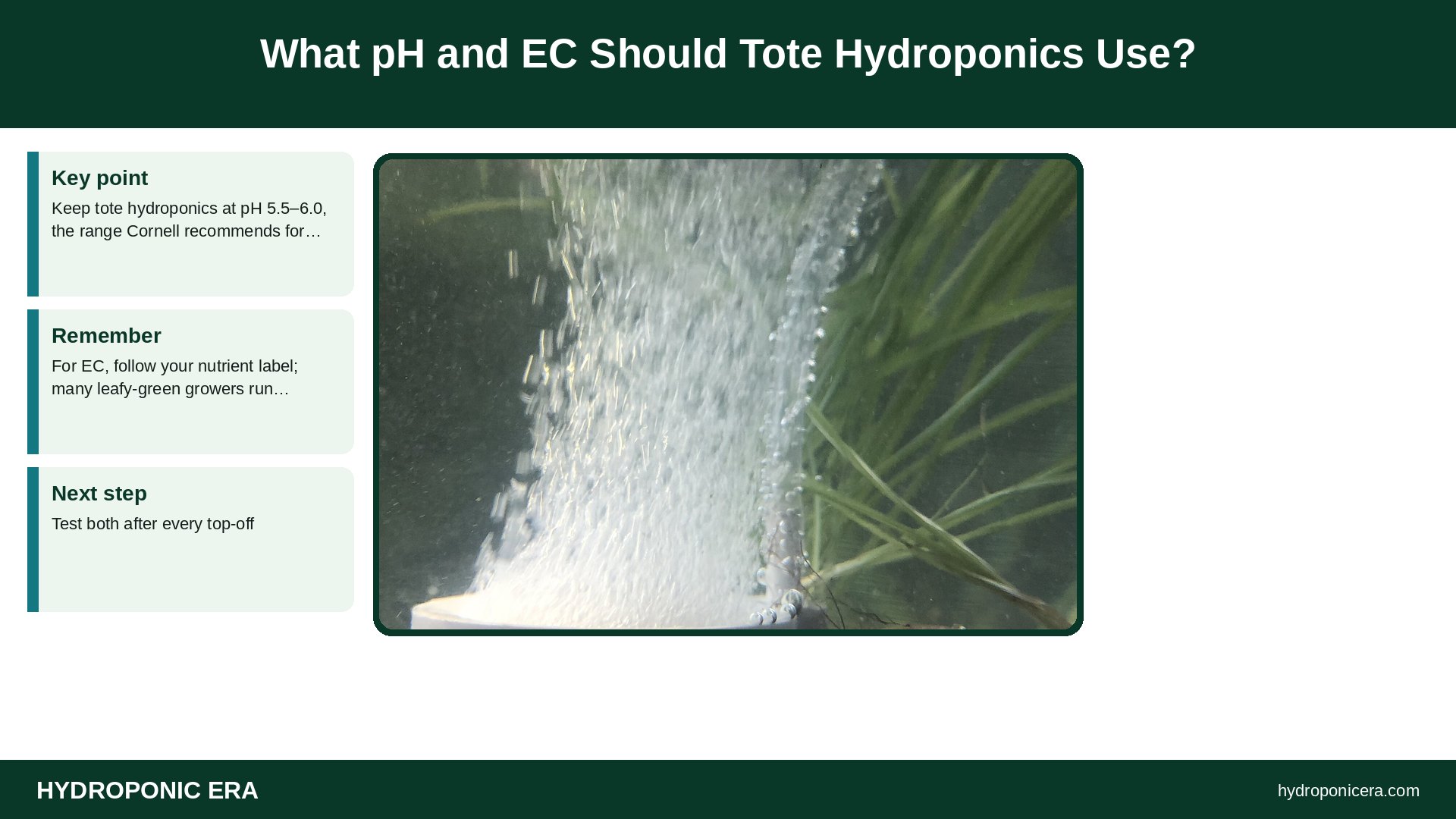
Keep tote hydroponics at pH 5.5–6.0, the range Cornell recommends for leafy greens, and check it a few times a week because it can drift within days. For EC, follow your nutrient label; many leafy-green growers run about 1.2–2.0 mS/cm. Test both after every top-off.
Track readings in a notebook or app. Our pH control guide explains how to raise or lower pH safely.
How Do You Keep Roots Healthy in a Tote?
Healthy roots in tote hydroponics are white or cream and smell clean. Cornell notes that cooler water holds more dissolved oxygen and recommends about 7–10 ppm. Run the air pump 24 hours a day, keep the tote out of sun, and aim for water around 65–72°F (18–22°C) to help prevent root rot.
- Brown, slimy roots: warm water or low oxygen; see our dissolved oxygen guide.
- Algae: seal light leaks with foil tape or paint.
- Falling water level: Cornell estimates lettuce uses about 100 mL per plant per day, about one-fifth of a gallon (0.7 L) a week.
What Can You Grow in Tote Hydroponics?
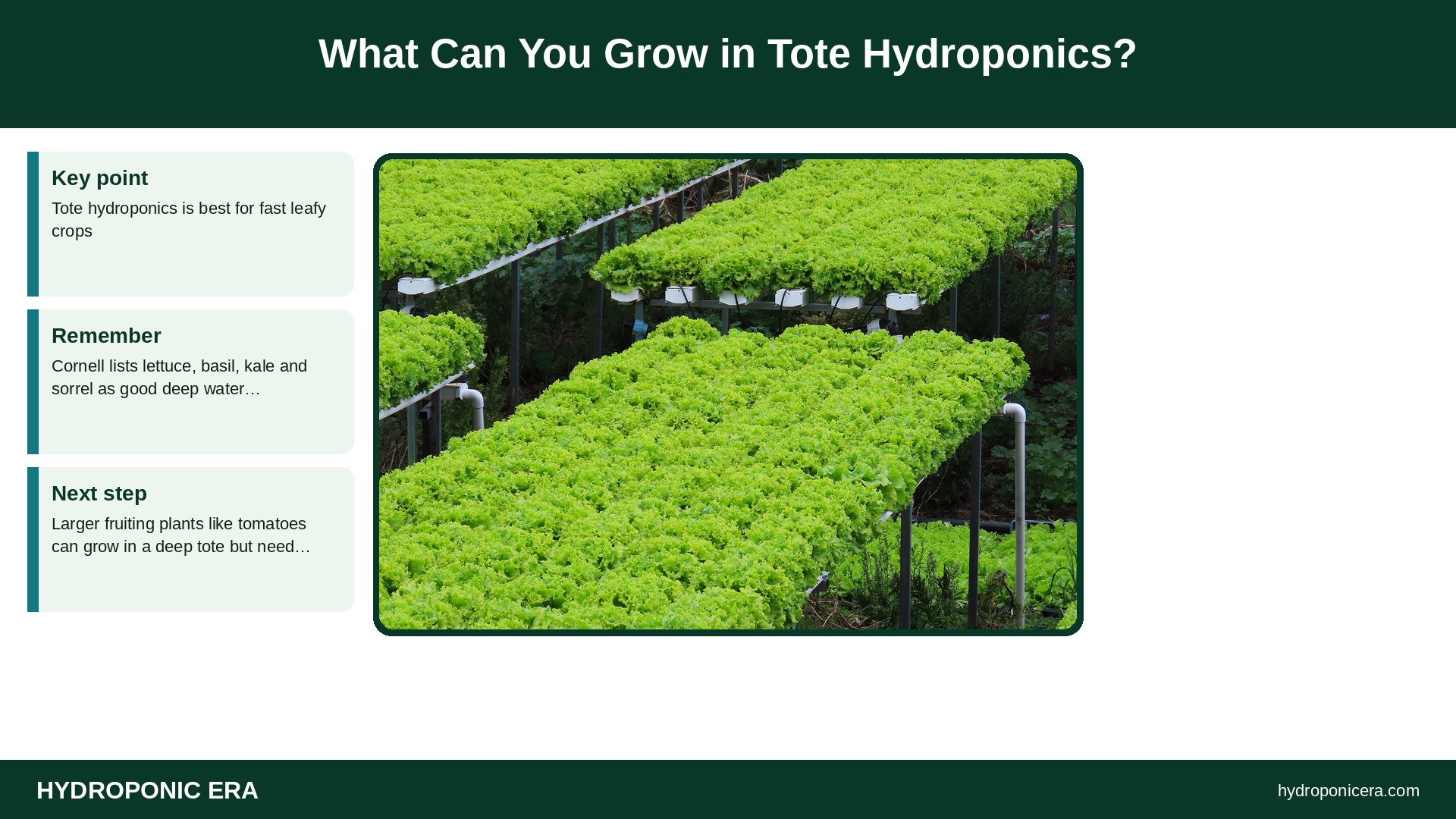
Tote hydroponics is best for fast leafy crops. Cornell lists lettuce, basil, kale and sorrel as good deep water culture crops. Larger fruiting plants like tomatoes can grow in a deep tote but need support, more nutrients and stronger light, so start with greens and herbs.
For a step-by-step lettuce plan, read our hydroponic lettuce guide.
FAQ About Tote Hydroponics
Do I need an air pump for tote hydroponics?
For active DWC, yes. Without one, use the Kratky method with an air gap instead.
How often should I change the water?
Many home growers change it every 2–3 weeks and top off between changes.
Can I use a clear tote?
Only if you fully cover it; light causes algae.
Does the lid need to touch the water?
Early on, keep water close to the net pots. As roots grow, leave a small air gap.
How much light do greens need?
Cornell gives a target of about 12–17 mol/m²/day for leafy greens.
Sources
- Cornell University (Ronzoni and Mattson) — Guide to Home Hydroponics for Leafy Greens
- UF/IFAS Extension — Leafy Greens in Hydroponics and Protected Culture for Florida
- Penn State Extension — Hydroponics Systems and Principles of Plant Nutrition
- Photo credits (Wikimedia Commons, edited with titles): Blue plastic storage organizer boxes for screws by Michal Klajban (CC BY-SA 4.0); Deep water culture by ArcadiYay (CC BY-SA 4.0); Air Stone Disk aquarium Germany 2024 by Nimmerwelk (CC BY-SA 4.0); Hydroponic lettuce @ Plaine des Cafres 03 by Rémih (CC BY-SA 4.0)