
Can you grow upland cress hydroponically? Yes. Kentucky State University Extension lists NFT, deep water culture, ebb and flow and vertical towers as suitable hydroponic systems for upland cress. Start seed in moist plugs at 50–72°F (10–22°C), expect sprouts in 5–10 days, and begin harvesting about 4–6 weeks after planting.
Key takeaway: Upland cress (Barbarea verna), also called land cress or American cress, is a peppery, cool-season green that adapts well to small hydroponic systems. Kentucky State University Extension describes it as a nutrient-rich member of the mustard family with a bold, peppery taste, and notes that unlike watercress it is normally grown in soil rather than in water.
| Factor | Guideline | Source |
|---|---|---|
| Best systems for upland cress | NFT, DWC, ebb and flow, towers | Kentucky State University |
| Germination | 5–10 days at 50–72°F (10–22°C) | Kentucky State University |
| Harvest | About 4–6 weeks after planting | Kentucky State University |
| Seed count | About 22,800 seeds per oz | Johnny’s Selected Seeds |
| Solution EC (lettuce guide) | 1.2–1.8 mS/cm (560–840 ppm) | UF/IFAS Extension |
| Solution temperature (lettuce guide) | 65–80°F (18–27°C) | UF/IFAS Extension |

What Is Upland Cress?
A peppery, cold-hardy cress grown on land. Kentucky State University Extension lists it as Barbarea verna in the mustard family (Brassicaceae), also known as land cress or American cress. West Virginia University Extension says the same plant is known in Appalachia as creasy greens or early winter cress, a biennial with a black-pepper taste.
- Flavor: bold and peppery, milder when cooked.
- Habit: biennial rosette; yellow flowers attract pollinators.
- Season: cool weather; flowers in late spring.
Which Hydroponic System Is Best for Upland Cress?
Any leafy-green system works. Kentucky State University Extension recommends nutrient film technique (NFT), deep water culture (DWC), ebb and flow, and vertical towers or aeroponics for this crop. It notes that NFT suits small leafy greens like cress, while DWC is easy to maintain. For a single kitchen setup, a small DWC tub or NFT channel is plenty.
See our NFT flow rate and slope guide if you build a channel system.

How Do You Start Upland Cress Seeds for Hydroponics?
Sow into moist plugs and keep them cool. Kentucky State University Extension says the seeds typically sprout in 5 to 10 days at 50–72°F (10–22°C). Johnny’s warns the seed germinates slowly, so keep the medium moist the whole time. Seed is small, with about 22,800 seeds per ounce, so drop two or three seeds per plug and thin later.
- Soak rockwool or other plugs and set them in a tray.
- Sow two or three seeds per plug, barely covered.
- Keep the tray at 50–72°F (10–22°C) and moist.
- Expect sprouts in about 5–10 days.
- Thin to the strongest seedling per plug.
- Move plugs into net cups once roots show.
What Nutrient Strength and pH Does Upland Cress Need?
Treat it like other leafy greens. There is little published hydroponic data for upland cress, so a lettuce-style solution is a sensible start. UF/IFAS Extension recommends an EC of 1.2–1.8 mS/cm (560–840 ppm) for hydroponic lettuce, a solution temperature of 65–80°F (18–27°C) and dissolved oxygen around 5 mg/L. UF/IFAS also lists a pH of 6.0–7.0 for lettuce, and Kentucky State notes the same 6.0–7.0 range is ideal in soil for upland cress.
Our hydroponic ppm chart shows typical ranges for other greens.

How Much Light Does Upland Cress Need?
Partial to full sun, or a leafy-green grow light indoors. Kentucky State University Extension says the plant prefers partial to full sunlight, and West Virginia University Extension notes the plants need plenty of sunshine and regular watering. Kentucky State adds that it thrives in cool climates, so avoid letting lights overheat the canopy.
When and How Do You Harvest Upland Cress?
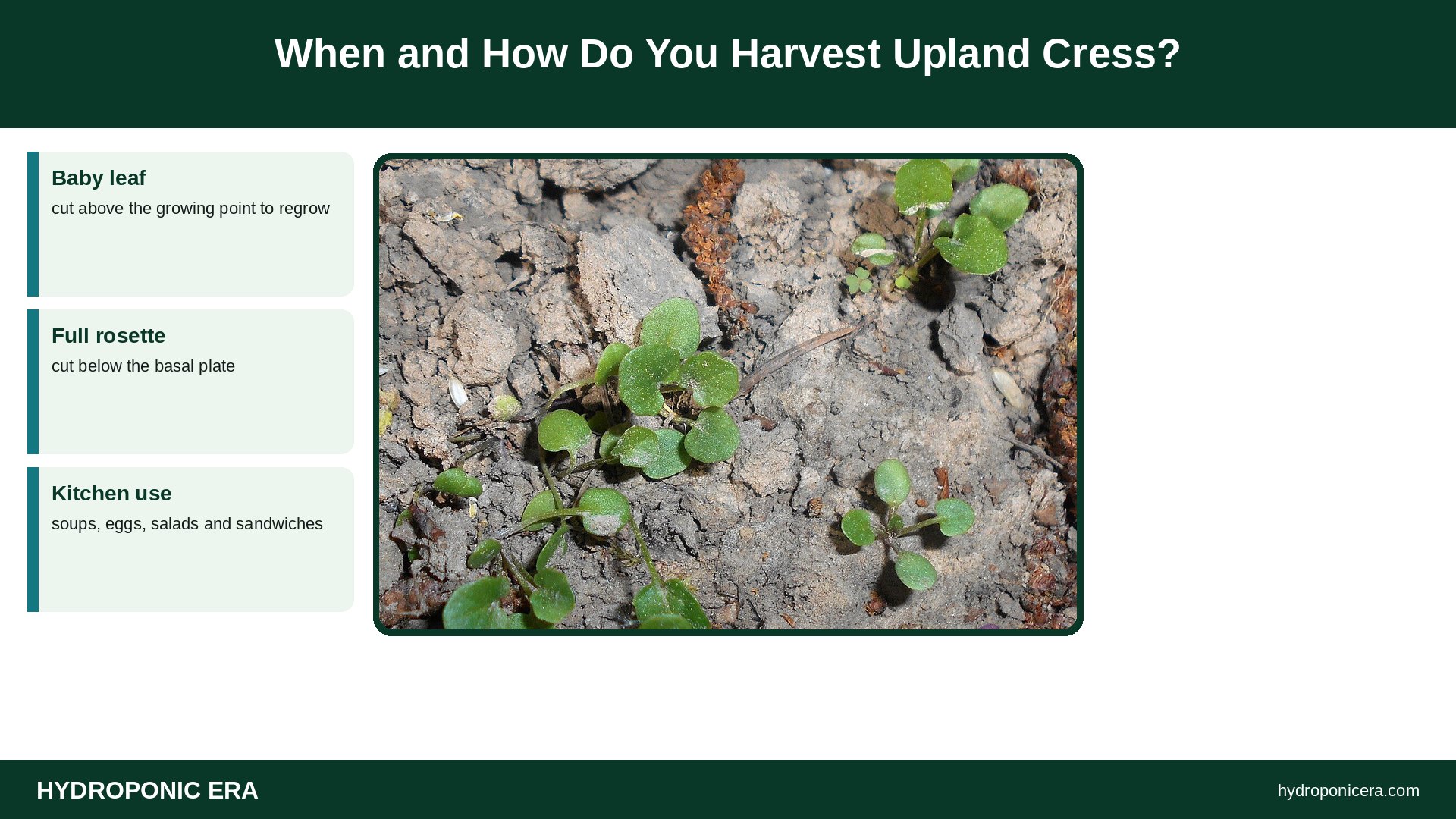
Start about 4 to 6 weeks after planting. Kentucky State University Extension says regular harvesting encourages new growth and prevents bolting. Johnny’s recommends cutting baby leaves above the basal plate so the plant regrows, or cutting full rosettes below the basal plate for a single harvest. WVU Extension says the greens taste best when eaten before plants go to seed.
- Baby leaf: cut above the growing point to regrow.
- Full rosette: cut below the basal plate.
- Kitchen use: soups, eggs, salads and sandwiches.
Is Upland Cress the Same as Watercress?
No. Kentucky State University Extension notes that upland cress is grown in soil rather than in aquatic environments, unlike watercress, and Johnny’s lists them as different species: Barbarea verna for upland cress and Nasturtium officinale for watercress. Both have a peppery bite. For the aquatic crop, see our guide on how to grow watercress hydroponically.
Can You Grow Upland Cress as Microgreens?
You can grow it dense and cut it young. Johnny’s suggests sowing 3–5 seeds per inch for baby leaf, and Penn State Extension says microgreens are generally harvested 7 to 21 days after germination. Upland cress germinates more slowly than garden cress, so expect a longer crop. Compare our cress microgreens guide.
Why Grow Upland Cress Hydroponically?
For steady, clean harvests in a small space. Kentucky State University Extension lists the advantages for urban growers as minimal land use, faster growth than in soil, year-round production, reduced pest and disease pressure, and higher water and nutrient use efficiency. West Virginia University Extension adds that the greens can be grown nearly year-round and eaten raw or cooked, and that cooking softens the black-pepper bite.
- Space: a small tub or channel feeds a household.
- Season: nearly year-round, per WVU Extension.
- Kitchen: raw for bite, cooked for a milder taste.
FAQ About Upland Cress
Can upland cress grow hydroponically?
Yes, in NFT, DWC, ebb and flow or towers.
How long does upland cress take to germinate?
About 5–10 days at 50–72°F (10–22°C).
When can I harvest upland cress?
About 4–6 weeks after planting.
What does upland cress taste like?
Bold and peppery, like watercress.
Is upland cress the same as creasy greens?
Yes, WVU Extension uses both names.
How do I stop it from bolting?
Harvest regularly and keep it cool.
Sources
- Kentucky State University Cooperative Extension — Upland Cress Fact Sheet
- West Virginia University Extension — Forage for Wild Creasy Greens
- Johnny’s Selected Seeds — Cress Greens: Watercress and Upland Cress Key Growing Information
- UF/IFAS Extension — Hydroponic Lettuce Production (HS1422)
- Penn State Extension — The ABCs of Microgreens
- Photo credits (Wikimedia Commons, edited with titles): Barbarea verna kz08 by Krzysztof Ziarnek, Kenraiz (CC BY-SA 4.0); Barbarea verna kz05 by Krzysztof Ziarnek, Kenraiz (CC BY-SA 4.0); Barbarea verna 2018-05-04 0804 by Salicyna (CC BY-SA 4.0)