
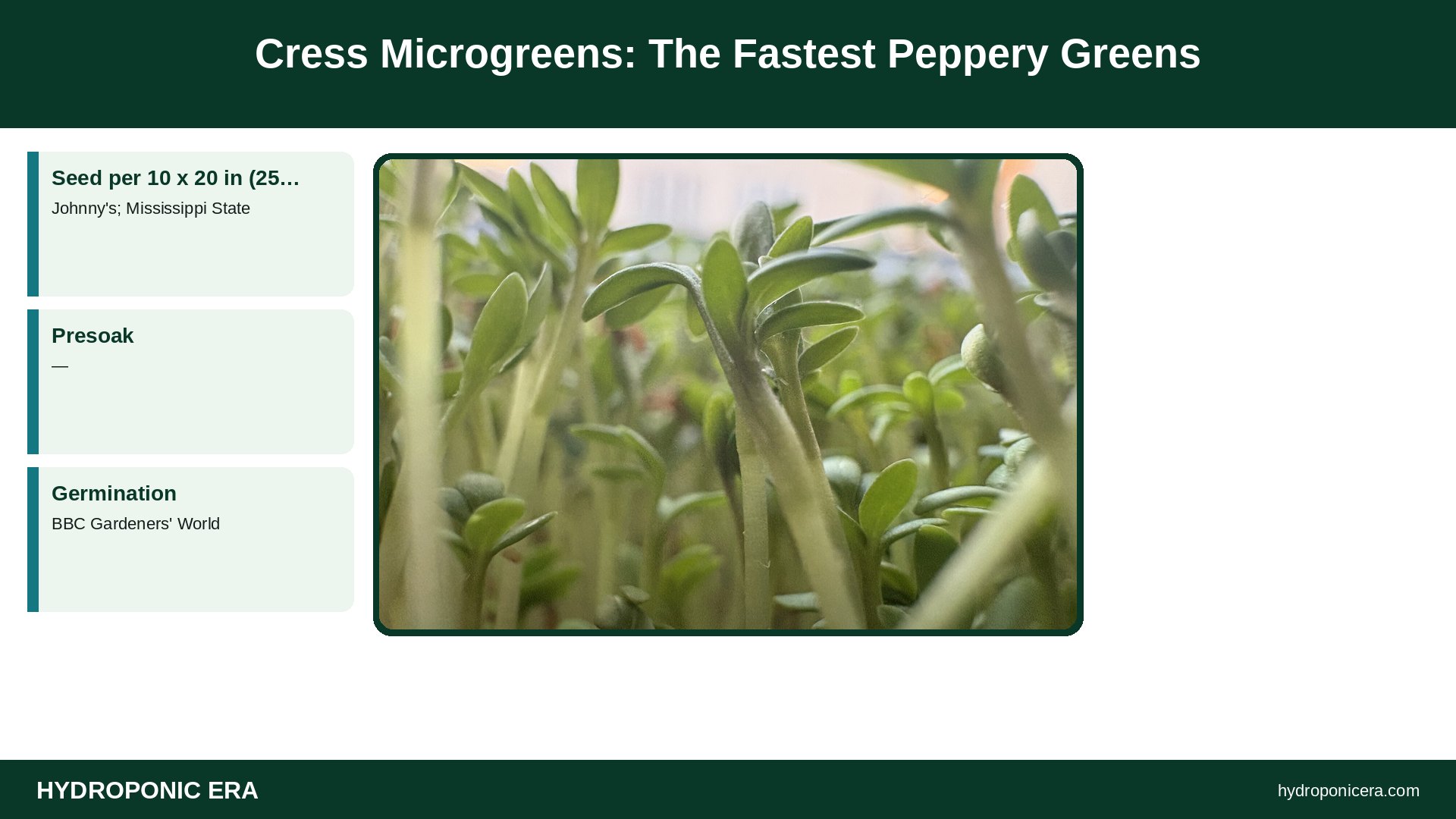
Cress microgreens are the fastest microgreens you can grow: garden cress (Lepidium sativum) germinates in a day or two indoors and can be cut in about 4–14 days. Sow about 10 grams of seed per 10 x 20 inch (25 x 51 cm) tray, or 2–3 teaspoons, on damp media, paper towel or cotton, keep it covered until it sprouts, then give light. Cress has a sharp, peppery bite and was one of the higher-yielding crops in Penn State’s microgreen trials.
Key takeaway: Cress is the ideal first crop or kids’ project. Sow dense, keep it damp, and harvest as soon as the leaves fully open.
| Cress microgreens at a glance | Value | Source |
|---|---|---|
| Seed per 10 x 20 in (25 x 51 cm) tray | About 10.5 g; or 2–3 teaspoons | Johnny’s; Mississippi State |
| Presoak | No | — |
| Germination | 1–2 days in a warm spot | BBC Gardeners’ World |
| Days to harvest | 4 days (USask) to about 13 days (Johnny’s); up to 2 weeks | USask; Johnny’s; BBC Gardeners’ World |
| Yield per tray | About 8 oz (227 g) (Johnny’s); 0.36 lb (164.3 g) Persian cress (Penn State) | Johnny’s; Penn State |
| Flavor | Spicy, peppery | Johnny’s; Mississippi State |
Types of Cress for Microgreens
- Curled cress: the most common type, and BBC Gardeners’ World calls it the best type for growing indoors.
- Cressida: Johnny’s and Mississippi State both list it for microgreens, with fancy three-lobed leaves and a spicy, peppery flavor.
- Persian cress: used in Penn State’s trials, where it averaged 0.36 lb (164.3 g) per tray.
- Greek cress: stronger and spicier, per BBC Gardeners’ World.
Watercress and land cress are different plants. BBC Gardeners’ World notes they aren’t the same as garden cress and aren’t as quick to grow. Johnny’s places watercress in its slow-growing group of 16–25 days, with round, glossy leaves.
How to Grow Cress Microgreens
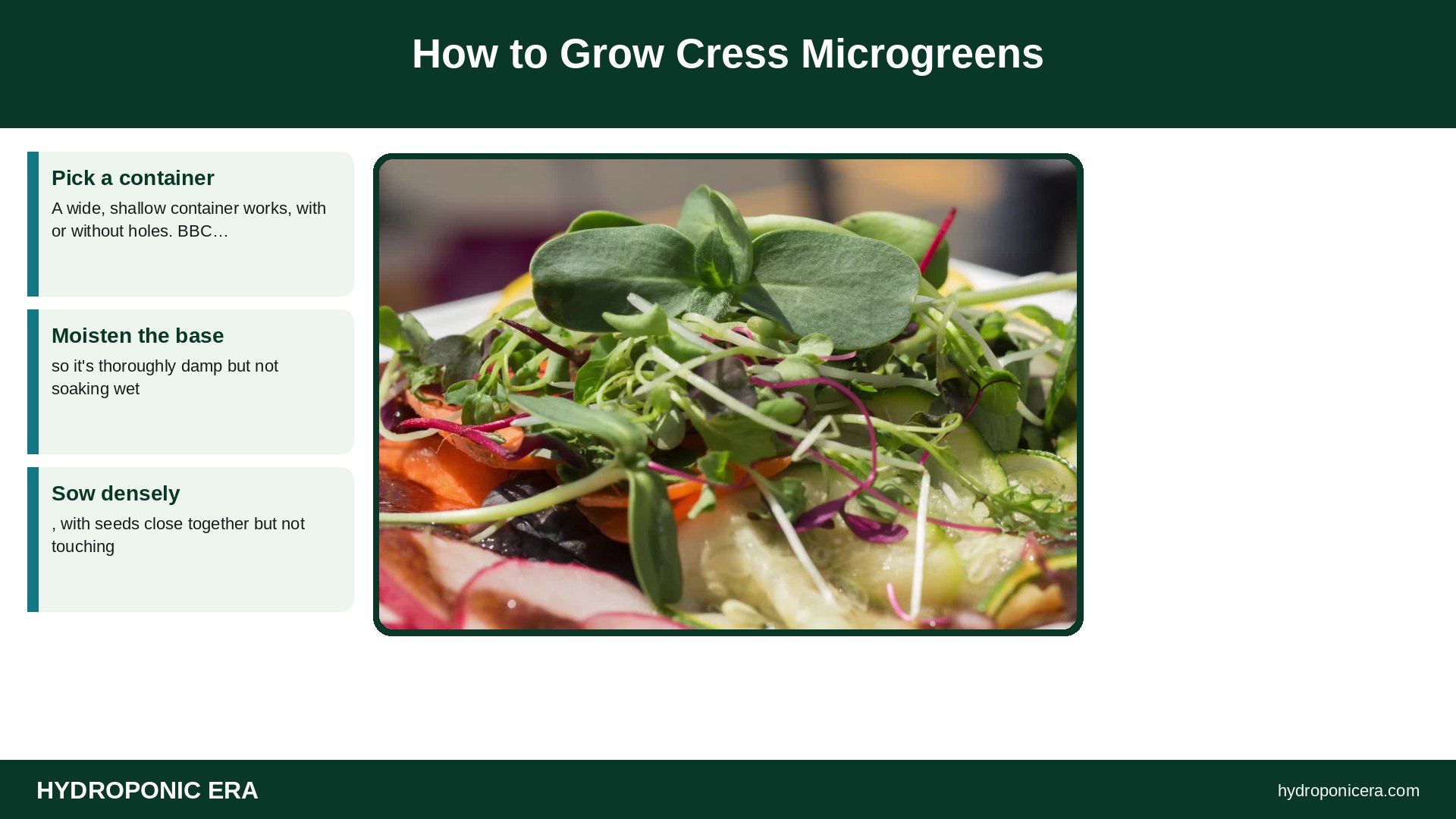
- Pick a container. A wide, shallow container works, with or without holes. BBC Gardeners’ World suggests kitchen towel, cotton wool, absorbent paper or compost as the base.
- Moisten the base so it’s thoroughly damp but not soaking wet.
- Sow densely, with seeds close together but not touching.
- Cover with a lid, plastic wrap or a bag so the seed doesn’t dry out.
- Keep warm. Cress starts to germinate in a day or two in a warm spot indoors.
- Move to light and remove the cover once seedlings are up.
- Water daily if needed. A paper base dries quickly in warm rooms.
- Harvest as soon as the seedlings have a pair of green leaves fully open.
How Fast Are Cress Microgreens?
The University of Saskatchewan lists cress as the easiest microgreen, ready in about 4 days. BBC Gardeners’ World says it takes up to two weeks to reach edible size. Johnny’s 2017 trial, harvested at first true leaf, took about 13 days for Cressida. The difference comes down to temperature, light and how big you like your greens. In a warm kitchen with good light, a week is typical for a tender cut.
Light and Temperature for Cress Microgreens
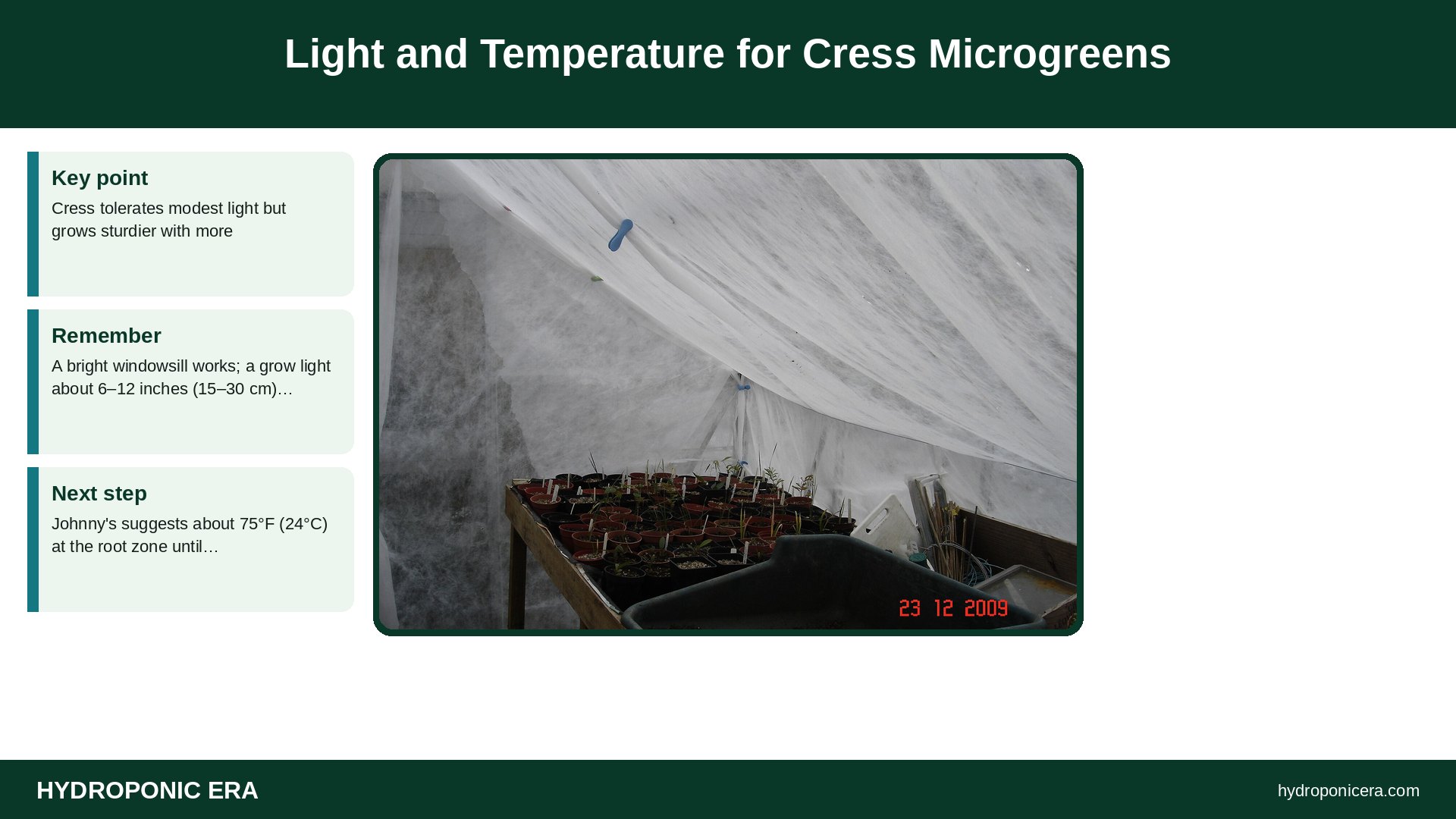
Cress tolerates modest light but grows sturdier with more. A bright windowsill works; a grow light about 6–12 inches (15–30 cm) above the leaves for 16 hours a day, as Maryland Extension suggests for microgreens, gives even, upright growth. Johnny’s suggests about 75°F (24°C) at the root zone until germination, then cooler, with 65–75°F (18–24°C) generally favorable. See microgreens light requirements.
Cress Microgreens Yield and Cost
| Source | Seed | Yield per tray |
|---|---|---|
| Johnny’s 2017 trial (Cressida) | 10.5 g | About 8 oz (227 g) |
| Penn State, greenhouse (Persian cress) | 10–15 g | 0.36 lb (164.3 g) |
| Mississippi State home guide (Cressida) | 2–3 teaspoons | 3–5 oz (85–142 g) |
Johnny’s says 1 oz (28 g) of seed sows about three flats. Mississippi State advises buying microgreen seed in bulk, since garden center packets aren’t economical. See microgreen seed density.
The Classic Kids’ Project
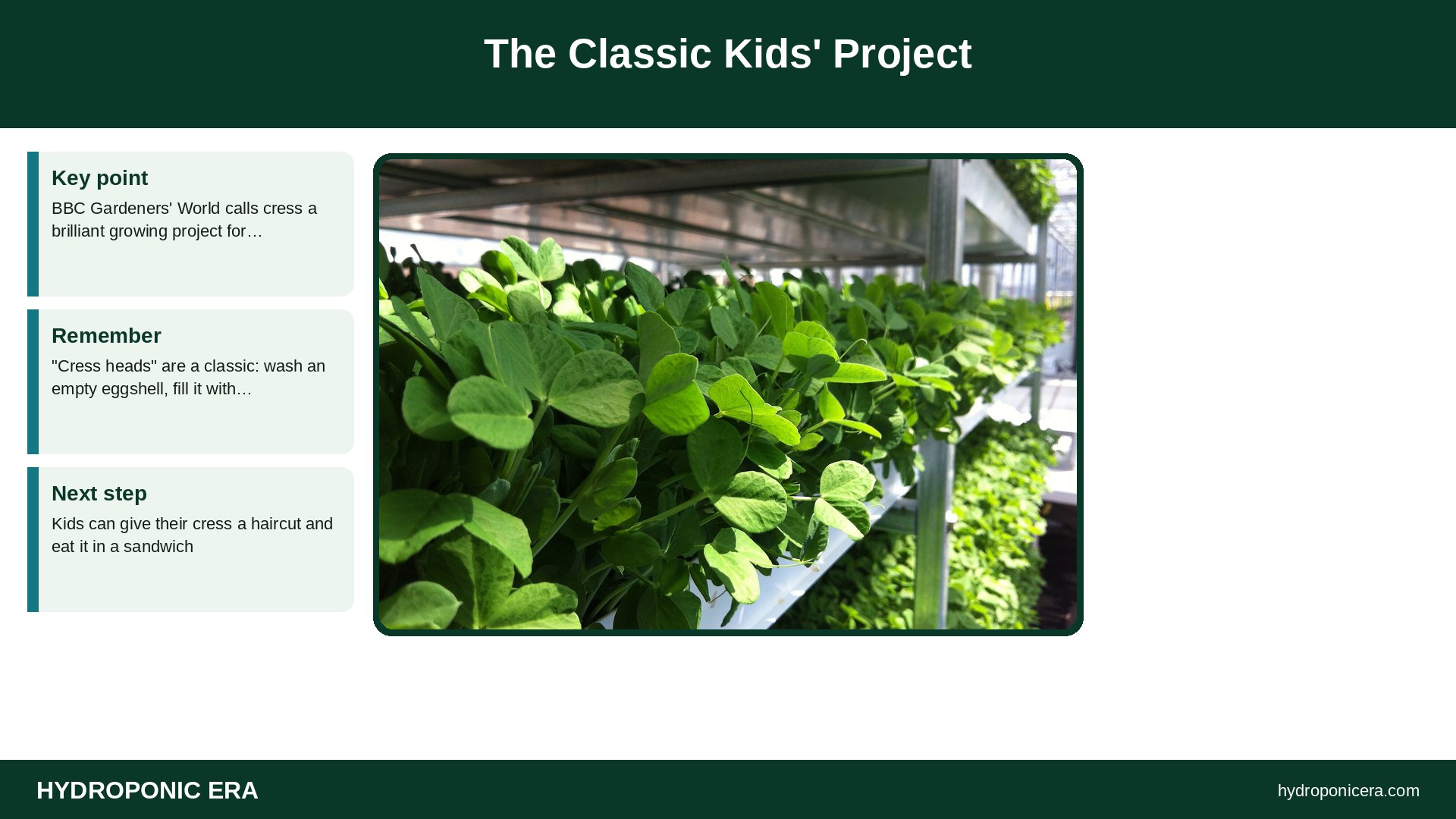
BBC Gardeners’ World calls cress a brilliant growing project for children because it grows so fast. “Cress heads” are a classic: wash an empty eggshell, fill it with moist cotton wool, sow the seed on top, draw a face on the shell and wait for the green “hair.” The Royal Horticultural Society offers a similar “Mr Cress” project using the foot of old tights filled with compost and about two teaspoons of seed. Kids can give their cress a haircut and eat it in a sandwich. See microgreens on paper towels.
Common Problems With Cress Microgreens
| Problem | Likely cause | Fix |
|---|---|---|
| Seedlings wilting | Base dried out | Water daily; keep a loose cover at first |
| Mold on paper or cotton | Too wet, no airflow | Drain extra water; uncover after sprouting |
| Long, pale stems | Low light | Move to a brighter spot |
| Bare patches | Uneven sowing | Sow densely and evenly |
| Grit in the harvest | Grown on compost | Rinse in a sieve before eating |
See microgreens mold.
Harvesting, Storing and Using Cress Microgreens

Snip cress close to the base with scissors. If grown on compost, BBC Gardeners’ World suggests rinsing it in a sieve under running water before eating. Store unwashed cress in a sealed container in the fridge if you aren’t eating it right away; delicate greens like cress are best within a few days. Use it in egg sandwiches, potato salad, soups and on avocado toast. Its peppery flavor is strong, so a little goes a long way. See how long microgreens last.
Cress microgreens are about as easy as growing gets. If you want a crop to prove that microgreens work before investing in trays and lights, start here. See best microgreens to grow.
Cress Microgreens in a Mixed Tray
Because cress is so quick, it’s best grown on its own or with other fast crops. Maryland Extension advises against mixing species in one tray because germination and growth rates differ. If you want a mix, grow cress microgreens, radish and mustard in separate small containers and combine them after harvest. The British “mustard and cress” sandwich filling traditionally uses both, and BBC Gardeners’ World notes cress is part of the same microgreen group as rocket, radish and pak choi. A peppery cress and mild broccoli blend is another easy pairing.
FAQs
How long do cress microgreens take?
About 4–14 days, often around a week.
Can I grow cress microgreens on paper towels?
Yes; paper, cotton wool and compost all work.
Do cress seeds need soaking?
No; sow them dry on a damp surface.
Is watercress the same as cress?
No; watercress is a different plant and grows more slowly.
How much cress seed per tray?
About 10.5 g, or 2–3 teaspoons, per 10 x 20 inch (25 x 51 cm) tray.
What do cress microgreens taste like?
Spicy and peppery.
Sources
- BBC Gardeners’ World — How to Grow Cress
- University of Saskatchewan Gardening — Grow With USask: Microgreens
- Mississippi State University Extension — Microgreen Varieties for the Mississippi Gardener
- Johnny’s Selected Seeds — Micro Greens Yield Trial 2017
- Johnny’s Selected Seeds — Microgreens Comparison Chart
- Penn State Extension — Growing Microgreens
- Royal Horticultural Society — Grow Cress With Children
- University of Maryland Extension — Growing Microgreens and Baby Greens Indoors
- Photo credits (Wikimedia Commons, edited with titles): Close-up of garden cress (Lepidium Sativum), 2025-01-19 by Nylki (CC0); 20160617-AMS-LSC-9000 (61-sec.) (27334710733) by U.S. Department of Agriculture (Public domain); Fleece lined greenhouse potting tray and seed pots – Flickr – peganum by peganum from Small Dole, England (CC BY-SA 2.0); Lufa Farms Microgreens in Trays by Lufa Farms (CC BY-SA 2.0); Liping Kou observes microgreens by Peggy Greb (Public domain)