
Alfalfa microgreens are delicate, mild greens grown from the same tiny seed used for alfalfa sprouts, but grown on media under light and cut above the roots. Sow about ½–¾ oz (14–21 g) of seed per 10 x 20 inch (25 x 51 cm) tray with no soaking, keep it covered 2–3 days until it germinates, then grow under light. Harvest times vary: one seed seller lists 8–12 days, while Johnny’s puts alfalfa in its slow group at 16–25 days. Because raw alfalfa sprouts have caused many outbreaks, use seed sold for sprouting and keep everything clean.
Key takeaway: Alfalfa microgreens are easy but slow to bulk up. Sow evenly on fine media, keep them damp, give good light and harvest when the tiny leaves are green and open.
| Alfalfa microgreens at a glance | Value | Source |
|---|---|---|
| Seed per 10 x 20 in (25 x 51 cm) tray | ½–¾ oz (14–21 g) | Seattle Seed Company |
| Presoak | Not needed | — |
| Days to germination | 2–3 days | Seattle Seed Company |
| Days to harvest | 8–12 days (Seattle Seed); 16–25 days (Johnny’s) | Seattle Seed; Johnny’s |
| Look | Delicate appearance | Johnny’s |
| Flavor | Nutty, pea-like; mild and grassy | Johnny’s; Seattle Seed |

Alfalfa Microgreens vs Alfalfa Sprouts
Alfalfa sprouts are germinated in a jar, rinsed several times a day and eaten whole after a few days, root and seed included. Alfalfa microgreens grow longer, in soil, coir or on a mat, with light, so the cotyledons turn green and you cut the stems above the media. That gives a more leafy, green crop and leaves the seed and root behind. See microgreens vs sprouts and how to grow sprouts in a jar.
Food Safety First

The FDA explains that sprouts grow in warm, humid conditions that are ideal for bacteria, and that even home sprouting can let a few bacteria on the seed multiply to high levels. It advises children, older adults, pregnant women and people with weakened immune systems to avoid raw sprouts, including alfalfa. The CDC has linked several outbreaks to alfalfa sprouts, including a 2022 Salmonella outbreak with 63 reported illnesses in 8 states. Alfalfa microgreens are grown drier and cut above the roots, which should lower risk, but they’re still a raw crop grown from the same seed. Use seed sold for sprouting or microgreens, clean trays and drinking-quality water, and wash the greens before eating. See home food safety.
How to Grow Alfalfa Microgreens
- Use fine, level media. Alfalfa seed is very small, so a smooth coir surface or a felt or fine hemp mat works best.
- Moisten the media until it feels like a wrung-out sponge.
- Weigh ½–¾ oz (14–21 g) of seed and sprinkle it evenly in two passes.
- Press gently. Johnny’s general method is to press seed firmly into the media and cover lightly with sowing mix, vermiculite or a humidity dome.
- Cover for 2–3 days until most seeds have germinated, misting if the surface dries.
- Give light for 16–18 hours.
- Bottom water; Johnny’s advises bottom watering or misting so media doesn’t splash onto seedlings.
- Harvest when the cotyledons are open and green.
Light and Temperature
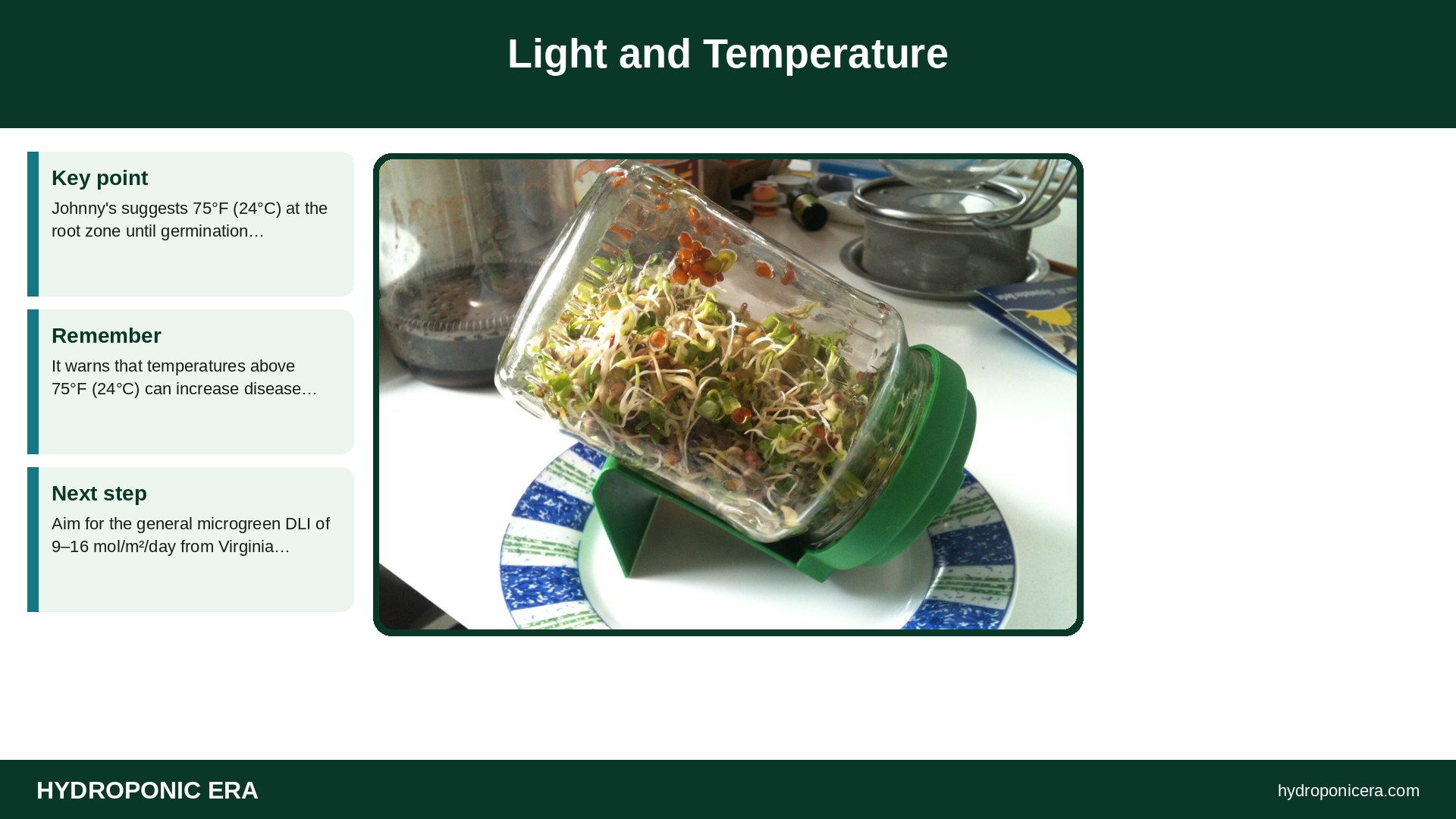
Johnny’s suggests 75°F (24°C) at the root zone until germination, then about 60°F (16°C), with ambient temperatures of 65–75°F (18–24°C) generally favorable. It warns that temperatures above 75°F (24°C) can increase disease pressure and inhibit germination, which is important for alfalfa, a crop associated with bacterial risk when grown warm and wet. Aim for the general microgreen DLI of 9–16 mol/m²/day from Virginia Cooperative Extension. See microgreens light requirements.
Why Harvest Times Differ
Seattle Seed Company lists alfalfa microgreens at 8–12 days, while Johnny’s lists 16–25 days. Johnny’s growing notes assume a greenhouse or protected area and a harvest anywhere from fully developed cotyledons to the first true leaves, while faster figures usually reflect warm indoor growing and an earlier cut. Johnny’s yield-trial notes say days to maturity vary with temperature, moisture and sunlight. Start checking at about a week and cut when the greens look the way you want.
Common Problems With Alfalfa Microgreens
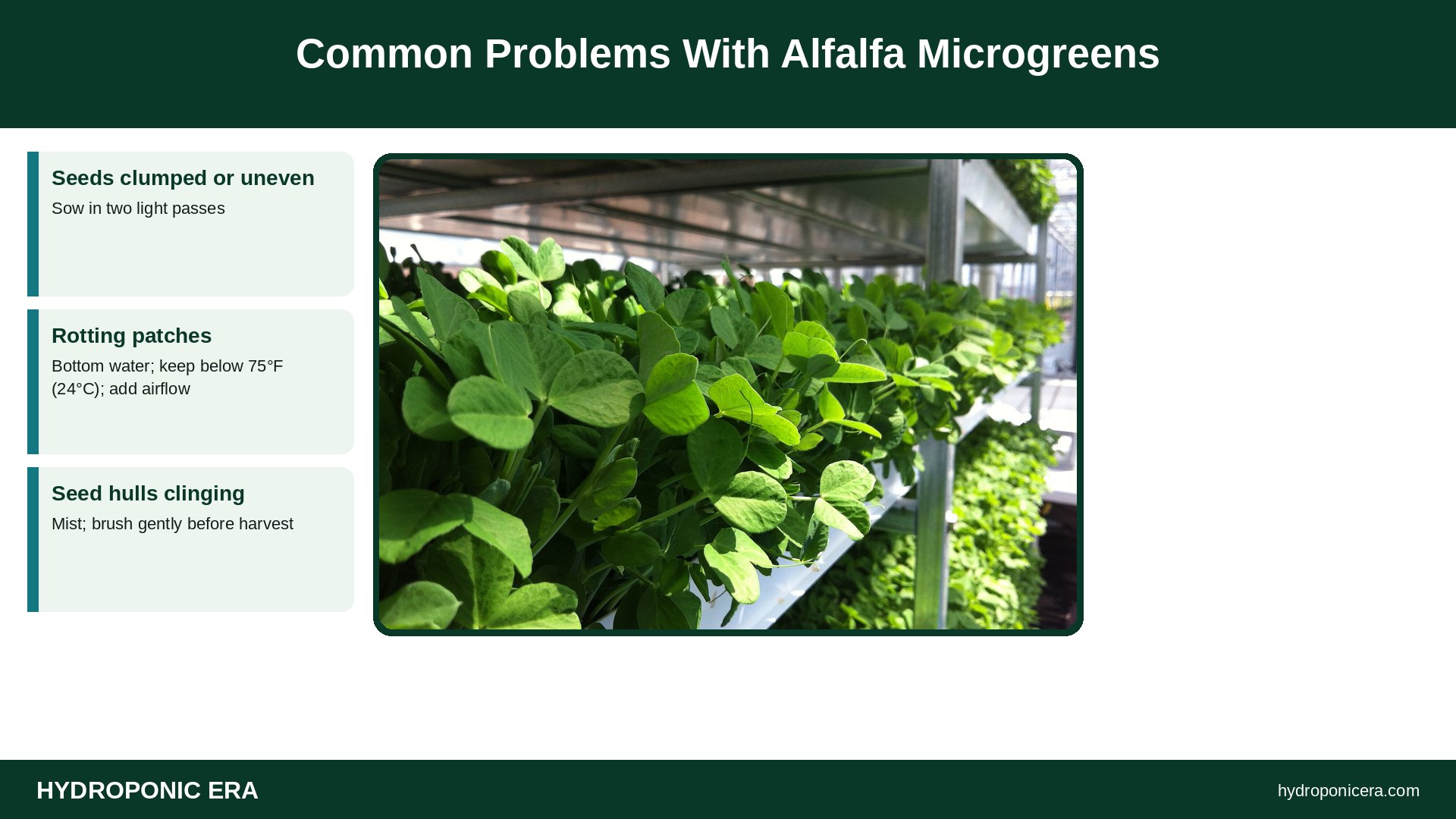
| Problem | Likely cause | Fix |
|---|---|---|
| Seeds clumped or uneven | Tiny seed poured too fast | Sow in two light passes |
| Rotting patches | Too wet, too warm | Bottom water; keep below 75°F (24°C); add airflow |
| Seed hulls clinging | Shallow sowing | Mist; brush gently before harvest |
| Thin, flopping stems | Low light | Brighter light, lamp closer |
| Short, sparse tray | Harvested early | Give a few more days |
See microgreens mold and damping-off.
Harvesting and Storage
Alfalfa microgreens are short and fine, so cut with sharp scissors just above the media, holding a small bunch at a time. Store unwashed in a sealed container in the fridge at 40°F (4°C) or below, as the FDA advises for fresh produce, and wash right before eating. Penn State reports microgreens kept at 41°F (5°C) in the dark can last 10–14 days, though delicate crops like alfalfa are best used within a few days. See how to harvest microgreens and how long microgreens last.
How to Use Alfalfa Microgreens
Use them anywhere you’d use alfalfa sprouts: sandwiches, wraps, salads, burgers and grain bowls. Their mild flavor pairs well with spicier microgreens like radish or mustard. Lightly cooking them, for example stirring into soup at the end, is an option for anyone in a higher-risk group who wants to reduce risk, in line with CDC advice that cooking sprouts thoroughly reduces the chance of illness.
Is It Worth Growing Alfalfa Microgreens?
Alfalfa microgreens are cheap and easy, but they’re a low-bulk crop compared with radish, sunflower or pea shoots. They’re worth growing if you love alfalfa’s mild flavor and want a greener, leafier version of the classic sprout. Grow them in small containers alongside faster crops. See best microgreens to grow.
What Alfalfa Microgreens Cost to Grow
Alfalfa seed is cheap. Johnny’s 2024 comparison chart lists alfalfa microgreen seed at about $13.80 per lb (454 g). At ½–¾ oz (14–21 g) per tray, 1 lb (454 g) sows roughly 21–32 trays, or about $0.43–$0.65 of seed per tray before media and power. Prices change, so check current listings, but alfalfa is one of the lowest-cost crops you can grow. Johnny’s describes the flavor as nutty and pea-like with a delicate look, which makes it a good filler for mixes with spicier greens.
FAQs
Are alfalfa microgreens the same as alfalfa sprouts?
No; microgreens get light and are cut above the roots.
How long do alfalfa microgreens take?
About 8–25 days, depending on conditions and harvest size.
How much alfalfa seed per tray?
About ½–¾ oz (14–21 g) per 10 x 20 inch (25 x 51 cm) tray.
Are alfalfa microgreens safe?
Use seed sold for sprouting, keep things clean and wash before eating.
Do alfalfa seeds need soaking?
Not for microgreens; sow dry on moist media.
What do alfalfa microgreens taste like?
Mild, nutty and slightly pea-like.
Sources
- Johnny’s Selected Seeds — Alfalfa Microgreen Seed
- Johnny’s Selected Seeds — Microgreens Comparison Chart
- Seattle Seed Company — Alfalfa for Microgreens
- US Food and Drug Administration — Selecting and Serving Produce Safely
- Centers for Disease Control and Prevention — Salmonella Outbreak Linked to Alfalfa Sprouts
- Virginia Cooperative Extension — Introduction to Microgreen Production
- Penn State Extension — Growing Microgreens
- Photo credits (Wikimedia Commons, edited with titles): Medicago sativa (alfalfa) by No machine-readable author provided. Hans B.~commonswiki assumed (based on copyr (Public domain); Salad, Romaine lettuce, cucumber, tomato, green pepper, radish, alfalfa sprouts, black olives, lemon juice, salt & olive oil (7765310086) by Lablascovegmenu from London (CC BY 2.0); Growing bean sprouts by User:tlcoles (CC BY-SA 3.0); Lufa Farms Microgreens in Trays by Lufa Farms (CC BY-SA 2.0); Vegetables in Refrigerator Bin by Alabama Extension (CC0)