
Onion microgreens are thin, grass-like green threads with a fresh, mild onion flavor. They’re slow: Mississippi State Extension and Johnny’s put scallion microgreens in the 16–25 day group. Sow about 2 tablespoons of seed per 10 x 20 inch (25 x 51 cm) tray, prime or pre-sprout the seed for more even germination, keep it covered and moist until the “loops” appear, then give light. Unlike most microgreens, scallion microgreens can be recut several times at about 2-week intervals.
Key takeaway: Use fresh seed, be patient with germination and keep the media evenly moist. The reward is a crop you can cut more than once.
| Onion microgreens at a glance | Value | Source |
|---|---|---|
| Recommended variety | Evergreen Hardy White scallion | Mississippi State; Johnny’s |
| Seeding rate (home tray) | About 2 tablespoons | Mississippi State |
| Days to harvest | 16–25 days | Mississippi State; Johnny’s |
| Expected yield | 2–3 oz (57–85 g) per tray | Mississippi State |
| Regrowth | Recut several times about 2 weeks apart | Mississippi State |
| Look and flavor | Green, thread-like leaves; onion flavor | Johnny’s |
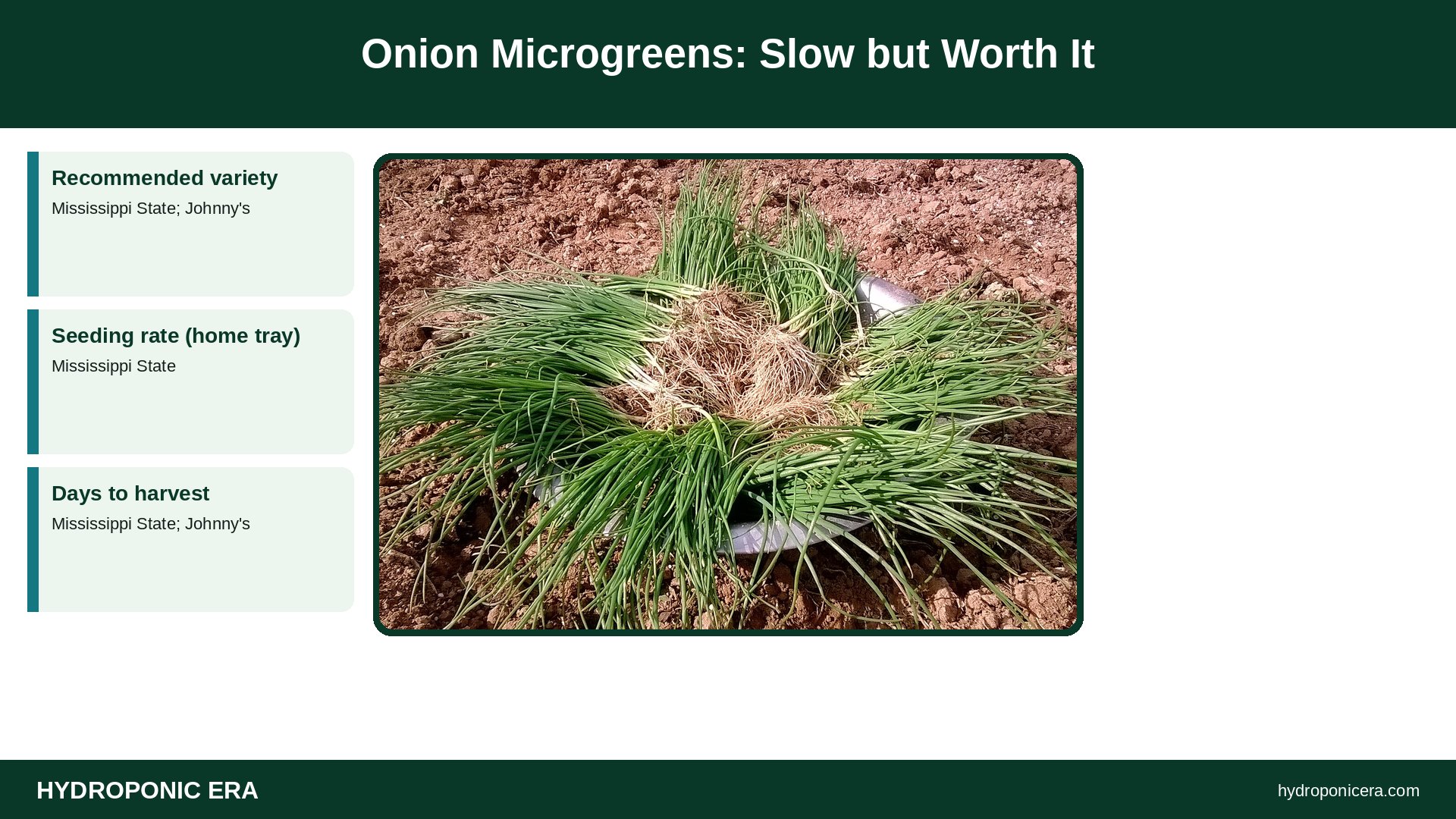
Onion vs Scallion vs Chive Microgreens
Most “onion microgreens” are grown from bunching onion or scallion seed, such as Evergreen Hardy White, which both Mississippi State and Johnny’s list for microgreens. Bulb onion seed works too, as do chives and leeks, which grow similarly as thin green threads. Virginia Cooperative Extension lists chives among common microgreen crops. Flavor ranges from mild scallion to garlicky garlic chive. All are in the onion genus, Allium, and share the same slow, grass-like growth.
How to Grow Onion Microgreens
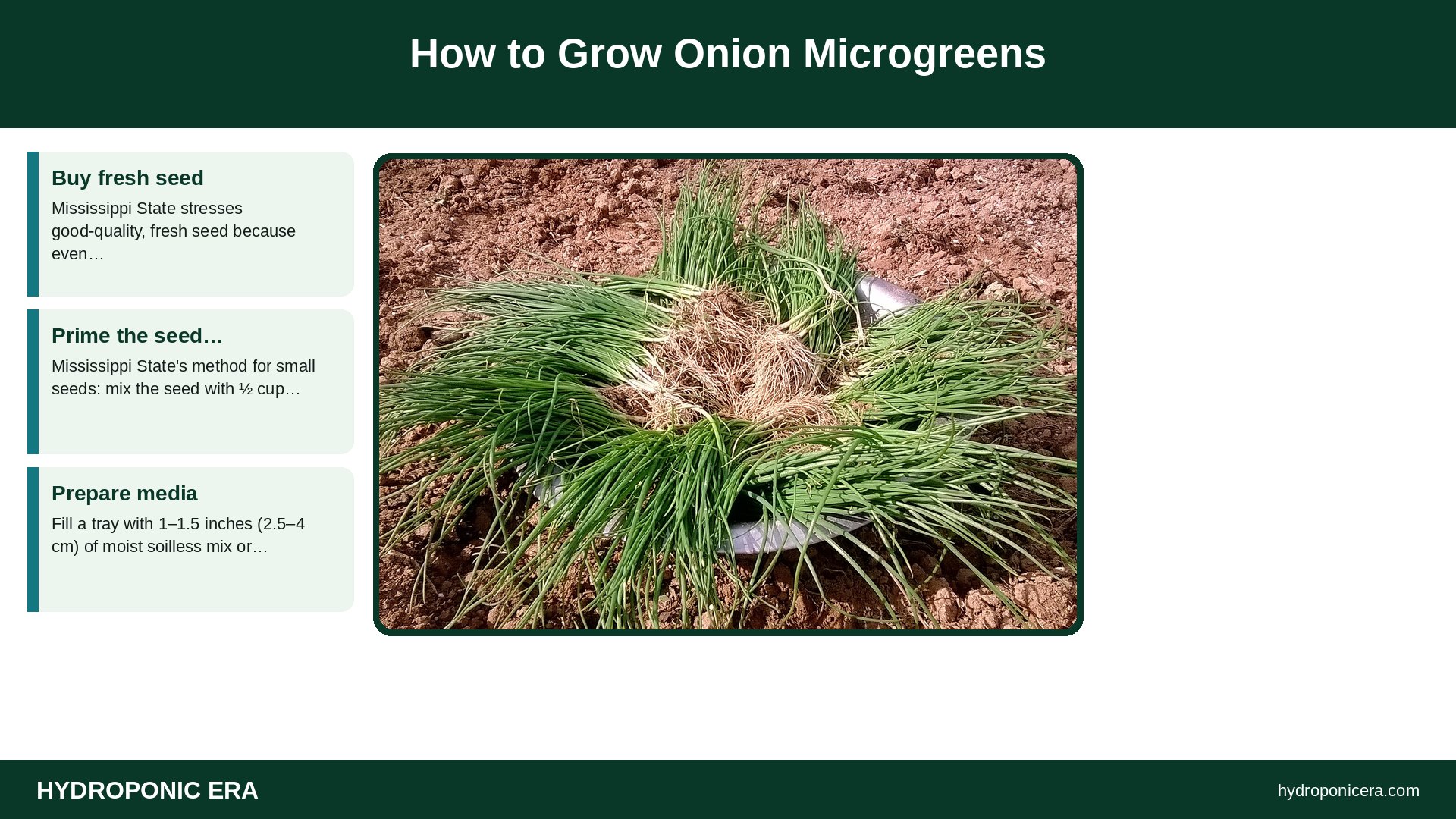
- Buy fresh seed. Mississippi State stresses good-quality, fresh seed because even germination is very important.
- Prime the seed (optional). Mississippi State’s method for small seeds: mix the seed with ½ cup of vermiculite and 2 tablespoons of water in a lidded container, keep it warm for a couple of days until the root tips emerge, then spread the mix on the tray.
- Prepare media. Fill a tray with 1–1.5 inches (2.5–4 cm) of moist soilless mix or coir. Soil-based media suits slow crops better than thin mats.
- Sow about 2 tablespoons of seed evenly, then press it into the surface.
- Cover lightly with a thin layer of mix or vermiculite, as Johnny’s suggests for microgreens, and cover the tray to hold moisture.
- Keep moist and dark until most seedlings show as small loops.
- Give light for 16–18 hours.
- Bottom water to keep the fine leaves upright and clean.
- Harvest at 16–25 days, when the threads are a few inches tall.
Dealing With Black Seed Coats
Onion seedlings often carry their black seed coat on the tip of each green thread. A light covering of mix or vermiculite helps scrape the coats off as seedlings push up, and weighting the tray during the first days in the dark helps too. Penn State notes that keeping weight on top of shoots during germination helps seed hulls detach for crops like sunflower. Any coats left are edible but look untidy; brush the tops gently or pick them off after harvest.
Light and Temperature
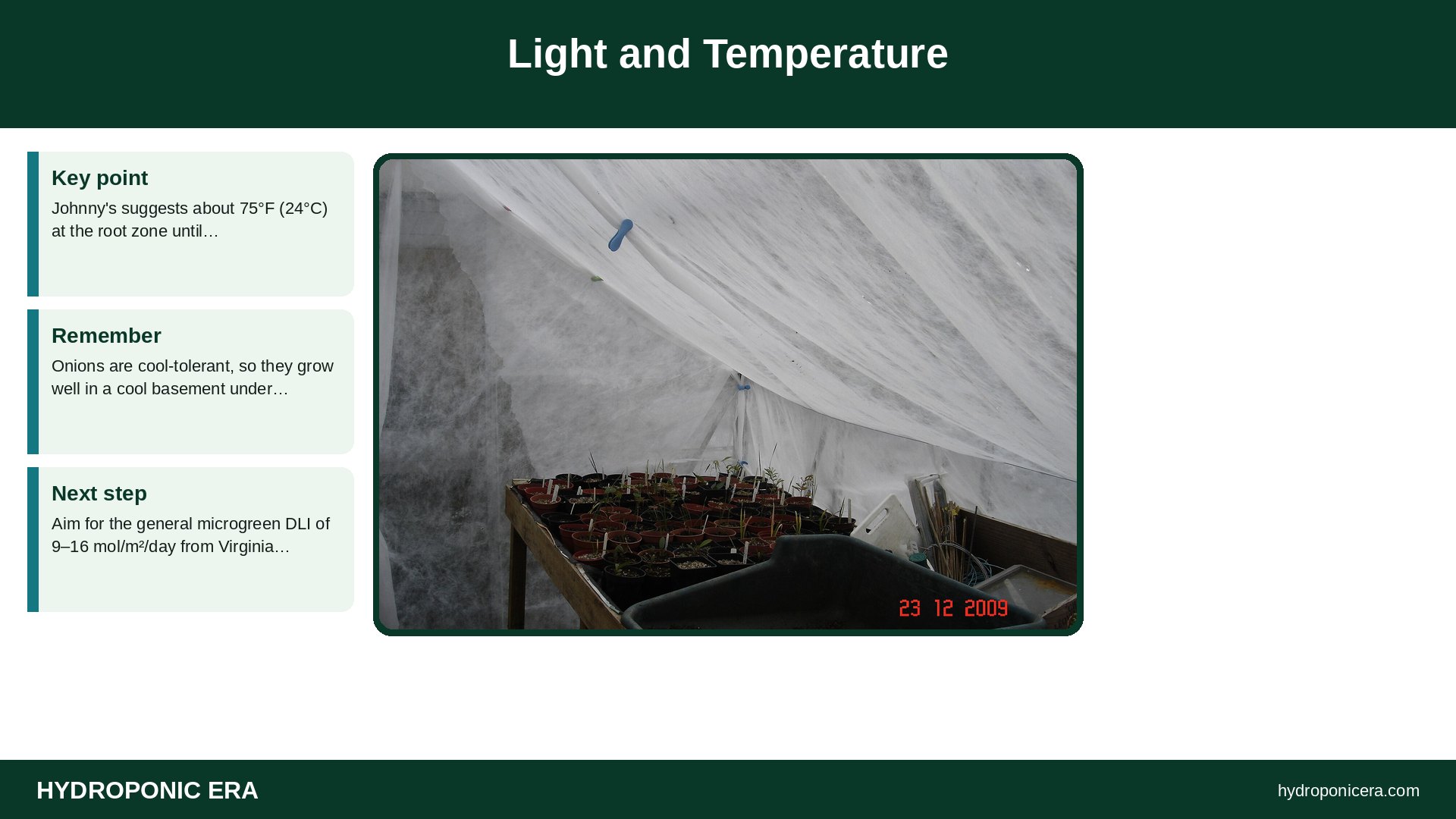
Johnny’s suggests about 75°F (24°C) at the root zone until germination, then about 60°F (16°C), with 65–75°F (18–24°C) generally favorable. Onions are cool-tolerant, so they grow well in a cool basement under lights. Aim for the general microgreen DLI of 9–16 mol/m²/day from Virginia Cooperative Extension, and keep the lamp close enough that the threads stand upright rather than flopping. See microgreens light requirements.
Recutting Onion Microgreens
This is where onions stand out. Most microgreens are cut below the growing point and won’t regrow, but onion leaves grow from the base. Mississippi State says scallion microgreens can be recut several times at about 2-week intervals. Cut about 1 inch (2.5 cm) above the media to leave the base intact, keep the tray watered and lit, and feed lightly with a dilute nutrient solution if regrowth looks pale; Penn State suggests 50–100 ppm nitrogen when microgreens need feeding. See can you regrow microgreens.
Yield and Planning
Mississippi State expects about 2–3 oz (57–85 g) per tray from 2 tablespoons of seed, a modest first cut. Because onion microgreens take 16–25 days and can be recut, plan them as a long-running tray beside quick crops like radish and mustard. Mississippi State groups crops by growth rate and recommends succession planting for a steady supply. See continuous harvest planning.
Common Problems With Onion Microgreens
| Problem | Likely cause | Fix |
|---|---|---|
| Erratic germination | Old seed or dry media | Use fresh seed; prime it; keep evenly moist |
| Black seed coats on tips | Normal for onions | Cover lightly with mix; weight early |
| Threads flopping over | Low light or top watering | Brighter light; bottom water |
| Mold during long germination | Too wet, no airflow | Vent covers daily; add a fan |
| Weak regrowth after cutting | Cut too low or no nutrients | Cut higher; feed lightly |
See microgreens mold.
Harvesting, Storage and Uses
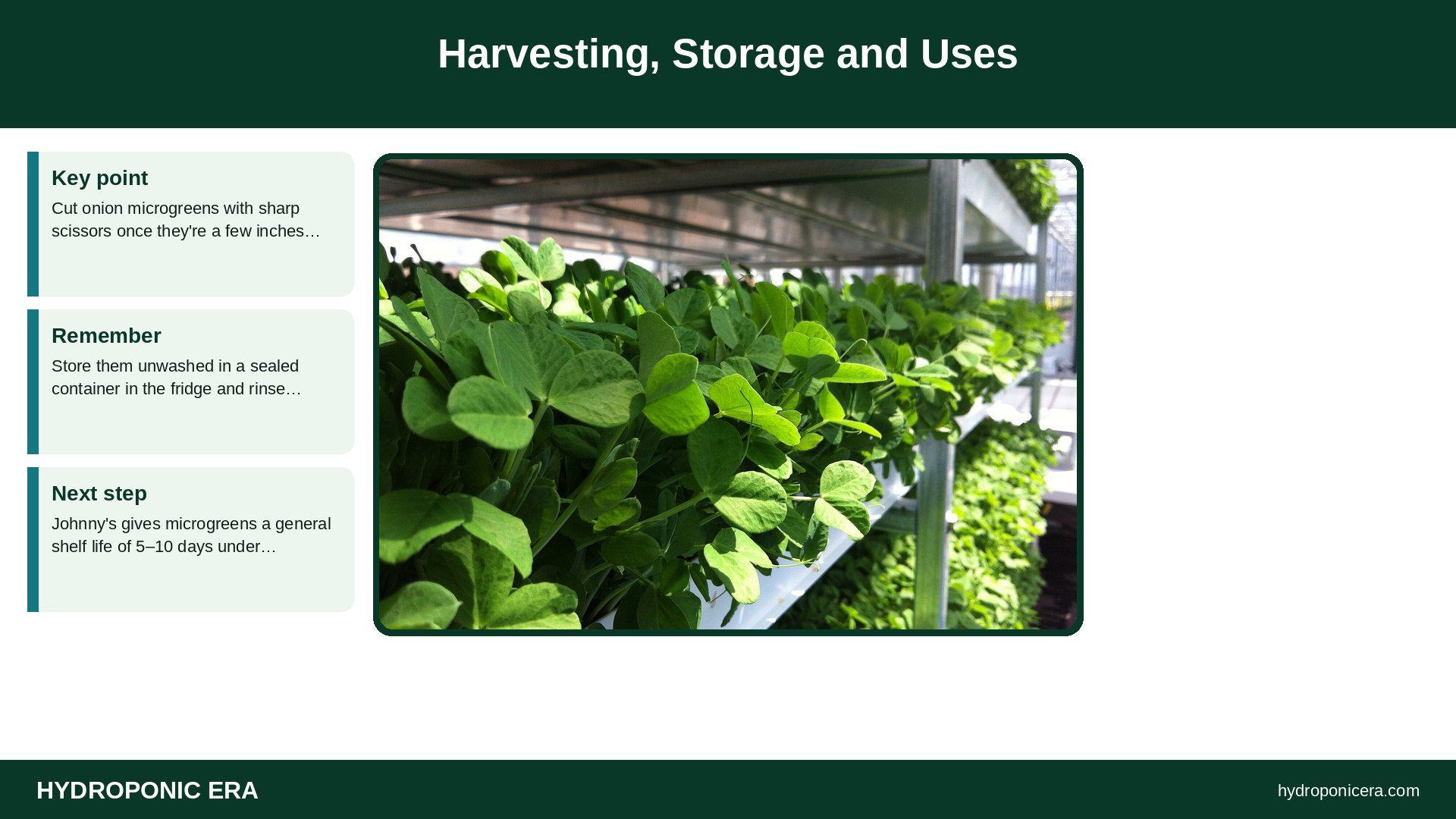
Cut onion microgreens with sharp scissors once they’re a few inches tall. Store them unwashed in a sealed container in the fridge and rinse before eating. Johnny’s gives microgreens a general shelf life of 5–10 days under proper storage. Use them like chopped chives or scallion greens: on baked potatoes, eggs, soups, tacos, sushi, dips and noodle bowls. Their mild flavor makes them easy to use by the handful. See how long microgreens last.
Onion microgreens ask for patience up front, but a single tray can be cut more than once. Start with fresh Evergreen Hardy White seed and give it a few weeks. See best microgreens to grow.
Growing Them Without Soil
You can grow these alliums on a hemp or coco mat in a hydroponic tray, but the long 16–25 day cycle means the mat must stay evenly damp for weeks without turning sour. Change the water in the reservoir tray often, keep the room cool, and add a light nutrient feed after the first week. Virginia Tech suggests an EC of at least 1.0 and a pH of 5.5–6.0 for hydroponic microgreens. See microgreen grow mats.
Buying and Storing Onion Seed
Onion seed is short-lived compared with most vegetable seed, so old packets often give patchy trays. Buy fresh seed for each season, and store what you don’t use in a sealed container in a cool, dry place.
FAQs
How long do onion microgreens take?
About 16–25 days.
Can onion microgreens regrow?
Yes; scallion microgreens can be recut several times about 2 weeks apart.
Which onion is best for microgreens?
Evergreen Hardy White scallion is a common choice.
How do I remove the black seed coats?
Cover seed lightly with mix and weight the tray early.
Do onion seeds need soaking?
Priming in damp vermiculite helps germination.
What do onion microgreens taste like?
Mild and fresh, like scallion greens.
Sources
- Mississippi State University Extension — Microgreen Varieties for the Mississippi Gardener
- Mississippi State University Extension — Growing Microgreens for the Mississippi Gardener
- Johnny’s Selected Seeds — Microgreens Comparison Chart
- Virginia Cooperative Extension — Introduction to Microgreen Production
- Penn State Extension — Growing Microgreens
- Penn State Extension — A Step-by-Step Guide for Growing Microgreens at Home
- Photo credits (Wikimedia Commons, edited with titles): Onion seedlings by Krish Dulal (CC BY-SA 3.0); Onion seedlings by Krish Dulal (CC BY-SA 3.0); Fleece lined greenhouse potting tray and seed pots – Flickr – peganum by peganum from Small Dole, England (CC BY-SA 2.0); Onion crop by Kasyap (CC BY-SA 4.0); Lufa Farms Microgreens in Trays by Lufa Farms (CC BY-SA 2.0)