
How do you grow alfalfa sprouts at home? Soak about 3 tablespoons of sprouting-grade alfalfa seed for 6–8 hours, drain it, then rinse and drain three to four times a day in a jar kept at 70–85°F (21–29°C). Oregon State University says alfalfa sprouts are ready in 3–5 days at 1–2 inches (2.5–5 cm) long, yielding about 1 quart (0.95 L).
Key takeaway: Alfalfa sprouts are easy but carry a real food safety risk. Use certified seed, sanitize the jar, rinse often, refrigerate at 40°F (4°C) or below, and skip raw sprouts if you are in a high-risk group.
| Alfalfa sprouts factor | Target | Source |
|---|---|---|
| Seed per quart jar | 3 tablespoons | OSU |
| Soak | 6–8 hours | UVM |
| Rinse | 3–4 times a day | OSU |
| Temperature | 70–85°F (21–29°C); best near 72°F (22°C) | OSU |
| Days to harvest | 3–5 | OSU |
| Yield | About 1 quart (0.95 L) | OSU |
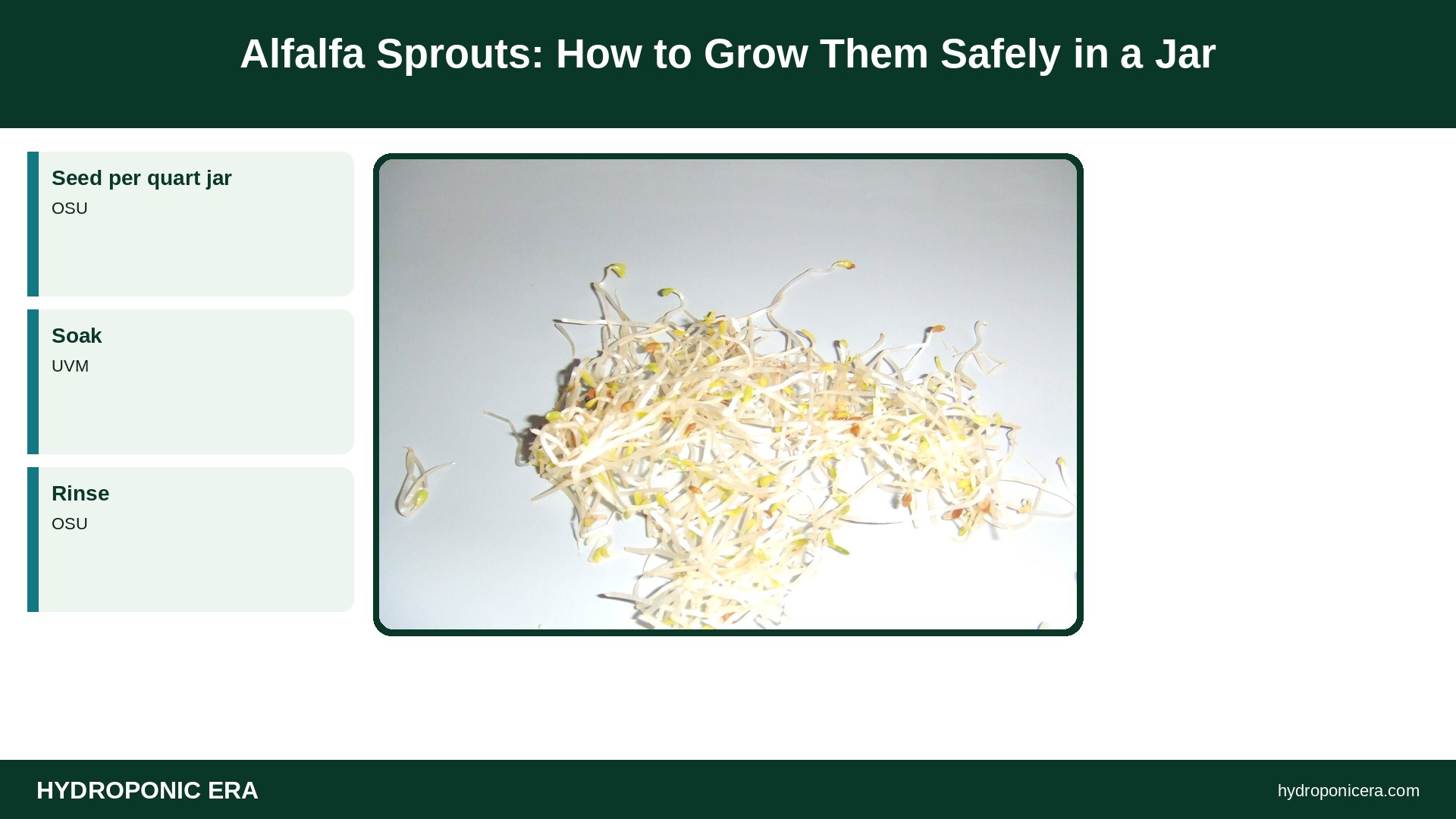
What Are Alfalfa Sprouts?
Alfalfa sprouts are the germinated seeds of alfalfa (Medicago sativa), a legume grown in the U.S. mostly as hay. Eaten after just a few days, they are thin, white stems with tiny green leaves and a mild, fresh, slightly nutty taste. They are a classic topping for sandwiches, wraps and salads.
Because each seed is tiny, a few tablespoons fill a whole jar. Oregon State University Extension lists it as a jar-method sprout that does best at about 72°F (22°C).
Are Alfalfa Sprouts Safe to Eat?
These sprouts can be eaten safely by most healthy adults, but they carry a known risk. UC Agriculture and Natural Resources reports that alfalfa, clover and mung bean have been involved in U.S. outbreaks of Salmonella and E. coli O157:H7 most often, and that contaminated seed was the likely source in most outbreaks.
The FDA explains that the warm, humid conditions used to grow sprouts are also ideal for bacteria, and that a few bacteria on seed can multiply to high levels even in a clean home kitchen. UC and the FDA advise children, older adults and people with weakened immune systems not to eat raw sprouts. Cooking to steaming hot, above 165°F (74°C), lowers the risk.
How Do You Grow Alfalfa Sprouts Step by Step?
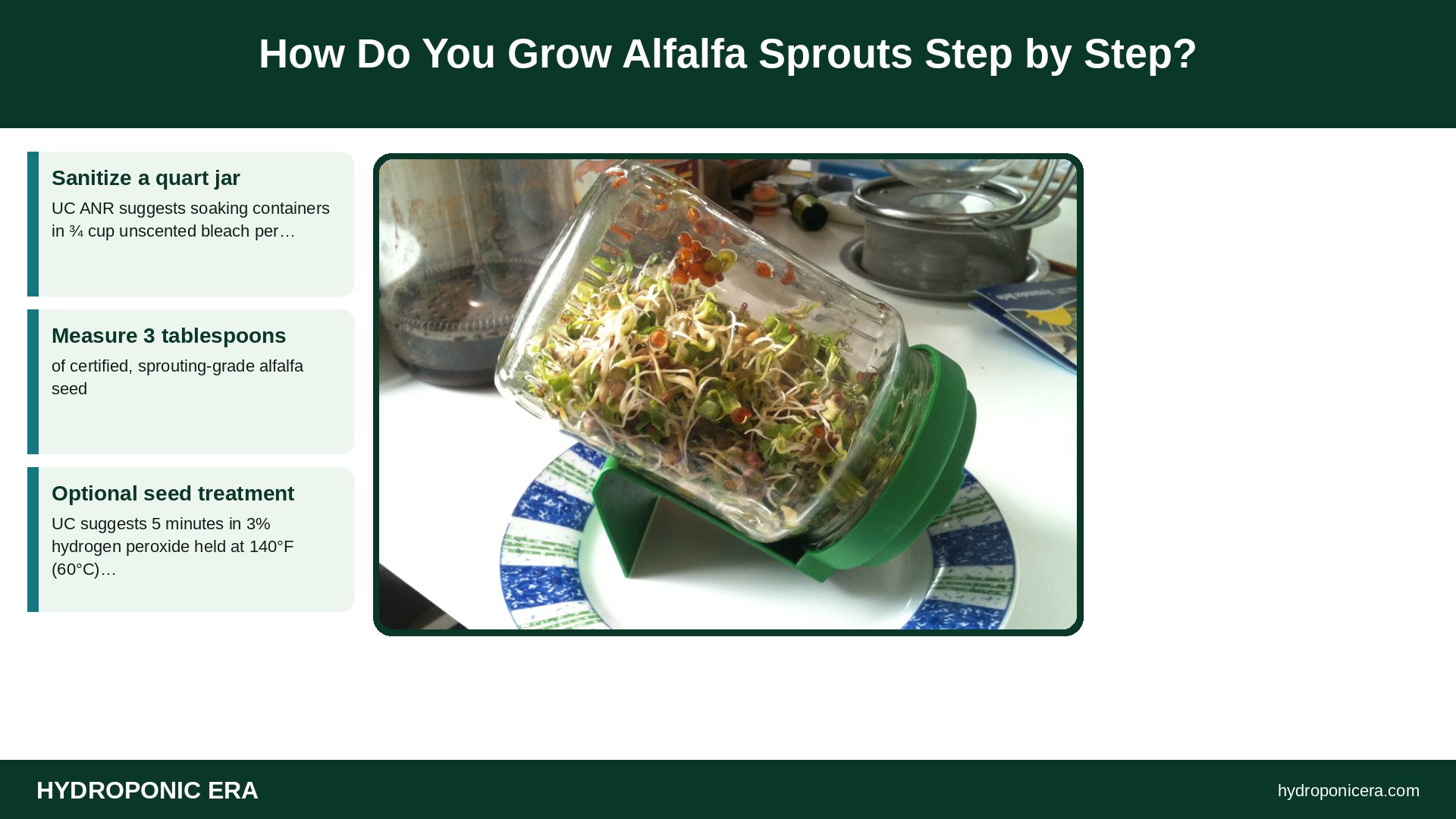
- Sanitize a quart jar. UC ANR suggests soaking containers in ¾ cup unscented bleach per gallon of water (3 tablespoons per quart) for 5 minutes, then rinsing.
- Measure 3 tablespoons of certified, sprouting-grade seed.
- Optional seed treatment: UC suggests 5 minutes in 3% hydrogen peroxide held at 140°F (60°C), then a 1-minute rinse.
- Skim floaters. Cover seeds with water plus 1 inch (2.5 cm), and remove floating seeds and debris.
- Soak 6–8 hours, the time UVM Extension gives for small seeds.
- Drain and tilt the jar mouth-down in a bowl, out of direct sun.
- Rinse and drain 3–4 times a day, as OSU recommends.
- Green them for a few hours in indirect light on the last day, then harvest at 1–2 inches (2.5–5 cm).
See our step-by-step guide on how to grow sprouts in a jar for lids and drainage tips.
How Long Do Alfalfa Sprouts Take to Grow?
They take about 3–5 days to grow, according to Oregon State University Extension. Warm rooms near 72°F (22°C) speed them along, while cool kitchens add a day or more. UVM Extension says sprouts are ready once leaves form and hulls begin to fall off.
| Day | Typical progress |
|---|---|
| Day 1 | Seeds swell; tiny white root tips |
| Day 2 | Roots ½ inch (1.3 cm); jar fills slightly |
| Day 3 | Tangled stems; first yellow leaves |
| Days 4–5 | 1–2 inch (2.5–5 cm) sprouts; green leaves after light |
How Do You Remove Hulls From Alfalfa Sprouts?
Remove hulls by floating the sprouts. Tip the sprouts into a large bowl of cool water and gently loosen the clump with your fingers. Hulls float to the top or sink to the bottom while sprouts hover in the middle. Skim the hulls off with a strainer, repeat once, then drain well.
NC State Extension describes the same float-and-skim method for bean sprouts. Removing hulls improves texture and helps sprouts keep longer.
How Should You Store Alfalfa Sprouts?
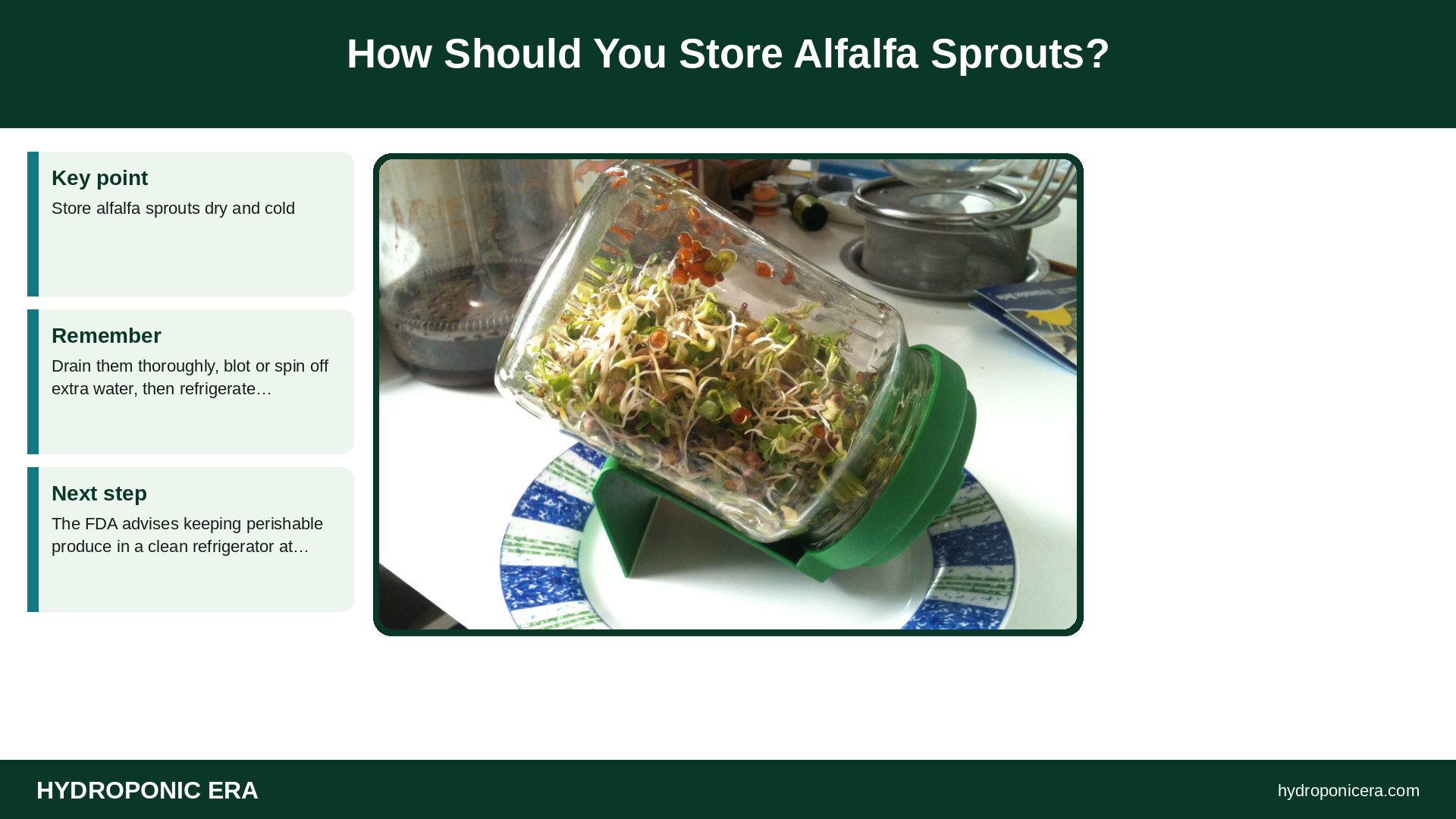
Store sprouts dry and cold. Drain them thoroughly, blot or spin off extra water, then refrigerate in a covered container lined with a paper towel. The FDA advises keeping perishable produce in a clean refrigerator at 40°F (4°C) or below. NC State notes that sprouts keep for several days refrigerated in closed containers.
Eat them within a few days and toss any that smell sour, look slimy or turn brown.
Grow small batches every few days rather than one big jar a week. Fresh, small harvests taste better, crowd less in the jar and are easier to rinse and dry properly before refrigerating.
Why Do Alfalfa Sprouts Smell Bad or Grow Mold?
- Sour smell: too few rinses or water pooling in the jar. Rinse more often and drain fully.
- Fuzzy white growth: on day 2–3 this is often root hairs, which collapse when wet. Gray or colored fuzz is mold; discard the batch.
- Uneven sprouting: old seed or a cold room.
- Brown, soggy sprouts: too much heat or crowding; use fewer seeds.
Learn more about handling home-grown food in our hydroponic food safety guide.
Alfalfa Sprouts vs Microgreens: What Is the Difference?
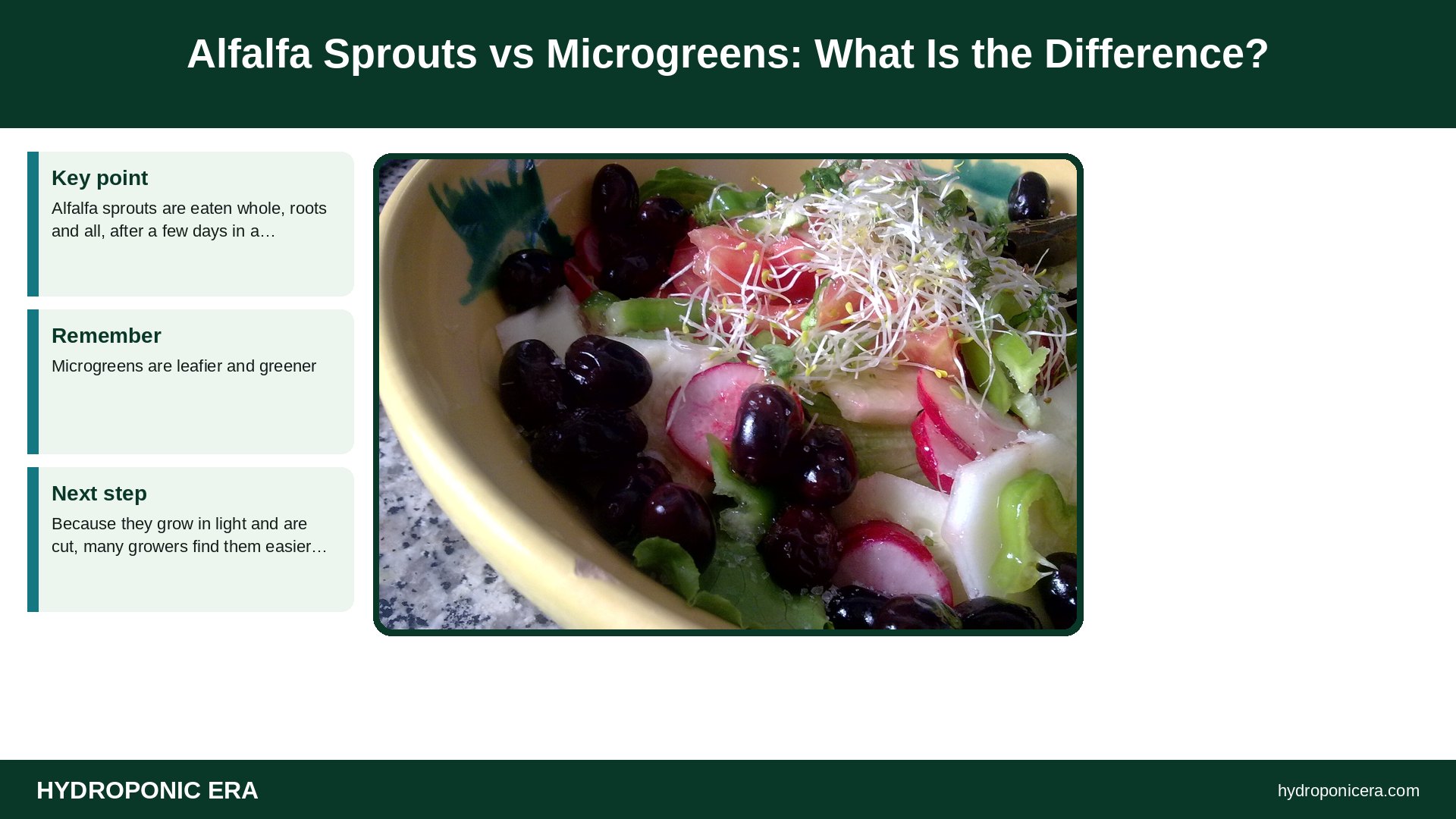
Alfalfa sprouts are eaten whole, roots and all, after a few days in a jar, while alfalfa microgreens are grown in light on a mat or medium for about 1–2 weeks and cut above the roots. Microgreens are leafier and greener. Because they grow in light and are cut, many growers find them easier to keep fresh.
Try both with our hydroponic microgreens guide.
What Seed Should You Buy for Alfalfa Sprouts?
Buy seed labeled for sprouting from a reputable seller. UC ANR advises using seed that is certified pathogen-free or produced for sprouting, not seed meant for planting fields, which may be treated with chemicals. Look for a lot number and storage advice on the bag, and keep seed in a cool, dry, sealed container.
- Buy small bags you can use within a season so seed stays fresh.
- Check for debris and broken seed before soaking.
- Note the lot number in case of a product recall.
FAQs
Do alfalfa sprouts need light?
No. Grow them in the dark, then give a few hours of indirect light at the end to green the leaves.
Can I use alfalfa seed from a farm store?
No. Field seed may be treated or untested. Use seed sold for sprouting.
Can I cook alfalfa sprouts?
Yes. UC says heating to steaming hot, above 165°F (74°C), reduces the risk.
How much seed makes a quart?
About 3 tablespoons, according to OSU.
Can I reuse rinse water?
Do not reuse it for sprouts. Virginia Tech notes some growers use it to water houseplants.
Sources
- Oregon State University Extension — Grow Your Own Vegetable Sprouts
- University of California ANR — Growing Seed Sprouts at Home (Publication 8151)
- U.S. Food and Drug Administration — Selecting and Serving Produce Safely
- University of Vermont Extension — Sprouts: The Superfood to Grow at Home
- NC State Extension — Bean Sprouts and Other Vegetable Seed Sprouts
- Virginia Tech — Sprouting Seeds for Food
- Photo credits (Wikimedia Commons, edited with titles): Medicago sativa (alfalfa) by No machine-readable author provided. Hans B.~commonswiki assumed (based on copyr (Public domain); Growing bean sprouts by User:tlcoles (CC BY-SA 3.0); Growing bean sprouts by User:tlcoles (CC BY-SA 3.0); Salad, Romaine lettuce, cucumber, tomato, green pepper, radish, alfalfa sprouts, black olives, lemon juice, salt & olive oil (7765310086) by Lablascovegmenu from London (CC BY 2.0); Mung bean sprouts, close-up by pics_pd (CC0)