
Do plants need darkness? Most plants do better with a daily dark period. Research shows tomatoes, eggplants and several other crops develop leaf yellowing and injury under 24-hour light, and short-day plants like holiday cactus need long nights to flower. Cucumbers and some leafy crops tolerate longer days. For home grow lights, 14–18 hours on and 6–10 hours off is a safe range.
Key takeaway: Do plants need darkness? Usually yes. Give at least 6 hours of uninterrupted dark for most crops, at least 8 for tomatoes, and long, strict nights for short-day bloomers.
| Plant group | Response to 24-hour light | Source |
|---|---|---|
| Tomato | Interveinal chlorosis, possible yield loss | Velez-Ramirez et al. 2017; Lanoue et al. 2019 |
| Eggplant | Among the most sensitive crops | Shibaeva et al. 2023 |
| Cucumber | Generally tolerated | Frontiers in Plant Science 2024 |
| Holiday cactus | Needs short days/long nights to bloom | Wisconsin Extension |
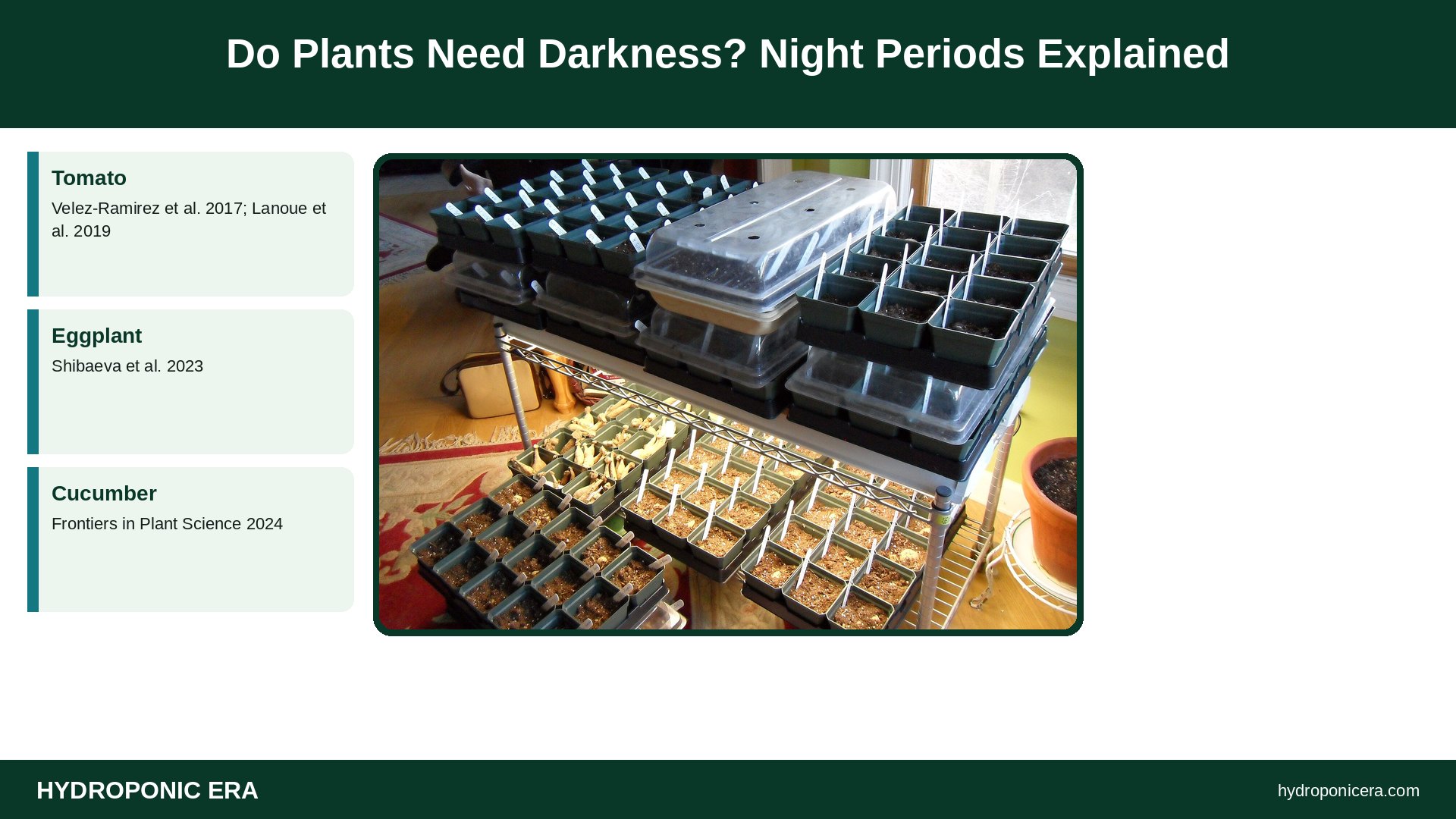
Do Plants Need Darkness to Grow?
Plants make sugars in light, and they keep using that energy for growth around the clock. Darkness isn’t required for photosynthesis, but many plants are tuned to a day-night cycle. A 2024 study in Frontiers in Plant Science lists eggplant, peanut, geranium, tomato and potato among species that respond poorly to continuous light, while greenhouse cucumber tolerates it. Its authors conclude that continuous light isn’t physiologically beneficial even though it drives photosynthesis day and night. So the answer to do plants need darkness depends on the species, but a dark period is the safe default.
Do Plants Need Darkness Every Night? What Happens Without It?
- Leaf yellowing: Lanoue and colleagues (Frontiers in Plant Science, 2019) note that lighting longer than 18 hours causes interveinal chlorosis in tomato, and yields stop rising with further extension.
- Leaf injury: A 2023 review in the Russian Journal of Plant Physiology describes potentially lethal interveinal chlorosis and necrosis in leaves of many species grown under continuous lighting.
- Compact, small plants: The 2024 Frontiers study notes continuous light often causes an overly compact plant shape and reduced leaf area in young tomatoes.
- Flowering problems: Short-day plants won’t bloom without long nights.
Why Do Plants Need Darkness? What Does Science Say?
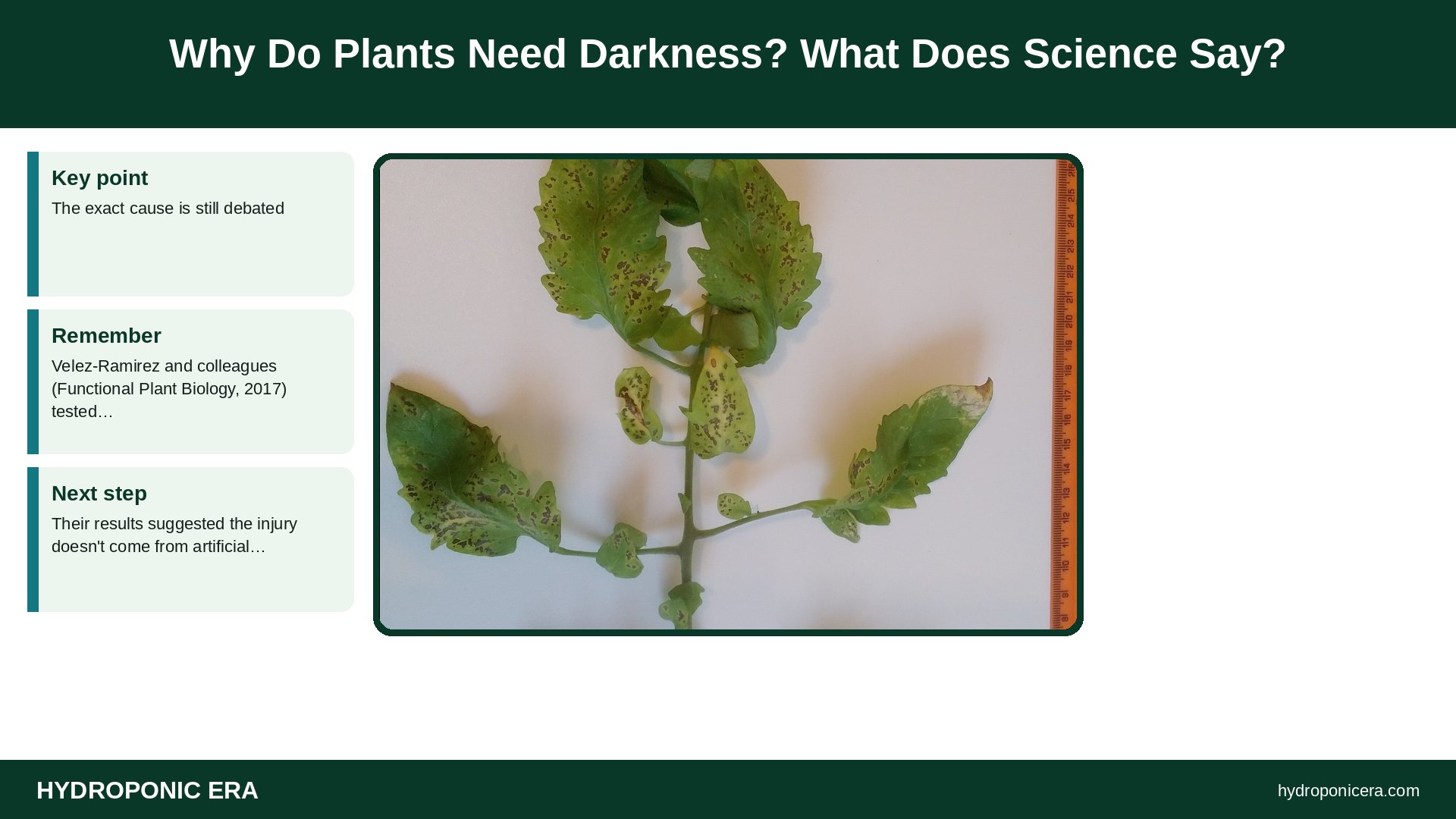
The exact cause is still debated. Velez-Ramirez and colleagues (Functional Plant Biology, 2017) tested five possible triggers of continuous-light injury in tomato. Their results suggested the injury doesn’t come from artificial light’s spectrum or from light continuity itself; instead, a mismatch between the plant’s internal circadian clock and the external light-dark cycle seemed to be the main factor. Shibaeva’s group reached a similar conclusion for tomato and eggplant: abnormal cycles caused injury even with half the time dark. A separate 2023 review in the same journal adds that photooxidation, stress-related aging and circadian mismatch likely act together.
Do Plants Need Darkness for 8 Hours? How Many Hours Are Enough?
| Crop type | Common light schedule | Darkness |
|---|---|---|
| Seedlings | 14–18 h on | 6–10 h |
| Lettuce and herbs | 14–16 h on | 8–10 h |
| Tomatoes, peppers | 14–16 h on | 8–10 h |
| Short-day bloomers (holiday cactus) | About 10 h light during bud set | About 14 h |
Velez-Ramirez’s abstract notes tomatoes develop injury when deprived of at least 8 hours of darkness per day. Our light schedule guide lists crop-by-crop photoperiods.
Do Plants Need Darkness to Flower?
Short-day plants do. Wisconsin Horticulture Extension explains that holiday cactus blooming is triggered by photoperiod. Indoors in a warm room, it recommends covering the plant or moving it into a dark closet so it gets only 10 hours of light per day for about 4 weeks, after which buds appear. Cool nights of 55–60°F (13–16°C) with natural fall day length also work. Long-day plants, by contrast, flower when nights are short.
Do Plants Need Darkness Without Light Leaks?
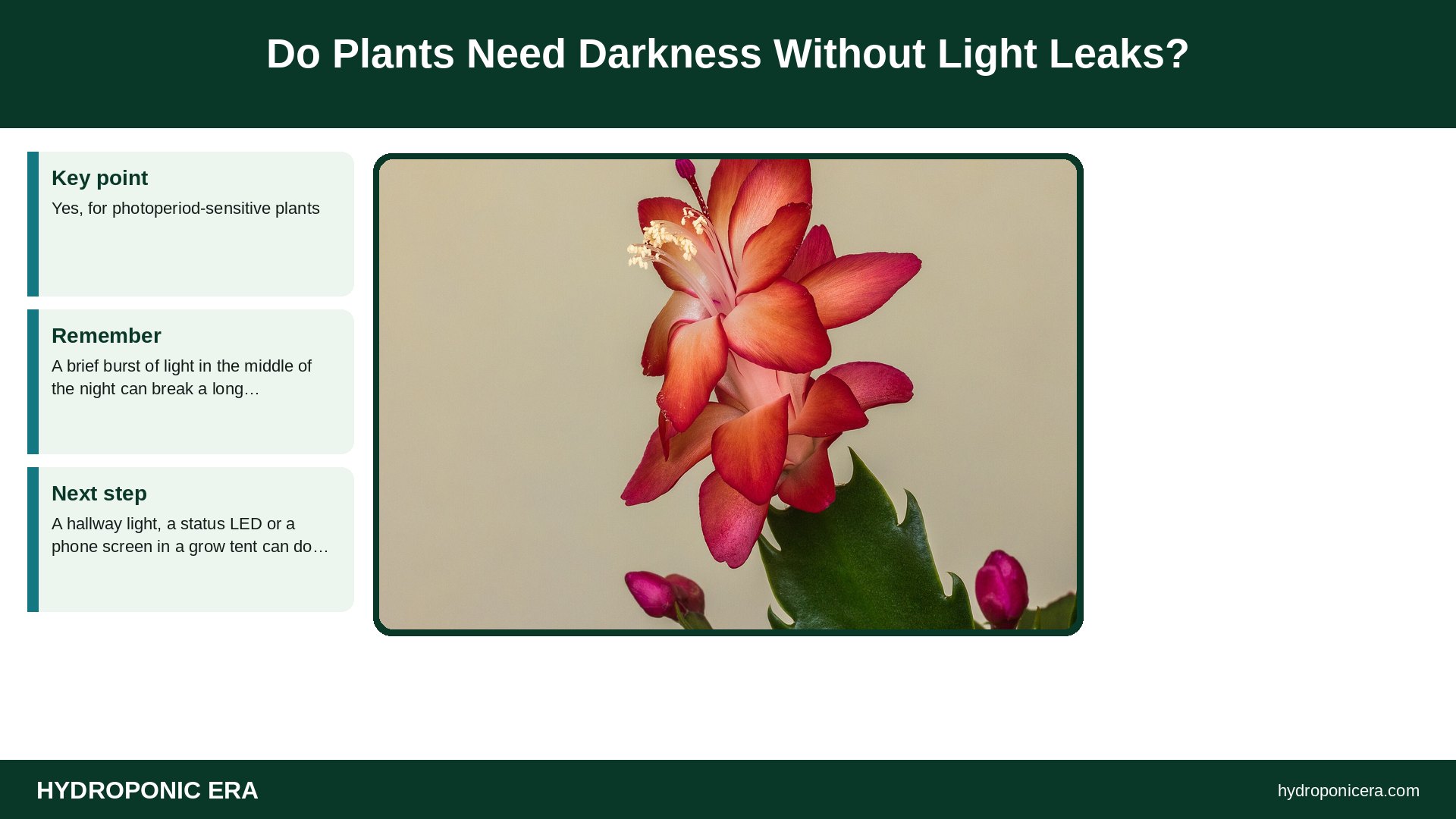
Yes, for photoperiod-sensitive plants. A brief burst of light in the middle of the night can break a long night, which is why commercial growers use night interruption lighting to control flowering. A hallway light, a status LED or a phone screen in a grow tent can do the same thing on a smaller scale. Our guide to light leaks and night interruption shows how to find and seal leaks.
Can Plants Grow Under 24-Hour Light Safely?
Some can, with special setups. Lanoue and colleagues grew tomatoes injury-free under continuous supplemental light by alternating red light during the day with blue light at night at the same daily light integral. The 2024 Frontiers study found dynamic LED recipes reduced chlorosis compared with constant light. These are research and commercial strategies; for home growers, a normal dark period is simpler and safer.
Do Plants Need Darkness Every Day or Can You Skip?
Keep it consistent. Shibaeva and colleagues found abnormal light-dark cycles (6 hours on, 6 off, or 24 on, 24 off) injured tomato and eggplant, even though those cycles gave less total light than a 16/8 schedule. A steady daily rhythm on a timer is best. See our timer fail-safes guide.
Do Plants Need Darkness in a Hydroponic Grow Tent?
Yes, the same rules apply indoors. A grow tent makes darkness easy because you control every light source. Set the timer so the dark period falls when your home is busiest and warmest, since lights add heat. Zip the tent fully, cover equipment status lights with tape and avoid opening it during the dark period. Keep fans and air pumps running at night, because roots and leaves still need fresh air and oxygen in the dark.
Is It Better to Run Lights Longer at Lower Intensity?
Sometimes. Daily light integral (DLI) equals intensity times hours, so a longer day lets you use a dimmer setting for the same total light. The 2024 Frontiers study notes a 24-hour photoperiod could cut supplemental intensity by a third for the same DLI, but crop sensitivity limits that. An 18-hour day is a reasonable upper limit for most home setups. Learn the math in PPFD and DLI.
Do Plants Need Darkness More Than They Get? Signs to Watch
- Yellowing between leaf veins on upper leaves, especially in tomatoes
- Bronzing or dead patches with no nutrient explanation
- Short-day plants that refuse to bloom
- Small, stunted leaves on otherwise healthy plants
Rule out nutrients first with our diagnosis checklist, then test a shorter photoperiod.
FAQs
Do seedlings need darkness?
A dark period of 6–8 hours is a safe default.
Do plants need darkness to germinate?
Most seeds germinate in dark or light; a few need light. Check the packet.
Can I leave grow lights on 24/7 for lettuce?
It’s possible for some greens, but a dark period is the safer choice.
Does moonlight or a nightlight harm plants?
Very dim light rarely matters, except for photoperiod-sensitive bloomers.
Do houseplants need darkness?
Yes, normal room night conditions are enough.
Sources
- Velez-Ramirez, A.I., et al. (2017). On the induction of injury in tomato under continuous light: circadian asynchrony as the main triggering factor. Functional Plant Biology.
- Lanoue, J., et al. (2019). Alternating Red and Blue Light-Emitting Diodes Allows for Injury-Free Tomato Production With Continuous Lighting. Frontiers in Plant Science.
- Frontiers in Plant Science (2024). Tomato and mini-cucumber tolerance to photoperiodic injury involves photorespiration and nighttime cyclic electron flow from dynamic LEDs
- Shibaeva, T.G., et al. (2023). Responses of Tomato and Eggplant to Abnormal Light/Dark Cycles and Continuous Lighting. Russian Journal of Plant Physiology.
- Russian Journal of Plant Physiology (2023). Possible Physiological Mechanisms of Leaf Photodamage in Plants Grown under Continuous Lighting
- Wisconsin Horticulture Extension — Holiday Cactus
- Photo credits (Wikimedia Commons, edited with titles): Dahlias started indoors by F. D. Richards from Clinton, MI (CC BY-SA 2.0); Septoria leaf spot symptoms on tomato leaf (Septoria lycopersici on Solanum lycopersicum leaf) by MerielGJones (CC BY-SA 4.0); Schlumbergera (actm) 01 by Agnes Monkelbaan (CC BY-SA 4.0); Low-key photograph of light bulb, Straume, Norway julesvernex2 by Jules Verne Times Two (CC BY-SA 4.0); Pepper and tomato seedling trays at Boğaziçi University 2026 by Furkan Akkurt (CC BY-SA 4.0)