
Is expanded shale good for aquaponics? Yes, with care. In expanded shale aquaponics, Oklahoma State Extension calls the medium one of the best aquaponic grow media: kiln-fired above 2,000°F (1,093°C), inert, reusable and holding up to 40% of its weight in water. Texas research measured pH 8.3 to 8.5 but very low liming power, so rinse it and test.
Key takeaway: Expanded shale aquaponics uses a fired, porous stone in place of clay pebbles in media beds. Oklahoma State University Extension lists clay pebbles, lava rock and expanded shale as the most widely used aquaponic media. This guide compares shale with clay pebbles on water holding, pH, weight and cost, using extension and university test data.
| Property | Expanded Shale | Source |
|---|---|---|
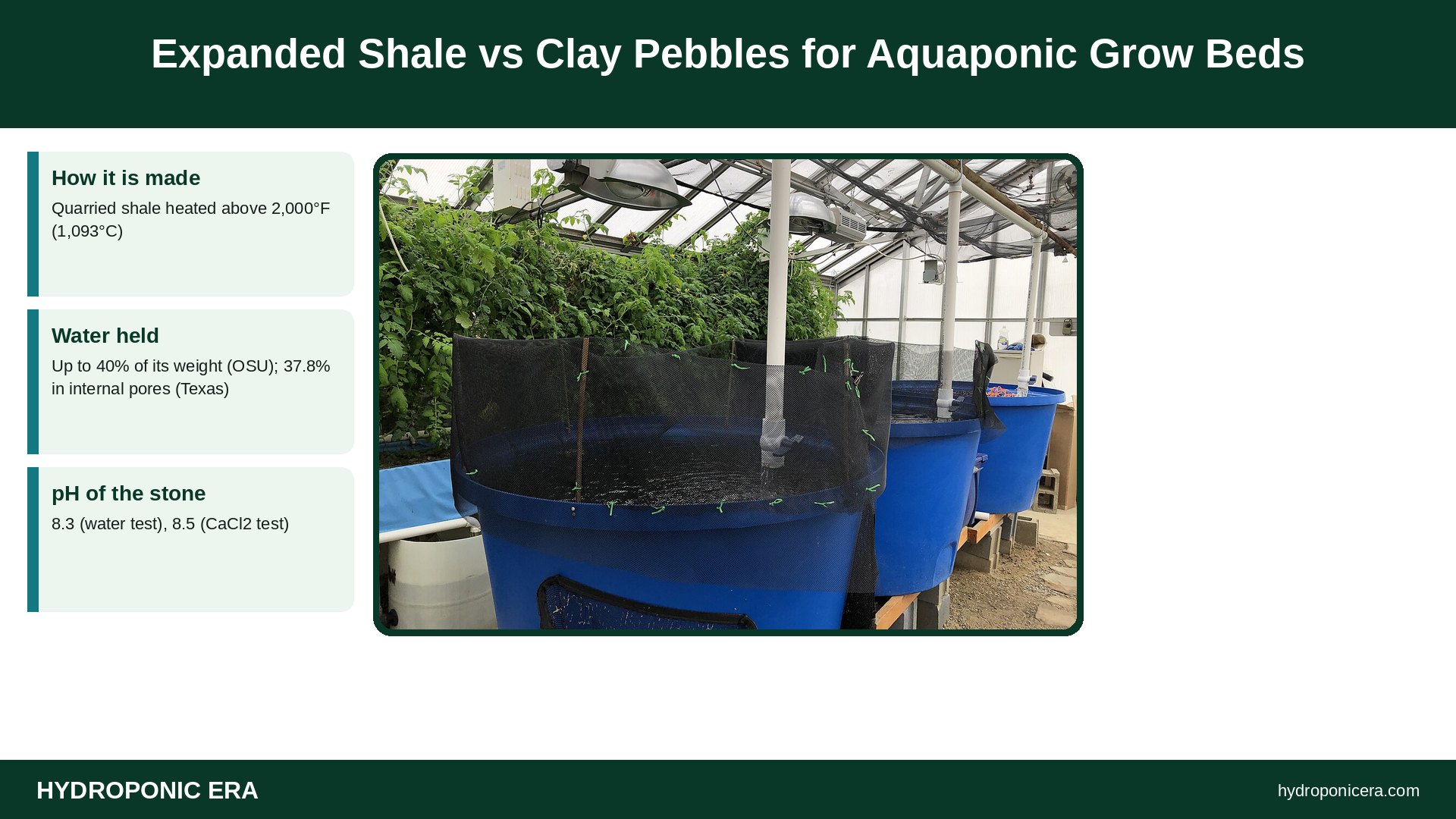
| How it is made | Quarried shale heated above 2,000°F (1,093°C) | Oklahoma State HLA-6728 |
| Water held | Up to 40% of its weight (OSU); 37.8% in internal pores (Texas) | OSU; Texas AgriLife |
| pH of the stone | 8.3 (water test), 8.5 (CaCl2 test) | Texas AgriLife (InTech) |
| Liming power (CCE) | Only 0.2 to 0.3% | Texas AgriLife (InTech) |
| EC of extract | 1.6 dS/m | Texas AgriLife (InTech) |
| Cost and reuse | Low to medium cost, reusable | Oklahoma State HLA-6728 |
| Lettuce in a demo float system | 8.15 oz/sq ft (2.5 kg/m²) vs 7.44 oz/sq ft (2.3 kg/m²) for clay | Ohio State South Centers |
Is Expanded Shale Good for Aquaponics?
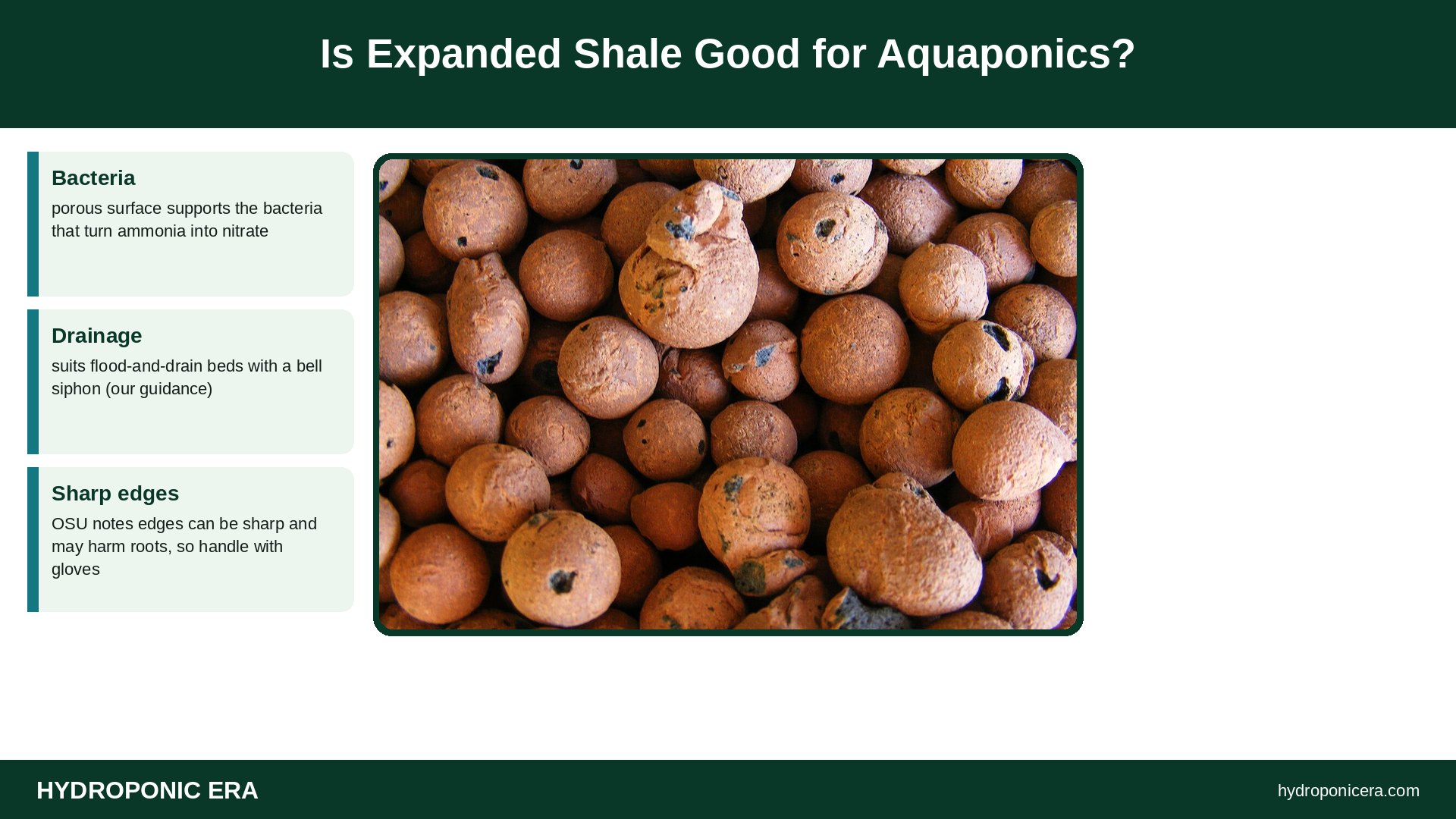
Yes. Oklahoma State Extension describes expanded shale as lightweight, chemically and biologically inert after firing, and “one of the best aquaponics grow media.” Each stone has a large surface area for nitrifying bacteria, and the free-draining texture helps oxygenate roots. For expanded shale aquaponics, choose 3/8 to 3/4 in (10 to 19 mm) pieces for media beds (our guidance).
- Bacteria: porous surface supports the bacteria that turn ammonia into nitrate.
- Drainage: suits flood-and-drain beds with a bell siphon (our guidance).
- Sharp edges: OSU notes edges can be sharp and may harm roots, so handle with gloves.
- Size options: a Texas producer screens shale into fractions from very fine sand up to about 5/8 in (15.9 mm).
How Does Expanded Shale Compare With Clay Pebbles?
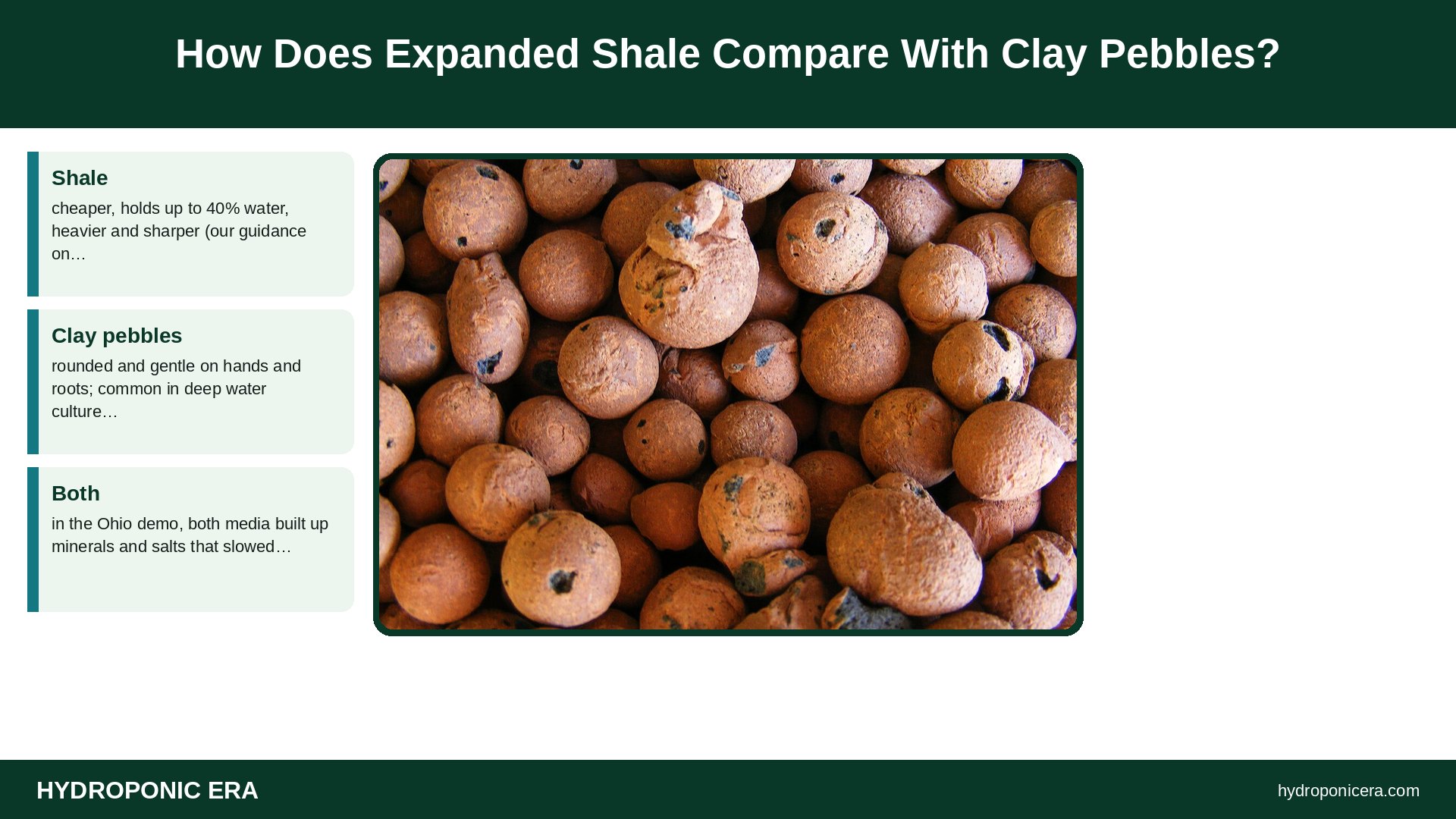
Performance is similar; price and weight differ, which is why expanded shale aquaponics appeals to budget builders. In an Ohio State aquaponics demo with tilapia and later yellow perch, red leaf lettuce gave 8.15 oz/sq ft (2.5 kg/m²) on expanded shale and 7.44 oz/sq ft (2.3 kg/m²) on clay Hydrocorn. OSU rates shale as low-to-medium cost and reusable, while clay pebbles are usually pricier (our guidance).
- Shale: cheaper, holds up to 40% water, heavier and sharper (our guidance on weight).
- Clay pebbles: rounded and gentle on hands and roots; common in deep water culture net pots too.
- Both: in the Ohio demo, both media built up minerals and salts that slowed germination.
- Best performer there: foam float trays with potting mix, at 11.44 oz/sq ft (3.5 kg/m²) of lettuce.
In short, expanded shale aquaponics works about as well as clay, at lower cost.
Does Expanded Shale Change pH?
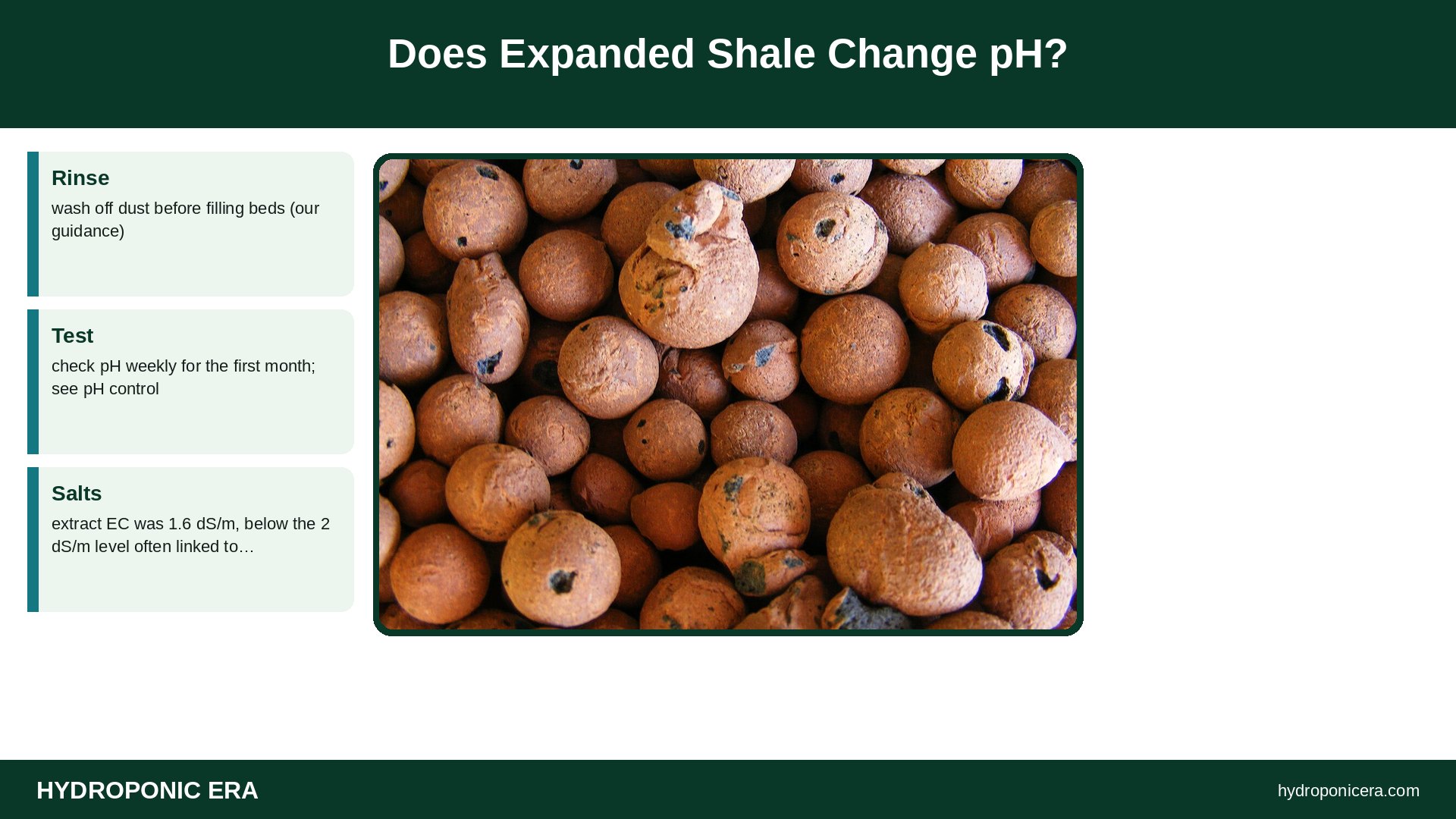
Only slightly in most expanded shale aquaponics systems. Texas AgriLife researchers measured a pH of 8.3 using water and 8.5 using calcium chloride for expanded shale, caused by small amounts of calcium, magnesium, potassium and sodium oxides. But its calcium carbonate equivalent was only 0.2 to 0.3%, so they concluded it is unlikely to shift pH much in a buffered medium. Rinse new shale and test water weekly.
- Rinse: wash off dust before filling beds (our guidance).
- Test: check pH weekly for the first month; see pH control.
- Salts: extract EC was 1.6 dS/m, below the 2 dS/m level often linked to salinity problems.
- Watch high pH: the Ohio demo ran near pH 8, which slowed plant growth even though fish were fine.
How Do You Set Up an Expanded Shale Grow Bed?
For expanded shale aquaponics, fill a media bed at least 12 inches (30 cm) deep so the top stays dry and the bottom hosts bacteria and worms (our guidance). Rinse the shale until water runs clear, cycle the system before adding plants, and feed fish lightly at first. The Ohio State demo had a fish kill from high ammonia, a reminder to build up stocking slowly.
- Rinse shale in a bucket until the water is clear.
- Fill the bed and install a bell siphon or timer.
- Cycle the system with a small fish load (our guidance).
- Test ammonia, nitrite, nitrate and pH every few days.
- Plant seedlings once nitrate appears.
Stocking matters as much as media; see aquaponics stocking density and tilapia aquaponics.
What Grows Well in Expanded Shale Aquaponics?
Leafy greens and herbs are the easiest crops for expanded shale aquaponics. Red leaf lettuce grew most consistently in the Ohio State demo, while mizuna did poorly in both shale and clay but well in float trays. Herbs and fruiting crops do well in deep media beds with stable nitrate (our guidance). For herb ideas, see aquaponics herbs.
- Lettuce: the most consistent crop in the Ohio test.
- Herbs: basil and mint suit media beds (our guidance).
- Fruiting crops: tomatoes and peppers need mature, stable systems (our guidance).
- Outdoor ponds: see pond aquaponics.
Start small, track yields, and you will quickly learn whether expanded shale aquaponics suits your crops (our guidance).
FAQ About Expanded Shale Aquaponics
Is expanded shale safe for fish?
Yes; OSU says firing makes it chemically and biologically inert.
Does expanded shale raise pH?
Its pH is about 8.3 to 8.5, but liming power is very low.
How much water does expanded shale hold?
Up to about 40% of its weight.
Is shale better than clay pebbles?
Similar yields; shale usually costs less.
Do I need to rinse expanded shale?
Yes, rinse dust off before use.
Can I reuse the media from expanded shale aquaponics?
Yes; OSU lists expanded shale as reusable.
Sources
- Oklahoma State University Extension — Soilless Growing Mediums (HLA-6728)
- Texas AgriLife Research (InTech) — Moisture and Nutrient Storage Capacity of Calcined Expanded Shale
- The Ohio State University South Centers — Aquaculture and Horticulture Programs Conduct First Ohio Aquaponics Research
- Photo credits (Wikimedia Commons, edited with titles): BGSU Aquaponics by Mbrickn (CC BY 4.0); Hydroton by Lucis (CC BY-SA 3.0)