
Can you use fabric pots for hydroponics? Yes, for media-based setups. Filled with coco coir or a soilless mix work well on drip or hand-fed systems. University of Maryland Extension says their porous walls “air prune” roots into a dense, fibrous mass instead of circling. They dry faster, so water more often than plastic.
Key takeaway: Also called grow bags, these are breathable felt or synthetic containers. They suit drip-fed coco and container crops, not water-culture systems like DWC.
| Feature | Fabric pots | Rigid plastic pots |
|---|---|---|
| Root shape | Air-pruned, fibrous, fewer circling roots | Roots can circle the wall |
| Drying rate | Faster; check daily in heat | Slower |
| Weight and storage | Light, foldable, portable | Heavier, rigid |
| Cost | Relatively inexpensive | Varies |
| Best hydroponic use | Drip-fed coco or soilless mix | Dutch buckets, drip, ebb and flow |

What Are Fabric Pots?
These are soft containers made from felt or woven material. University of Maryland Extension describes them as relatively inexpensive, reusable, lightweight and portable, made from natural or synthetic fibers or a blend. Kentucky State University Extension adds that grow bags are porous and breathable, which improves drainage compared with rigid pots.
They hold soilless media, so pair them with a medium from our growing media for hydroponics guide.
How Do Fabric Pots Air Prune Roots?
Roots stop when they reach air. UMD Extension explains that when roots hit the open air at the bag’s edge, they stop growing in length and branch into a denser, fibrous system that stays in the mix. In a solid pot, a root that hits the wall keeps growing as a single root, which can lead to circling.
Do Fabric Pots Really Grow Better Roots?
Research on trees supports fewer circling roots. In a three-year Colorado State study, pear trees grown in two fabric containers had no difference in top growth, but by years two and three they grew more roots beyond the original root ball than trees from black plastic pots. The authors note fabric-grown trees had fewer noticeable circling roots.
For crops grown short-term, that benefit mainly means a healthier, non-root-bound plant at transplant.

Can You Use Fabric Pots in a Hydroponic System?
Use them with a medium, not bare water. They work best on drip lines with coco coir, perlite or a soilless mix, where solution runs through and drains away. They are not designed for deep water culture or NFT, where roots sit in moving water. Set them on a tray or grate so runoff can drain or be collected.
- Good fit: hydroponic drip systems feeding coco coir.
- Good fit: hand-watered nutrient solution in a soilless mix.
- Poor fit: DWC, Kratky and NFT, which need net cups.
- Learn coco basics in our coco coir hydroponics guide.
How Often Should You Water Fabric Pots?
More often than plastic. Kentucky State University Extension says grow bags drain and dry out more quickly than plants in the ground, so check moisture by touch; if the mix feels dry 1 in (2.5 cm) below the surface, it is probably too dry. UMD notes some containers need daily watering in hot, dry weather. Water at the base.
- Fill the pot with pre-moistened coco or soilless mix.
- Soak the mix until runoff drains from the bottom.
- Check moisture daily 1 in (2.5 cm) deep.
- Set a drip timer with more frequent, shorter cycles in heat.
- Group pots or use a tray to cut drying from wind.
- Watch the runoff EC so salts do not build up.
What Size Fabric Pot Do You Need?
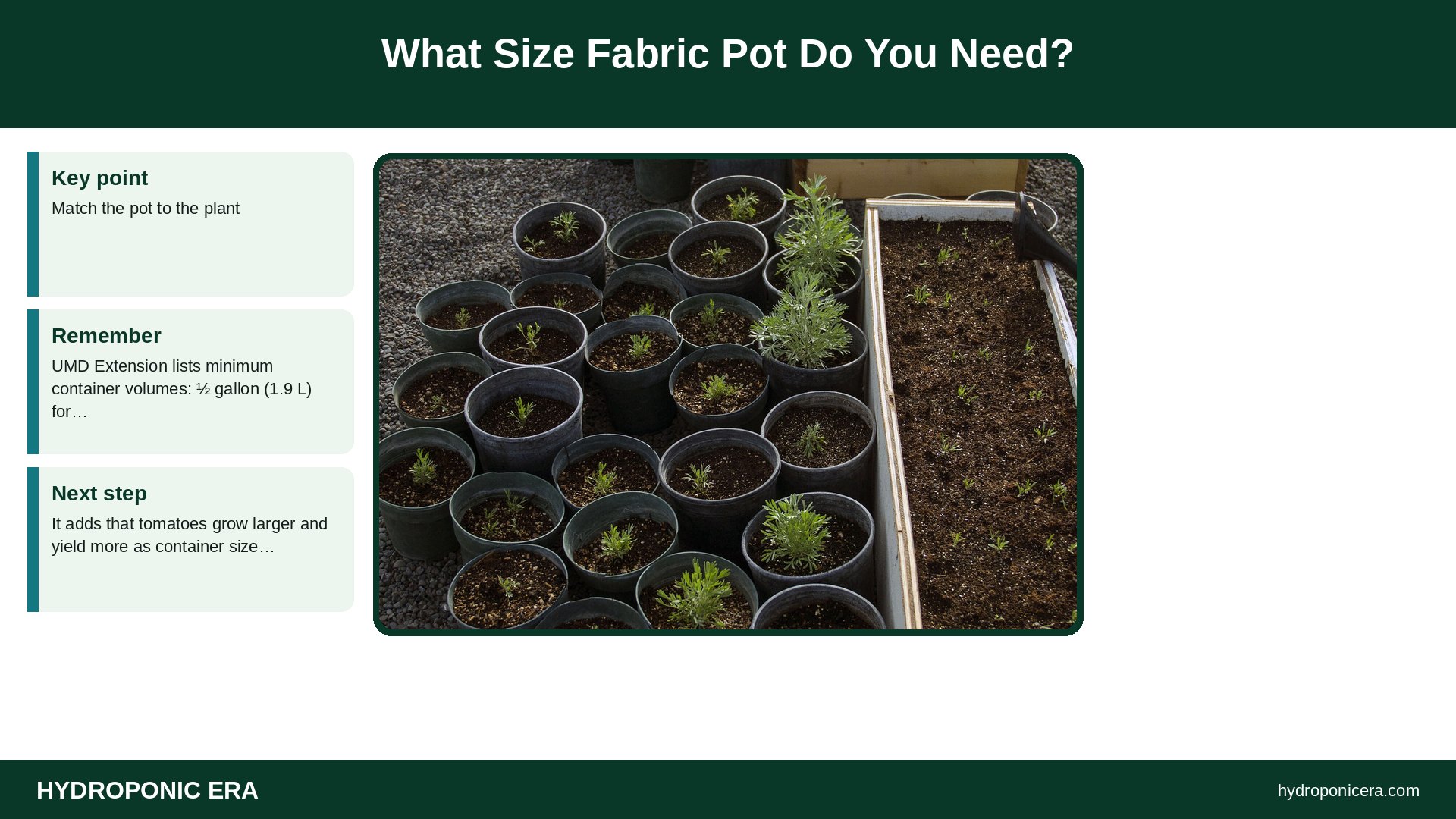
Match the pot to the plant. UMD Extension lists minimum container volumes: ½ gallon (1.9 L) for leaf lettuce, 2 gallons (7.6 L) for cherry tomatoes and bush beans, 5 gallons (19 L) for peppers, cucumbers and standard tomatoes, and 10 gallons (38 L) for summer squash. It adds that tomatoes grow larger and yield more as container size increases.
Are Fabric Pots Better Than Plastic Pots?
Each has a role. Fabric wins on root structure, weight and storage. Plastic holds water longer and is easier to clean. UMD Extension warns that dark containers can raise mix temperature and injure tender roots, so color matters too. For bucket systems that recirculate solution, rigid buckets are still the standard, as in our Dutch bucket guide.
How Do You Clean and Reuse Fabric Pots?
Empty old media and brush off roots, then wash. UMD Extension calls fabric bags reusable. For reused food-grade containers it recommends washing with soap, rinsing, soaking 10 minutes in a 10% bleach solution, washing again and air drying; a similar routine works for grow bags, though the material may fade. Dry them fully before storing.
FAQ About Fabric Pots
Do grow bags need drainage holes?
No. The porous fabric drains through its walls and base.
Can they sit in a saucer?
Yes, but empty standing water so roots do not stay soaked.
Do they prevent root rot?
They improve drainage and airflow but do not guarantee it.
What bag size suits tomatoes?
At least 5 gallons (19 L) for standard tomatoes, per UMD.
Can I use them indoors?
Yes, on a tray to catch runoff.
Sources
- University of Maryland Extension — Growing Vegetables in Containers and Salad Tables
- Kentucky State University Cooperative Extension — Gardening in a Grow Bag (PDF)
- O’Connor, Klett and Koski, Arboriculture & Urban Forestry (2018) — Container Type Affects Root Development of Chanticleer Pear (PDF)
- Photo credits (Wikimedia Commons, edited with titles): Potato bag cultivation by Jolly Janner (Public domain); Spathiphyllum wallisii hydroponically grown by Kephalian (CC BY-SA 4.0); Prisoners Growing Sagebrush – 21288327248 by Bureau of Land Management Oregon and Washington (Public domain); Perlite1 by KENPEI (CC BY-SA 3.0)