
How much greenhouse ventilation do you need? For summer greenhouse ventilation, plan one air change per minute: 8 to 10 CFM per square foot of floor (about 2.4–3 m³/min per m²). UMass Extension uses this rule, and the NGMA standard starts at 8 CFM per square foot. Winter needs only about one quarter of an air change per minute.
Key takeaway: Greenhouse ventilation removes solar heat, replaces carbon dioxide and controls humidity, so size it by floor area and season.
| Item | Recommendation | Source |
|---|---|---|
| Summer fan capacity | 8–10 CFM per sq ft of floor | UMass, NGMA |
| Same rule by volume | 1 air change/min to 8 ft (2.4 m) height | UMass |
| Winter fan capacity | About 1/4 air change per minute | UMass |
| Roof and side vents | Each 15–20% of floor area | UMass (ASABE) |
| Intake louver area | At least 1 1/4 times fan area | UMass |
| Fan spacing on exhaust wall | No more than 25 ft (7.6 m) | NGMA |
| Fan rating | AMCA-tested, VER 15 CFM/W or better | UMass, NGMA |
| Evening humidity purge | Heat and vent 2–3 times per hour | UConn |
What Does Greenhouse Ventilation Do?
Greenhouse ventilation swaps inside air for outside air. The National Greenhouse Manufacturers Association (NGMA) defines ventilation as that exchange, used to remove heat from solar radiation, replenish carbon dioxide and help control relative humidity. Because the heat load comes from sunlight on the floor, the standard measures the rate in CFM per square foot of floor area.
How Do You Size Exhaust Fans?
Multiply floor area by 8 for summer greenhouse ventilation. UMass Extension’s Bartok says fans should give one volume air change per minute to a height of 8 ft (2.4 m), giving an 8–10°F (4–6°C) rise from louver to fan. So a 25 by 96 ft (7.6 by 29 m) house needs 19,200 CFM. Hot climates sometimes use 10 ft (3 m).
NGMA adjusts its 8 CFM base for elevation above 1,000 ft (305 m), interior light and allowed temperature rise. Our hydroponic airflow and fans guide covers smaller indoor setups.
How Big Should Natural Ventilation Vents Be?
Each set about 15 to 20 percent of floor area. UMass cites the agricultural engineers’ standard: combined sidewall vent area should equal combined ridge vent area. Wind does most of the work; a 2–3 mph (3–5 km/h) breeze can supply 80 percent or more of the ventilation in a well-designed house. Orient the ridge across summer winds.
Hoophouse growers often use roll-up sides, Bartok notes, which need good summer breezes and space between houses.
Where Should Fans and Louvers Go?
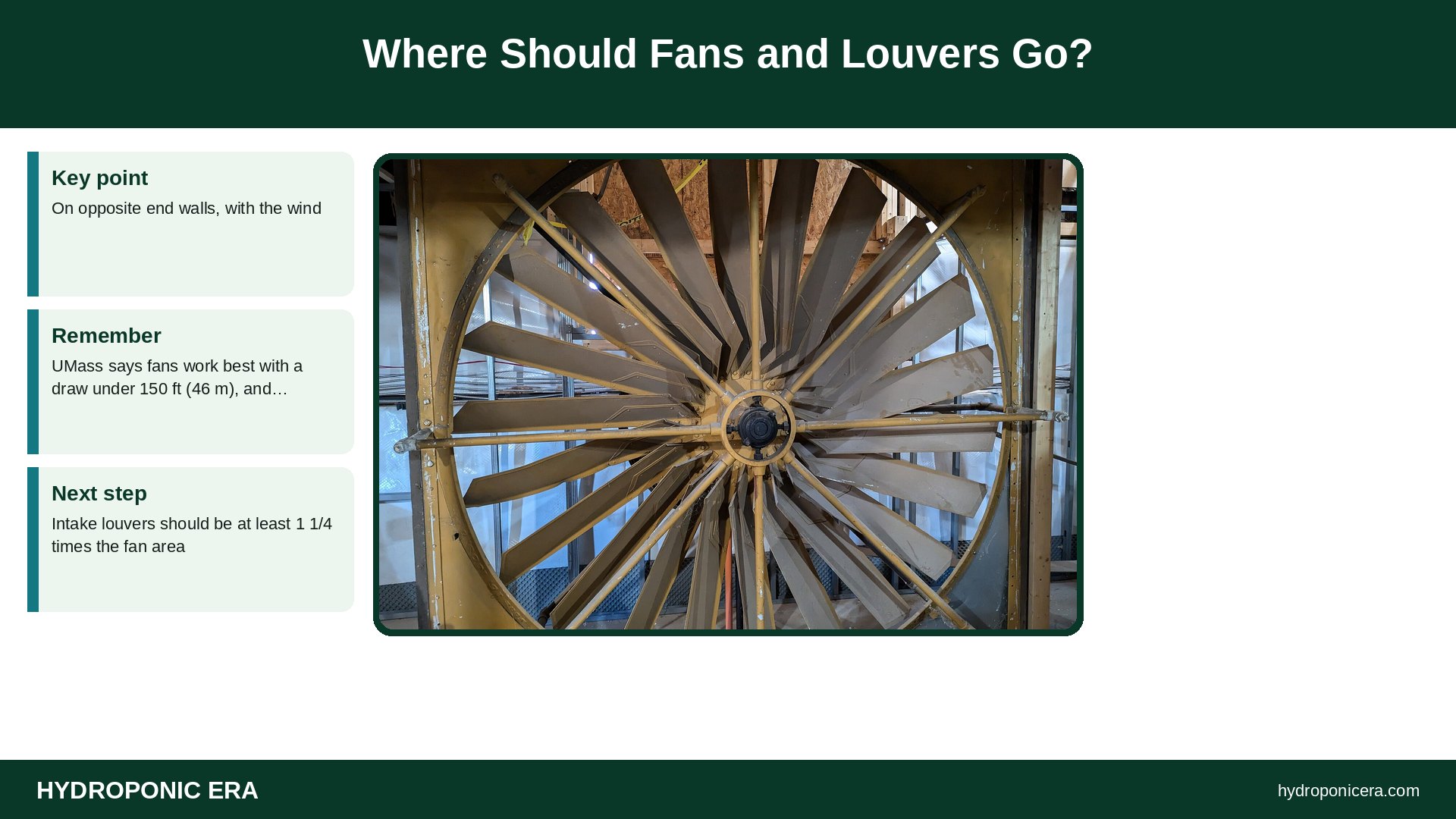
On opposite end walls, with the wind. UMass says fans work best with a draw under 150 ft (46 m), and exhausting into the wind cuts output 10 percent or more. Intake louvers should be at least 1 1/4 times the fan area. Set fan and louver bottoms about 3 ft (0.9 m) high.
- Measure floor length and width.
- Multiply by 8 for base summer CFM.
- Choose AMCA-rated fans that deliver it at 0.1 in (2.5 mm) static pressure.
- Space fans no more than 25 ft (7.6 m) apart.
- Size intake louvers at 1 1/4 times fan area.
- Add a second speed or stage for spring and winter.
How Does Winter Greenhouse Ventilation Differ?
Much lower rates, with cold air mixed in first. UMass says about one quarter air change per minute is enough in winter, and fan-and-tube systems mix cold outside air with warm greenhouse air before it reaches plant level. A fan-jet unit is sized at about 1/2 CFM per square foot of floor (0.15 m³/min per m²).
How Does Ventilation Control Humidity and Disease?
Greenhouse ventilation replaces moist air with drier outside air. UConn Extension explains that air cooling in the evening reaches its dew point and condenses on plants, which favors Botrytis. It advises heating and venting two or three times per hour after sunset and near sunrise, cracking vents about 1 inch (2.5 cm) or briefly running fans.
Use a relay so the heater cannot draw flue gases back in while fans run, UConn adds. Read more in our Botrytis gray mold guide.
How Do You Keep Greenhouse Ventilation Efficient?
Efficient greenhouse ventilation starts with rated, maintained fans. Bartok suggests fans with a ventilating efficiency ratio of 15 CFM per watt or more, cleaning blades and shutters, and tight-closing shutters to prevent winter heat loss. Two-stage thermostats beat single-stage ones. He warns that a hot day without ventilation can push temperatures above 100°F (38°C) within minutes.
For cold-season planning, see our greenhouse heating guide.
FAQ About Greenhouse Ventilation
How many air changes per hour does a greenhouse need?
About one per minute in summer and one quarter of that in winter.
Are roof vents better than fans?
They use little energy; fans work in all weather.
Should circulation fans run with roof vents open?
UMass says turn them off to keep hot air high.
Does a small greenhouse need fans for ventilation?
Use vents or a two-speed fan sized by floor area.
Why does my greenhouse drip at night?
Cooling air hits its dew point; heat and vent.
Sources
- UMass Extension, John W. Bartok Jr. — Ventilation for Greenhouses
- National Greenhouse Manufacturers Association — Ventilating and Cooling Greenhouses standards (PDF)
- UConn Extension IPM, Leanne Pundt — Tips on Preventing Botrytis During Cool, Cloudy Weather
- Photo credits (Wikimedia Commons, edited with titles): Copped Hall kitchen walled garden, greenhouse ventilation mechanism, Essex, England 1 by Acabashi (CC BY-SA 4.0); Windows throughs a window, Royal Greenhouses, Laeken, 2026 by DimiTalen (CC0); Aledo Opera House evaporative cooling fan by Dentree2 (CC BY-SA 4.0); Greenhouse in Qingjing Small Swiss Garden 清境小瑞士花園溫室 – panoramio by lienyuan lee (CC BY 3.0)