
A hydroponic banana tree can work if you choose a dwarf variety such as ‘Dwarf Cavendish’ and grow it in a large, free-draining container fed by drip, with full-sun-level light, warmth, and plenty of water. Bananas are big, thirsty, frost-tender plants: UF/IFAS says they perform best in moist, fertile conditions in full sun, need regular water but are harmed by continuously wet soil, and are damaged by frost. Indoors, most plants are grown for their leaves; fruit needs a large, warm, bright space and patience.
Key takeaway: Grow a dwarf banana in a big drip-fed container of coarse media, keep it warm and bright, feed it heavily, and never let roots sit waterlogged.
| Need | What UF/IFAS says |
|---|---|
| Variety | ‘Dwarf Cavendish’ widely available, suits cooler subtropics |
| Light | Full sun, wind-protected |
| Water | Regular water; avoid continuously wet soil |
| Feeding | Frequent fertilizing, more at flowering |
| Cold | Damaged by frosts and freezes |
| Stalks | Keep three or four stalks of different ages |

Can You Grow a Hydroponic Banana Tree?

Yes, with the right variety and space. Bananas aren’t true trees; the “trunk” is a pseudostem of tightly wrapped leaves growing from an underground rhizome. UF/IFAS lists banana among fruit crops suited to containers, and a container in hydroponics is simply one filled with soilless media. Container growing also lets you move the plant inside before freezes, as UF/IFAS advises for colder areas.
Best Variety for a Hydroponic Banana Tree
UF/IFAS describes ‘Dwarf Cavendish’ as widely planted, better adapted to cooler subtropical climates than most commercial types, and able to produce large bunches of medium fruit. It’s the most common choice for containers. Smaller ornamental dwarf bananas also exist but may not fruit well. Check mature height before buying.
Best Systems for a Hydroponic Banana Tree
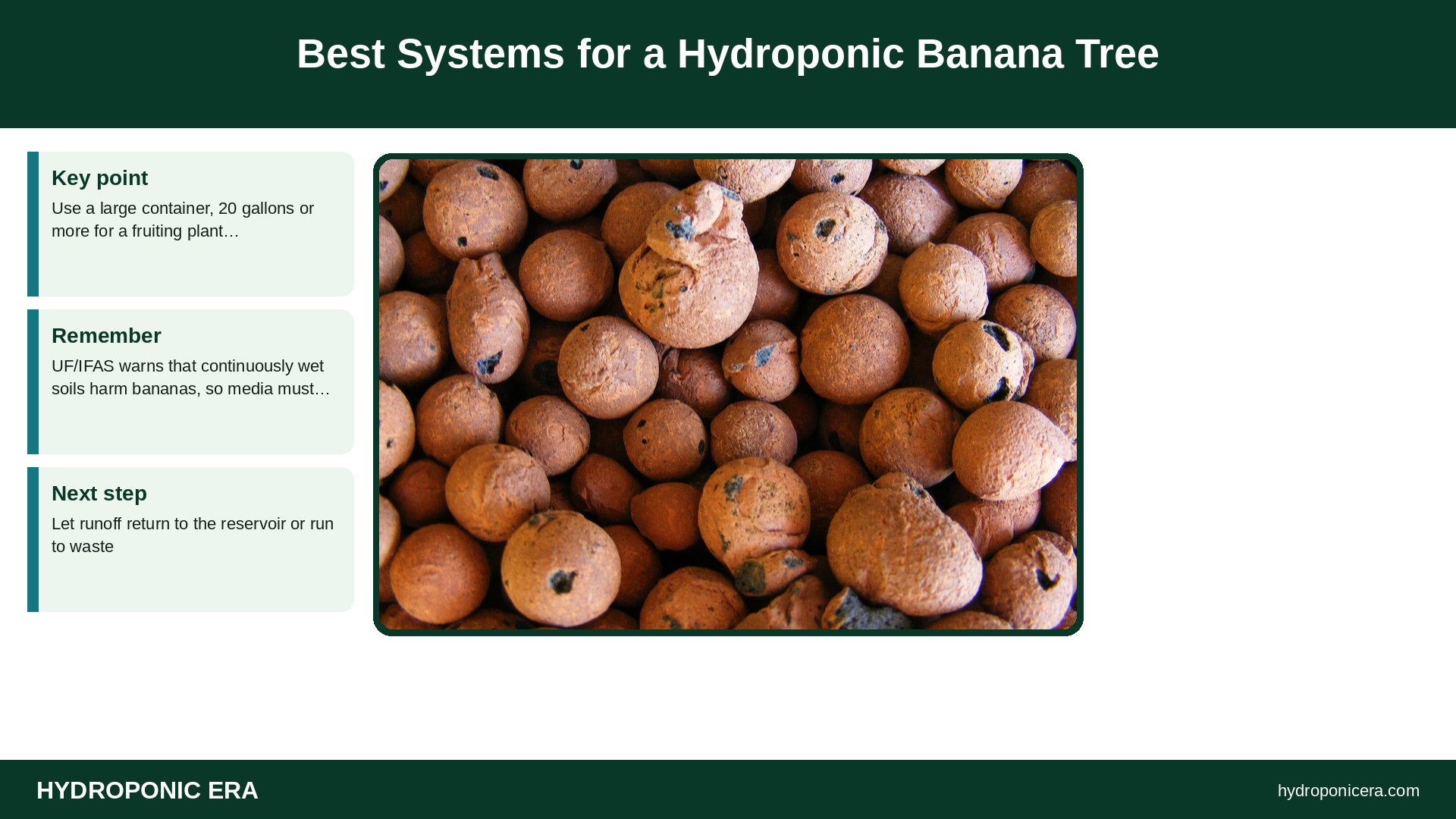
Use a large container, 20 gallons or more for a fruiting plant, filled with perlite, coco, or clay pebbles and fed by drip on a timer. UF/IFAS warns that continuously wet soils harm bananas, so media must drain freely; avoid deep water culture for large plants. Let runoff return to the reservoir or run to waste. See Dutch bucket hydroponics.
Light and Temperature
UF/IFAS recommends full sun and a wind-protected spot. Indoors, that needs a strong LED fixture or a bright greenhouse. Keep the plant warm, protect it from frost, and avoid drafts. Big, tattered leaves usually mean wind or rough handling, not disease. See LED watts per square foot.
Nutrients for a Hydroponic Banana Tree
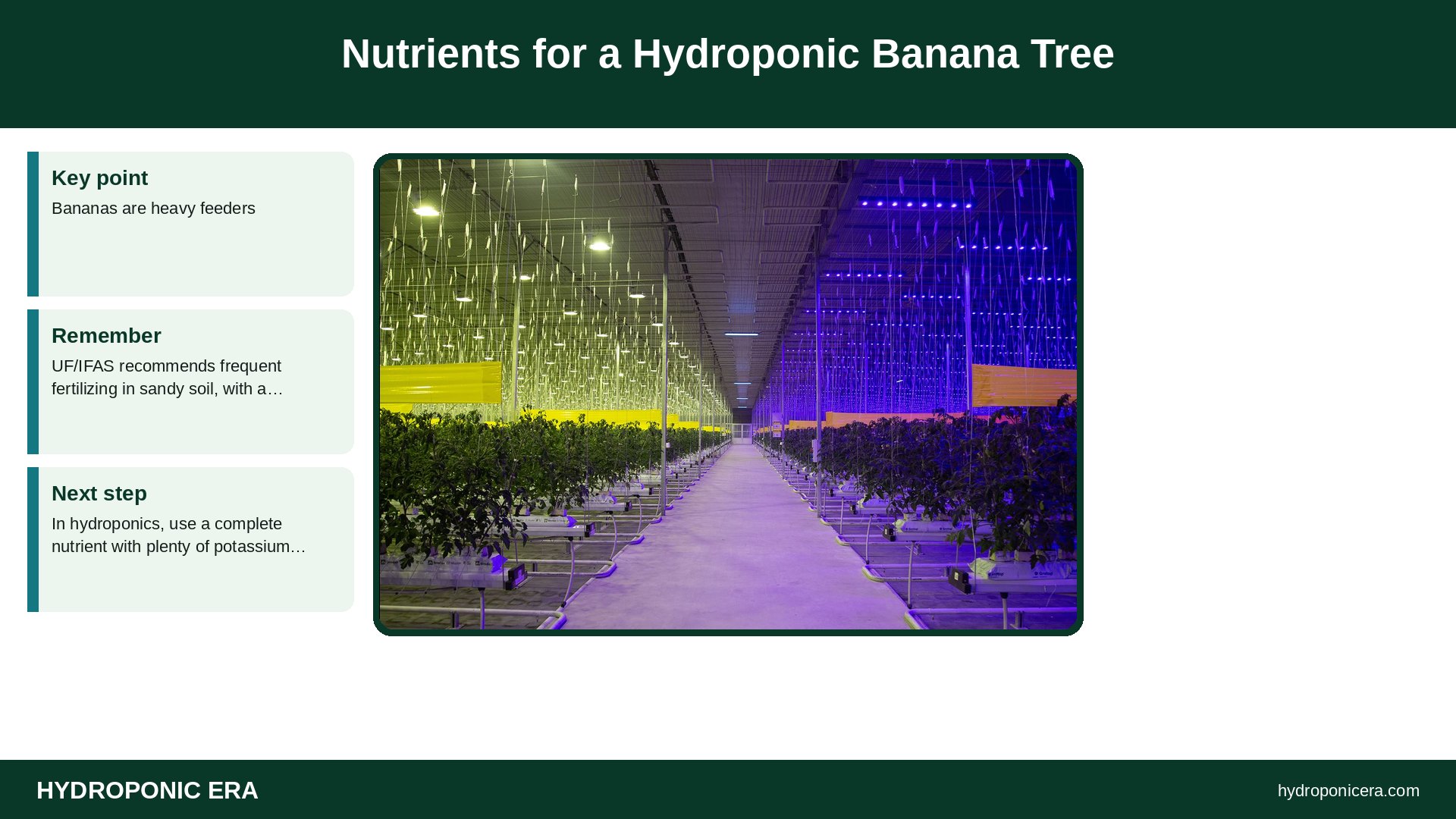
Bananas are heavy feeders. UF/IFAS recommends frequent fertilizing in sandy soil, with a potassium-rich 6-2-12 type fertilizer increasing toward flowering and fruiting. In hydroponics, use a complete nutrient with plenty of potassium, keep pH around 5.5–6.5, and raise strength as the plant grows. Check EC often, since large leaves drink a lot of water. See how to lower EC.
Managing Suckers
Bananas send up new shoots, called suckers, from the rhizome. UF/IFAS suggests limiting a plant to three or four stalks of different ages: one flowering or fruiting, one about half to a third its size, and one or two small ones. In a container, keep fewer, often just the main stalk plus one follower, and remove the rest.
Flowering and Fruit

A stalk flowers once, produces a bunch, and then dies back, while the follower takes over. Indoors it may take a long time to reach flowering size, and many indoor plants never fruit. Once a bunch forms, support the stalk if needed and harvest when fruit is plump and the first hands begin to yellow.
Common Problems
- Yellow, brown leaf edges: low potassium, dry air, or salt buildup.
- Root rot: media too wet.
- Spider mites: common indoors in dry air.
- Cold damage: leaves blacken after chilling.
- No fruit: too little light or space.
Weekly Routine for a Hydroponic Banana Tree
- Check pH and EC and record them.
- Top off the reservoir; check daily in summer.
- Make sure emitters flow and media drains.
- Look under leaves for mites.
- Remove extra suckers.
- Flush media with plain water every few weeks.
Hydroponic Banana Tree Space Planning
Before starting, measure ceiling height and the width the leaves will need. Dwarf types still spread wide, and large leaves shade nearby plants. A corner of a greenhouse, a sunroom, or a covered patio in summer gives the best results, with the plant moved under cover before cold nights.
Beginner Mistakes With a Hydroponic Banana Tree
The most common mistakes are using a container that’s too small, letting media stay soggy, underfeeding potassium, and placing the plant in low light. Bananas grow fast and show stress quickly, which makes problems easy to spot if you check the plant often.
Equipment Checklist for Hydroponic Banana Tree
- A large container (15–25 gallons) with drain holes.
- Coarse media: perlite, coco, or clay pebbles.
- A drip pump, timer, and emitters.
- A pH and EC meter.
- A complete fruiting-crop nutrient.
- A stake or trellis for support.
Most of this gear is reusable from crop to crop, so the first setup costs the most. Buy reliable meters first; they prevent the majority of problems.
Beginner Mistakes With Hydroponic Banana Tree
The biggest mistakes are a container that’s too small, soggy media, too little potassium, and low light. Bananas show stress quickly, so watch new leaves for clues.
Getting Started With Hydroponic Banana Tree
Start small, change one thing at a time, and keep a simple log of pH, EC, temperature, and what you changed. Most hydroponic problems show up as patterns in those numbers before they show on the plant. Compare your notes with the sources below, and adjust slowly rather than chasing every small swing. A steady routine matters more than any single product or setting.
FAQs: Hydroponic Banana Tree
Can bananas grow hydroponically?
Yes, in a large drip-fed container of coarse media.
Which banana is best for containers?
‘Dwarf Cavendish’ is the common choice.
Will an indoor banana fruit?
Sometimes, with strong light, warmth, and space; many don’t.
Do bananas need a lot of potassium?
Yes; UF/IFAS recommends a potassium-rich fertilizer.
Can bananas handle frost?
No, frost damages them.
How big a container does a banana need?
About 20 gallons or more for a fruiting plant.
Sources
- UF/IFAS — Banana Growing in the Florida Home Landscape (HS10)
- UF/IFAS Gardening Solutions — Bananas
- UF/IFAS Extension — Small Edibles for Small Spaces
- Photo credits (Wikimedia Commons, edited with titles): Dwarf cavendish leaf by Ben Clough (CC BY 2.5); Drip irrigation (2552390830) by Dwight Sipler from Stow, MA, USA (CC BY 2.0); Hydroton by Lucis (CC BY-SA 3.0); Greenhouse in Kazakhstan by Gakon Netafim (CC BY-SA 4.0); Greenhouse in Qingjing Small Swiss Garden 清境小瑞士花園溫室 – panoramio by lienyuan lee (CC BY 3.0)