
Hydroponic shallots are easy to grow for green tops and possible to grow for full bulbs. Plant individual shallot bulbs (sets) in net cups or a media bed with the pointed tip up and the base just touching moisture. Green shoots are ready to snip in about 50–60 days, when they’re 6–8 inches (15–20 cm) tall, according to Utah State University Extension. For dry bulbs, keep the plants growing until the tops fall over, then stop feeding, lift, cure for 1–2 weeks and store cool and dry. One set can split into a cluster of up to 10–15 bulbs.
Key takeaway: Use firm, disease-free sets, keep only the bottom of each bulb wet, harvest greens at 6–8 inches (15–20 cm) and grow bulbs in a well-drained media bed or Dutch bucket rather than deep water.
| Goal | Best system | Time | Harvest sign |
|---|---|---|---|
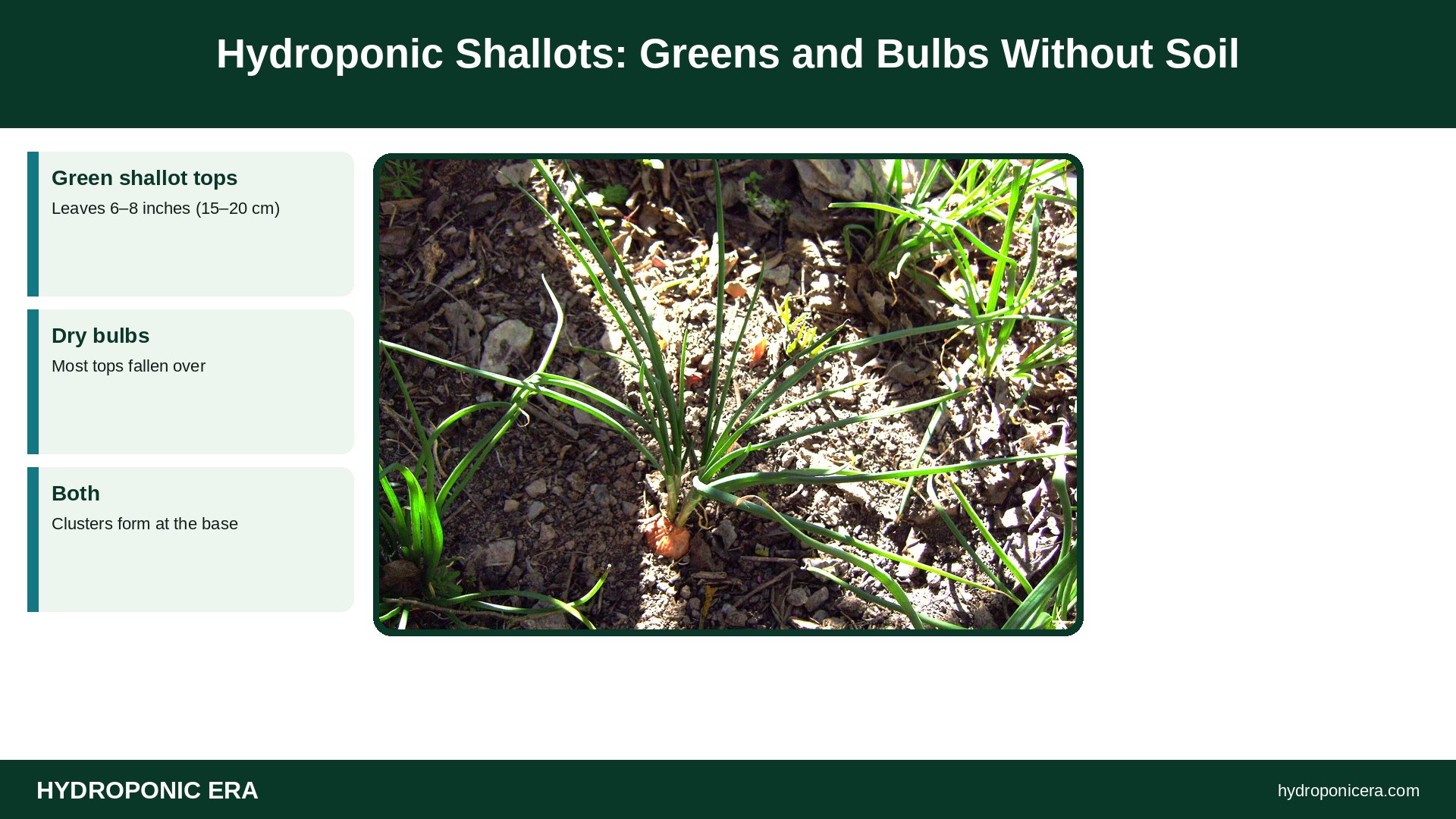
| Green shallot tops | Kratky, DWC, NFT | About 50–60 days | Leaves 6–8 inches (15–20 cm) |
| Dry bulbs | Media bed, ebb and flow, Dutch bucket | Varies by variety | Most tops fallen over |
| Both | Media bed with wider spacing | Snip some tops, then let bulbs mature | Clusters form at the base |
What Makes Hydroponic Shallots Different From Onions?
Shallots are a close relative of onions, often listed as Allium cepa var. aggregatum. Instead of one big bulb, each planted shallot divides into a cluster. Utah State University (USU) Extension explains that bulbs planted close together yield one shallot each, while wider spacing may produce clusters of 10–15 bulbs. Each seed, by contrast, makes just one bulb.
USU lists common varieties as French Red, the most common in stores; Gray Griselle, with the best flavor; and Dutch Yellow, which is stronger and more onion-like. All three can be grown as hydroponic shallots. For bulb onions, see hydroponic onions.
Hydroponic Shallots Research
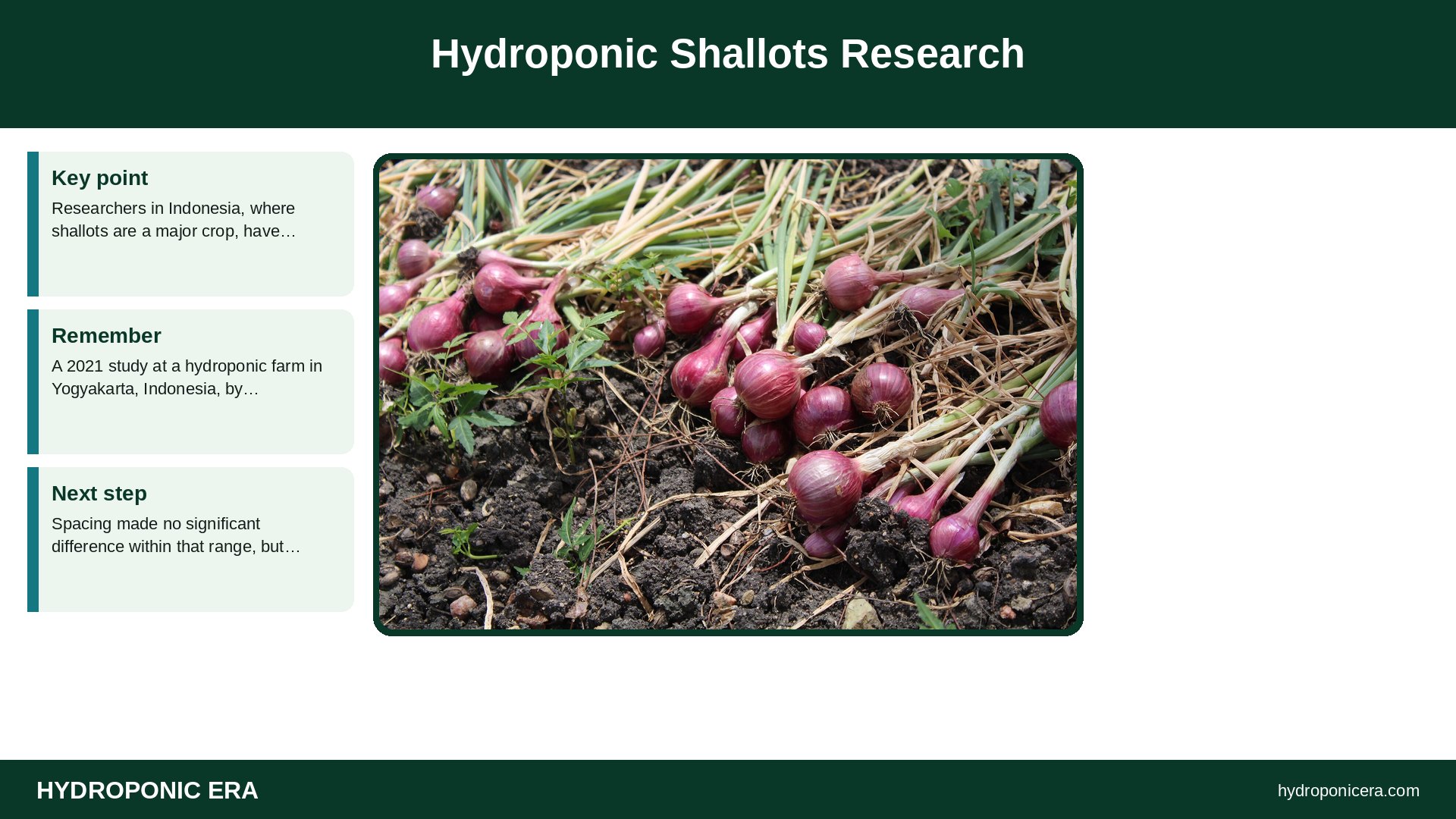
Researchers in Indonesia, where shallots are a major crop, have tested hydroponic shallots in NFT. A 2021 study at a hydroponic farm in Yogyakarta, Indonesia, by Siagian, Sasmita and Irawati grew shallots in NFT channels at three spacings, from about 4×4 to 4×8 inches (10×10 to 10×20 cm), with planting bulbs uncut or with one-third or one-quarter of the top cut off. Spacing made no significant difference within that range, but trimming the bulb tops clearly affected growth and yield.
How to Grow Hydroponic Shallots for Greens
- Pick sets. Choose firm bulbs without mold or soft spots. USU notes properly stored bulbs can be replanted in spring, so a good grocery or saved shallot can work, though certified sets are safer.
- Prep the bulb. Peel loose outer skin and, if you like, trim a little off the top as in the Indonesian trials.
- Set in net cups. Place each bulb root-end down in a 2–3 inch (5–8 cm) net cup filled with clay pebbles. Only the root plate should touch the solution; a wet bulb rots.
- Add light. Give strong light, 14–16 hours a day indoors, or a sunny window.
- Feed lightly. Start at a mild nutrient strength and raise it as leaves grow.
- Harvest. Snip leaves when they reach 6–8 inches (15–20 cm), about 50–60 days after planting per USU. Leave an inch (2.5 cm) or so to regrow.
Our guide to growing green onions hydroponically uses the same steps.
How to Grow Hydroponic Shallots for Bulbs
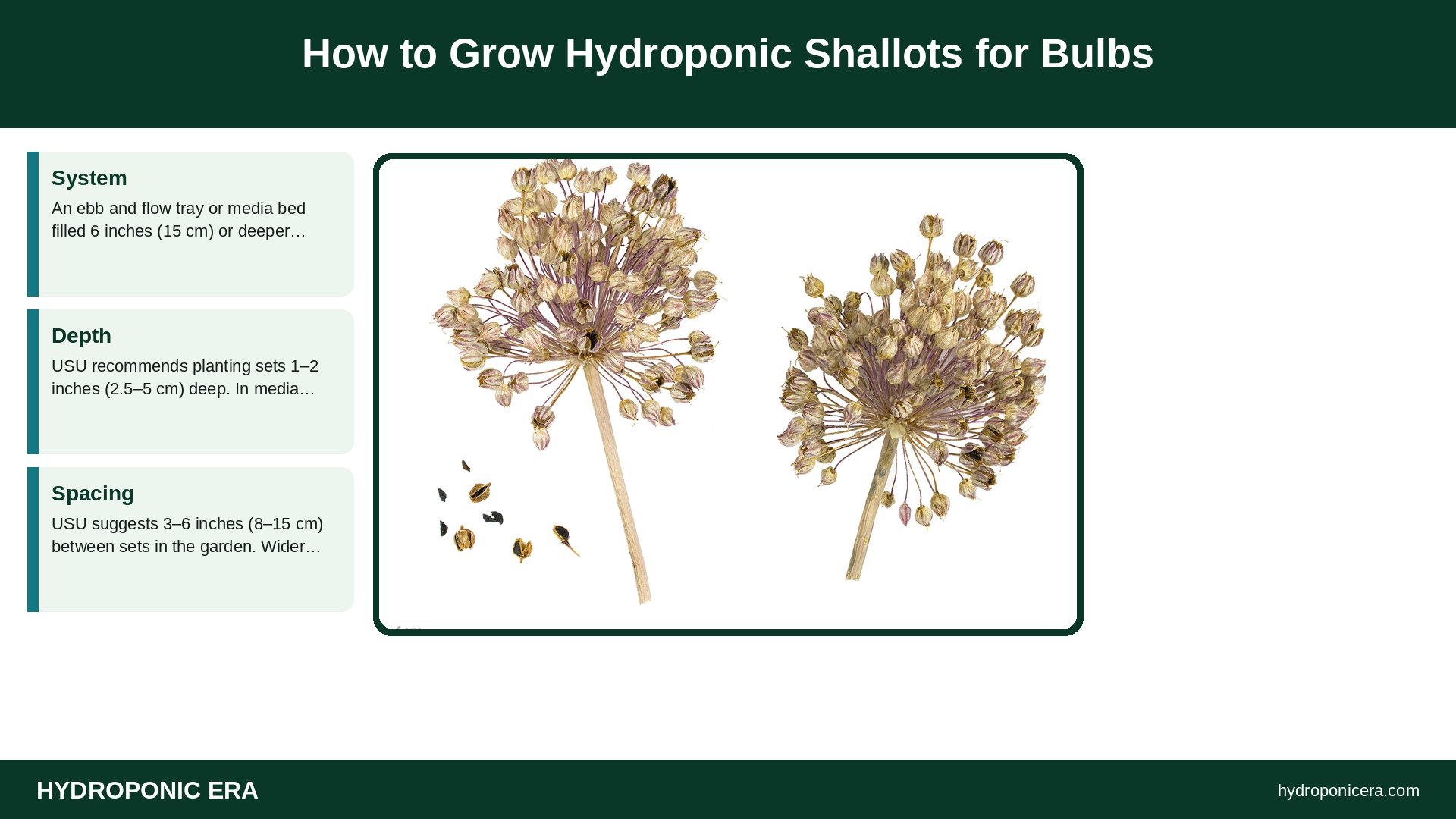
Bulbs need room, drainage and a dry finish, so a media system works best:
- System: An ebb and flow tray or media bed filled 6 inches (15 cm) or deeper with clay pebbles, perlite or coco coir. Dutch buckets also work.
- Depth: USU recommends planting sets 1–2 inches (2.5–5 cm) deep. In media, bury the bulb so only the tip shows.
- Spacing: USU suggests 3–6 inches (8–15 cm) between sets in the garden. Wider spacing gives bigger clusters; close spacing gives single bulbs or more greens.
- Moisture: USU says drought stress lowers growth and yield, while overwatering causes bulb rot. Flood often enough to stay moist but drain fully.
- Feeding: USU warns that late nitrogen stimulates extra leaf growth, delays bulbing and reduces storage life. Lower nitrogen once bulbs begin to swell.
Harvesting, Curing and Storing Shallots
Harvest dry bulbs after most of the tops fall over. USU says to lift the bulbs, separate clusters and cure for 1–2 weeks until bulbs and leaves are completely dry and the skin is papery. Iowa State University Extension advises curing in a warm, dry place, then storing in mesh bags at 32–40°F (0–4°C) and 60–70% relative humidity. Properly cured shallots keep 6 months or longer. USU suggests braiding the tops or cutting leaves 2 inches (5 cm) above the bulb.
Light and Temperature for Hydroponic Shallots
Shallots are a cool-season crop that grows best in full sun, according to USU. Like onions, bulbing is tied to day length and warmth, so indoor growers who want bulbs should give long days and avoid very low light. For greens, a moderate grow light is plenty. If you’re choosing fixtures, read full spectrum grow lights.
Common Hydroponic Shallots Problems
- Bulb rot: The bulb sits in solution. Raise it so only roots touch water.
- Thrips: USU says leaves turn silver or gray and may twist; rinse with a stiff water spray.
- Botrytis and downy mildew: USU advises avoiding wet leaves and crowding; improve airflow.
- Tall leaves, no bulbs: Too much late nitrogen or too little light.
- Soft stored bulbs: Incomplete curing; dry them longer next time.
Are Hydroponic Shallots Worth It?
For a steady supply of mild, onion-garlic greens, yes. They regrow after cutting and take little space. For bulbs, the payoff is smaller but real, especially for gourmet varieties that are pricey in stores. Want more alliums? See growing garlic hydroponically.
Getting More From Each Planting of Hydroponic Shallots
You can stretch hydroponic shallots further by staggering plantings. Start a new net cup or a few sets every 2–3 weeks so fresh greens are always coming. Cut no more than about a third of the leaves at a time from bulb plants, since leaves feed the bulbs below. Save a few of your best cured bulbs as next season’s sets, as USU notes properly stored bulbs can be replanted. Label varieties, because French Red, Gray Griselle and Dutch Yellow look similar once sprouted.
FAQs
Can you grow shallots hydroponically?
Yes; greens are easy in net cups, and bulbs grow best in a drained media bed.
Can I plant store-bought shallots?
Often yes, if firm and healthy, though certified sets reduce disease risk.
How long do hydroponic shallots take to grow?
About 50–60 days for greens; bulbs take longer, depending on variety.
How many shallots grow from one bulb?
One set can form a cluster of up to 10–15 bulbs with wide spacing.
Why are my hydroponic shallots rotting?
The bulb is too wet; keep only the roots in solution.
How should I store shallots?
Cure 1–2 weeks, then keep in mesh bags at 32–40°F (0–4°C).
Sources
- Utah State University Extension — How to Grow Shallots in Your Garden
- Iowa State University Extension — How Do I Harvest, Dry, and Store Shallots?
- Siagian, Sasmita and Irawati (2022), IOP Conference Series: Earth and Environmental Science — The Growth and Yield Responses of Shallot to Plant Spacing and Tuber Cutting by NFT Hydroponic
- Photo credits (Wikimedia Commons, edited with titles): A. cepa var. aggregatum conreu by Victor M. Vicente Selvas (Public domain); Onion crop by Kasyap (CC BY-SA 4.0); Allium ampeloprasum MHNT.BOT.2006.46.12 by Roger Culos (CC BY-SA 3.0); Onion seedlings by Krish Dulal (CC BY-SA 3.0); Porree Scharpflanzung–Josef Schlaghecken by Schlaghecken Josef (CC BY-SA 4.0)