
Hydroponic horseradish is doable, but it’s better for leaves than for big roots. Horseradish grows from root cuttings, not seed, and the plant makes its thick, pungent root over a long season, about a year in the field according to Oregon State University. In water culture you’ll get plenty of leafy growth and some root, but the long, straight roots sold in stores need deep, loose media. The practical method: plant an 8–14 inch (20–36 cm) root cutting at a 45-degree angle in a deep drip-fed container of coco coir or perlite, and harvest after cool weather.
Key takeaway: For roots, use a container at least 12–18 inches (30–46 cm) deep with drained media. For quick, sharp-tasting leaves, a root crown in a DWC net cup works. Expect a long crop, and keep roots in the dark so they don’t turn green.
| Goal | System | Notes |
|---|---|---|
| Leaves | DWC, Kratky, ebb and flow | Fast and easy; leaves are pungent |
| Roots | Deep drip containers, grow bags, Dutch buckets | Long season; needs depth |
| Planting stock | Root cuttings (“sets”) | 3/8–3/4 inch (1–2 cm) thick |
| Storage of roots | 30–32°F (−1 to 0°C), 90–95% humidity | Up to 10–12 months, in the dark |
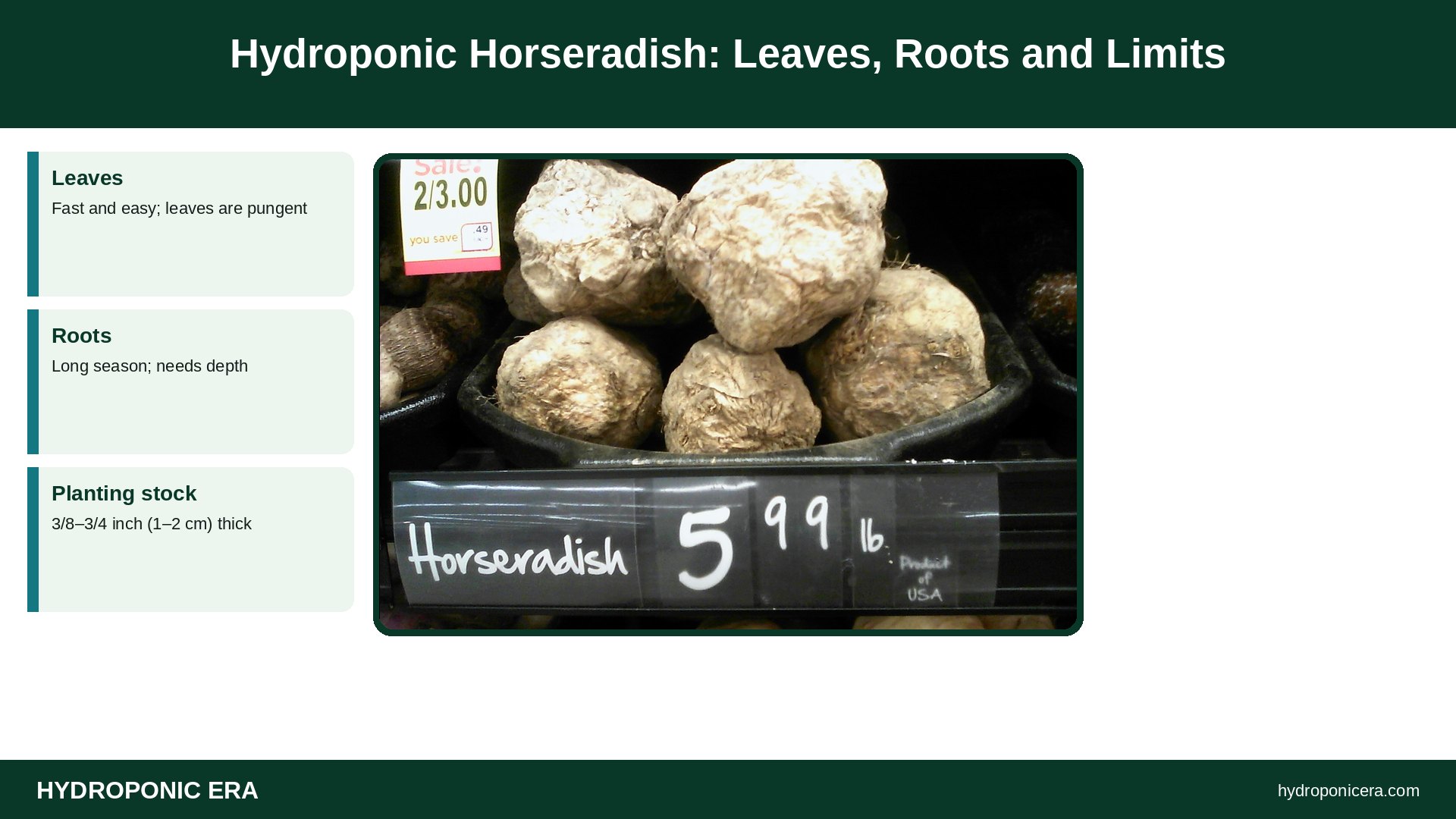
What Is Horseradish? (Before You Try Hydroponic Horseradish)
Horseradish (Armoracia rusticana) is a hardy perennial in the mustard family, grown for its thick, white taproot. Oregon State University notes that it’s grown on only about 3,000 acres in the US, mostly in California, New Jersey, Virginia, Illinois and Wisconsin. A 2000 crop profile from Illinois put that state’s share at about 65% of the US crop, centered near Collinsville, home of the International Horseradish Festival.
Varieties fall into two types, according to OSU. “Common” types have broad, crinkled leaves and better quality, while “Bohemian” types have narrow, smooth leaves, somewhat lower quality and better disease resistance. Note that true wasabi is a different plant; see how to grow wasabi hydroponically.
Can Horseradish Grow Hydroponically?
Yes, the plant itself adapts well. It roots readily from cuttings and sprouts vigorously, so hydroponic horseradish leaves come quickly. The limits are about the root you want to eat:
- Depth: Field plantings use 8–14 inch (20–36 cm) root pieces laid at an angle, and growers dig deep at harvest to recover the long roots. Shallow systems give short, branched roots.
- Season: OSU says about a year is required to produce a crop, and the plant makes its greatest growth in late summer and early fall.
- Light exposure: OSU notes roots turn green when exposed to light, so roots must stay fully covered.
There’s little published research on fully hydroponic horseradish, so treat this as an experimental crop and expect to adjust.
How to Plant Hydroponic Horseradish
1. Get root cuttings
OSU recommends root pieces about 1/2–3/4 inch (1.3–1.9 cm) thick and 8–14 inches (20–36 cm) long. They’re cut square at the top and slanted at the bottom so you can tell which end is up. Nurseries sell sets in spring, and a fresh, firm grocery root often sprouts too.
2. Choose the container
For roots, pick a tall container at least 12–18 inches (30–46 cm) deep, such as a large grow bag, a tall bucket or a Dutch bucket stacked with an extension. Fill it with coco coir, perlite or a coco-perlite mix. See coco coir hydroponics.
3. Set the root at an angle
OSU stresses planting at about a 45-degree angle, which it calls very important for vigorous establishment and growth. Point the square top upward and cover the lower end with media, leaving the crown just below the surface.
4. Feed and water
Run a drip line on a timer so the media stays moist but drains freely. OSU notes greater yields when field horseradish is irrigated in dry late-summer periods, and that lighter soils need more frequent but smaller waterings, the same pattern as a fast-draining hydroponic medium. Use a general vegetable nutrient; OSU’s field guide calls for fields limed to a 6.0–6.5 pH.
5. Light and temperature
Give full sun outdoors or strong grow lights indoors. Horseradish is cold-hardy, and OSU notes roots conditioned by cold weather before digging store better than roots dug while growing.
Growing Hydroponic Horseradish for Leaves
If you mainly want greens, set a short crown piece in a net cup with clay pebbles over a DWC bucket or Kratky jar. Keep the crown above the water line so it doesn’t rot, with roots reaching down. Snip young leaves as they appear; hydroponic horseradish regrows leaves quickly from the crown. Young horseradish leaves are edible and have a sharp, mustard-like bite; a 2013 review by Agneta and colleagues covers the plant’s glucosinolates, the compounds behind its heat. Use them sparingly in salads or cook them like other strong greens.
Harvesting and Storing Hydroponic Horseradish
- Timing: In the field, OSU says harvest usually waits until October or early November, after frost kills the tops, for best yield. Indoors, plan on a similar timeline of roughly a year before roots size up.
- Lift gently: Tip out the container and pull roots free of the media.
- Save sets: OSU advises keeping side roots about 1/2 inch (1.3 cm) thick and 10–14 inches (25–36 cm) long as next year’s planting stock, cut square at the top and slanted at the bottom.
- Store: OSU says horseradish keeps up to 10–12 months at 30–32°F (−1 to 0°C) and 90–95% relative humidity, in perforated bags and in the dark.
- Grate fresh: The heat develops when the root is grated; process with ventilation, as the fumes are strong.
Hydroponic Horseradish Pests and Problems
- Flea beetles: The Illinois crop profile notes emerging shoots can be heavily damaged.
- Beet leafhopper: In Illinois it spreads “brittle root” disease, so growers have very low tolerance for it.
- Root rot: Caused by soggy media; improve drainage and air.
- Green roots: Light reaching the root; cover the top of the media.
- Spreading: Outdoors, horseradish spreads aggressively from root pieces, which is one advantage of keeping it in a container.
Is Hydroponic Horseradish Worth It?
For leaves and a modest root, yes, and it’s a fun experiment. For large, market-quality roots, a deep container of loose media outdoors is more reliable than a fully hydroponic system. Either way, a container keeps this famously invasive plant under control. For other unusual root crops, see growing carrots hydroponically.
FAQs
Can you grow horseradish hydroponically?
Yes; leaves are easy, and roots are possible in deep drip-fed containers.
How deep should a hydroponic horseradish container be?
At least 12–18 inches (30–46 cm) for roots.
Can I grow horseradish from a grocery root?
Often yes, if it’s firm and fresh; plant the top end up.
How long does horseradish take to grow?
About a year for a full root, per Oregon State University.
Are horseradish leaves edible?
Yes; young leaves are sharp and mustard-like.
Why are my horseradish roots green?
They were exposed to light; keep them covered.
Sources
- Oregon State University, Department of Horticulture — Horseradish (Oregon Vegetables)
- USDA NIFA Crop Profile — Crop Profile for Horseradish in Illinois
- University of Illinois Extension — How to Grow and Harvest Horseradish
- Agneta et al. (2013) — Horseradish (Armoracia rusticana), a Neglected Medical and Condiment Species with a Relevant Glucosinolate Profile: A Review
- Photo credits (Wikimedia Commons, edited with titles): Horseradish root by San906 (CC0); White plastic bucket by Santeri Viinamäki (CC BY-SA 4.0); Starr-210221-9070-Daucus carota subsp sativus-harvested from veggie garden mostly Chantenay type-Hawea Pl Olinda-Maui (51074739266) by Forest and Kim Starr (CC BY 2.0); Fleece lined greenhouse potting tray and seed pots – Flickr – peganum by peganum from Small Dole, England (CC BY-SA 2.0); Deep water culture by ArcadiYay (CC BY-SA 4.0)