
Hydroponic edamame works well: edamame is just a soybean picked green, and NASA has grown soybeans from seed to maturity in recirculating hydroponic systems for decades. Grow it in Dutch buckets, a media bed or a deep-water setup with support, keep the solution near pH 5.8, give strong light and harvest when pods are plump, bright green and the beans nearly touch, about 10–12 weeks after planting. South Dakota State University Extension notes edamame can even be produced hydroponically, and the harvest window lasts only a few days.
Key takeaway: Pick an early bush variety like Chiba Green or Tohya, start seeds in plugs, space plants about 4–6 inches (10–15 cm) apart, support stems and check pods daily from week 9.
| Factor | Hydroponic edamame target |
|---|---|
| Time to harvest | About 10–12 weeks (SDSU); about 80 days (NDSU) |
| Solution pH | About 5.8 (NASA soybean trials) |
| Air temperature | NASA used 79°F (26°C) light / 68°F (20°C) dark |
| Systems | Dutch bucket, ebb and flow, NFT with support, DWC |
| Harvest sign | Full-size, bright green pods; beans nearly touching |
| Storage | 2–3 days fresh; up to 12 months frozen |
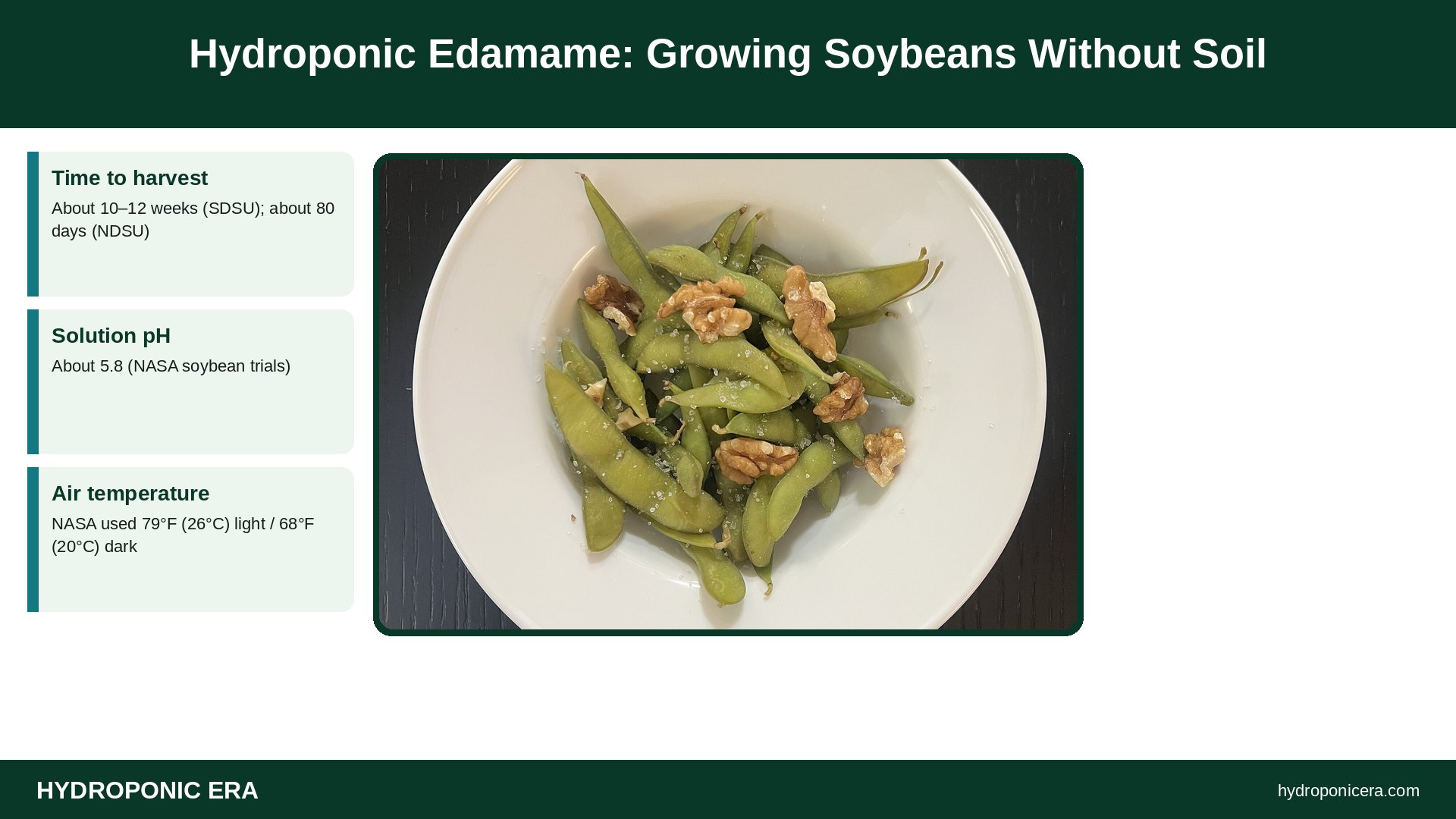
What Is Edamame?
SDSU Extension describes edamame as the Japanese name for edible, immature soybeans (Glycine max), which are cooked before eating. North Dakota State University Extension calls them “green soybeans” harvested at an early stage. The plant is a warm-season annual legume, and growing it is usually the same as growing regular soybeans until harvest.
Popular varieties listed by SDSU include Agate, an heirloom; Chiba Green, an early, productive bush type with big beans and good pest resistance; Kuroshinju or “Black Pearl”; Manitoba Brown for northern climates; and Tohya, an early variety with big pods.
What NASA Learned Growing Soybeans Hydroponically
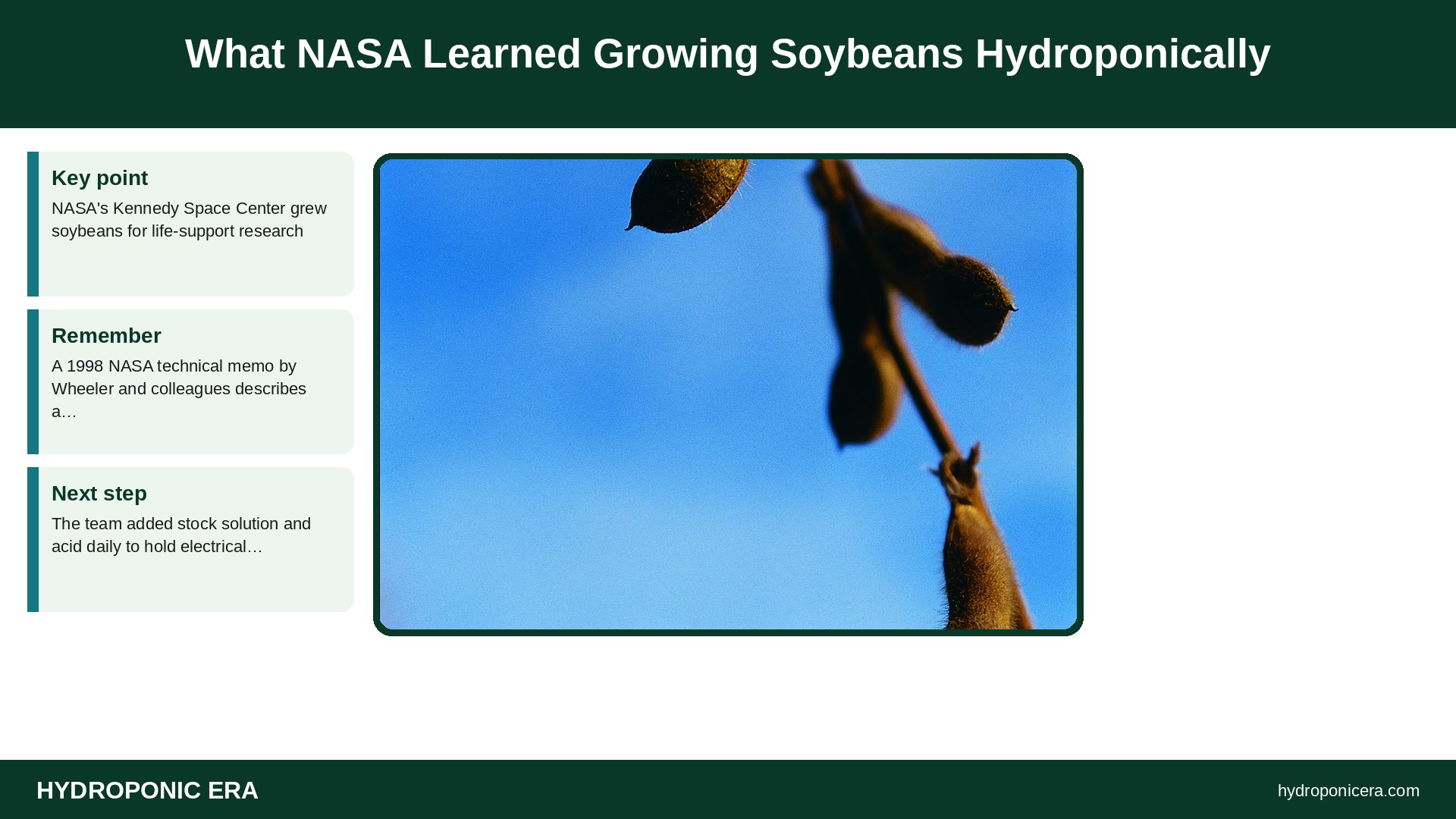
NASA’s Kennedy Space Center grew soybeans for life-support research. A 1998 NASA technical memo by Wheeler and colleagues describes a 215-square-foot (20 m²) stand of the cultivar McCall grown from seed to maturity in 97 days in a closed chamber with a recirculating hydroponic system. The team added stock solution and acid daily to hold electrical conductivity at 0.12 S/m (1.2 mS/cm) and pH at 5.8. Without acid, solution pH tended to rise.
Conditions included a 10-hour light and 14-hour dark cycle, 79°F (26°C) in the light and 68°F (20°C) in the dark, and 70–75% humidity. Flowering began around day 28, with small pods 3–4 days later. Under high-intensity HPS lighting, dry seed yield was roughly 1.6 oz (45 g) per square foot, versus about 0.9 oz (26 g) per square foot under dimmer metal halide lights. Light clearly drove yield.
How to Grow Hydroponic Edamame
1. Start seeds
Sow seeds about 1 inch (2.5 cm) deep in rockwool cubes, peat pellets or coco plugs. NDSU advises sowing outdoors only after the last frost in warm soil, which tells you edamame dislikes cold. Keep starter trays warm. For starter options, see peat pellets hydroponics.
2. Pick a system
- Dutch buckets or media beds: The most reliable choice for a bushy plant with a heavy pod load. See Dutch bucket hydroponics.
- Ebb and flow: Works well in trays of clay pebbles.
- DWC and NFT: Possible; NASA used a recirculating system. Add horizontal netting or stakes because plants get top-heavy. NASA supported shoots with wire fencing about 12 inches (30 cm) above the trays.
3. Space plants
NASA thinned to roughly 1.2 plants per square foot (12.8 plants per square meter). In home systems, about 4–6 inches (10–15 cm) between plants in rows works for bush varieties, similar to NDSU’s 2-inch (5 cm) field spacing once you allow for root zones and airflow.
4. Manage the solution
Hold pH near 5.8 and check daily, since NASA saw pH climb. Use a balanced vegetable nutrient. Because soybeans grown hydroponically get nitrogen from the solution, they don’t need the rhizobium inoculant field growers use. For pH routines, read pH rising vs falling.
5. Light and day length
Soybeans respond to day length; NASA used a short 10-hour photoperiod with very high light for its cultivar. Indoors, a 12–14 hour schedule with strong LEDs is a reasonable starting point; adjust if flowering is slow. The NASA results show more light means more beans, so don’t skimp. See LED vs HPS grow lights.
6. Water during flowering and pod fill
SDSU notes water demand peaks during flowering and pod fill. Check reservoir levels daily then, because a big plant can drink a lot.
When to Harvest Hydroponic Edamame
SDSU says to harvest when pods are full-sized and bright green, around soybean growth stage R6, when beans nearly touch inside the pod. That’s usually 10–12 weeks after planting, and the window is just a few days. Most pods ripen at once. Pick before leaves yellow; SDSU says later beans taste starchy instead of sweet and nutty. Harvest in the cool early morning for freshness.
Storing and Cooking
- NDSU recommends using fresh edamame within 2–3 days, refrigerated in a perforated plastic bag.
- To freeze, NDSU blanches pods about 3 minutes in boiling water, chills them in ice water, dries and bags them; frozen edamame keeps quality up to 12 months.
- To eat, boil pods in salted water about 5 minutes, then drain and season.
Hydroponic Edamame Pests and Problems
- Aphids, stink bugs and leafhoppers: SDSU lists these as edamame pests; Chiba Green has better resistance.
- Powdery mildew and leaf spots: Improve airflow and avoid wet leaves.
- Falling over: Add netting or stakes before pods set.
- Few pods: Usually too little light or high heat at flowering.
Is Hydroponic Edamame Worth It?
Hydroponic edamame is a rewarding crop if you have room and strong light. Plants are compact compared with tomatoes, need no pruning and give one big harvest, which suits a single grow cycle in a tent or greenhouse. The trade-off is yield per square foot: the NASA trial shows a well-lit stand produced roughly 1.6 oz (45 g) of dry seed per square foot, so a small home setup gives a few generous servings rather than a freezer full. Staggering plantings every 2–3 weeks spreads out the harvest. If you mainly want quick, high-value greens, see the best microgreens to grow instead.
FAQs
Can you grow edamame hydroponically?
Yes; SDSU notes it can be produced hydroponically, and NASA grew soybeans this way.
How long does hydroponic edamame take?
About 10–12 weeks from planting to harvest.
What pH is best for hydroponic edamame?
About 5.8, the level NASA held in its soybean trials.
Do I need inoculant?
No; in hydroponics, nitrogen comes from the nutrient solution.
Which edamame variety is best indoors?
Early bush types like Chiba Green or Tohya.
How do I know edamame is ready?
Pods are plump and bright green, and the beans nearly touch.
Sources
- South Dakota State University Extension — Edamame: Harvest and Storage
- North Dakota State University Extension — Field to Fork: Edamame!
- Wheeler et al. (1998), NASA Technical Memorandum — A Data Base of Nutrient Use, Water Use, CO2 Exchange, and Ethylene Production by Soybeans in a Controlled Environment
- Photo credits (Wikimedia Commons, edited with titles): Liat Portal for Foodie Disorder – Edamame with Walnuts by HaJunkiyada (CC BY-SA 4.0); NRCSIA99680 – Iowa (3981)(NRCS Photo Gallery) by Photo by Lynn Betts, USDA Natural Resources Conservation Service. (Public domain); AeroFarms Danville Location by Kristian Bottini (CC0); White plastic bucket by Santeri Viinamäki (CC BY-SA 4.0); Cucumber cultivation on a trellis, Kurigram, Bangladesh by Tanvir Rahat (CC BY-SA 4.0)