
LED vs HPS comes down to this: modern LED grow lights turn electricity into plant light more efficiently than high pressure sodium (HPS), run cooler at the canopy and last longer, while HPS fixtures cost far less up front and add useful heat in a cold greenhouse. Peer-reviewed tests show the best double-ended HPS fixtures top out near 1.7 µmol/J, while today’s typical LED fixtures deliver about 2–3 µmol/J. For a home grow room, tent or hydroponic shelf in the US, LED is the better buy in almost every case.
Key takeaway: Choose LED for efficiency, lower heat and easy dimming. Consider HPS only for a large, cold greenhouse where cheap fixtures and the extra heat are worth more than the power savings.
| Factor | LED | HPS (high pressure sodium) |
|---|---|---|
| Typical efficacy | About 2–3 µmol/J; DLC minimum 2.5 µmol/J | About 1.7 µmol/J (double-ended); about 1.0 µmol/J (older mogul-base) |
| Up-front cost | Higher | Lower (5–10 times less per photon in a 2014 test) |
| Heat at the canopy | Low; heat leaves through the back of the fixture | High radiant heat from a hot bulb |
| Light color | White, “blurple” or tunable | Orange-white |
| Dimming | Easy and continuous | Limited |
| Bulb replacement | None; diodes are built in | Lamp replacement needed |
| Best fit | Homes, tents, vertical farms, greenhouses | Large, cold greenhouses on a tight budget |
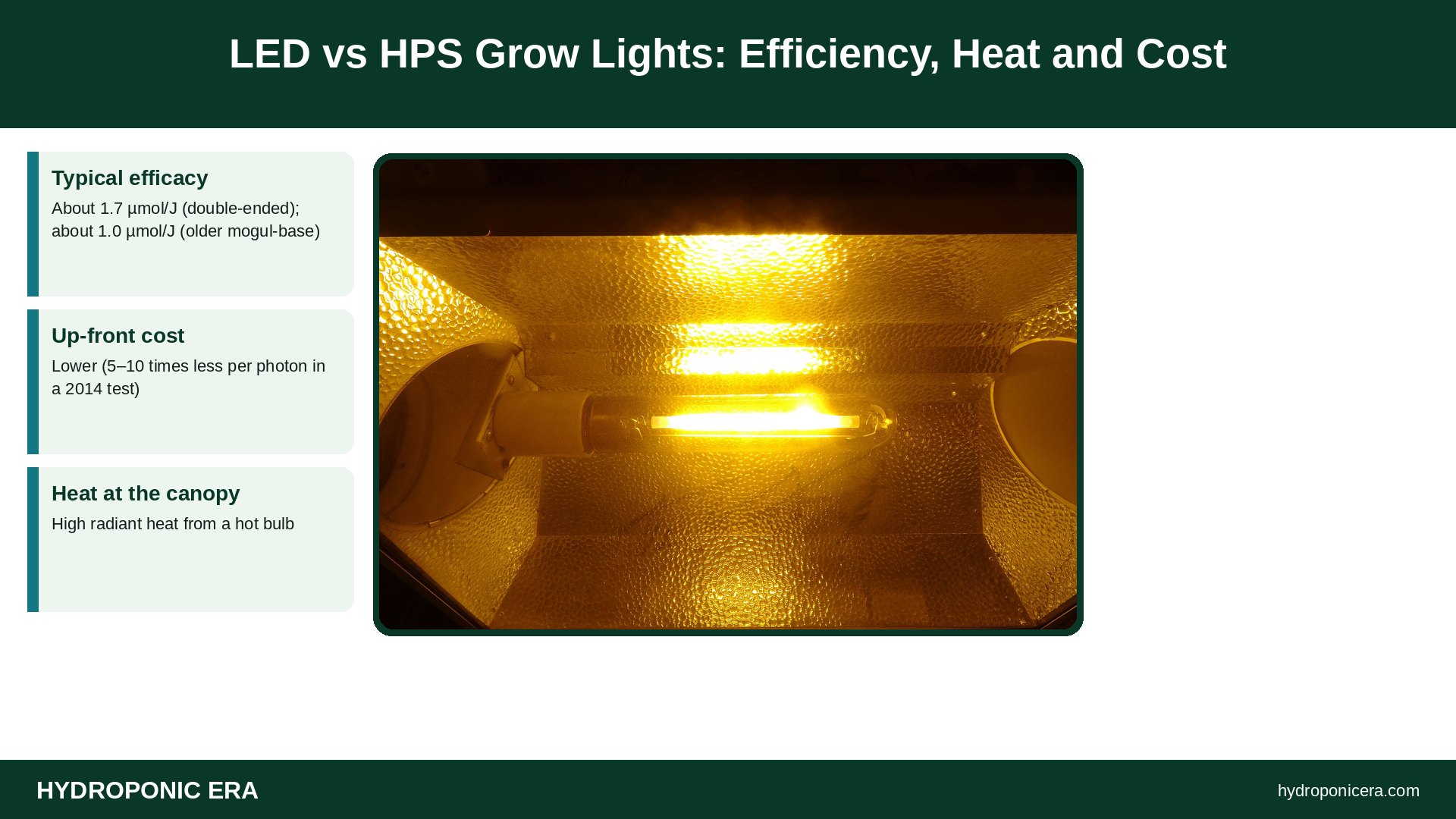
LED vs HPS: How Each Light Works
High pressure sodium lamps are a type of high-intensity discharge (HID) light. An electric arc passes through sodium vapor inside a glass tube, which glows a bright orange-white. A ballast controls the current, and a reflector aims the light down. University of Maryland Extension’s Maryland Grows blog notes that HID lights have intense output, so they must be mounted much higher above plants than other fixture types.
LED grow lights use many small diodes on a circuit board. Each diode emits a narrow band of color, and white LEDs use a phosphor coating to spread blue light across the spectrum. Because diodes are directional, LED fixtures don’t need big reflectors, and they reach full brightness instantly. For a deeper look at spectrum choices, see full spectrum grow lights.
Efficiency: Which Light Makes More Plant Light per Watt?
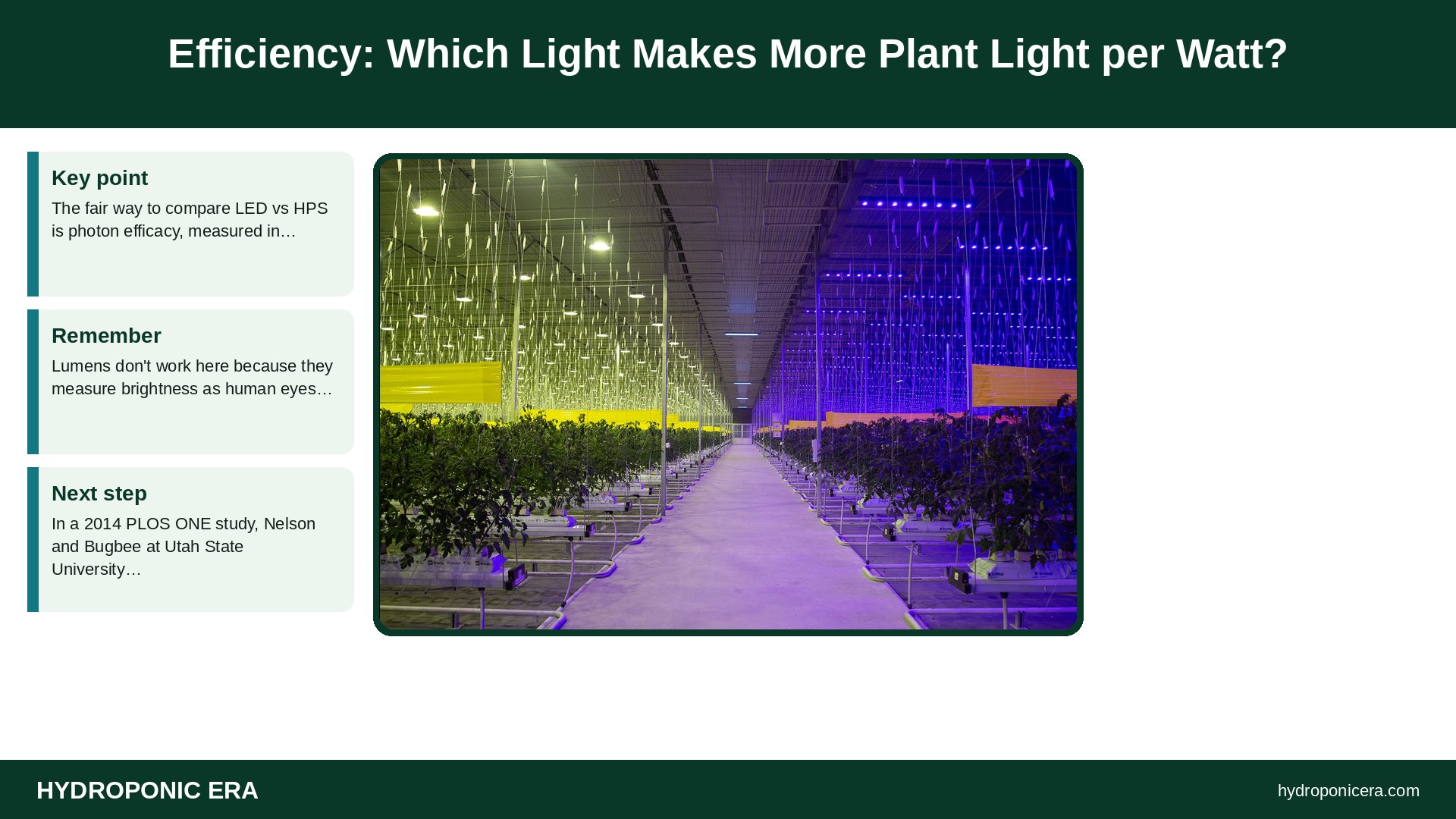
The fair way to compare LED vs HPS is photon efficacy, measured in micromoles of photosynthetic photons per joule of electricity (µmol/J). Lumens don’t work here because they measure brightness as human eyes see it, not the light plants use.
In a 2014 PLOS ONE study, Nelson and Bugbee at Utah State University tested 22 fixtures. The two most efficient LED fixtures and the two most efficient double-ended HPS fixtures were nearly identical, at about 1.66–1.70 µmol/J. Those four were a big improvement over the 1.02 µmol/J of the common mogul-base HPS fixtures, and double-ended HPS with electronic ballasts was about 1.7 times more efficient than older mogul-base HPS.
LEDs kept improving after that. A 2020 review by Kusuma, Pattison and Bugbee put typical LED fixtures at about 2–3 µmol/J and calculated practical limits of 3.4 µmol/J for white plus red fixtures and 4.1 µmol/J for blue plus red fixtures. A 2023 HortScience review cites LED products of 2.5 µmol/J or more, compared with about 1.7 µmol/J for HPS and 1.46 µmol/J for metal halide. The DesignLights Consortium now requires at least 2.5 µmol/J for LED fixtures on its qualified list.
What that means on your power bill
Here is simple LED vs HPS math. A 1,000-watt HPS fixture at 1.7 µmol/J makes about 1,700 µmol/s of light. An LED rated 2.7 µmol/J needs only about 630 watts to make the same 1,700 µmol/s. That saves roughly 370 watts. Run 12 hours a day, that is about 4.4 kWh per day, or about 1,620 kWh per year. At an example rate of 15 cents per kWh, that is roughly $240 a year for one fixture. Check your own utility rate, because prices vary widely across the US.
LED vs HPS Up-Front Cost: Where HPS Still Wins
High pressure sodium fixtures are cheap to buy, and that is the main reason the LED vs HPS debate still exists. Nelson and Bugbee found that, per photon delivered, LED fixtures cost five to ten times more than HPS fixtures in 2014. Because of that high capital cost, the five-year cost per mole of photons for the LEDs they tested was more than twice that of HPS when all light was assumed to be captured by plants.
LED prices have fallen since then and efficacy has risen, so the payback gap is much smaller today. Still, if you are pricing a large greenhouse range, run the numbers with current quotes, your electricity rate and how many hours you light each year. Some US utilities offer rebates for fixtures on the DLC Qualified Products List, which can cut LED costs further.
Heat: LED vs HPS in Grow Rooms and Greenhouses
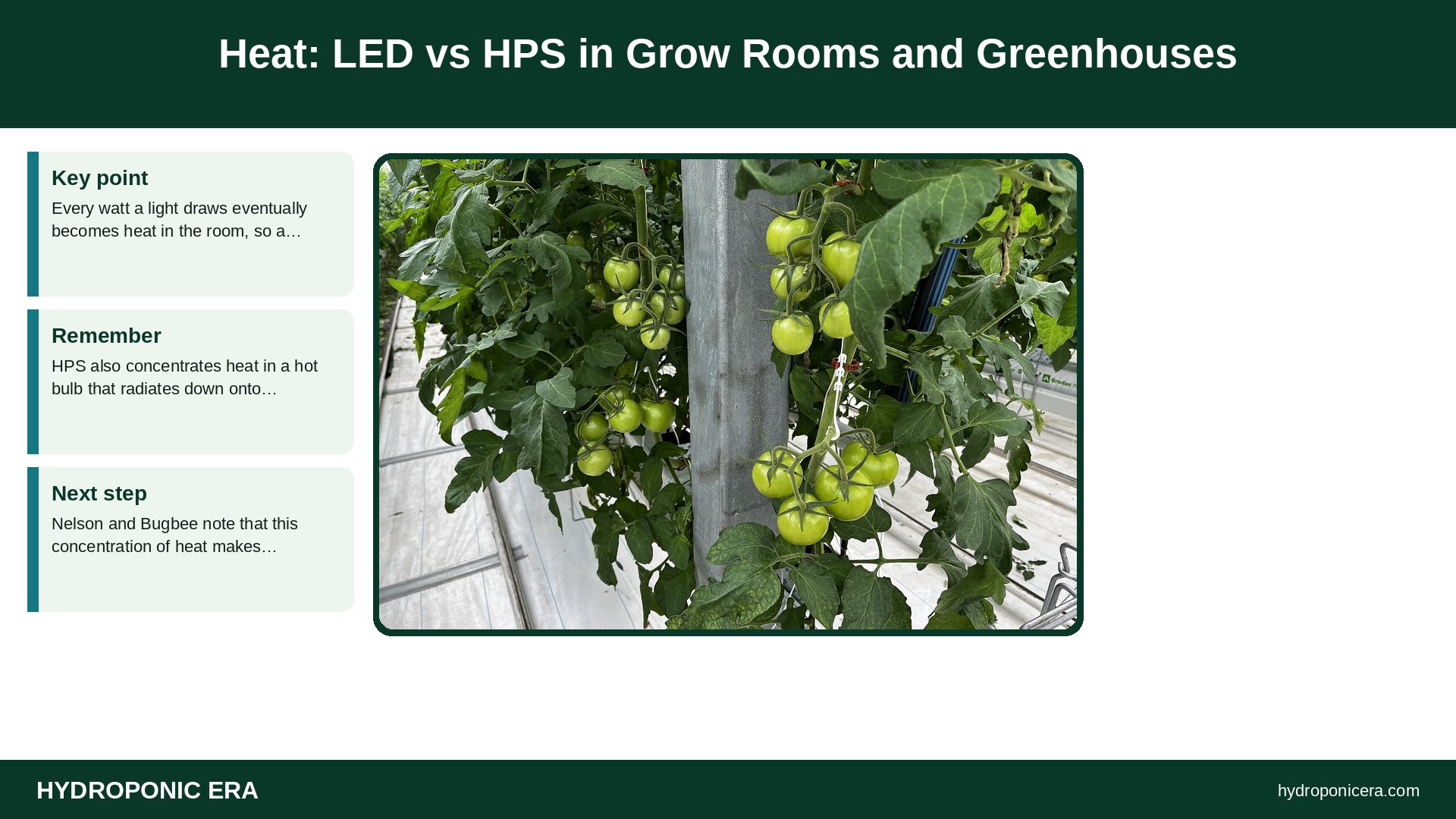
Every watt a light draws eventually becomes heat in the room, so a light that uses fewer watts for the same output adds less total heat. HPS also concentrates heat in a hot bulb that radiates down onto leaves. Nelson and Bugbee note that this concentration of heat makes intracanopy lighting with high-wattage HPS fixtures infeasible, while LEDs can be placed close to or inside the canopy.
In the LED vs HPS heat comparison for a small room or grow tent, lower heat from LED usually means smaller fans or less air conditioning. In a cold greenhouse, the story changes. A 2021 modeling study by Katzin and colleagues found that switching from HPS to LED cut total greenhouse energy use by 10–25% in most climates. LEDs always reduced lighting energy but increased heating demand, because the HPS heat had been doing part of the heating work.
Keep any high pressure sodium lamp well above the canopy. University of Minnesota Extension stresses keeping distance from bulbs that make a lot of heat, such as incandescent and high pressure sodium. For LED distances, see our guide to LED grow light watts per square foot.
LED vs HPS Light Quality and Plant Growth
High pressure sodium light is rich in yellow-orange near 600 nm and low in blue. Nelson and Bugbee note that when light quality is scored with the yield photon flux curve, HPS lamps are equal to or better than the best LED fixtures, because plants use orange and red photons well. Low blue light can make some plants stretch, which is one reason greenhouse growers often mix HPS with daylight or blue light.
LEDs let you choose the spectrum. White LEDs show true plant colors, so you can spot pests and nutrient problems. Red-blue fixtures look pink but are slightly more efficient. So in LED vs HPS terms, color is rarely the deciding factor. For most leafy greens, herbs and fruiting crops, a good white LED with some added red works well. The bigger factor is usually the amount of light, measured as PPFD and DLI, not the exact color mix. See PPFD and DLI explained.
LED vs HPS Lifespan and Maintenance
High pressure sodium lamps wear out and must be replaced. Nelson and Bugbee cite a life expectancy of about 10,000 hours to 90% survival for 1,000-watt double-ended HPS lamps, and HPS output drops as lamps age. LED diodes are built into the fixture, so there are no bulbs to change, though power supplies and boards can fail. The researchers reported premature failures of LED power supplies, LED boards, HPS lamps and electronic HPS ballasts in their own greenhouses, so buy from makers that offer a solid warranty.
Which Should You Choose: LED vs HPS?
- Home hydroponics, tents and shelves: LED. It runs cooler, uses less power and is safer near plants and people.
- Vertical farms and sole-source rooms: LED, because heat removal is costly and fixtures sit close to plants.
- Small hobby greenhouse: LED for most growers, especially where summers are hot.
- Large, cold commercial greenhouse: Compare both. HPS has a low purchase price and adds heat, but LED cuts lighting energy and can be dimmed when the sun is out.
- Switching from HPS: Match or slightly exceed the old PPFD at the canopy and plan for less heat in winter.
If you are also weighing fluorescent tubes, see T5 vs LED grow lights.
LED vs HPS Setup Tips
- Compare fixtures by µmol/J and a PPFD map, not by watts or lumens.
- Hang HPS much higher than LED, as Maryland Grows advises, and raise it if leaves feel hot to the back of your hand.
- Start an LED at the maker’s recommended height; University of Minnesota Extension suggests 6–12 inches (15–30 cm) for hydroponic lettuce and herbs. Fine-tune with a light meter.
- Add airflow under any light and check leaf-level air temperature with a thermometer.
- Use a timer and track your actual daily kWh with a plug-in meter.
FAQs
Which wins in LED vs HPS for home growers?
For most growers, yes; LED makes more plant light per watt and adds less heat at the canopy.
Do LED grow lights produce higher yields than HPS?
Yield depends mainly on how much light plants get; at equal PPFD, results are similar.
What wattage LED replaces a 1,000-watt HPS?
About 600–700 watts of LED at 2.5–2.8 µmol/J matches the light of a 1.7 µmol/J HPS.
Why do some greenhouses still use high pressure sodium?
The fixtures are cheap, proven and their heat helps in cold climates.
Can I mix HPS and LED?
Yes; many greenhouses combine them to balance heat, spectrum and cost.
Does HPS work for leafy greens?
It works, but LED is easier to place close to short crops like lettuce.
Sources
- Nelson and Bugbee (2014), PLOS ONE — Economic Analysis of Greenhouse Lighting: Light Emitting Diodes vs. High Intensity Discharge Fixtures
- Kusuma, Pattison and Bugbee (2020), Horticulture Research — From Physics to Fixtures to Food: Current and Potential LED Efficacy
- HortScience (2023) — Reducing Lighting Energy Use in Controlled Agricultural Environments
- Katzin et al. (2021), Applied Energy — Energy Savings in Greenhouses by Transition from High-Pressure Sodium to LED Lighting
- DesignLights Consortium — Horticultural Technical Requirements V4.0
- Maryland Grows, University of Maryland Extension — Indoor Lighting Options: Terms, Types and Measurements
- University of Minnesota Extension — Lighting for Indoor Plants and Starting Seeds
- Photo credits (Wikimedia Commons, edited with titles): HPS (High Pressure Sodium) grow light bulb by Plantlady223 (CC BY-SA 4.0); Greenhouse in Kazakhstan by Gakon Netafim (CC BY-SA 4.0); U.S. Department of Agriculture (USDA) Rural Development (RD) Ohio business program staff visited Mucci Farms, a 75-acre greenhouse production farm in Huron, Ohio on September 25, 2024 – 3 by USDAgov (Public domain); Potted plants succulents under grow light Nov 2016 by Asdfjrjjj (CC BY-SA 4.0); Lettuce Closeup Greenhouse Phuktal Zanskar Jun24 A7CR 00442 by This Photo was taken by Timothy A. Gonsalves. Feel free to use my photos, but pl (CC BY-SA 4.0)