
Yes, regular LED lights grow plants. Plants don’t care whether a bulb says “grow light” on the box; they respond to how much photosynthetic light reaches their leaves and for how many hours. A bright white household LED or a 4-foot LED shop light can grow seedlings, herbs, lettuce and houseplants if you keep it close and run it long enough. University of New Hampshire Extension says LED shop lamps work fine for starting seedlings, because failure under lamps is usually about light quantity, not spectrum. The catch: most regular LED lights are too weak for fruiting crops like tomatoes and peppers.
Key takeaway: Regular LED lights grow plants well when they are bright, close (4–6 inches (10–15 cm) for seedlings) and on 12–16 hours a day. Use a dedicated grow light for high-light and fruiting crops.
| Light type | Can it grow plants? | Best for |
|---|---|---|
| Single household LED bulb | Yes, over a small area | One or two houseplants, a small herb pot |
| LED shop light, 4 feet (1.2 m) | Yes, well | Seedlings, lettuce, herbs, microgreens |
| LED strip or desk lamp | Weakly | Low-light foliage plants |
| Dedicated LED grow light | Yes, best | Everything, including tomatoes and peppers |

Why Regular LED Lights Grow Plants
Plants use light between about 400 and 700 nanometers, called photosynthetically active radiation (PAR). A white LED is a blue diode coated with phosphor that converts part of the blue into green, yellow and red. That broad mix falls inside the PAR range, so the light from regular LED lights is usable by plants. A 2020 review by Kusuma, Pattison and Bugbee notes that green photons are also effective for photosynthesis and penetrate deeper into a plant canopy than blue or red.
UNH Extension specialist Jonathan Ebba explains that a grow lamp’s advantage is a spectrum with a larger share of photons available for photosynthesis. Correct spectrum is nice, he says, but intensity and duration matter more. In other words, a bright regular LED beats a dim grow light, which is why regular LED lights grow plants so often in home setups.
Which Plants Regular LED Lights Grow Well (and Which They Can’t)
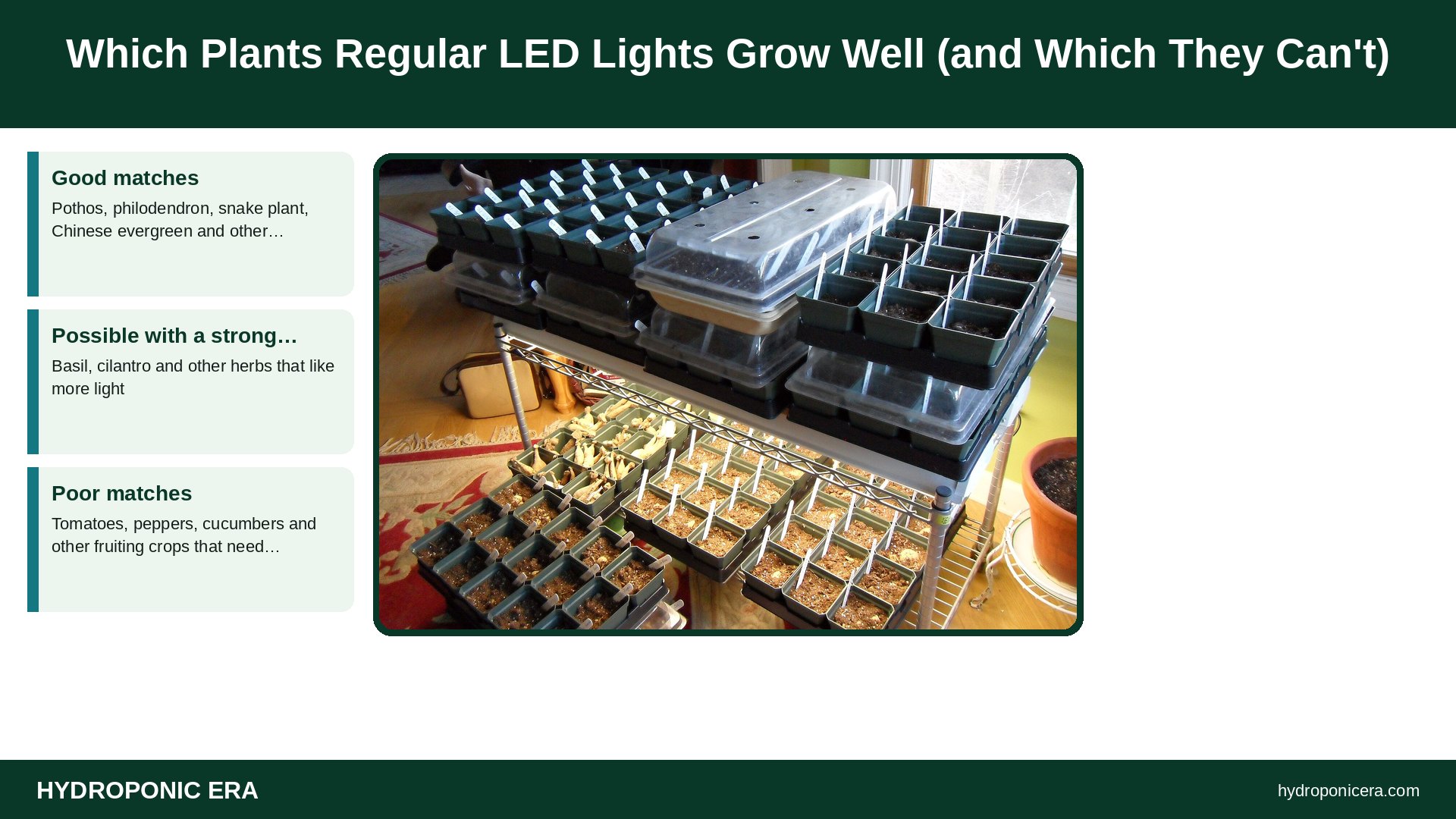
Light needs are measured as the daily light integral (DLI), the total photosynthetic light a plant gets in one day. UNH lists rough targets of 4–6 mol/m²/day for houseplants, 6–8 for shade plants, 10–12 for part-shade plants and 14–20 for full-sun crops, with 8–14 for seedlings before transplanting.
- Good matches: Pothos, philodendron, snake plant, Chinese evergreen and other low-light houseplants; seedlings; lettuce and leafy greens; many herbs; microgreens.
- Possible with a strong fixture: Basil, cilantro and other herbs that like more light.
- Poor matches: Tomatoes, peppers, cucumbers and other fruiting crops that need full-sun DLI. Household bulbs rarely give them enough light for good yields.
Here is quick math. DLI equals PPFD times hours of light times 0.0036. A household LED giving 100 µmol/m²/s at leaf level for 16 hours delivers about 5.8 mol/m²/day, enough for houseplants but short of what tomatoes need. To learn the terms, see PPFD and DLI explained.
How to Make Regular LED Lights Grow Plants Well
1. Pick bright, white bulbs or fixtures
Iowa State University Extension suggests a standard 4-foot (1.2 m) LED shop fixture for indoor plants that need medium to high light, using a full-spectrum, high-output model. It adds that mixing cool and warm colored fixtures can help increase photosynthetic output. University of Minnesota Extension says white or balanced light suits most plants at any stage of growth.
2. Keep the light close
Light intensity drops quickly with distance. UNH says growers often simply hang a household, fluorescent or LED lamp 4–6 inches (10–15 cm) from the tops of seedlings. If seedlings burn, raise it; if they stretch, lower it or run it longer. University of Minnesota Extension gives these distances:
- Seedlings: 4–6 inches (10–15 cm)
- Hydroponic lettuce and herbs: 6–12 inches (15–30 cm)
- Foliage houseplants: 12–24 inches (30–61 cm)
- Flowering houseplants: 6–12 inches (15–30 cm)
3. Run them long enough
Weak light can be partly made up with more hours. University of Minnesota Extension suggests 16–18 hours a day for seedlings, 12–14 hours for hydroponic lettuce, herbs and foliage houseplants, and 14–16 hours for flowering houseplants. Use a plug-in timer so the schedule stays consistent.
4. Watch the plants
Plants tell you whether your regular LED lights grow plants well or leave them short of light. UMN lists pale or yellow leaves, long thin “leggy” stems, wide gaps between leaves, dropped lower leaves and variegated leaves turning solid green as signs of too little light. Scorched or bleached leaves mean too much.
Do Regular LED Lights Need a Special Color Temperature?
No single color temperature is required. Maryland Grows, the University of Maryland Extension blog, explains that Kelvin ratings describe how warm or cool white light looks, from about 2700 K warm white to about 6500 K cool white. Plants grow under both.
Cool white has more blue and tends to keep seedlings compact, while warm white has more red. If you can, choose a “daylight” bulb around 5000–6500 K or mix warm and cool bulbs, as Iowa State suggests. For more on spectrum, read full spectrum grow lights.
Regular LED Lights vs Grow Lights
| Feature | Regular LED lights | LED grow lights |
|---|---|---|
| Output labeled in | Lumens and watts | Often PPF, PPFD and µmol/J |
| Brightness per fixture | Low to moderate | Moderate to very high |
| Spectrum | Made for human eyes | Tuned for photosynthesis |
| Cost | Low | Higher |
| Good for | Seedlings, greens, houseplants | All crops, including fruiting plants |
Lumens are not a direct measure of plant light. Maryland Grows uses the phrase “lumens are for humans.” Still, Iowa State notes lumens are a better clue to intensity than watts. Within one family of white LEDs, more lumens usually means more plant light. UNH also mentions free phone light-meter apps that estimate PAR, which can help you check a bulb at leaf height.
Safety Tips When Regular LED Lights Grow Plants
- Use fixtures rated for the location. Near hydroponic reservoirs, keep cords high and use a GFCI outlet.
- LEDs run cool, but high-power units still get warm; don’t let leaves touch them.
- Add a reflective surface or white wall behind plants to bounce light back.
- Avoid incandescent bulbs. Iowa State says they have low efficiency, run hot and are weak in blue light, and UMN notes their high far-red makes plants stretch.
- Replace a dim fixture rather than running lights around the clock.
For a ready-made setup, see our seed starting shelf with grow lights.
FAQs
Can a normal LED bulb help a houseplant?
Yes; a bright white LED 12–24 inches (30–61 cm) away helps low- and medium-light houseplants.
Do regular LED lights grow plants as well as grow lights?
For seedlings and greens they work well; for fruiting crops a grow light is better.
How many hours should regular LED lights be on for plants?
About 12–16 hours a day for most plants; seedlings can take 16–18.
Can LED shop lights start seeds?
Yes; UNH Extension says LED shop lamps work fine for seedlings.
Do warm white LEDs grow plants?
Yes, but cool or daylight white keeps seedlings more compact.
Can LED strip lights grow plants?
Only weakly, unless they are high-output strips placed close to leaves.
Sources
- University of New Hampshire Extension — Optimizing Plant Growth with Indoor Lighting Q&A
- University of Minnesota Extension — Lighting for Indoor Plants and Starting Seeds
- Iowa State University Extension — Sources of Supplemental Light for Indoor Plants
- Maryland Grows, University of Maryland Extension — Indoor Lighting Options: Terms, Types and Measurements
- Maryland Grows, University of Maryland Extension — Fine-Tuning Your Indoor Plant Lighting Choices
- Kusuma, Pattison and Bugbee (2020), Horticulture Research — From Physics to Fixtures to Food: Current and Potential LED Efficacy
- Photo credits (Wikimedia Commons, edited with titles): LEDシーリングライト (7900161546) by Party Lin (CC BY 2.0); Dahlias started indoors by F. D. Richards from Clinton, MI (CC BY-SA 2.0); DSC 00837734 (2631741968) by Marufish from Alor Setar, Malaysia (CC BY-SA 2.0); Click & Grow Smart Garden 27 by Janar Raidla (CC BY-SA 4.0); Click & Grow Smart Garden 27 by Janar Raidla (CC BY-SA 4.0)