
Grow light bulbs are screw-in bulbs made to fit a regular lamp socket (in the US, usually the standard E26 medium base) while putting out light that plants can use. The best choice today is an LED grow light bulb: it runs cool, uses little power and lasts for years. A single bulb works for one to a few houseplants, a small herb pot or a seedling flat placed close underneath. Skip incandescent bulbs, which Iowa State University Extension calls poor sources of plant light because they are inefficient, run hot and are weak in blue.
Key takeaway: Buy an LED grow light bulb with a stated wattage (actual draw, not “equivalent”) and ideally a PPF rating. Put it in a reflector or clamp lamp 6–12 inches (15–30 cm) above plants and run it 12–16 hours a day.
| Bulb type | Plant light | Heat | Lifespan | Verdict |
|---|---|---|---|---|
| LED grow light bulb | Good | Low | Long | Best choice |
| Bright white household LED | Fair | Low | Long | Fine for low-light plants |
| Compact fluorescent (CFL) | Fair | Moderate | Medium; dims with age | Usable, being replaced by LED |
| Incandescent or halogen “plant” bulb | Poor | High | Short | Avoid |
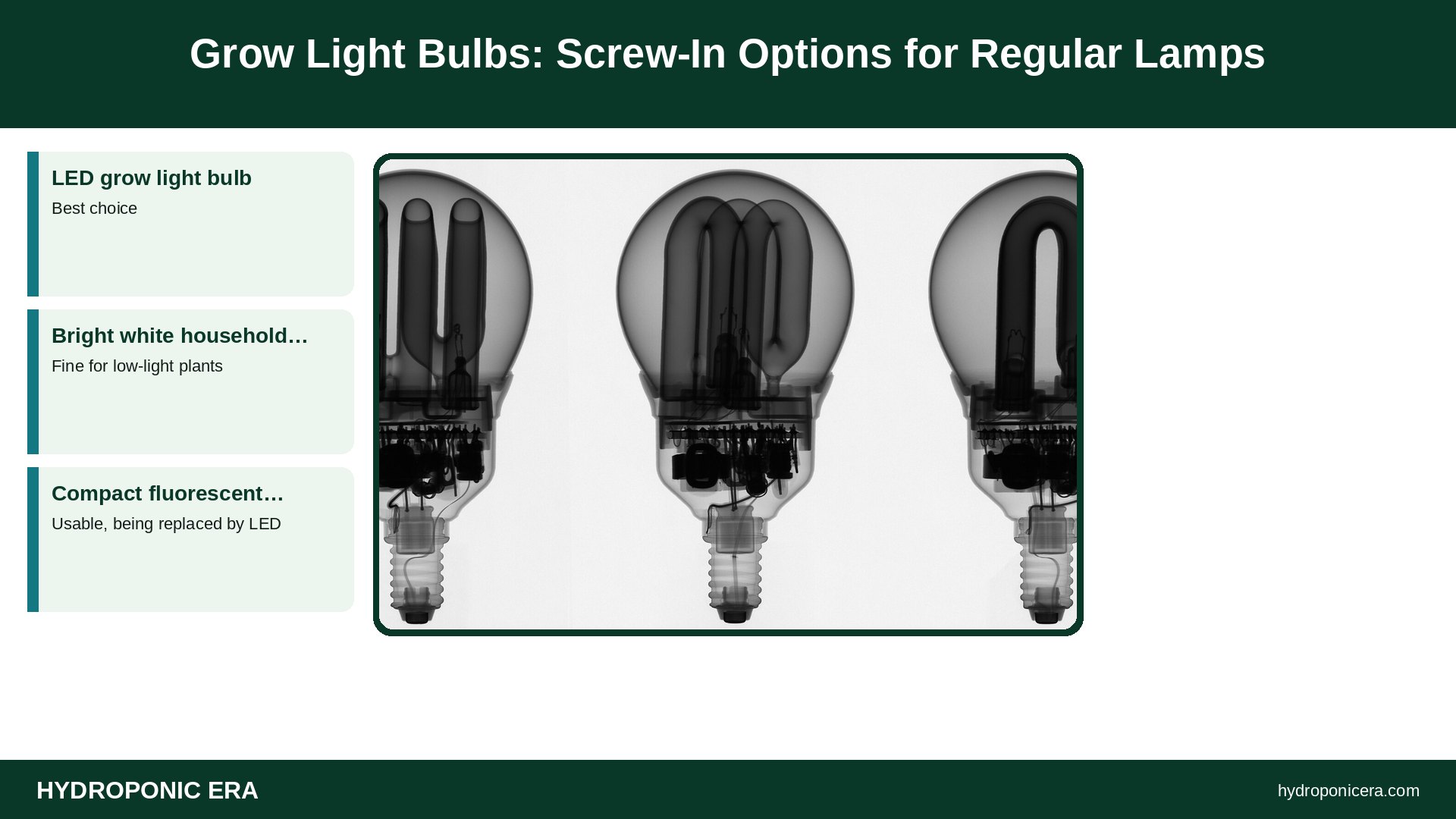
What Are Grow Light Bulbs?
A grow light bulb is a light source shaped like a household bulb. Most are LEDs in common shapes: a standard A19 “pear” shape, a reflector shape such as BR30 or PAR38 that throws light forward, or a “corn” bulb covered in diodes. Some are white, and some glow pink or purple because they use mainly red and blue diodes. Iowa State Extension explains that LED grow lights often look pink to purplish because they emit mainly red and blue wavelengths with few yellows and greens.
The appeal is simple: you can use a desk lamp, clamp lamp, pendant or track light you already own. There is no ballast and no special wiring. For larger areas, a panel or bar fixture is more efficient, but grow light bulbs fill a real niche for small spaces.
Types of Grow Light Bulbs
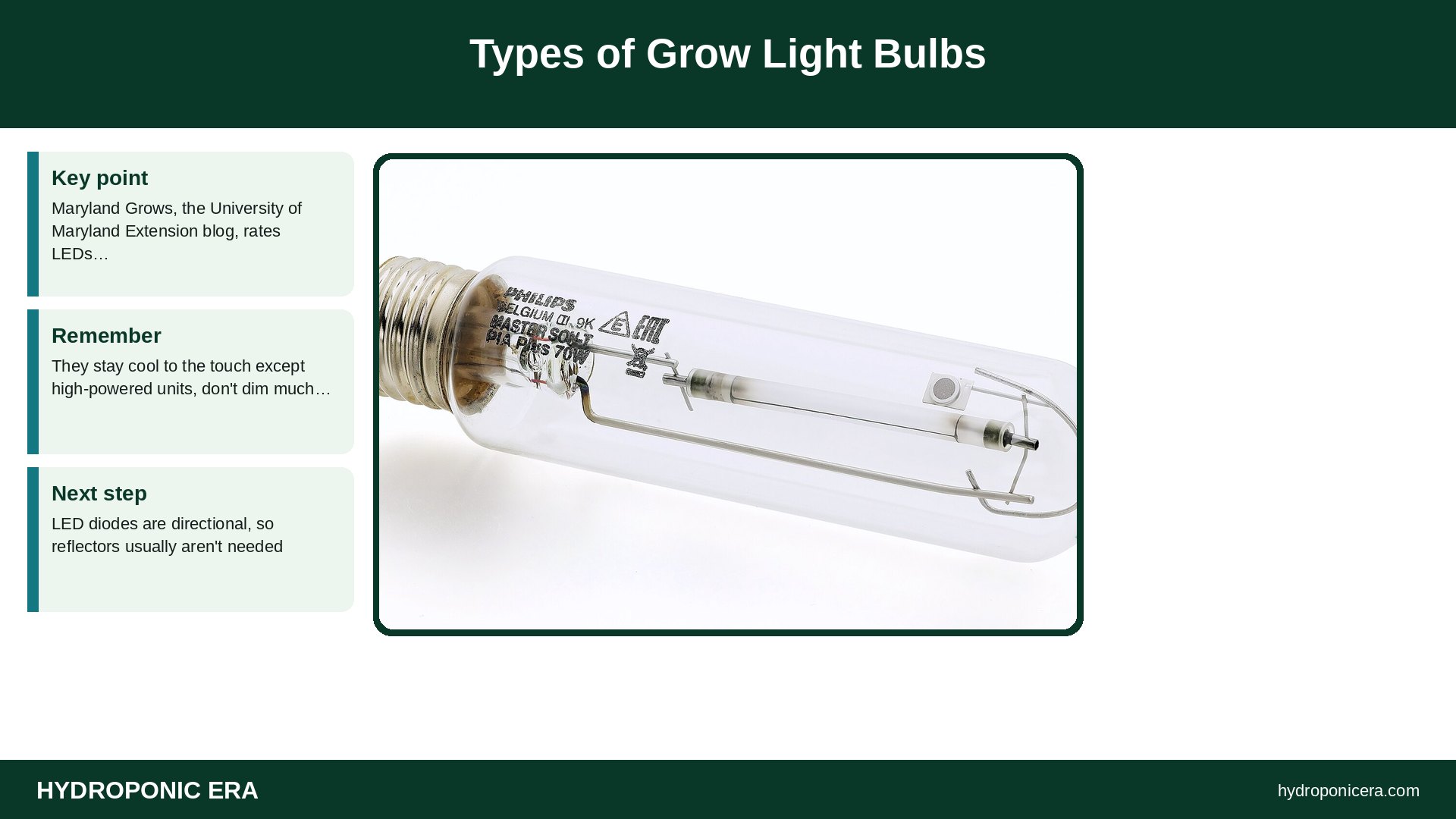
LED grow light bulbs
Maryland Grows, the University of Maryland Extension blog, rates LEDs as the most energy-efficient lights in terms of light produced per watt, especially with an ideal spectrum. They stay cool to the touch except high-powered units, don’t dim much over time and reach full brightness right away. LED diodes are directional, so reflectors usually aren’t needed.
Compact fluorescent bulbs
Maryland Grows lists CFLs among fluorescent options. Fluorescents are fairly energy-efficient and affordable, but their light output dims as the tube ages, and they can take a few minutes to reach full brightness. Iowa State notes that most fluorescents produce little heat, with compact fluorescent bulbs the exception, and lean toward blue light that suits foliage and seedlings.
Incandescent and halogen bulbs
Iowa State says incandescent bulbs are not good supplemental light for plants: they produce mostly red wavelengths and little blue, have low efficiency, run hot and burn out fast. University of Minnesota Extension adds that their high far-red light causes plants to stretch. Maryland Grows warns they can damage plants that touch the bulb.
How to Choose Grow Light Bulbs
- Check the socket. Most US lamps take an E26 medium base. Small candelabra sockets need E12 bulbs, which are usually too weak for plants.
- Read the true wattage. Ignore “100-watt equivalent” claims. Look for the actual power draw on the label.
- Look for PPF or PPFD. Good makers list photosynthetic photon flux in µmol/s, or a PPFD at a set distance. Lumens alone tell you little; Maryland Grows reminds readers that “lumens are for humans.”
- Pick a beam shape. Reflector bulbs (BR or PAR styles) aim light down onto plants. Standard A-shape bulbs spray light in many directions and work best in a reflector lamp.
- Choose a color you can live with. White bulbs show true leaf color. Pink bulbs are fine in a closet but look odd in a living room.
- Confirm a safety listing. Look for UL or ETL marks, and check that the lamp is rated for the bulb’s wattage.
For more on spectrum and labels, see full spectrum grow lights, and for whether household bulbs work at all, see can regular LED lights grow plants.
How Far and How Long to Run Grow Light Bulbs
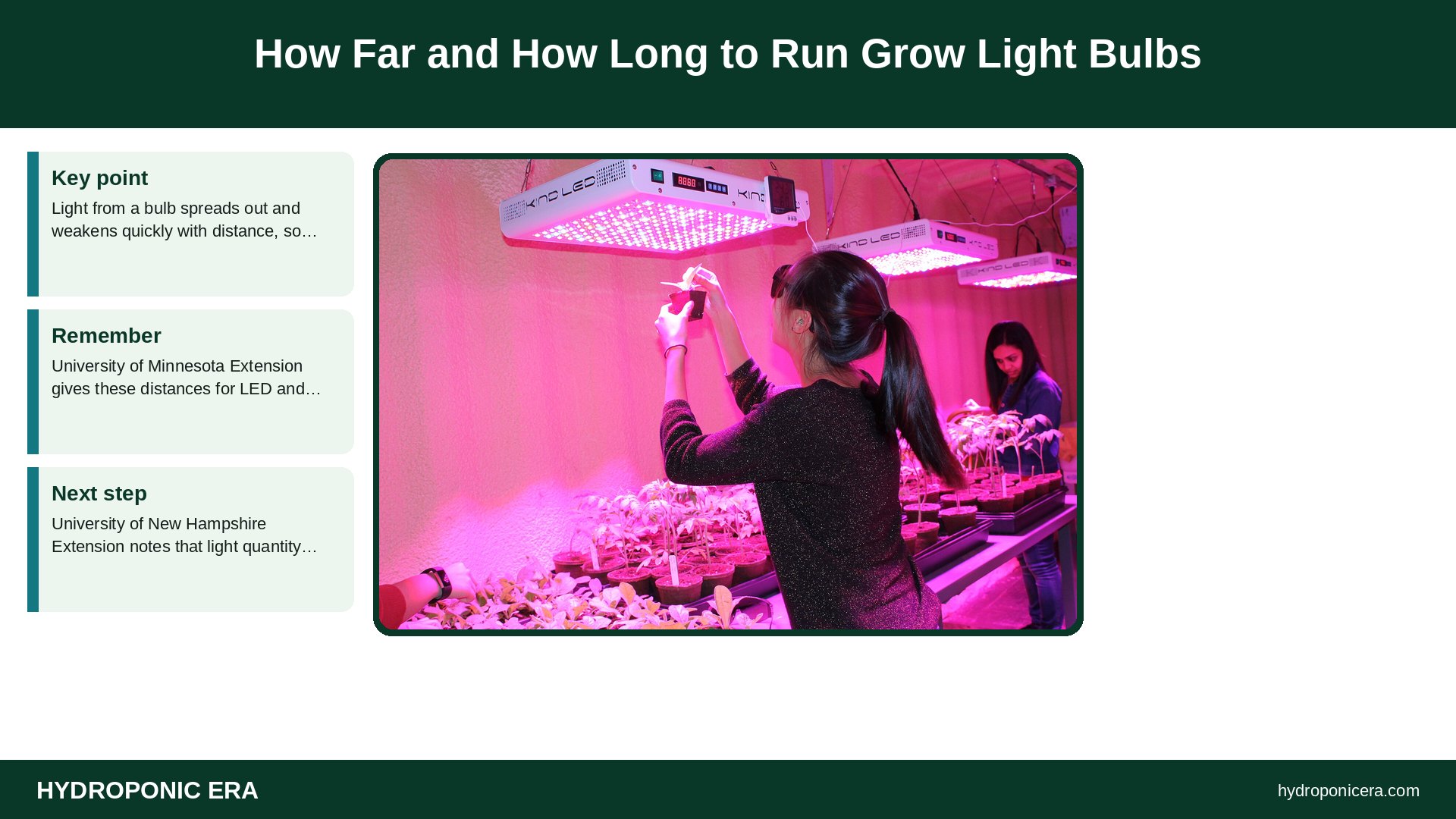
Light from a bulb spreads out and weakens quickly with distance, so placement matters more than the bulb’s box claims. University of Minnesota Extension gives these distances for LED and fluorescent lights:
- Seedlings: 4–6 inches (10–15 cm), raising the light as plants grow
- Hydroponic lettuce and herbs: 6–12 inches (15–30 cm)
- Foliage houseplants: 12–24 inches (30–61 cm)
- Flowering houseplants: 6–12 inches (15–30 cm)
UMN also suggests timer settings of 16–18 hours for seedlings, 12–14 hours for hydroponic lettuce, herbs and foliage plants, and 14–16 hours for flowering houseplants. University of New Hampshire Extension notes that light quantity, meaning intensity and duration, matters more than spectrum, so a closer bulb run longer often fixes a stretched plant.
Quick light math
The daily light integral (DLI) is PPFD times hours times 0.0036. If one bulb gives 150 µmol/m²/s at leaf height for 14 hours, the plant gets about 7.6 mol/m²/day. UNH lists 4–6 mol/m²/day for houseplants and 14–20 for full-sun crops, so one bulb suits houseplants and greens but not tomatoes. Learn more in PPFD and DLI explained.
Best Uses for Grow Light Bulbs
- A houseplant in a dim corner or north window
- A kitchen herb pot or small countertop hydroponic garden
- A single tray of microgreens or seedlings under a clamp lamp
- Extra light for a plant shelf during short winter days
Grow light bulbs are a poor fit for a full grow tent or fruiting crops. Iowa State’s comparison chart rates LED grow light fixtures and HID lights much higher for intensity than ordinary bulbs, and a multi-bulb setup quickly costs more than one efficient panel. For larger setups, compare fixtures in LED vs HPS grow lights.
Safety Tips
- Never exceed the lamp’s maximum rated wattage.
- Keep bulbs and cords away from water and reservoir splashes; plug into a GFCI outlet.
- Don’t use enclosed fixtures with LED bulbs not rated for them, since trapped heat shortens LED life.
- Keep incandescent or halogen bulbs away from leaves and fabric.
- Use a timer instead of leaving bulbs on around the clock.
FAQs
Do grow light bulbs really work?
Yes, for small areas; an LED grow light bulb close to plants can supply enough light for houseplants and greens.
Can I put grow light bulbs in a regular lamp?
Yes, if the base matches (most US lamps use E26) and the lamp is rated for the wattage.
How many grow light bulbs do I need?
Usually one per plant or small pot; use a fixture for a full shelf.
Are pink or white grow light bulbs better?
Both grow plants; white is nicer to live with and shows plant problems.
How long do LED grow light bulbs last?
Many years of normal use; check the rated hours on the box.
Can a grow light bulb burn plants?
LEDs rarely do; incandescent and halogen bulbs can scorch leaves.
Sources
- Iowa State University Extension — Sources of Supplemental Light for Indoor Plants
- Maryland Grows, University of Maryland Extension — Indoor Lighting Options: Terms, Types and Measurements
- University of Minnesota Extension — Lighting for Indoor Plants and Starting Seeds
- University of New Hampshire Extension — Optimizing Plant Growth with Indoor Lighting Q&A
- Photo credits (Wikimedia Commons, edited with titles): Defective compact fluorescent lamp x-ray by SecretDisc (CC BY-SA 3.0); PHILIPS MASTER SON-T PIA Plus by Mister rf (CC BY-SA 4.0); Terramera scientists working in a climate-controlled growth chamber located in Vancouver, BC. The space uses LED lighting, which supports plant growth. (50188965171) by Simon Fraser University – Communications & Marketing (CC BY 2.0); Saintpaulia ionantha (Claire Felloni) by Felloni claire (CC BY-SA 4.0); Ocimum Basilicum leaf lighted by the left by BernaBotto (CC BY-SA 4.0)